
What if the highest-rated attorney isn’t the right fit for your injury case? Local MA accident attorney reviews can offer useful clues, but conflicting ratings and brief comments rarely show whether a lawyer has experience with cases like yours or communicates clearly under pressure.
It’s understandable to look for reassurance after an accident. Reviews can help you spot patterns in client feedback, but they’re only a starting point. A thoughtful choice also means checking an attorney’s Massachusetts credentials and confirming that personal injury litigation is a meaningful part of their practice.
This guide explains how to assess review sources, weigh detailed and consistent feedback, and verify an attorney’s standing through official Massachusetts records. You’ll also find practical questions to ask about experience with similar cases, who would handle your matter, communication, and representation terms. Whether you’re considering counsel in Fall River or elsewhere in Massachusetts, these steps can help you make an informed decision without relying on star ratings alone.
Key Takeaways
- Use local MA accident attorney reviews to identify patterns in client experiences, not to predict your case outcome.
- Look beyond star averages: compare review detail, recency, consistency, and relevance to injury representation.
- Verify an attorney’s Massachusetts standing through official records, then assess whether their practice fits your accident matter.
- Before speaking with an attorney, prepare key facts about the accident, injuries, treatment, insurance contact, and available records.
- Before deciding, clarify who will handle your case, how communication works, and what the written representation terms say.
What Local MA Accident Attorney Reviews Can and Cannot Tell You
Reviews can help you prepare questions before speaking with an attorney, but they are not evidence that a lawyer will achieve a particular result. A high star rating alone doesn’t establish experience with your type of accident, the strength of a potential claim, or whether the attorney’s approach fits your needs.
Why accident attorney reviews matter after an injury
After an accident, pain, missed work, medical appointments, and concern for family finances can make comparing attorneys difficult. Client reviews may offer clues about how people experienced communication, responsiveness, and the process of working with a firm. Look for descriptions of specific interactions rather than treating a rating as a complete assessment.
Read each account carefully. A firsthand client description may provide context about that person’s experience, but it still reflects one perspective. Firm marketing is different: it presents the firm’s own claims and isn’t independent client feedback. Anonymous comments and claims without enough detail to assess their source are harder to verify. None should be treated as a guarantee.
Local MA accident attorney reviews can help you decide what to ask, not whether you have a claim or what it may be worth. Reviews also don’t replace legal advice or a case-specific conversation. A Fall River firm may be familiar with handling Massachusetts injury matters, but not every reader needs local counsel. Consider whether the attorney can address the relevant location, claim, and practical needs.
What reviews cannot establish about a Massachusetts claim
A review cannot determine who was legally responsible, predict compensation, estimate how long a matter will take, or establish the likely outcome. Each claim depends on its own facts, evidence, injuries, insurance issues, and procedural considerations. Even accounts that sound similar may involve materially different circumstances.
Public feedback describes someone else’s experience. Only an individualized legal assessment can address how the facts of your matter may affect your options.
Reviews may mention fees, but a comment isn’t a substitute for understanding the terms that would apply to your own representation. Ask the attorney to explain the written agreement, including how fees and case-related expenses are handled. For general context on fee arrangements, see this overview of understanding attorney’s fees. Confirm any specific terms directly with the attorney before deciding.
How to Evaluate Local MA Accident Attorney Reviews for Credibility
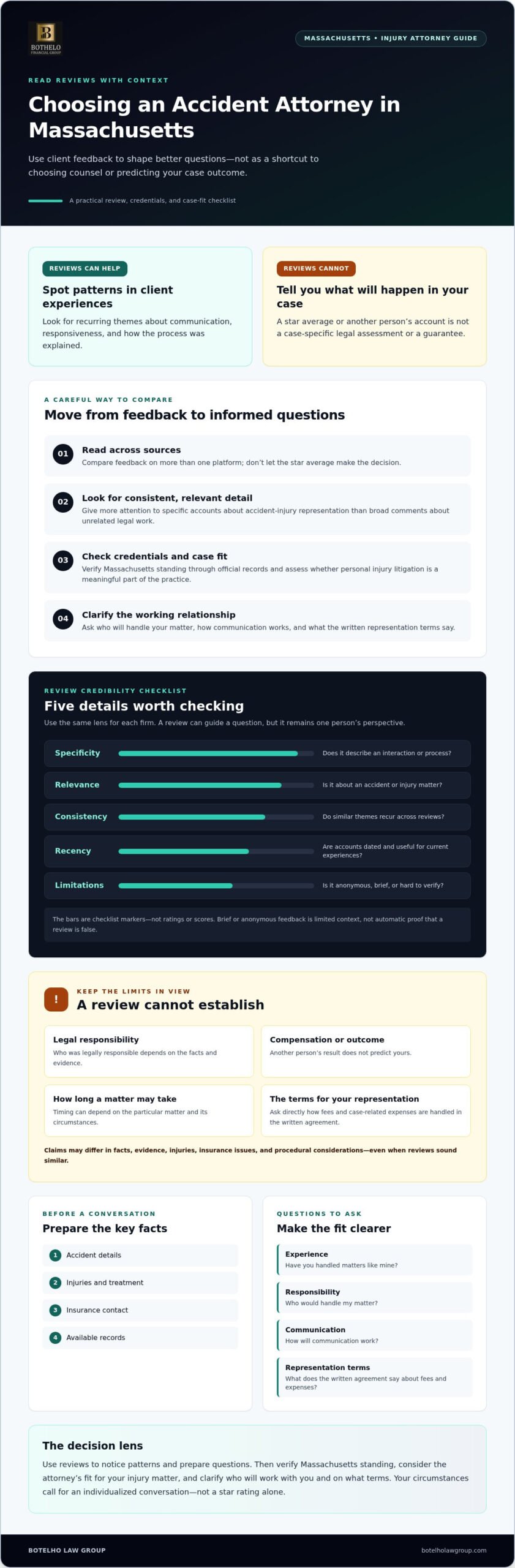
Use the same checks for every firm instead of letting the star average drive your decision. Read reviews across more than one platform, look for patterns in dated comments, and separate feedback about accident-injury representation from feedback about unrelated legal services. A firm may handle several practice areas, so a general comment about a different matter may tell you little about its approach to an injury claim.
Which review details are most useful to compare?
Specific descriptions are more useful than broad praise or criticism. Look for accounts that explain whether the attorney or staff communicated clearly, answered questions, explained next steps, and helped the client understand the process. Then compare those themes across sources. Repeated comments can guide questions for an initial discussion, but they don’t prove that your experience will be the same.
Apply this practical checklist:
- Specificity: Does the review describe an interaction or process, rather than only offering a rating or sweeping claim?
- Relevance: Does it concern personal injury or an accident-related matter, or a different type of legal service?
- Consistency: Do similar comments about communication or case management appear across multiple reviews?
- Recency: Are the accounts dated, and do recent comments provide a useful picture of current client experiences?
- Limitations: Is the review anonymous, brief, or difficult to verify? Treat that as limited context, not automatic proof that it is false.
How to handle conflicting or unusually broad reviews
Disagreement is a reason to investigate, not to select whichever account confirms your first impression. Compare several dated reviews and ask whether a concern or positive theme recurs. One account may reflect a particular circumstance; a repeated pattern deserves a direct question. Broad claims about guaranteed outcomes or universal satisfaction offer little practical detail and shouldn’t replace a careful assessment.
Review platforms may moderate submitted content, but their policies and processes differ. A posted review isn’t necessarily independently verified, and moderation doesn’t establish that every statement is accurate. The FTC guide on hiring a lawyer offers additional consumer guidance for evaluating and speaking with counsel.
Local MA accident attorney reviews are most useful when they help you prepare focused questions. If you’re considering a Fall River firm, ask who would communicate with you, how the firm explains the process, and whether it handles matters like yours. You can also discuss a Massachusetts injury matter with a firm before deciding whether the fit is right.
Compare Massachusetts Accident Attorney Reviews with Credentials and Case Fit
Reviews are one part of the decision. Compare them with verifiable credentials, the attorney’s experience with injury matters like yours, and the communication approach you can expect. The goal isn’t to identify a universally “best” firm. It’s to determine whether a particular attorney is qualified and suited to assess your circumstances.
Check Massachusetts licensing and relevant experience
Use the official Massachusetts Board of Bar Overseers directory to check an attorney’s current status, and consult the appropriate official source for disciplinary information. Confirm the attorney’s identity carefully, especially if a firm has several lawyers. Years in practice alone don’t establish quality or suitability. Ask whether the attorney handles injury claims with facts similar to yours and who would be responsible for the work.
Location can matter for practical communication and familiarity with the region, but it shouldn’t be the only test. A Fall River-based firm, for example, may assess a Massachusetts injury matter, while a reader elsewhere may prefer counsel closer to home. Consider relevant experience and fit alongside geography. The Massachusetts Bar Association Lawyer Referral Service is another resource for people seeking help locating counsel.
Compare the review with the legal service being offered
A review about immigration or estate planning doesn’t necessarily speak to personal injury representation. Focus on feedback relevant to accident-related injury matters, then ask who will manage your case and how updates will be provided. Botelho Law Group is headquartered in Fall River and handles personal injury litigation in Massachusetts and Rhode Island. Readers can review its Massachusetts personal injury lawyer guide for information about that practice area.
| Factor | What to check | Question to ask |
|---|---|---|
| Reviews | Specific feedback about injury representation, communication, and process | Do these comments relate to a matter like mine? |
| Credentials | Current Massachusetts status through official records | Can you confirm who would represent me? |
| Case fit | Experience with similar accident circumstances and injuries | Have you handled matters with comparable issues? |
| Communication | Who will be the main contact and how updates are handled | Who will answer my questions as the matter progresses? |
Use local MA accident attorney reviews to develop questions, then compare the answers with official status and case fit. A direct discussion can clarify whether the attorney’s personal injury practice aligns with your needs before you decide about representation.
Questions to Ask a Fall River Accident Attorney Before You Decide
A focused first discussion can help you understand whether an attorney’s experience and approach fit your situation. Before speaking with a Fall River accident attorney, prepare a brief factual summary. Note when and where the accident happened, what you understand about how it occurred, the injuries you experienced, treatment to date, and any contact with insurers. You don’t need to resolve every detail before asking for legal guidance.
Prepare for a Massachusetts injury consultation
Gather relevant information if it’s available, but don’t postpone needed medical care or assume you can wait to address a legal deadline. An attorney can explain which timing rules may apply to your circumstances. Useful materials may include:
- Photographs of the scene, vehicles, or visible injuries.
- Medical information or treatment records you already have.
- Insurance details and correspondence with an insurer.
- Incident reports, witness information, or other records related to the accident.
Keep sensitive documents private. Don’t post medical records, insurance correspondence, or identifying details in public review comments or on social media. Share relevant materials through a channel the firm identifies as appropriate.
Questions that help test communication and fit
Use the conversation to understand how the attorney evaluates a matter, explains uncertainty, and communicates with clients. Ask direct questions such as:
- Have you handled injury claims involving circumstances similar to mine?
- What facts or records would you need to assess my situation?
- What possible next steps should I understand, and what remains uncertain?
- Who would handle my matter, and who should I contact with questions?
- How will I receive updates, and what should I expect about communication?
Then clarify the financial terms before deciding. Ask how the attorney’s fee is calculated, whether case-related expenses are handled separately, and what happens to those expenses under different outcomes. Personal injury cases may use contingency-based fees, but the exact arrangement and conditions should be confirmed in the written engagement agreement.
Fee terms should be clear in writing before representation begins, including how fees and case-related expenses are handled. Read the agreement carefully and ask for an explanation of any term you don’t understand. A firm’s answers can help you judge whether its communication is clear and its approach feels appropriate, beyond what local MA accident attorney reviews can convey.
If you’d like to discuss a Massachusetts injury matter and review the proposed representation terms, contact Botelho Law Group about your case.
Choosing an Accident Attorney in Massachusetts: A Careful Next Step
There’s no single rating or firm that is right for every injured person. A sound choice comes from weighing several kinds of information together: review patterns, current professional standing, experience with relevant injury matters, communication, and written representation terms. Use each source for what it can tell you, then consider whether the attorney’s answers address your circumstances clearly.
When to seek a case-specific discussion
Online reviews can help you prepare, but they can’t establish liability, predict case value, or determine how long a matter may take. A short description posted online leaves out details that may affect the analysis. If you want to understand what options may be available, discuss the specific facts with counsel and ask what records could help assess the matter. In a wrongful death matter, readers may also consult this Massachusetts wrongful death lawyer guide.
How to make a considered choice
Before deciding, compare what you learned from reviews with what you can verify and what you hear directly. Consider whether feedback relates to personal injury representation, whether the attorney’s current status checks out through official Massachusetts sources, and whether the attorney can explain how their experience may relate to your matter. Pay attention to whether answers are direct and realistic, including what remains unknown, rather than relying on confident promises.
Review the engagement documents before signing. Confirm who will handle the matter, how communication will work, how the attorney’s fee is calculated, and how case-related expenses are treated. Botelho Law Group is headquartered in Fall River and handles personal injury litigation in Massachusetts and Rhode Island. Its personal injury matters use contingency-based fees, with no upfront legal fees unless the firm successfully recovers compensation. Ask the firm to confirm the specific terms for your case in writing.
Use local MA accident attorney reviews as one part of a careful comparison, not as a substitute for verifying credentials or discussing case fit. If you have questions about a potential injury matter, you can contact Botelho Law Group to discuss the facts and review representation terms before deciding whether to proceed.
Make Your Next Decision with Confidence
Choosing counsel is a judgment based on more than a star rating. Use local MA accident attorney reviews to identify questions, then verify the attorney’s current Massachusetts status, experience with relevant injury matters, and approach to communication. Clear answers and realistic expectations can tell you more about fit than a rating alone.
The firm uses contingency-based fees for personal injury matters, with no upfront legal fees unless it successfully recovers compensation. Confirm the specific fee and expense terms in a written agreement before deciding whether to proceed.
If you’re considering representation, contact Botelho Law Group to discuss your Massachusetts injury matter. A direct conversation can help you understand whether the firm may be a fit and what information could help assess your situation. Take the next step at your own pace, with the facts and terms clear.
Frequently Asked Questions
Are online accident attorney reviews reliable?
Online reviews can provide useful clues, but they aren’t a complete or independently verified record of an attorney’s work. Review platforms may moderate posts, and an individual comment may not establish who wrote it or whether it reflects the full context. Compare dated feedback across multiple sources, focus on specific descriptions of communication and process, and use recurring themes to guide questions rather than treating them as proof.
How can I verify a Massachusetts accident attorney’s license?
Check the attorney’s current status through the official Massachusetts Board of Bar Overseers directory and consult official Massachusetts sources for available disciplinary information. Match the attorney’s name carefully, particularly if a firm has multiple lawyers. A directory check helps verify status, but it doesn’t show whether the attorney’s experience fits your injury matter. Ask directly who would represent you and whether they handle cases involving similar circumstances.
Should I choose an accident lawyer based on star ratings alone?
No. A high average rating doesn’t establish that an attorney handles accident-related injury claims or has experience with circumstances like yours. Read the substance of reviews, note whether they concern personal injury representation, and compare patterns across sources. Then assess credentials, case fit, communication, and written engagement terms. Use local MA accident attorney reviews to prepare questions, not to predict liability, compensation, or results.
What questions should I ask a car accident attorney in Massachusetts?
Ask whether the attorney handles claims involving facts like yours, what information is needed to assess your situation, and what possible next steps may be considered. Clarify who would handle the matter, how you’ll receive updates, and whom to contact with questions. Also ask how fees are calculated, whether case-related expenses are separate, and how both are addressed in the written agreement. Clear answers help you evaluate fit.
Do accident attorneys in Massachusetts charge upfront fees?
Fee arrangements vary, so ask the attorney to explain the terms for your specific matter. Botelho Law Group handles personal injury cases on a contingency basis, with no upfront legal fees unless the firm successfully recovers compensation. Confirm the details in the written engagement agreement, including how the fee is calculated and how case-related expenses are treated. Don’t assume that every attorney uses the same arrangement.
Can I change attorneys if I am unhappy with my current accident lawyer?
It may be possible to change attorneys, but the steps and financial implications can depend on your engagement agreement and the status of your matter. Review your existing documents and ask how fees, expenses, and case files would be handled before making a change. You can also speak with another attorney about your concerns and options. Avoid ending representation without understanding any deadlines or pending case requirements.
How quickly should I contact an attorney after an accident in Massachusetts?
Consider seeking legal guidance promptly, especially if you have questions about evidence, insurance communications, or deadlines. For most Massachusetts personal injury claims, the general statute of limitations is three years from the injury, but exceptions apply and some claims may involve earlier notice requirements. Don’t rely on that general period to determine your deadline. Get medical care as needed and ask an attorney to assess the timing rules for your circumstances.