
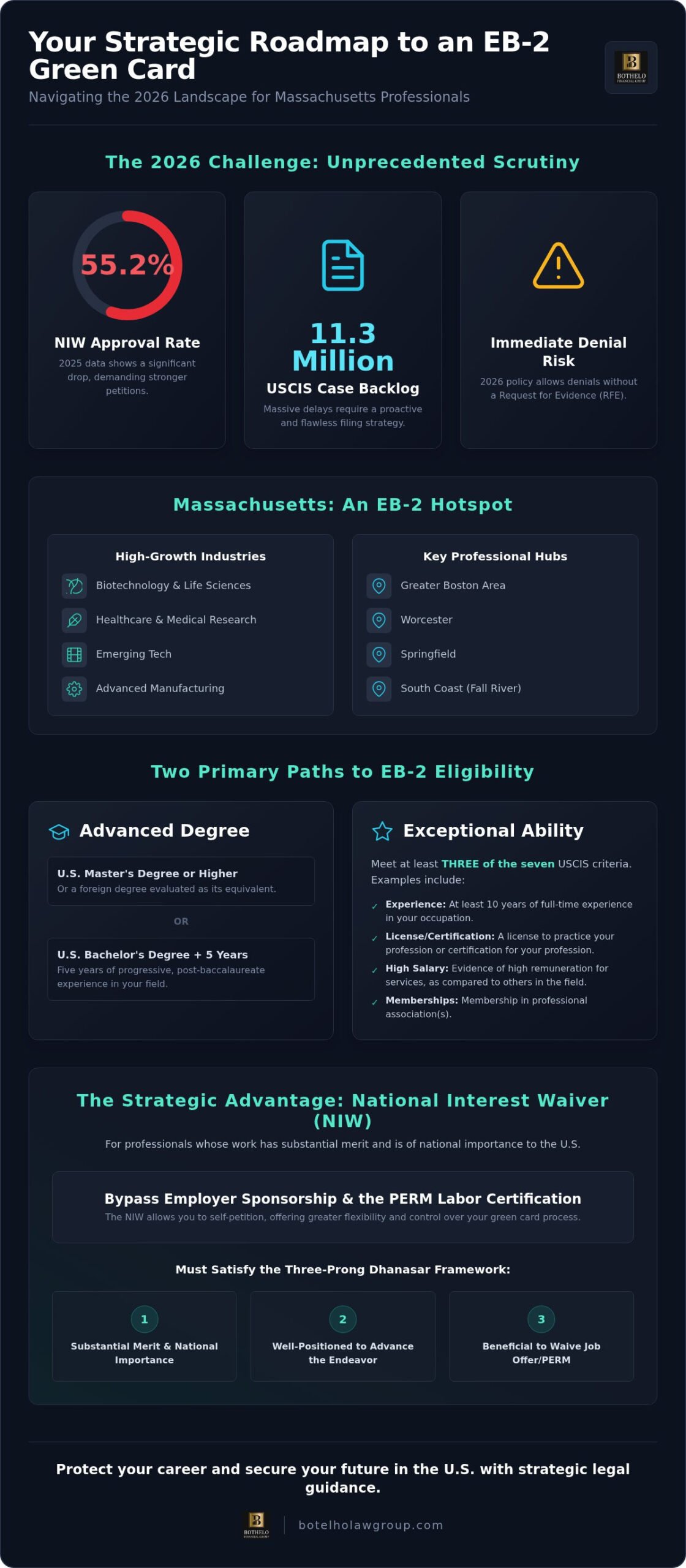
With EB-2 National Interest Waiver (NIW) approval rates dropping to just 55.2 percent in 2025, the margin for error in your green card petition has never been thinner. You’ve likely spent years building an elite career in the biotech or tech sectors of the Commonwealth, only to face a USCIS backlog that now exceeds 11.3 million pending cases. It’s frustrating to see your professional stability threatened by complex PERM certifications and a 2026 policy shift that allows for immediate denials without a Request for Evidence. Partnering with a dedicated EB-2 visa lawyer Massachusetts professionals trust ensures your filing is robust enough to withstand this heightened scrutiny.
You deserve a clear path to permanent residency that reflects the value of your contributions to high-growth industries. This article provides a strategic roadmap to master the complexities of the EB-2 process with expert legal tactics tailored to the local economic landscape. We’ll examine how to navigate the 2026 fee structures, bypass the labor certification through the NIW framework, and secure the documentation necessary to protect your career from administrative delays.
Key Takeaways
- Identify the strategic advantages of filing for an EB-2 visa within the high-growth innovation sectors of Massachusetts in 2026.
- Differentiate between “Advanced Degree” and “Exceptional Ability” pathways to select the most viable evidentiary strategy for your specific background.
- Understand the specific criteria for a National Interest Waiver (NIW) to potentially bypass employer sponsorship and the lengthy PERM labor certification.
- Engage an EB-2 visa lawyer Massachusetts to manage complex USCIS documentation and protect your career stability against rising administrative scrutiny.
- Coordinate your employment-based filing with long-term residency goals, including comprehensive legal support for your dependents and future naturalization.
The EB-2 Visa Landscape for Massachusetts Professionals
The Employment-Based, Second Preference (EB-2) visa serves as a primary vehicle for foreign professionals possessing advanced degrees or exceptional ability to secure permanent residency. As we move through 2026, this EB-2 visa overview reveals a landscape defined by high demand and rigorous federal scrutiny. For many, the choice is between the standard PERM labor certification process and the more flexible National Interest Waiver (NIW). Given that the USCIS backlog reached 11.3 million applications by the start of the 2026 fiscal year, selecting the correct path is a high-stakes decision. An experienced EB-2 visa lawyer Massachusetts professionals rely on can help determine which route aligns with both federal regulations and regional economic priorities.
The Economic Drivers of EB-2 in the Commonwealth
Massachusetts continues to lead the nation in sectors that favor EB-2 candidates. While the Greater Boston area remains a global center for biotechnology and life sciences, other regions are seeing significant professional growth. Worcester and Springfield have become hubs for healthcare and medical research, attracting specialists from across the globe. Crucially, the South Coast, including Fall River, is experiencing a surge in emerging tech and advanced manufacturing. Unlike firms that focus solely on Boston’s multinational corporations, an employment based visa attorney understands that these localized industries offer unique opportunities for “National Interest” arguments. These regional hubs provide a strong foundation for professionals looking to prove their work benefits the United States as a whole.
Who Qualifies as an EB-2 Candidate?
To qualify for an EB-2 visa in 2026, you must generally hold a U.S. Master’s degree or its foreign equivalent. Alternatively, individuals without an advanced degree may qualify by demonstrating “Exceptional Ability” through at least three of seven USCIS criteria, such as ten years of full-time experience or professional license certification. Under the August 2026 USCIS policy update, officers now have broader authority to deny petitions without first issuing a Request for Evidence (RFE). This shift makes a comprehensive initial filing mandatory for success. A skilled EB-2 visa lawyer Massachusetts ensures that your documentation is not just present, but persuasive enough to prevent an immediate denial. We focus on building a systematic case that addresses the three-prong Dhanasar framework while highlighting your specific achievements in the Massachusetts workforce.
Whether you are pursuing a self-petition via the NIW or navigating employer sponsorship through PERM, the 2026 standards require a higher level of precision. The goal is to move from temporary status to a permanent green card while minimizing the risk of administrative delays or denials that could impact your career stability.
Eligibility Deep Dive: Advanced Degree vs. Exceptional Ability
Securing an EB-2 green card requires meeting strict thresholds defined by the official USCIS EB-2 eligibility criteria. Understanding these distinctions is the first step in building a successful petition. An EB-2 visa lawyer Massachusetts professionals consult can help determine which path offers the highest probability of approval based on your specific academic and professional history. In 2026, the volume of filings makes it essential to identify the correct category before initiating the process.
The Advanced Degree Path
Most applicants qualify through the advanced degree category. This requires a U.S. Master’s degree or higher, or a foreign degree evaluated as its equivalent. If you hold a Bachelor’s degree, you may still qualify by proving five years of progressive experience in your field. Progressive experience refers to a continuous increase in responsibility and complexity within a professional role, demonstrating a trajectory of growth rather than repetitive tasks. Identifying the correct educational equivalency is critical, as USCIS frequently challenges foreign credentials that don’t align perfectly with U.S. standards. A meticulous EB-2 visa lawyer Massachusetts can assist in obtaining the necessary credential evaluations to satisfy these requirements.
The Exceptional Ability Path
For those without an advanced degree, the Exceptional Ability category provides an alternative. You must meet at least three of the seven criteria established by federal regulations. These include:
- Official academic records showing a degree related to your area of exceptional ability.
- Evidence of ten years of full-time experience in your occupation.
- A license to practice your profession or certification for your profession.
- Evidence that you’ve commanded a salary or other remuneration for services that demonstrates your exceptional ability.
- Membership in a professional association.
- Recognition for your achievements and significant contributions to your industry by peers, government entities, or professional organizations.
- Other comparable evidence of eligibility.
In Massachusetts, specialized experience in biotechnology, data science, or medical research often carries significant weight. Peer recommendations from established leaders in the Cambridge or Boston research hubs can serve as powerful evidence of your standing. However, documenting these credentials requires precision. Many petitions fail because the evidence provided is too general or lacks the specific legal formatting required by USCIS. If you’re unsure how your background fits these criteria, speaking with a qualified immigration attorney can provide the necessary clarity to move forward confidently.
The National Interest Waiver (NIW) Strategy for MA Professionals
The National Interest Waiver (NIW) represents one of the most powerful tools for professionals seeking permanent residency without the constraints of employer sponsorship. Unlike the standard EB-2 path, which requires an employer to navigate the PERM Labor Certification process, the NIW allows for a “self-petition.” This means you don’t need a specific job offer or a company to act as your petitioner. For professionals in Massachusetts, this flexibility is invaluable, especially in fast-moving sectors where career mobility is essential. However, the 2026 adjudication environment is rigorous, with NIW approval rates showing a marked decline to 55.2 percent in fiscal year 2025. Consulting an EB-2 visa lawyer Massachusetts residents trust is critical to structuring a petition that meets the “Matter of Dhanasar” three-prong test.
Prong 1: Substantial Merit and National Importance
USCIS first evaluates whether your proposed endeavor has both substantial merit and national importance. In the Commonwealth, this often involves linking your work to major economic, healthcare, or scientific initiatives. While biotechnology and life sciences are traditional strongholds, 2026 standards also recognize contributions to renewable energy, cybersecurity, and advanced manufacturing in regions like Fall River and the South Coast. National Importance in the context of regional Massachusetts development refers to work that addresses critical labor shortages or technological gaps in local innovation clusters, thereby strengthening the broader U.S. economic and scientific infrastructure. Demonstrating how your research or professional practice supports state-funded initiatives or federal priorities within the state creates a compelling case for merit.
Prong 2 and 3: Personal Qualifications and the Waiver Justification
The final two prongs focus on your personal qualifications and the justification for waiving the labor certification. You must prove you’re “well-positioned” to advance your endeavor, which requires extensive evidence of past successes. An EB-2 visa lawyer Massachusetts can help you compile evidence such as Massachusetts-based awards, venture capital funding, or grants from institutions like the Massachusetts Life Sciences Center. Finally, you must show that, on balance, it’s beneficial to the U.S. to waive the job offer requirement. This involves arguing that your contributions are so significant that the country shouldn’t wait for an employer to test the local labor market. By highlighting your unique expertise and the urgency of your work, we build a protective case that positions you as an indispensable asset to the national interest.
Navigating the PERM Labor Certification Process in Massachusetts
The standard EB-2 path requires your employer to test the U.S. labor market through the PERM Labor Certification. It’s a mandatory safeguard designed to ensure that hiring a foreign national doesn’t adversely affect the wages or working conditions of U.S. workers. In 2026, this process is more time-intensive than ever. The entire cycle, from the initial wage request to final certification, now averages between 20 and 26 months. An EB-2 visa lawyer Massachusetts helps employers navigate these hurdles while protecting the professional’s long-term residency goals and career stability.
The Step-by-Step PERM Roadmap
The Department of Labor (DOL) mandates a three-step recruitment phase. It’s rigorous and requires perfect documentation. Failure to document every applicant’s rejection reason with legal specificity can trigger a DOL audit, which adds significant delays to an already lengthy processing queue. The steps include:
- Step 1: Prevailing Wage Request: As of June 2026, the National Prevailing Wage Center is processing requests filed in April 2026. We utilize the updated July 1, 2026, Occupational Employment and Wage Statistics (OEWS) data to ensure your salary offer meets the strict federal standards for the Massachusetts region.
- Step 2: Mandatory Recruitment: Employers must place two Sunday newspaper ads and a 30-day job order with the Massachusetts Department of Career Services. Internal job postings and additional recruitment steps are also required for professional roles.
- Step 3: Filing ETA Form 9089: Once recruitment is finalized, we file the application. Currently, the DOL is processing applications filed in September 2025, with an average processing time of approximately 372 days.
Common Challenges in the MA Labor Market
Boston and Cambridge present unique difficulties for the PERM process. The high density of qualified graduates from local institutions makes it harder to prove that no U.S. worker is available for the role. We must define “minimum requirements” with extreme precision; they must be stringent enough to reflect the specialized nature of the position but not so narrow that the DOL labels them “unduly restrictive.” Defining these requirements incorrectly is a primary cause of petition denial. Collaborating with a PERM labor certification lawyer ensures your job description stands up to federal scrutiny while accurately reflecting your professional expertise. If your employer is ready to sponsor your permanent residency, contact our legal team to begin the local market analysis and secure your place in the 2026 filing queue.
Strategic timing is essential. Because the EB-2 visa lawyer Massachusetts professionals hire must coordinate with your employer’s HR department, starting the prevailing wage request early is the only way to mitigate the impact of the current DOL backlogs.
Why Strategic Legal Representation is Critical for EB-2 Success
The EB-2 process is not a mere administrative filing; it’s a high-stakes legal maneuver that requires a “Protective Advocacy” approach. With the 2026 policy updates allowing USCIS officers to deny petitions without first issuing a Request for Evidence (RFE), the quality of your initial submission is paramount. Choosing a results-oriented EB-2 visa lawyer Massachusetts ensures your case is prepared with the precision required to withstand this heightened scrutiny. Botelho Law Group positions itself as a sophisticated legal strategist, acting as a relentless fighter for our clients’ professional futures while providing a calm, authoritative presence throughout the process.
Success in your career often coincides with a need for broader legal security for your family. Once your employment-based petition is underway, you must consider the status of your dependents. Our firm provides seamless support as a family based green card attorney, ensuring your spouse and children transition smoothly to permanent residency alongside you. Additionally, establishing a permanent life in the U.S. involves protecting your assets and autonomy. We coordinate your immigration filing with our estate planning lawyer Fall River MA team to secure your property and legacy from the moment you settle in the Commonwealth.
The Botelho Law Group Advantage
We represent clients in all 50 states from our Fall River headquarters, proving you don’t need a Boston-based firm to receive elite, nationwide representation. This local accessibility combined with national reach allows us to serve the South Coast professional community with a level of attention that larger firms often overlook. You’ll have direct attorney access throughout your case, ensuring your professional portfolio is meticulously prepared. Our experience with complex RFE responses is particularly vital in 2026, as we understand the specific evidentiary standards required to navigate the new, shorter response windows and prevent petition denial.
Next Steps: Securing Your Future in Massachusetts
The 2026 fiscal year is seeing unprecedented volume, with the employment-based immigration backlog exceeding 1.2 million people. Starting the process early is the only way to mitigate the impact of these growing delays. Your next step is scheduling an initial evaluation to determine your eligibility under the Dhanasar framework or the PERM requirements. Prepare your professional portfolio, including degrees, publications, and peer reviews, for our legal review. A proactive EB-2 visa lawyer Massachusetts can then begin the labor market analysis or NIW strategy necessary to secure your green card and provide the stability your career requires.
Securing Your Professional Future in the 2026 Innovation Economy
Navigating the current immigration landscape requires a shift from standard administrative filing to high-stakes legal strategy. As processing backlogs grow and USCIS scrutiny intensifies, the precision of your initial documentation determines your success. Whether you’re bypassing the labor market through a National Interest Waiver or coordinating with your employer for a PERM certification, you must align your professional achievements with the specific economic priorities of the Commonwealth. Partnering with an EB-2 visa lawyer Massachusetts professionals trust is the most effective way to mitigate the risk of immediate denial under current federal policies.
Botelho Law Group provides nationwide immigration representation from our Fall River headquarters, maintaining a specialized focus on employment-based green cards. Our results-oriented approach ensures your petition is built on a foundation of protective advocacy, allowing you to focus on your career while we handle the complexities of the legal system. Secure your EB-2 consultation with Botelho Law Group today to begin the process of anchoring your future in the United States. Your expertise is a vital asset to the national interest, and we’re here to ensure your residency status reflects that value.
Frequently Asked Questions
What is the current processing time for an EB-2 visa in Massachusetts for 2026?
In 2026, processing times for EB-2 visas vary significantly based on the chosen path. USCIS reports that 80 percent of Form I-140 NIW petitions take approximately 24 months under standard processing. If your case requires a PERM labor certification, the entire cycle often takes 20 to 26 months. This includes the prevailing wage determination and a 372-day average for Department of Labor processing. An EB-2 visa lawyer Massachusetts professionals trust can help manage these timelines through strategic filings.
Can I self-petition for an EB-2 visa if I am an entrepreneur in Fall River?
Yes, entrepreneurs in Fall River and throughout the South Coast can self-petition through the National Interest Waiver (NIW). You don’t need a traditional employer to sponsor you if you can prove your business venture has substantial merit and national importance. We focus on demonstrating how your startup or professional practice strengthens the U.S. economy or technological infrastructure. This “self-petition” advantage provides significant professional freedom while bypassing the lengthy labor certification process required for standard employment filings.
What is the difference between EB-2 and EB-3 visas for skilled workers?
The primary difference lies in the eligibility requirements and priority date availability. EB-2 is reserved for professionals with advanced degrees or exceptional ability, while EB-3 covers professionals with bachelor’s degrees and skilled workers with at least two years of experience. Because EB-2 has higher entry requirements, it often has shorter backlogs for most countries. However, for applicants from India and China, both categories face significant retrogression in 2026, making strategic legal planning essential to secure a priority date.
Do I need a job offer to apply for an EB-2 National Interest Waiver?
No, a job offer is not required for an EB-2 National Interest Waiver (NIW). The NIW specifically waives the requirement for a job offer and the PERM labor certification. This allows you to petition on your own behalf, provided you meet the Dhanasar framework’s three-prong test. This flexibility is ideal for researchers, consultants, and specialists who work across multiple projects or are currently between employers but possess skills that are vital to the national interest of the United States.
What happens if my PERM labor certification is audited by the Department of Labor?
If the Department of Labor audits your PERM certification, your employer must submit all recruitment documentation for federal review. This includes resumes, rejection reasons for U.S. applicants, and proof of all advertisements. An audit doesn’t mean a denial, but it adds several months to the processing timeline. We provide protective advocacy by ensuring all recruitment records are “audit-ready” before the initial filing, significantly reducing the risk of a successful challenge by federal officers during the 2026 cycle.
Can my spouse and children get green cards through my EB-2 application?
Yes, your spouse and unmarried children under age 21 are eligible for derivative green cards through your EB-2 application. They can apply for adjustment of status or consular processing concurrently with or after your I-140 approval. This ensures your family can live, work, and attend school in the United States. Botelho Law Group provides full-service support for these petitions, coordinating the entire household’s transition to permanent residency to ensure legal stability for all your dependents.
Is a PhD required for the EB-2 National Interest Waiver?
A PhD is not a mandatory requirement for the EB-2 National Interest Waiver. You can qualify with a Master’s degree or a Bachelor’s degree plus five years of progressive, post-baccalaureate experience. Individuals without these degrees can also qualify through the “Exceptional Ability” pathway by meeting at least three out of seven specific USCIS criteria. While a PhD can strengthen a case in academic research, many successful NIW applicants are professionals in business, tech, or healthcare with advanced industry experience.
How much does an EB-2 visa lawyer in Massachusetts typically cost?
Legal fees for an EB-2 visa lawyer Massachusetts residents hire depend on the complexity of the case and the specific filing path chosen. At Botelho Law Group, we utilize both flat-fee arrangements for standard filings and hourly rates for more complex litigation or RFE responses. These professional fees cover counsel, document preparation, and case management. It’s important to remember that these fees are separate from mandatory USCIS filing fees, such as the $715 fee required for Form I-140 petitions.