
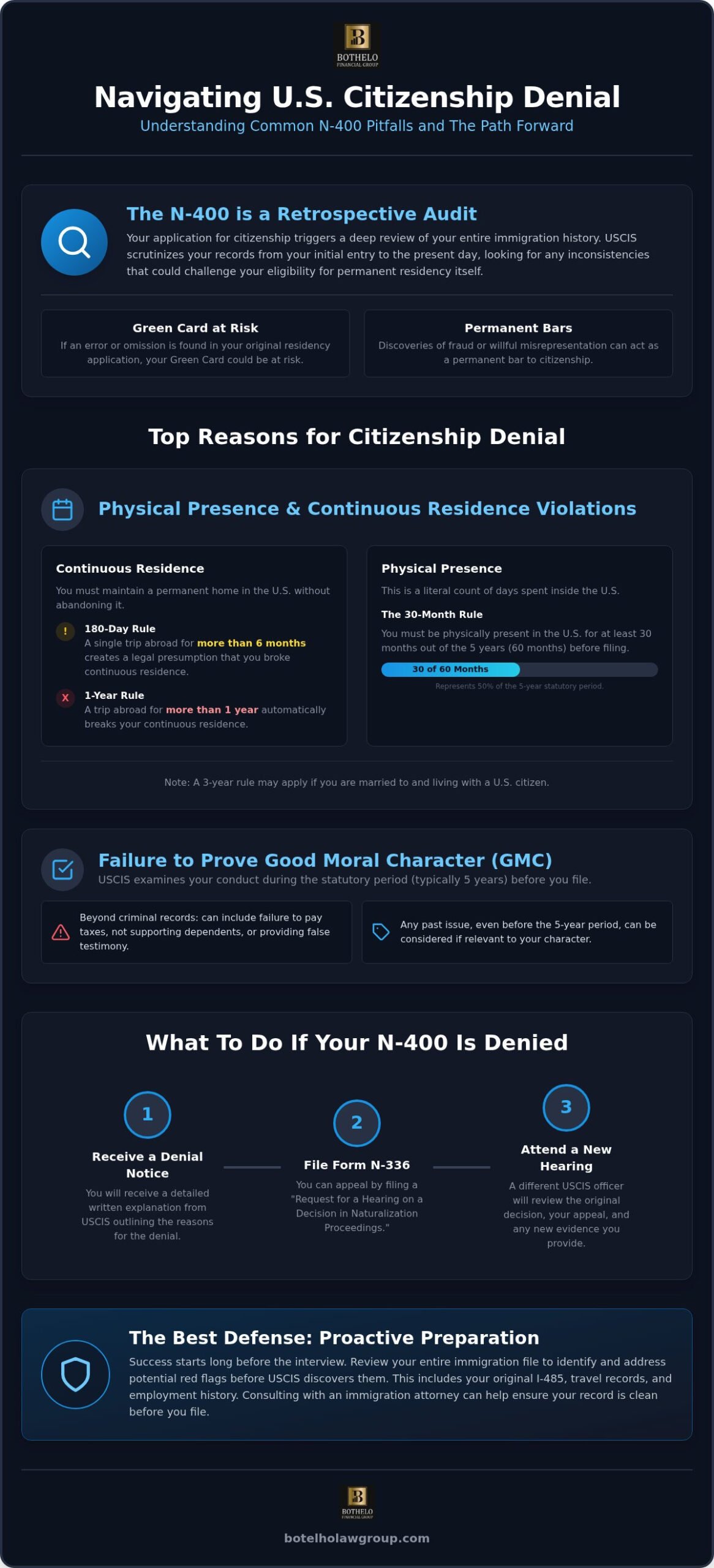
An N-400 application is more than just a request for a new passport; it’s a retrospective audit of your entire immigration history that can put your permanent residency at risk. While many applicants focus solely on the civics test, the reality is that the most common reasons for citizenship denial often stem from technicalities or past actions that USCIS uncovers during their deep dive into your records. Whether it’s a misunderstanding of physical presence requirements or a forgotten tax filing from years ago, a rejection letter can feel like a devastating blow to your future in the United States.
It’s natural to feel a sense of panic when your path to naturalization is blocked, especially when you fear that a denial might lead to the loss of your green card. You’ve worked hard to build a life here, and the complexity of federal immigration law shouldn’t be the reason that life is disrupted. This article will provide you with a clear understanding of why USCIS denies applications and the strategic legal steps you can take to secure your American dream. We’ll examine the specific grounds for rejection, explain how to handle the N-336 appeal process, and show you how to protect your status while moving forward.
Key Takeaways
- Recognize the N-400 as a retrospective audit that scrutinizes your entire immigration record for inconsistencies or past errors.
- Identify the common reasons for citizenship denial, including technical violations of the physical presence and continuous residence requirements.
- Evaluate how the five year statutory period for good moral character affects your eligibility and which specific legal issues lead to automatic rejection.
- Master the strategies for handling the naturalization test and avoiding common pitfalls during the rigorous USCIS interview process.
- Learn the precise legal procedure for requesting an N-336 hearing to appeal a denial and protect your status as a permanent resident.
The N-400 Audit: Why USCIS Re-Examines Your Entire Immigration History
Many applicants mistakenly view the naturalization process as a simple civics examination. In reality, the N-400 application serves as a final, comprehensive audit of your entire legal status under U.S. nationality law. USCIS officers use this opportunity to scrutinize every step of your journey, from your initial entry to the present day. They aren’t just looking for your knowledge of history; they’re looking for inconsistencies that suggest you weren’t eligible for residency in the first place.
One of the most common reasons for citizenship denial involves “unlawful admission.” If an officer determines that your green card was issued in error or that you omitted critical information during your residency application, your current status becomes vulnerable. Fraud or willful misrepresentation acts as a permanent bar to citizenship. Because the N-400 re-opens your entire file, any past mistake can suddenly become a present crisis that threatens your future in the United States.
The Risk of Reopening Your Green Card Case
The N-400 interview is a tactical verification of your old data. Officers compare your current testimony against your previous filings to detect discrepancies. Travel records are a frequent point of contention; if your history shows long absences, USCIS may argue you abandoned your residence. Unlike other immigration denials, a failed N-400 can sometimes lead directly to removal proceedings if the underlying residency is found to be invalid. This high-stakes environment requires a defensive strategy that protects your right to remain in the country while you pursue naturalization.
Pre-Filing Review: Identifying Red Flags Early
Success starts long before the interview. It’s vital to review your original I-485 or immigrant visa documentation to ensure everything aligns with your current records. A family based green card attorney specializes in identifying these audit triggers. They can spot red flags such as conflicting employment dates or undisclosed addresses that might lead to common reasons for citizenship denial. If you suspect an error exists in your past filings, you must address it proactively rather than waiting for an officer to discover it during the final audit. Identifying these issues early allows you to build a robust defense or delay filing until your record is clean.
Physical Presence and Continuous Residence Violations
Maintaining a consistent presence in the United States is a fundamental requirement for naturalization. Many applicants fail to distinguish between “continuous residence” and “physical presence,” which is one of the most common reasons for citizenship denial. Continuous residence refers to the maintenance of a permanent home within the U.S., while physical presence is a literal count of the days you’ve spent inside the country. You must satisfy both to be eligible.
The “180-Day Rule” is a frequent trap for those who travel for work or family. Any single trip outside the U.S. lasting more than six months but less than one year creates a legal presumption that you’ve broken your continuous residence. If you stay abroad for more than one year, your continuity is automatically broken by law, unless you’ve secured a reentry permit or qualify for specific exceptions. For most applicants, the “30-Month Rule” also applies; you must prove you were physically present in the U.S. for at least 30 months out of the five years preceding your application.
Certain individuals, such as military members or those working for the U.S. government abroad, may qualify for exceptions to these strict timelines. According to the USCIS Policy Manual on Naturalization Denials, failing to meet these mathematical thresholds results in an immediate rejection. If you’ve spent significant time abroad, consulting an immigration attorney can help you determine if you meet the requirements before you file.
The Statutory Period: 3 Years vs. 5 Years
The “statutory period” is the window of time USCIS examines to ensure you’ve met residency requirements. For most permanent residents, this period is five years. However, if you’re married to and living with a U.S. citizen, you may qualify under the three-year rule. Calculating this period accurately is critical; filing even a few days too early can lead to a denial. You must ensure you’ve met the physical presence quota within that specific three or five-year look-back window.
Rebutting the Presumption of Abandonment
If you’ve stayed outside the U.S. for more than six months, you must proactively rebut the presumption that you abandoned your residence. USCIS expects to see evidence that your life remained rooted in America during your absence. This includes filing U.S. tax returns as a resident, maintaining a lease or mortgage, and keeping active bank accounts. If you cannot provide this documentation, it’s often safer to wait until you’ve re-established your continuity before submitting the N-400. This careful timing is essential to avoid the common reasons for citizenship denial that plague frequent travelers.
Good Moral Character (GMC): Beyond Criminal Records
Good Moral Character (GMC) is a subjective but strictly enforced standard that serves as a cornerstone of the naturalization process. While the “statutory period” for review is typically five years, USCIS has the authority to look beyond this window if earlier conduct reflects poorly on your current character. Meeting the USCIS eligibility requirements involves proving you are a person of integrity. Certain criminal convictions, such as “crimes involving moral turpitude” (CIMT), lead to automatic denial. Even more severe are aggravated felonies, which create a permanent bar to citizenship regardless of how much time has passed since the offense.
It’s a common misconception that GMC only relates to criminal records. In reality, non-criminal behaviors like financial negligence or procedural omissions are common reasons for citizenship denial. USCIS views these issues as evidence that an applicant does not respect the laws and obligations of the United States. To succeed, you must demonstrate that you have fulfilled your civic and personal responsibilities throughout the statutory period.
Financial Obligations and Citizenship
Financial history is a primary focus during the character audit. If you owe federal, state, or local taxes, you must prove that you’ve filed all required returns and are in good standing with the tax authorities. Owed balances don’t trigger an automatic rejection if you have a formal IRS payment plan in place and can demonstrate a history of consistent payments. Similarly, child support is a critical GMC factor. You must provide evidence that you’re meeting all court-ordered obligations for dependents. USCIS frequently denies applications when they find a history of “willful failure” to support family members.
Selective Service and Other Procedural GMC Issues
All males who lived in the U.S. between the ages of 18 and 26 in any status other than a non-immigrant visa are required to register for the Selective Service. Failing to register is a frequent hurdle for naturalization. If you’re now over age 31, you must prove that your failure to register wasn’t a “willful” attempt to evade the law. This usually requires obtaining a “Status Information Letter” and providing a sworn statement explaining the circumstances. Demonstrating a lack of intent to break the law is essential to overcoming this character bar.
Voter Registration and False Claims to Citizenship
Accidental voter registration is an increasingly frequent problem, often occurring during routine DMV transactions through “Motor Voter” programs. Even an unintentional registration can be interpreted as a “false claim to U.S. citizenship,” which carries severe consequences including permanent ineligibility and deportation. Because the stakes are so high, even an accidental false claim requires an immigration lawyer Fall River MA to clarify the intent behind the error. These procedural traps are common reasons for citizenship denial that demand a sophisticated legal defense to protect your residency.
Failing the Naturalization Test and Interview Pitfalls
The naturalization interview is the final, high-pressure hurdle in the citizenship journey. It requires you to demonstrate English proficiency through reading, writing, and speaking, alongside a mastery of U.S. history and government in the civics test. While the questions are standardized, the environment is not. Nerves often lead to simple mistakes that an officer may interpret as a lack of understanding. If you fail any portion of these tests, USCIS allows for a second attempt, usually scheduled 60 to 90 days after the initial interview. A second failure results in an administrative closure of your case, making test preparation one of the most critical steps in the process.
Exemptions and Accommodations
Age and residency length can provide relief from the standard English requirements. Under the “50/20” rule, applicants over age 50 who’ve lived in the U.S. as permanent residents for 20 years can take the civics test in their native language. Similarly, the “55/15” rule applies to those over 55 with 15 years of residency. Medical disability waivers, submitted via Form N-648, offer another path for those with physical or mental impairments. However, USCIS scrutinizes these forms with extreme precision. Incomplete medical documentation or vague diagnoses are common reasons for citizenship denial, as the burden is on the applicant to prove that their condition specifically prevents them from learning English or history. For those with hearing or visual impairments, you have the right to request specific accommodations, such as a sign language interpreter or large-print testing materials, provided you notify USCIS in advance.
Behavioral and Credibility Issues During the Interview
Your conduct during the interview is under constant evaluation. Evasive or contradictory answers can lead to a denial based on a perceived lack of good moral character. Officers compare your spoken testimony against every line of your written N-400 application. Any discrepancy, even if unintentional, can damage your credibility. You must be prepared to discuss every aspect of your past, including arrests that were later expunged or dismissed. Concealing this information is far more dangerous than disclosing it. Having a naturalization attorney present provides a critical layer of protection; they can intervene if an officer’s questioning becomes inappropriate or moves beyond the legal requirements of the audit.
If you’re anxious about the interview process or need to secure a medical waiver, don’t walk into the USCIS office alone. Reach out to the Botelho Law Group today to ensure your application is airtight and your interview performance is beyond reproach.
How to Fight an N-400 Denial: The N-336 Appeal Process
A denial letter from USCIS is a high-stakes legal event that requires an immediate, calculated response. You have a strictly enforced 30-day window from the date of the decision to file Form N-336, Request for a Hearing on a Decision in Naturalization Proceedings. If you fail to act within this timeframe, the denial becomes a permanent part of your immigration record, which can complicate any future attempts to naturalize. While the common reasons for citizenship denial often involve complex residency or character issues, the law provides a clear mechanism to challenge an incorrect ruling.
Strategic decision-making is essential at this stage. In some cases, it’s more effective to re-file the N-400 rather than pursuing an appeal. For example, if a denial was based on a temporary lack of physical presence that you’ve now corrected, re-filing might be faster. However, if the denial involves a legal error or a finding of “lack of good moral character,” an appeal is often necessary to clear your record and prevent future rejections. If administrative reviews fail, you may even have the right to seek judicial review in a U.S. District Court, where a federal judge examines your case from the beginning.
The N-336 Administrative Hearing
The N-336 hearing isn’t a repeat of your first interview; it’s an administrative review conducted by a senior USCIS officer who was not involved in the original decision. This officer has the authority to overturn the previous rejection if you can demonstrate that the law was applied incorrectly or if you provide new evidence that resolves the initial concerns. If your case was denied due to a misunderstanding of tax transcripts, travel records, or court dispositions, this hearing is your opportunity to clarify the facts. Once the hearing is complete, USCIS is generally required to issue a final decision within 180 days, providing a definitive timeline for your case resolution.
Strategic Legal Representation
Navigating an appeal requires a comprehensive legal brief that directly challenges the specific findings of the naturalization officer. The Botelho Law Group acts as a focused advocate for clients facing these difficult rejections. We meticulously prepare your appeal to highlight legal errors and protect your permanent residency from the risk of deportation, especially in cases involving criminal records or alleged fraud. Our firm provides nationwide representation; your location doesn’t limit your access to our specialized expertise. We handle the complex math of physical presence and the nuances of character requirements to ensure your residency is protected and your path to citizenship remains open.
Protecting Your Residency and Your Future
A naturalization rejection is a serious legal hurdle, but it doesn’t have to be the end of your American dream. By understanding the common reasons for citizenship denial, you can take the necessary strategic steps to correct your record and defend your status. Whether your case requires an N-336 administrative hearing or a fresh N-400 filing, success depends on a meticulous review of your immigration history and a proactive approach to character and residency requirements.
The Botelho Law Group provides sophisticated legal representation for clients in all 50 states, combining expertise in Federal and State law to solve complex immigration challenges. Because we handle personal injury litigation with no upfront fees, our firm can dedicate concentrated resources to your specific naturalization needs. Contact our N-400 denial appeal lawyers today for a comprehensive case review. You’ve worked hard to build your life here, and we’re here to help you secure it permanently.
Frequently Asked Questions
What is the most common reason for citizenship denial in 2026?
In 2026, failures related to Good Moral Character and continuous residence remain the most common reasons for citizenship denial. USCIS officers strictly enforce the 180-day rule for travel and scrutinize tax compliance. Many applicants also face rejection due to inconsistencies between their current N-400 testimony and their original green card records. Addressing these technical and character-based issues before your interview is essential for a successful outcome in the Massachusetts or Rhode Island jurisdictions.
Can I apply for citizenship again if my N-400 was denied?
You can typically re-apply for citizenship if your initial application was denied, provided the reason for rejection isn’t a permanent bar. If you failed the civics test or didn’t meet physical presence requirements, you may re-file once you’ve addressed those specific deficiencies. However, if the denial involved a lack of Good Moral Character, you might need to wait for the statutory period to reset. Consulting a Fall River immigration attorney ensures your next filing is strategically timed.
Will I lose my green card if my citizenship application is rejected?
A citizenship denial doesn’t automatically result in the loss of your green card, but it can trigger removal proceedings in specific circumstances. If USCIS discovers evidence of fraud in your original residency application or a deportable criminal offense during their audit, they may issue a Notice to Appear in immigration court. This risk makes it vital to have a focused advocate review your history before exposing your permanent resident status to federal scrutiny.
How long do I have to appeal a naturalization denial?
You have exactly 30 days from the date on your denial notice to file an N-336 appeal. This administrative hearing allows a senior officer to review your case and overturn the initial decision if an error occurred. Missing this deadline often means you must start the entire process over by filing a new N-400 application. Because the window is so narrow, immediate action is required to protect your rights and maintain your path to U.S. citizenship.
What happens if I fail the English or Civics test twice?
If you fail either the English proficiency or civics portion of the test during your second attempt, USCIS will deny your N-400 application. This failure results in the administrative closure of your case. You’ll be required to submit a new application and pay the associated filing fees again if you wish to proceed. Many applicants in Massachusetts seek professional tutoring or legal guidance to ensure they are fully prepared for the linguistic and historical requirements of the interview.
Can unpaid taxes stop me from becoming a U.S. citizen?
Unpaid taxes are among the common reasons for citizenship denial because they reflect on your Good Moral Character. To overcome this hurdle, you must demonstrate that you’ve filed all required returns and are in good standing with the tax authorities. If you owe back taxes, providing evidence of a formal, active payment plan and a history of consistent payments can often satisfy the officer’s concerns. Failure to address tax debt before your interview usually leads to an immediate rejection.
Do I need a lawyer for my citizenship interview or appeal?
While you aren’t legally required to have an attorney, legal representation is highly recommended for any case involving arrests, long trips abroad, or tax issues. An experienced lawyer can intervene during the interview to ensure the officer follows proper procedures and doesn’t overstep legal boundaries. For N-336 appeals, having a strategist who understands both Federal and State law is critical to drafting a persuasive brief that addresses the specific legal grounds for your initial denial.
Is a 10-year-old arrest still a problem for my N-400 application?
Yes, you must disclose every arrest on your N-400, even if it happened ten years ago or was expunged. While the statutory period for Good Moral Character is typically five years, USCIS has the authority to consider older conduct if it suggests a pattern of behavior or involves an aggravated felony. Failing to disclose a decade-old arrest is often viewed as willful misrepresentation, which is a permanent bar to citizenship and a serious threat to your residency.