
The choice that seems the fastest for your relationship might actually be the one that keeps your lives on hold the longest. While many couples assume the K-1 fiancé visa is the express lane to the United States, current 2026 processing trends suggest a more complex reality. Deciding between a K-1 fiancé visa vs CR-1 spouse visa is no longer just about which path gets your partner through the airport first. It’s about how quickly they can start their life, build a career, and secure their legal standing. We recognize that the weight of a long separation is exhausting and the urgency to reunite is your primary concern.
This article provides a rigorous comparison of the timelines, costs, and legal protections associated with both paths in the current regulatory environment. You’ll discover why the CR-1 spouse visa often provides superior financial stability, even if the initial processing takes a few months longer. We will break down the $1,500 average cost difference, the impact of recent USCIS policy shifts, and the critical advantage of immediate work authorization. This analysis offers the strategic clarity you need to choose the path that best protects your marriage and your long-term goals.
Key Takeaways
- Compare the financial and legal implications of the K-1 fiancé visa vs CR-1 spouse visa to determine which offers the most stable foundation for your marriage.
- Analyze 2026 timeline shifts to understand why the CR-1 path often results in faster work authorization despite a slightly longer initial wait for entry.
- Evaluate the total cost structure of both paths, accounting for the additional $1,440 adjustment of status fee required for K-1 holders after arrival.
- Identify the legal protections of entering as a permanent resident, which eliminates the period of financial dependence and travel restrictions common in the fiancé process.
- Learn how professional legal strategy mitigates the risk of RFEs and denials, ensuring your petition withstands the rigorous scrutiny of current immigration authorities.
Understanding the K-1 Fiancé Visa and CR-1 Spouse Visa Dilemma
The choice between a K-1 fiancé visa vs CR-1 spouse visa is a high-stakes decision that dictates how you will begin your life together in the United States. A K-1 visa is a non-immigrant category designed for those who intend to marry on U.S. soil, while the CR-1 is an immigrant visa for those already married abroad. In 2026, the core dilemma centers on a trade-off: do you prioritize the earliest possible physical reunification or the immediate security of permanent resident status?
Relying on luck or “winging it” isn’t a viable strategy. U.S. immigration law treats the concept of “intent” with extreme gravity. If an individual enters the country on a visitor visa with the undisclosed intent to marry and stay, they risk being charged with visa fraud. This can lead to permanent inadmissibility. Strategic planning is essential because the path you choose today determines your legal rights for years to come. We approach these cases with a focus on risk mitigation to ensure your family’s future is never jeopardized by a lack of foresight.
The Fundamental Legal Distinction: Engagement vs. Marriage
Both categories require couples to prove their relationship is “bona fide,” meaning it wasn’t entered into solely for immigration benefits. However, the legal burdens shift depending on your marital status. For a fiancé petition, you must demonstrate a clear intent to marry within 90 days of entry and prove you’ve physically met within the last two years. Spousal petitions require a valid marriage certificate and extensive evidence of shared lives, such as joint financial accounts or property leases.
Where you choose to marry dictates your entire immigration strategy. If the ceremony occurs outside the U.S., the CR-1 is your primary vehicle for entry. For marriages less than two years old at the time of admission, the CR-1 visa results in conditional permanent residency, requiring a later petition to remove those conditions. This distinction is critical for long-term planning, as it impacts when you’ll need to file additional paperwork to secure permanent status.
Why Your 2026 Timeline Depends on Consular Backlogs
Current processing trends in 2026 show that “average” timelines found on internet forums are often misleading. While USCIS handles the initial petition, the final visa issuance depends on the specific U.S. embassy or consulate in the foreign partner’s home country. Some jurisdictions face massive backlogs due to local policy shifts or staffing shortages, while others remain relatively efficient. These localized bottlenecks can add months to your wait time, regardless of how quickly the initial paperwork is approved.
We analyze these regional variables to provide our clients with a realistic outlook rather than a generic estimate. Your specific location is often the most significant factor in determining when you’ll finally be reunited. Understanding these regional delays is a core component of a results-oriented legal strategy that prioritizes transparency and precision.
The K-1 Fiancé Visa: Faster Entry with a Conditional Path
The K-1 visa process begins with Form I-129F, the Petition for Alien Fiancé. For many couples, this is the preferred route because it traditionally offered the fastest path to physical reunification in the United States. As of early 2026, processing times for the I-129F petition average between 9 and 11 months. While this gets your partner across the border sooner than other methods, it’s only the first phase of a complex, two-part legal journey. Entry is not the end of the road; it’s a temporary admission that requires immediate action to secure permanent status.
The 90-Day Marriage Requirement and Legal Risks
Upon entry, the law imposes a strict deadline. You must marry your U.S. citizen petitioner within exactly 90 days. This window is non-negotiable. If the marriage doesn’t occur within this timeframe, the foreign fiancé must depart the U.S. immediately. Staying beyond the 90-day limit triggers serious deportation risks and can result in a permanent bar from re-entering the country. There are no extensions or options to switch to a different visa category once the fiancé has entered under K-1 status. This rigid structure provides legal protection for the petitioner, ensuring the visa is used solely for its intended purpose of establishing a permanent union.
Adjustment of Status: The Second Hurdle After Entry
The wedding ceremony is a milestone, but it doesn’t grant legal residency. To remain in the country, the couple must file Form I-485 to adjust status. This second step is where many couples encounter unexpected delays and significant costs. In 2026, the filing fee for the I-485 is $1,440. Unlike the CR-1 spousal visa, which allows the beneficiary to arrive with a green card, K-1 holders enter a period of legal limbo. They can’t work or travel outside the U.S. until they receive separate authorizations, which typically take 4 to 6 months to process after filing. This lack of immediate financial independence is a major factor when weighing the K-1 fiancé visa vs CR-1 spouse visa.
Managing this transition requires precision to avoid gaps in legal status. Our team provides the specialized Adjustment of Status Lawyer support needed to secure your partner’s future after the wedding. We ensure every form is filed correctly to minimize the time your spouse spends without work authorization.
The CR-1 Spousal Visa: Immediate Permanent Residency Upon Arrival
For couples who are already married, the CR-1 spousal visa serves as the gold standard for immigration. The process initiates with the filing of Form I-130, which establishes the legal validity of the marriage to the satisfaction of U.S. Citizenship and Immigration Services (USCIS). While the average processing time for the I-130 is approximately 12.9 months in 2026, the long-term advantages often outweigh the wait. This is a “one and done” solution that bypasses the secondary, expensive hurdles associated with the fiancé path.
When analyzing the K-1 fiancé visa vs CR-1 spouse visa, the most significant differentiator is the status of the partner upon arrival. A CR-1 recipient enters the United States as a lawful permanent resident. There’s no need to file for adjustment of status or pay additional fees once you land. You aren’t just visiting; you’re home. This immediate legal certainty provides a foundation of stability that allows the couple to focus on their future rather than ongoing paperwork with the federal government.
The Benefits of Immediate Work and Travel Authorization
One of the most grueling aspects of immigration is the period of forced inactivity. Unlike the K-1, which leaves the foreign partner unable to contribute financially for months, the CR-1 allows for immediate integration into the U.S. economy. There’s no 4 to 6 month wait for an Employment Authorization Document (EAD). Your spouse arrives with the right to work, a Social Security number can be issued almost immediately, and travel outside the U.S. is permitted from day one. This independence is vital for the psychological well-being of the immigrant spouse, who can begin building their own life and career without delay.
Consular Processing: What to Expect at the Interview
After USCIS approves the initial petition, the case moves to the National Visa Center (NVC). This phase requires meticulous document collection, including financial affidavits and police clearances from every country the spouse has lived in. The process culminates in a high-stakes interview at a U.S. embassy or consulate. This isn’t a mere formality; it’s a rigorous examination of the relationship’s authenticity. Preparing for the medical exam and the interview questions is where professional strategy becomes indispensable. We act as a Consular Processing Attorney to ensure our clients are fully prepared for this final, critical step, mitigating the risk of a denial that could separate your family for years.
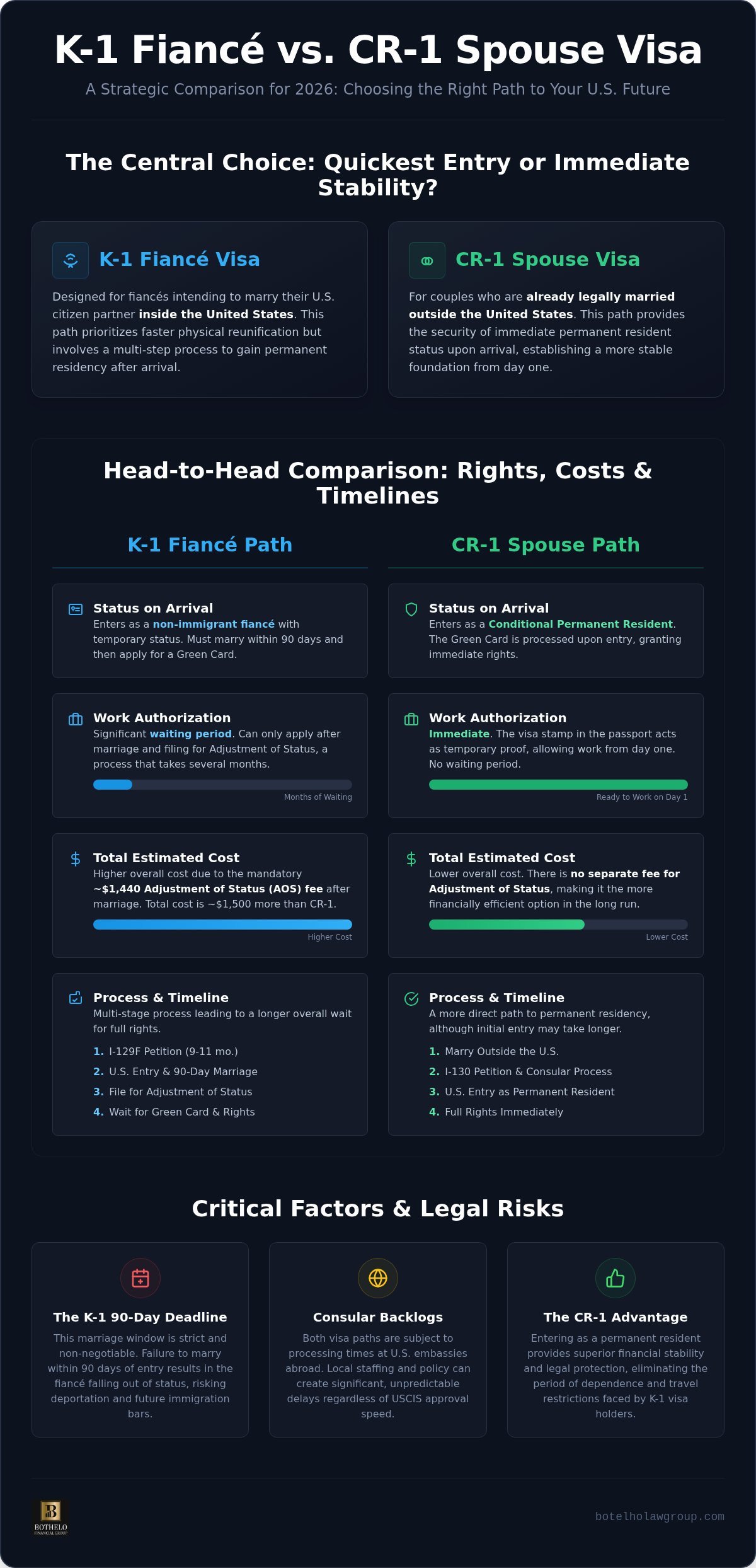
Side-by-Side Comparison: Cost, Timelines, and Legal Rights
Choosing between a K-1 fiancé visa vs CR-1 spouse visa requires a cold-eyed analysis of the total investment. While the K-1 often appeals to couples desperate for a faster reunion, the financial and legal burdens of the two-step process are substantial. We advocate for a strategy that considers the total cost of your immigration journey rather than just the initial filing fee. Results-oriented planning means looking past the flight date to the first year of residency.
Calculating the Total Financial Commitment for 2026
The financial disparity between these two paths is stark. For the K-1 fiancé visa, you’ll pay $675 for the initial I-129F petition. However, the true cost escalates after entry when you must file for Adjustment of Status (Form I-485), which carries a $1,440 fee. When you include biometrics, the $630 travel document fee, and the required medical exams, the K-1 path typically costs between $3,000 and $5,000 in government and related fees.
The CR-1 spouse visa operates on a different financial scale. The I-130 petition fee is $675, followed by a $325 immigrant visa application fee and a $120 affidavit of support review fee. Because there is no secondary adjustment of status fee required upon arrival, the CR-1 path is almost always cheaper in total government fees. This path saves couples approximately $1,500 to $1,700 compared to the fiancé route, making it the more fiscally responsible choice for many families.
Work and Travel Authorization: Managing the ‘Gap’ Period
The most significant hidden cost of the K-1 is the inability to work. K-1 holders typically face a 4 to 6 month wait after filing their adjustment paperwork before they receive an Employment Authorization Document (EAD). During this time, the household relies on a single income, which can strain a new marriage. Travel is also strictly restricted. If the foreign spouse leaves the U.S. without an approved Advance Parole document, they’re considered to have abandoned their application. This creates a period of legal and financial vulnerability that many couples find exhausting.
The CR-1 visa eliminates this gap. Upon arrival, the spouse is immediately authorized to work and travel. This freedom of movement is essential for international families who may need to return home for emergencies. Both paths require the U.S. sponsor to sign an I-864 Affidavit of Support, a legally binding contract to maintain the spouse at 125% of the Federal Poverty Guidelines. This is a serious legal obligation that persists until the spouse becomes a citizen or reaches 40 quarters of work history. If you’re struggling to weigh these competing priorities, contact Botelho Law Group to determine which path secures your financial and legal future.
Strategic Planning with a Specialized Immigration Attorney
Choosing between a K-1 fiancé visa vs CR-1 spouse visa is a decision that carries lifelong legal consequences. Professional representation isn’t merely about completing paperwork; it’s about sophisticated risk mitigation. At Botelho Law Group, we act as a focused advocate for couples navigating these high-stakes systems. While we’re headquartered in Fall River, MA, and serve as a local partner for Massachusetts and Rhode Island residents, our firm provides expert immigration representation across all 50 states and for consular processing worldwide.
Our role is to serve as your strategist through a system that’s often unforgiving of minor errors. For marriages less than two years old, the journey continues even after initial approval. You’ll eventually need to file a petition to remove conditions on the “Conditional” Green Card. We prepare our clients for this transition from day one, ensuring that the evidence gathered during the initial K-1 or CR-1 process builds a bulletproof foundation for your permanent future in the United States.
How Botelho Law Group Protects Your Marital and Legal Interests
We begin every case by vetting for potential red flags that could trigger a Request for Evidence (RFE) or an outright denial. Common issues include gaps in financial sponsorship, previous marital history, or inconsistencies in relationship documentation. Our results-oriented approach means we don’t just react to problems; we anticipate them. If an RFE occurs, we handle the response with professional precision, treating it as the “complex litigation” it is to protect your family’s right to remain together.
Next Steps: Your Consultation and Case Strategy
The path to a successful outcome starts with a clear mapping of your specific circumstances. During an initial consultation, we review your timeline, financial standing, and long-term goals to determine which path offers the most stability. To make the most of this session, you should be prepared to discuss your marriage or engagement history, current income levels, and any previous immigration filings. Choosing the right path requires more than a generic internet search; it requires a dedicated legal strategist who understands the nuances of the K-1 fiancé visa vs CR-1 spouse visa dilemma. If you’re ready to secure your future, contact an Immigration Lawyer Fall River MA to begin your personalized case evaluation.
Securing Your Future Through Strategic Immigration Planning
The decision between a K-1 fiancé visa vs CR-1 spouse visa is the first major milestone of your shared life in the United States. While the allure of a faster physical reunion through the K-1 is strong, the CR-1 path offers a more stable and cost-effective foundation for your family’s financial health. Entering as a permanent resident eliminates the months of legal limbo and work restrictions that often strain new marriages. Every case involves unique variables, and the current 2026 processing landscape requires a precise, results-oriented strategy to avoid costly delays.
Botelho Law Group provides sophisticated immigration representation for clients across all 50 states. We specialize in navigating the complexities of family-based petitions and consular processing. Whether you need the local advocacy of our Fall River, MA headquarters or our nationwide expertise, we act as your dedicated legal strategist. Don’t leave your partner’s legal status to chance. Secure your partner’s future; schedule a consultation with our immigration experts today. We look forward to helping you build your American dream with confidence and security.
Frequently Asked Questions
Is the K-1 fiancé visa faster than the CR-1 spouse visa in 2026?
The K-1 fiancé visa remains slightly faster for initial entry into the United States, typically allowing arrival 4 to 5 months sooner than the CR-1 path. However, when comparing the K-1 fiancé visa vs CR-1 spouse visa based on the time it takes to obtain a Green Card, the CR-1 is often more efficient. While a K-1 holder must wait months after arrival to adjust status, a CR-1 holder arrives with immediate residency.
Can my fiancé work immediately after arriving on a K-1 visa?
No, a fiancé cannot work immediately upon arrival. They must first marry within 90 days and file for Adjustment of Status along with an Employment Authorization Document. In 2026, the wait for work authorization typically lasts 4 to 6 months after the initial filing. This period of financial dependence is a significant factor for many Massachusetts couples who need two incomes to manage the local cost of living.
What happens if we get married on a K-1 visa but don’t file for a Green Card?
If you marry but fail to file Form I-485, the foreign spouse loses their legal standing once the 90-day K-1 period expires. They will be “out of status,” making them ineligible for work or international travel. This situation creates a high risk of deportation and can complicate any future immigration filings. It’s vital to begin the adjustment process immediately after the wedding to maintain continuous legal protection under federal law.
Do I have to be a U.S. citizen to apply for a fiancé visa?
Yes, only U.S. citizens are eligible to petition for a K-1 fiancé visa. Lawful Permanent Residents do not have the legal authority to sponsor a fiancé. If you are a permanent resident living in Fall River or elsewhere in the United States, you must use the CR-1 spouse visa path. This requires you to be legally married before filing the initial I-130 petition with USCIS to bring your spouse to the country.
Can we switch from a K-1 to a CR-1 visa after the petition is filed?
You cannot simply switch or convert a pending K-1 petition into a CR-1 petition. If your plans change and you decide to marry before the K-1 is approved, you must withdraw the I-129F and file a completely new I-130 petition. This often results in significant delays and the loss of initial filing fees. We recommend finalizing your marriage strategy before submitting any paperwork to the federal government to avoid these setbacks.
How much does an immigration lawyer cost for a fiancé or spouse visa?
Legal fees for immigration representation vary based on the complexity of the case and the specific services required. At Botelho Law Group, we typically utilize flat-rate structures for standard fiancé and spouse visa filings or hourly rates for cases involving complex litigation or prior denials. These fees cover professional counsel, document preparation, and strategic management. We provide detailed fee structures during our initial consultations to ensure full financial transparency for our clients.
What is the I-864 Affidavit of Support, and why is it a legal risk?
The I-864 is a legally binding contract between the sponsor and the U.S. government. By signing it, you agree to support the immigrant spouse at 125% of the Federal Poverty Guidelines. This obligation is a serious legal risk because it does not end with divorce. It persists until the spouse becomes a citizen or works for 40 quarters. We ensure our clients fully understand these long-term financial commitments before filing any family-based petitions.
Does the foreign spouse need a medical exam for both K-1 and CR-1 visas?
Yes, a medical examination by a government-authorized physician is mandatory for both K-1 and CR-1 visa applicants. For the K-1, the exam occurs before the consular interview abroad. If the adjustment of status takes longer than a year, a second exam may be required in the U.S. The CR-1 path requires one comprehensive exam during the consular processing phase. These exams verify that the applicant meets all health-related admissibility requirements before they enter the country.