
Did you know that a single administrative oversight in the Bristol County Probate Court can hold you personally liable for an estate’s debts? It’s a heavy burden to carry while grieving, especially when you’re facing confusing court procedures and the potential for family disputes over assets. You want to honor your loved one’s legacy, but the technical requirements of the Massachusetts Uniform Probate Code often feel like a legal minefield.
Securing a probate lawyer Fall River MA provides the strategic advocacy needed to manage these high-stakes transitions with professional confidence. We’ll help you secure your Letters of Authority and protect the estate from aggressive creditors, ensuring a final distribution that respects the decedent’s wishes. In this overview, we’ll examine the 2026 filing requirements, the implications of the $2 million state tax threshold, and the most efficient paths to settling Bristol County estates with precision.
Key Takeaways
- Learn the specific filing requirements for Bristol County Probate Court to prevent administrative delays and ensure the court validates your authority.
- Understand the risks of personal liability and how a structured legal approach protects your personal assets from the estate’s creditors.
- Discover why a probate lawyer Fall River MA provides critical protection that standard “Lawyer for the Day” court forms don’t offer.
- Identify how to resolve complex title issues on multi-generational Fall River properties to ensure a clean and final asset distribution.
- Master the 2026 procedural changes to navigate the $2 million Massachusetts estate tax threshold with professional confidence.
Understanding Probate Law in Fall River, Massachusetts
Probate is the court-supervised legal procedure used to authenticate a decedent’s will and oversee the orderly distribution of their assets. For residents of Fall River, this process occurs within the Massachusetts Probate and Family Court, specifically the Bristol County division. This judicial oversight ensures that the decedent’s final wishes are honored and that all legal obligations, including debts and taxes, are satisfied before heirs receive their inheritance. It’s a rigorous system designed to prevent fraud and resolve conflicting claims to an estate.
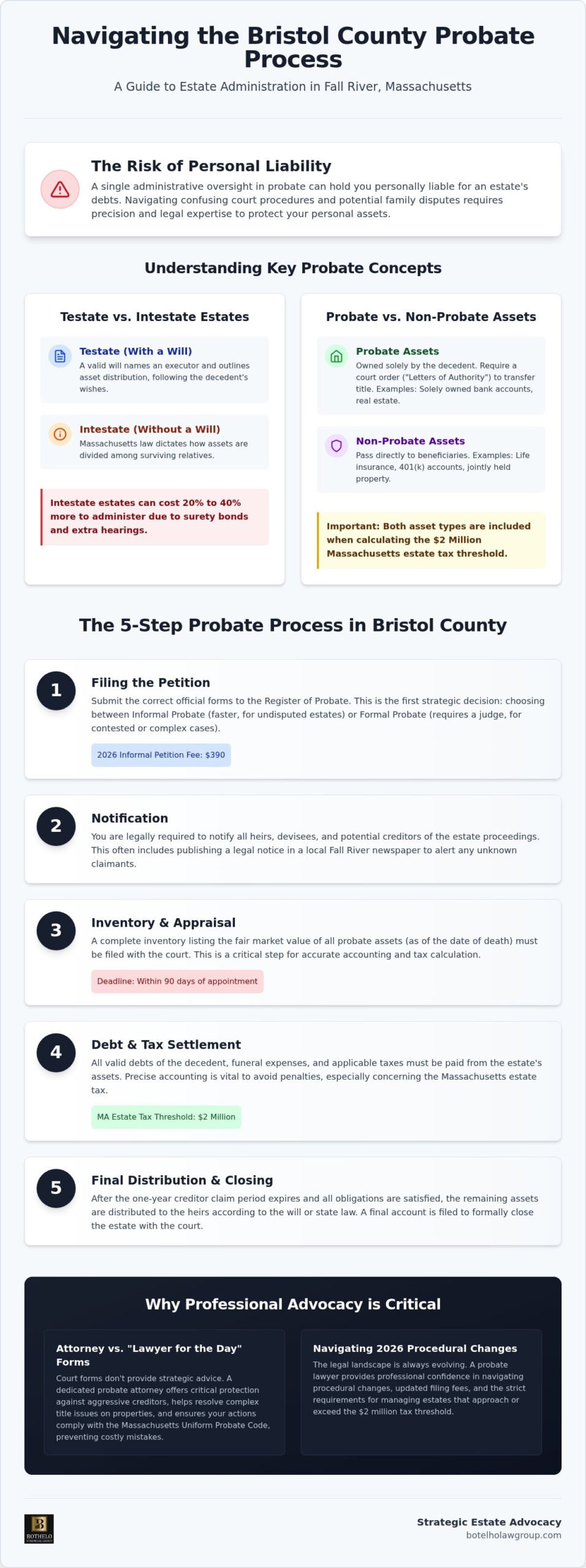
The nature of these proceedings depends heavily on whether the individual died “testate” or “intestate.” A testate estate involves a valid will that names an executor and outlines asset distribution. Conversely, an intestate estate occurs when no valid will exists. In these cases, Massachusetts law dictates how assets are divided among surviving relatives. Research indicates that intestate estates can cost 20% to 40% more to administer than testate estates because they often require surety bonds and additional court hearings. Engaging a probate lawyer Fall River MA ensures that every procedural step meets the strict standards of the Massachusetts Uniform Probate Code, regardless of whether a will is present.
The Legal Necessity of Probate
You can’t simply take over a deceased relative’s bank account or sign a new deed for their home. Financial institutions and the Registry of Deeds require a court-issued document, known as “Letters of Authority,” before they’ll recognize a successor’s right to act. The court acts as a shield, protecting the rights of legitimate creditors while ensuring heirs aren’t deprived of their rightful legacy. Failing to initiate this process in a timely manner often leads to frozen assets, escalating tax penalties, and potential litigation from disgruntled creditors or overlooked family members.
Probate vs. Non-Probate Assets
Not every asset owned by a Fall River resident must pass through the court system. Assets with designated beneficiaries, such as life insurance policies and 401(k) accounts, typically bypass probate and transfer directly to the named individuals. Similarly, real estate held in “Joint Tenancy” or as “Tenants by the Entirety” passes automatically to the surviving owner. Understanding these distinctions is a core responsibility for any probate lawyer Fall River MA when inventorying an estate.
Probate assets are any properties or holdings owned solely by the decedent at the time of death that require a court order to transfer title to legal heirs. Distinguishing between these categories is vital for accurate estate valuation. While non-probate assets avoid the court process, they’re still included when calculating the $2 million Massachusetts estate tax threshold, making precise legal accounting a necessity for avoiding unexpected tax liabilities.
The Probate Process in Bristol County: A Step-by-Step Guide
The administration of an estate in Bristol County requires strict adherence to a five-step sequence mandated by the Massachusetts Uniform Probate Code. This isn’t a mere administrative exercise; it’s a judicial process where missing a deadline can result in personal financial loss. Every step serves to protect the estate’s integrity and ensure legal transparency.
- Filing the Petition: You must submit the correct official probate and estate forms to the Register of Probate. In 2026, the filing fee for an informal petition is $390.
- Notification: You’re legally required to notify all heirs, devisees, and potential creditors. This often includes a published legal notice in a Fall River newspaper to alert unknown claimants.
- Inventory and Appraisal: Within 90 days of your appointment, you must file an inventory that lists the fair market value of all probate assets as of the date of death.
- Debt and Tax Settlement: You must pay valid debts, funeral expenses, and taxes. Since the Massachusetts estate tax threshold remains at $2 million, precise accounting is vital to avoid penalties.
- Final Distribution: Once the one-year creditor period expires and all obligations are met, you distribute the remaining assets and file a final account to close the estate.
Filing Your Petition in Fall River
Choosing between “Informal” and “Formal” probate is your first strategic decision. Informal probate is an administrative process that doesn’t require a judge’s direct involvement, making it faster for estates where no disputes exist. However, if there are concerns regarding the will’s validity or if heirs are missing, you must pursue Formal probate. This track requires a court citation and a $15 surcharge. If a family member contests the estate, a probate lawyer Fall River MA can represent your interests at the initial court appearance to prevent the process from stalling or being dismissed due to procedural errors.
The Role of the Personal Representative
Once the court appoints you, you’re a fiduciary. This means you have a legal obligation to act in the best interests of the estate and its beneficiaries. You’ll receive “Letters of Authority,” which are the only documents financial institutions will accept to grant you access to the decedent’s accounts. Any error, from miscalculating taxes to distributing assets too early, can lead to personal liability for the representative. Because the court expects meticulous record-keeping, many representatives seek strategic legal support to ensure every transaction is documented and defensible under Massachusetts law.
Why You Need a Probate Attorney vs. “Lawyer for the Day” Forms
Many Fall River residents attempt to manage estate administration by utilizing the “Lawyer for the Day” program at the Massachusetts Probate and Family Court. While this resource provides basic guidance on form selection, it doesn’t constitute legal representation. These volunteers can’t act as your advocate, nor can they provide strategic advice on complex asset protection. Relying on minimal assistance for a high-stakes estate often results in “pro se” filings that the court rejects due to technical oversights.
The Limitations of Self-Representation
Clerical errors are the primary cause of administrative delays in Bristol County. A minor mistake in notifying a remote heir or miscalculating the value of a probate asset can lead to a petition’s denial. Navigating the Massachusetts Uniform Probate Code (MUPC) requires more than just filling in blanks on a page; it requires a deep understanding of statutory deadlines and fiduciary obligations. Correcting a flawed filing often costs significantly more in additional fees and lost time than engaging a probate lawyer Fall River MA at the outset. Professional counsel ensures your documentation is accurate and defensible, preventing the cycle of rejection that often stalls self-represented cases.
Strategic Advocacy in Contested Estates
When family dynamics become volatile, an attorney serves as a vital professional buffer. Disputes between heirs regarding the sale of Fall River real estate or the distribution of personal property can quickly escalate into litigation. An attorney provides the protective advocacy needed to defend the estate against these internal conflicts and external creditor claims. This level of strategic defense is entirely unavailable through government-provided forms or limited-scope volunteer programs. You need a dedicated representative who can handle aggressive claimants while maintaining the estate’s solvency.
While a robust Power of Attorney could have addressed many of these concerns during the decedent’s lifetime, the estate is now subject to the court’s jurisdiction. At this stage, the priority is the efficient and final distribution of the legacy. You need a seasoned strategist who understands the specific procedural nuances of the Fall River registry to ensure the estate is settled without unnecessary legal exposure or personal liability for the personal representative.
Common Challenges in Fall River Estate Administration
Fall River’s unique architectural and social history often presents specialized hurdles during the probate process. Many families find that settling an estate involves more than just reading a will; it requires untangling decades of informal property transfers and addressing Massachusetts estate planning deficiencies. When a decedent’s plan is outdated or nonexistent, the administrative burden increases significantly, particularly for personal representatives who reside out of state. Managing a remote administration requires a high degree of coordination to meet Bristol County’s strict procedural deadlines.
Real Estate and Title Issues
A frequent complication in Fall River probate involves multi-generational triple-deckers and historic homes with “clouded” titles. These issues often arise from past “handshake” agreements or improperly recorded deeds from previous generations. Resolving these discrepancies is essential before a property can be sold or transferred. If the decedent held a “Life Estate” in a property, the remainder interest may pass outside of probate, but the tax implications must still be reported to the court.
Selling real estate during probate isn’t a simple transaction. You must obtain a “License to Sell” from the Bristol County Probate Court, even if the will grants the executor the power of sale. This requirement ensures that the sale price is fair and that the proceeds are handled according to the law. Professional appraisals are mandatory for Fall River’s unique housing stock to ensure the estate isn’t undervalued, which could lead to disputes among heirs or challenges from the Department of Revenue.
Tax Liabilities and Debt Management
In 2026, the Massachusetts estate tax threshold remains a critical factor for local families. With the exemption set at $2 million, many Fall River estates that include multi-family properties or significant retirement accounts may trigger a tax liability. A probate lawyer Fall River MA helps you navigate these filings to ensure you don’t overpay or miss critical deadlines that result in interest and penalties. You must also prioritize debt payments correctly; funeral expenses and administrative costs generally take precedence over unsecured credit card debts.
In Massachusetts, creditors have exactly one year from the date of death to file a claim against the estate assets. Distributing funds before this period expires is a high-risk move that can leave a personal representative personally liable if a valid claim arises later. If you’re facing these complex administrative hurdles, contact a probate lawyer Fall River MA at Botelho Law Group to ensure your legacy is protected through methodical legal strategy.
Strategic Estate Advocacy with Botelho Law Group
Botelho Law Group operates with a singular focus: protecting the assets and legacies of Fall River families. We don’t view probate as a mere administrative filing. Instead, we treat it as the final, critical stage of a comprehensive asset protection strategy. Our firm brings a methodical, results-oriented approach to the Bristol County Probate Court, ensuring that every procedural requirement is met with precision. As your probate lawyer Fall River MA, we provide the protective advocacy needed to shield estate assets from aggressive creditors and administrative errors.
Our “Focused Advocate” persona isn’t just a title; it’s a commitment to treating every case with individual seriousness. We understand the gravity of the legal matters you’re facing. Whether you’re dealing with a straightforward informal petition or a multi-faceted estate with complex tax implications, our team acts as a sophisticated strategist. We balance an authoritative stance in the courtroom with a reassuring, client-focused undertone that keeps you informed at every stage of the process.
Why Choose a Full-Service Fall River Firm?
Selecting a firm with deep local roots in the Fall River legal community provides a distinct advantage. We understand the specific expectations of the Bristol County Registry of Probate and the local dynamics that can influence a case’s timeline. Unlike firms that offer generalized services, we specialize in high-stakes estate matters. This depth of knowledge allows us to handle complex litigation if the probate becomes contested by disgruntled heirs or claimants. We prioritize clear, direct communication, ensuring you never feel overwhelmed by dense legal terminology or court-mandated deadlines. Our role is to act as your relentless fighter in the legal system, securing the best possible outcome for your family’s future.
Next Steps: Securing Your Letters of Authority
The first step toward a final asset distribution is securing your “Letters of Authority” from the court. To streamline this process, we recommend bringing the original will, a certified copy of the death certificate, and a preliminary list of the decedent’s assets to your initial consultation. We’ll review these documents to determine the most efficient probate track for your specific situation. Our team handles the heavy lifting of court filings and notifications, significantly reducing the stress associated with estate administration. Don’t leave your family’s financial security to chance. Schedule your consultation with Botelho Law Group today to ensure your legacy is managed by a dedicated probate lawyer Fall River MA.
Securing Your Family’s Financial Future in Bristol County
Managing the complexities of the Bristol County Probate Court requires more than just administrative diligence; it demands a strategic defense of your family’s legacy. We’ve explored how navigating the 2026 filing procedures and the $2 million estate tax threshold is essential for any personal representative. Whether you’re untangling clouded titles on historic Fall River properties or defending the estate against aggressive creditor claims, the precision of your legal approach determines the security of the inheritance.
As a dedicated probate lawyer Fall River MA, Botelho Law Group serves as a focused advocate for local families. From our headquarters in Fall River, we provide the specialized expertise in asset protection needed to handle even the most contested estate administrations. You don’t have to carry the burden of fiduciary liability alone. Our methodical representation ensures that your loved one’s wishes are honored while protecting you from costly procedural errors.
Protect Your Legacy: Consult a Fall River Probate Expert
Take the first step toward a final and efficient distribution of assets today. We’re ready to guide you through this high-stakes transition with professional composure and legal strength.
Frequently Asked Questions
How long does the probate process typically take in Fall River, MA?
The probate process generally lasts between 9 and 18 months. Massachusetts law requires a mandatory one-year creditor claim period that begins on the date of death. While informal probate for straightforward estates can move more quickly, formal proceedings or estates involving the sale of Fall River real estate often extend the timeline. Delays are also common if there’s a significant backlog at the Bristol County Probate and Family Court.
Can I avoid probate if there is a will in Massachusetts?
No, a will doesn’t allow you to bypass the court; it actually serves as the roadmap for the probate process. The court must validate the document and officially appoint a personal representative before any assets can be legally transferred. To avoid probate entirely, you must have established a trust or utilized beneficiary designations and joint ownership structures for all assets before the individual’s passing.
What is the difference between a Personal Representative and an Executor?
Under the Massachusetts Uniform Probate Code (MUPC), “Personal Representative” is the modern legal term that replaces “Executor” or “Administrator.” This individual is the court-appointed fiduciary responsible for settling the estate’s affairs. Whether you were specifically named in a will or appointed by a judge in an intestate case, your legal duties and personal liabilities remain identical under the jurisdiction of the Bristol County court system.
How much does a probate lawyer in Fall River cost in 2026?
Legal fees depend on the estate’s complexity and whether the case involves contested litigation. Most firms structure their costs as either a flat fee for predictable informal filings or an hourly rate for complex formal administrations. You must also budget for mandatory court expenses, including the $390 informal petition fee and the various surcharges for formal citations or certified copies required by the Bristol County Register of Probate.
What happens if a family member contests the will in Bristol County?
If a will is contested, the case moves from the informal track to formal probate. A judge in the Bristol County Probate and Family Court will oversee the dispute, which often involves evidentiary hearings and extensive legal discovery. This transition significantly increases the time and expense required to settle the estate. A probate lawyer Fall River MA provides the strategic advocacy necessary to defend the decedent’s intent against these challenges.
Is probate required for small estates in Massachusetts?
Massachusetts offers a simplified process called Voluntary Administration for estates with personal property valued at $25,000 or less, excluding one vehicle. This path involves a reduced filing fee of $115 and avoids the lengthy requirements of formal probate. However, if the decedent owned any real estate in Fall River, you’ll likely need to file for full probate to legally clear the property title for a future sale.
Can an out-of-state resident serve as a Personal Representative in MA?
Yes, an out-of-state resident can serve, but they must appoint a resident agent who lives in Massachusetts. This agent is legally authorized to receive service of process and official court notices on the representative’s behalf. Managing a local estate from a distance often presents logistical hurdles regarding property inspections and court deadlines, which is why many out-of-state representatives hire local legal counsel to manage the Bristol County filings.
What assets are exempt from probate in Fall River?
Non-probate assets include life insurance policies with named beneficiaries, retirement accounts with valid designations, and bank accounts set to “Payable on Death.” Real estate held as “Joint Tenants” or “Tenants by the Entirety” also transfers automatically to the surviving owner without court intervention. While these assets bypass the probate process, they’re still included when calculating the $2 million Massachusetts estate tax threshold for the 2026 tax year.