
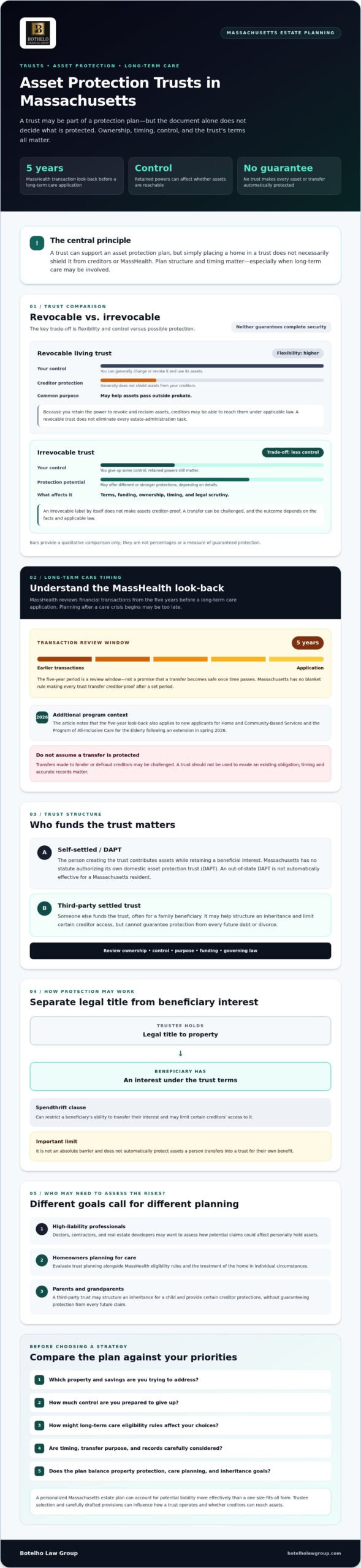
A trust can be part of an asset protection plan, but simply putting your home in one won’t necessarily shield it from creditors or MassHealth. If you’re searching for an asset protection trust MA residents can use to protect a home and savings, timing and structure matter. MassHealth reviews financial transactions from the five years before a long-term care application, so planning after a crisis begins may be too late.
It’s understandable to want to preserve your home, qualify for long-term care assistance without exhausting your savings, and leave an inheritance for your children. The challenge is knowing which trust may help. A revocable living trust may avoid probate, but it generally doesn’t protect assets from creditors or MassHealth. An irrevocable trust may offer different protections, but it requires careful planning and involves important trade-offs.
This guide explains how Massachusetts trust structures work, how they differ from basic estate planning trusts, and what to consider when addressing creditor exposure and long-term care eligibility. Botelho Law Group focuses on Massachusetts estate planning and asset protection, helping families assess their options before a lawsuit, care need, or other crisis narrows them.
Key Takeaways
- An asset protection trust MA plan depends on more than the trust document. Ownership, timing, and control can affect the protection available.
- Trustee selection and carefully drafted provisions can influence how a trust operates and whether creditors can reach assets.
- MassHealth evaluates assets under specific rules. How a home is treated depends on eligibility requirements and individual circumstances.
- Compare trust strategies against your priorities for protecting property, planning for long-term care, and preserving an inheritance.
- A personalized estate plan can account for potential liability more effectively than a one-size-fits-all form.
Understanding an Asset Protection Trust MA Residents Should Know
An asset protection trust is generally an irrevocable trust designed to place assets under a trustee’s legal control and help protect them from certain future creditor claims. Its effectiveness depends on the trust’s terms, how it is funded, and whether the transfer can withstand legal scrutiny. A general Asset-protection trust overview explains concepts such as irrevocability and spendthrift clauses, but Massachusetts residents need advice grounded in the law that applies to their circumstances.
In 2026, reviewing an existing plan is especially relevant for families considering long-term care planning. The five-year MassHealth look-back also applies to new applicants for Home and Community-Based Services and the Program of All-Inclusive Care for the Elderly following an extension in spring 2026. Timing and accurate records matter. A transfer should not be treated as protected simply because it has been made or because time has passed.
The Legal Mechanics of Asset Shielding
A trust can hold title to property through its trustee, separating legal ownership from the beneficiary’s interest. A spendthrift clause can restrict a beneficiary’s ability to transfer that interest and may limit certain creditors’ access to it. It is not an absolute barrier, and it does not automatically protect assets a person transfers into a trust for their own benefit.
The phrase “statute of repose” can suggest a fixed waiting period after which every transfer becomes safe. Massachusetts does not have a blanket rule that makes all trust transfers creditor-proof after a set time. Transfers made to hinder or defraud creditors may be challenged, and the result can depend on the facts and applicable law. Plan before a claim or financial crisis arises, and do not use a trust to evade an existing obligation.
Who Needs an Asset Protection Trust in MA?
An asset protection trust MA strategy may be worth considering for people with distinct risks and goals, including:
- High-liability professionals: Doctors, contractors, and real estate developers may want to assess how potential claims could affect personally held assets.
- Homeowners: Families concerned about long-term care expenses may need to evaluate trust planning alongside MassHealth eligibility rules.
- Parents and grandparents: A third-party trust funded with a family member’s assets may help structure an inheritance for a child, including protections from certain creditor claims. It cannot guarantee protection from every future divorce or debt.
Trusts also differ according to who funds them. A domestic asset protection trust, or DAPT, is self-settled: the person creating it contributes assets while retaining a beneficial interest. Massachusetts has no statute authorizing its own DAPT. An out-of-state DAPT is not automatically effective for a Massachusetts resident. By contrast, a third-party settled trust is funded with someone else’s assets, often for a family beneficiary. Each structure requires careful review of ownership, control, purpose, and the law governing the transfer.
Revocable vs. Irrevocable: Which Trust Actually Protects You?
The difference comes down to ownership and control. A revocable living trust lets you retain the power to change or revoke the trust and use its assets. That flexibility can help with estate administration, but it generally does not shield those assets from your creditors. An irrevocable trust may offer stronger protection because you give up some control, but no trust guarantees complete security. Its terms, funding, and your retained powers all matter.
Revocable Trusts: For Probate, Not Protection
A revocable trust is commonly used to help assets pass outside probate, though it doesn’t eliminate every estate administration task or guarantee a faster, less costly process. Because you can revoke the trust and reclaim its assets, creditors may be able to reach those assets under applicable law. A court may also consider your power to revoke when determining whether property is available to satisfy a judgment. For a basic comparison of estate planning approaches, see simple will versus trust planning in Massachusetts.
Consider a hypothetical example: a Massachusetts homeowner transfers a house into a revocable trust, remains the trustee, and retains full power to revoke it. If a creditor obtains a judgment, the trust label alone may not prevent the creditor from pursuing the homeowner’s interest. The outcome depends on the facts and applicable law. A revocable trust should not be treated as a creditor shield.
Irrevocable Trusts: More Protection, Less Control
With an irrevocable trust, the grantor generally gives up the unilateral right to take assets back. This legal separation can make it harder for a creditor to treat trust property as the grantor’s own, but protection depends on proper design and funding. A power of appointment may allow limited authority to direct who receives trust assets. Retaining too much control, however, can weaken the intended separation. Massachusetts trust law is shaped by statutes and court decisions. The state’s Massachusetts law about trusts resource provides a starting point for understanding that framework.
Irrevocable planning may also affect estate tax exposure. Massachusetts has a $2 million estate tax exemption per person and does not allow portability of a deceased spouse’s unused exemption. A properly structured trust may help address estate tax planning, but tax results depend on the trust terms and the grantor’s circumstances. Asset protection and tax planning are related, but they are not interchangeable goals.
An asset protection trust MA strategy requires balancing access, control, creditor risk, and family priorities. Botelho Law Group focuses on estate planning and asset protection for Massachusetts families. Reviewing the differences between wills and trusts can help clarify questions to raise when assessing your plan.
Protecting Your Home from MassHealth and the 5-Year Look-Back
Long-term care can place substantial pressure on family finances. Research available for 2026 puts average Massachusetts nursing home costs at approximately $12,000 to $14,000 per month. MassHealth eligibility depends on more than the value of a person’s home. For long-term care, the individual asset limit is $2,000, while a home may receive different treatment under eligibility rules, including a 2026 home equity limit of $1,130,000.
MassHealth reviews financial transactions made during the five years, or 60 months, before an application for long-term care. Certain transfers during that period can result in a penalty and delay eligibility. The look-back was also extended in spring 2026 to new applicants for Home and Community-Based Services and the Program of All-Inclusive Care for the Elderly. Waiting until a health crisis is underway may leave too little time for a transfer strategy to work as intended.
Plan Early and Compare Home-Transfer Options
Transferring a home directly to children can mean giving up ownership and control, and the home may become exposed to a child’s creditors or other financial difficulties. A properly drafted irrevocable trust may offer another way to plan, but it requires giving up certain rights and does not guarantee MassHealth eligibility or protection. Tax treatment also depends on the structure. A trust may preserve the possibility of a step-up in basis for heirs in some circumstances, but this outcome is not automatic and should be reviewed as part of the broader estate plan.
For homeowners in Fall River and Bristol County, the 60-month period makes early review particularly important. A life estate is another option to discuss, but it differs from an asset protection trust in how ownership, control, and the right to occupy the home are arranged. Read more about what a life estate means for protecting a Massachusetts home. A general guide to asset protection trusts can explain common trust concepts, but it cannot determine how MassHealth will assess a particular transfer.
MassHealth Estate Recovery and the Home
MassHealth may seek recovery for certain long-term care benefits after a recipient dies, subject to applicable rules and exceptions. Whether a home is exposed can depend on how it was owned, the recipient’s circumstances, and the estate recovery rules that apply. Placing a home in a trust may keep it outside the probate estate, but that alone does not establish that the transfer will qualify for MassHealth purposes or prevent every claim. An asset protection trust MA plan should be evaluated as part of a coordinated strategy for eligibility, estate recovery, taxes, and family goals.
Critical Features of a Robust Massachusetts Asset Protection Plan
A trust’s protective value depends on more than its title. The trustee, distribution terms, recordkeeping, and applicable Massachusetts law all affect how the arrangement works. A carefully drafted asset protection trust MA plan should reflect the grantor’s goals without leaving them with so much control that the trust appears to be an extension of their personal finances.
Choose a Trustee and Distribution Terms Carefully
An independent trustee can help demonstrate that trust assets are managed separately. A family member may understand the beneficiaries’ needs but face conflicts or practical pressures. The right choice depends on the trust’s purpose and the trustee’s ability to follow its terms.
A spendthrift provision generally restricts a beneficiary from assigning their interest and may limit certain creditors’ ability to reach it. It doesn’t stop every claim. A beneficiary’s enforceable right to receive income or principal may also affect creditor access, so discretionary distribution terms can matter. The trust instrument should state who can authorize distributions and under what standards, while preserving the trustee’s obligation to follow the document and applicable law.
Avoid the “Alter Ego” Trap
Trust property should not be treated as a personal piggy bank. Paying personal expenses directly from trust funds, mixing trust and personal money, or disregarding trustee procedures can undermine the separation the trust is meant to establish. These facts may give a creditor grounds to argue that the trust is a sham or that the grantor retains effective ownership. They don’t automatically invalidate a trust, but they can invite costly disputes.
Maintain accurate records and use accounts titled and managed consistently with the trust. Tax reporting depends on the trust’s classification and terms, so separate tax filings aren’t required in every case. A Massachusetts plan must also account for the state’s statutes and case law. A form drafted without regard to local rules may not accomplish its intended purpose.
Coordinate the Trust With Other Protections
A trust is one part of a broader risk management plan. Depending on the circumstances, business owners may discuss whether an LLC could help separate business liabilities from personal assets. An LLC isn’t a substitute for insurance or a trust, and it won’t protect against every claim. Appropriate umbrella insurance may provide another layer of coverage, subject to policy limits, exclusions, and terms.
Planning for incapacity is also distinct from creditor protection. A power of attorney for financial decisions can authorize an agent to act under its terms, but it doesn’t itself shield assets from creditors.
For a plan that accounts for Massachusetts law and your specific exposure, learn about estate planning and asset protection with Botelho Law Group.
Securing Your Legacy with Botelho Law Group
Asset protection planning should reflect your property, family priorities, and exposure to potential claims. Botelho Law Group is headquartered in Fall River and focuses on estate planning and asset protection for homeowners and families in Massachusetts and Rhode Island, including clients from Boston to Providence. Rather than relying on a generic form, the goal is to assess how trust structure, ownership, and timing fit your circumstances.
Liability considerations matter in this work. Botelho Law Group handles personal injury litigation as well as estate planning and asset protection. No trust can prevent every claim or guarantee a particular outcome, but reviewing ownership and potential exposure can help clarify the planning issues to address.
A Holistic Legal Perspective
Families may have planning needs that cross more than one area of law. For international families, immigration matters and estate planning can intersect with questions about family members, assets, and long-term intentions. A firm that also handles immigration and personal injury matters can bring broader context to those discussions while keeping the estate plan focused on the client’s goals.
Botelho Law Group’s approach is focused on understanding family priorities, identifying risks, and considering how Massachusetts rules affect the available options. That local perspective is relevant for homeowners weighing creditor concerns, long-term care planning, and the inheritance they hope to preserve.
Prepare for a Plan Review
To make a discussion about an asset protection trust MA strategy more productive, gather documents that show what you own, how it is titled, and what planning is already in place. Useful materials may include:
- Existing wills, trusts, powers of attorney, and related planning documents
- Deeds and information about mortgages or other property interests
- A general inventory of accounts, investments, and business interests
- Questions about potential claims, long-term care, and intended beneficiaries
These records can help identify gaps and clarify which issues need closer review. A sound plan must be tailored to your situation and comply with applicable law. No document can promise complete protection from creditors, lawsuits, or MassHealth recovery.
If your estate plan has not been reviewed for your current risks and goals, contact Botelho Law Group about estate planning and asset protection.
Protect Your Plans Before Circumstances Change
Effective planning starts with a clear view of what you own, the risks you face, and the legacy you want to preserve. The right trust structure depends on more than choosing between revocable and irrevocable. Control, administration, and your broader estate plan all deserve careful review. Early action can also preserve more options than waiting until a lawsuit or long-term care need is imminent.
An asset protection trust MA strategy should be tailored to your circumstances, not built from a generic form. Botelho Law Group is a Fall River based firm focused on estate planning and asset protection, with personal injury litigation among its other practice areas. Its work centers on Massachusetts homeowners and families weighing local concerns such as creditor exposure, long-term care planning, and the inheritance they hope to preserve.
Gather your current estate planning documents and a basic inventory of your property and concerns, then schedule an asset protection consultation with Botelho Law Group to discuss your goals and potential planning options.
Frequently Asked Questions
Can I still live in my house if I put it in an asset protection trust in MA?
Yes, a trust can be drafted to let you continue living in your home, but the arrangement must clearly define your rights and responsibilities. Transferring title may affect your control over the property, and retaining certain rights can influence creditor protection, MassHealth eligibility, and tax treatment. Before transferring a deed, review the trust terms and your goals with a Massachusetts estate planning attorney.
Is an asset protection trust the same as a “Medicaid Trust”?
Not necessarily. “Medicaid trust” is a general term often used for an irrevocable trust intended to help with long-term care eligibility planning. An asset protection trust may be designed to address creditor exposure or other goals. The labels don’t determine the legal effect: the trust’s terms, funding, timing, and applicable MassHealth rules matter. Ask what a specific trust is designed to accomplish and what control you would give up.
How much money do I need to make an asset protection trust worth it?
There’s no universal asset or income threshold that makes a trust worthwhile. The decision depends on what you own, your exposure to claims, long-term care concerns, family objectives, and the trade-offs involved in transferring control. A homeowner with substantial equity may have different planning needs from someone whose main concern is preserving investments for heirs. Assess the potential benefits and limitations against your full financial and estate plan.
Can a trust protect my assets from a divorce in Massachusetts?
A trust may affect how assets are owned and managed, but it can’t guarantee that property will be excluded from consideration in a Massachusetts divorce. Courts may examine when and why assets were transferred, each spouse’s rights and control, and the facts of the marriage. Transfers made in anticipation of divorce can create serious legal challenges. Trust planning should not be used to conceal assets or defeat a spouse’s lawful claims.
What happens to the assets in the trust after I die?
The trust document controls what happens next. It may direct the trustee to distribute assets to named beneficiaries, hold them in continuing trusts, or distribute them under specified conditions. The trustee generally follows those instructions and applicable law. Review beneficiary designations and the trust together, since some assets may pass under separate contracts rather than through the trust. Clear, updated terms help align distributions with your intentions.
Can I change an irrevocable trust once it is created?
Often, changing an irrevocable trust is more difficult than changing a revocable one, and you may not be able to amend it unilaterally. The trust’s terms and Massachusetts law determine whether modification is possible, potentially through beneficiary agreement or court involvement in appropriate circumstances. Because giving up flexibility is a central feature of irrevocable planning, review the proposed terms, trustee powers, and distribution provisions carefully before transferring assets.
How long does it take for the trust to start protecting my assets from creditors?
There’s no guaranteed waiting period after which assets become immune from creditor claims. Protection depends on the trust’s structure, the transfer, your retained control, and whether a claim already exists or is reasonably anticipated. A transfer intended to hinder or defraud creditors may be challenged. Creating a trust after a lawsuit or financial problem arises can therefore fail to provide the protection you expect. Plan before a crisis, with legal advice.
Does an asset protection trust help me avoid Massachusetts estate taxes?
A trust may be part of estate tax planning, but it doesn’t automatically eliminate Massachusetts estate tax. In 2026, the state exemption is $2 million per person, and Massachusetts doesn’t allow a surviving spouse to use a deceased spouse’s unused exemption through portability. Whether trust assets are included in a taxable estate depends on the structure and rights retained. Coordinate trust planning with individualized tax advice before making transfers.