
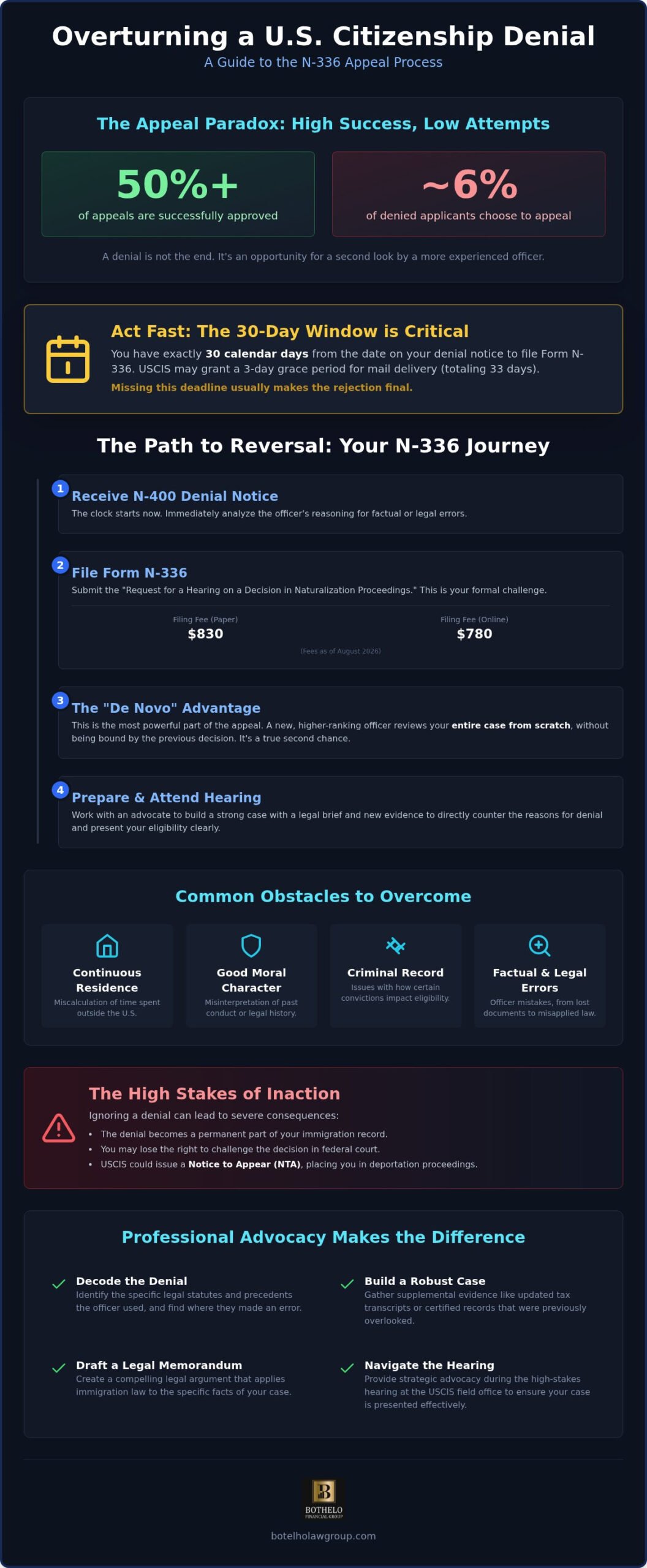
Did you know that while over 50% of citizenship denial appeals are successfully approved, only about 6% of applicants actually choose to fight back? Receiving a denial notice for your naturalization is a crushing blow, especially when you’ve followed every rule and waited years for your moment. It’s natural to feel a sense of panic about your residency or the looming 30-day deadline to respond. However, a denial isn’t a final verdict; it’s a procedural opening for a fresh, comprehensive review of your case. Partnering with an experienced N-400 denial appeal lawyer allows you to challenge USCIS errors and present your qualifications to a higher-ranking officer.
We understand the frustration of facing bureaucratic delays and the fear that your American dream is slipping away. You’ve worked too hard to let a technicality or a mistaken officer’s decision stand in your way. This guide provides the exact legal roadmap you need to navigate the N-336 appeal process and secure your U.S. citizenship. We’ll break down the critical filing deadlines, current 2026 fee structures, and the strategic advantages of requesting a formal hearing to overturn your rejection once and for all.
Key Takeaways
- Identify the critical 30-day deadline to ensure your citizenship denial does not become a permanent legal barrier.
- Understand the power of a “De Novo” review, which allows a higher-ranking officer to evaluate your case with a fresh perspective.
- Evaluate the cost and timeline differences between filing an N-336 appeal and submitting an entirely new naturalization application.
- Learn how an experienced N-400 denial appeal lawyer prepares the specific documentation required to overcome residence and moral character rejections.
- Discover the strategic advantages of professional advocacy when navigating high-stakes hearings at local USCIS field offices.
Understanding Your N-400 Denial: Why the 30-Day Window Matters
Receiving a Form N-646 denial notice triggers an immediate, high-stakes countdown. You have exactly 30 calendar days from the date on the letter to file Form N-336 and request a hearing. If the decision arrived by mail, USCIS allows a three-day grace period, bringing the total to 33 days. Missing this window usually makes the rejection final. When this happens, you lose the chance for a “De Novo” review by a superior officer. In 2025, approximately 11% of naturalization applications were denied, yet many of these rejections were based on errors that could’ve been overturned with timely action. Engaging an N-400 denial appeal lawyer immediately is the most effective way to protect your rights during this narrow window.
Factual vs. Legal Errors in USCIS Decisions
Officers often work under heavy caseloads, which leads to clerical and interpretative mistakes. Factual errors frequently involve miscalculating travel dates or claiming a candidate failed to provide tax transcripts that were actually included in the file. Legal errors are more nuanced. They happen when an officer misinterprets the statutory period for residency or applies a standard for “Good Moral Character” that exceeds legal requirements. An N-400 denial appeal lawyer reviews the denial letter to “decode” the specific legal statutes the officer cited. We look for instances where the officer ignored binding precedents or failed to consider mitigating evidence. This level of scrutiny is necessary because the appeal hearing is your opportunity to prove the law is on your side.
The Consequences of an Unchallenged Denial
Ignoring a denial letter can have severe long-term impacts on your legal status. If USCIS believes the denial is based on a ground that also makes you deportable, such as certain criminal convictions or suspected fraud, they may issue a Notice to Appear (NTA) in immigration court. This shifts your case from a citizenship application to a deportation defense. Beyond the threat of removal, failing to appeal means you haven’t “exhausted administrative remedies.” This is a legal requirement that must be met before you can seek relief in federal court. By fighting the denial now, you protect your record and keep the path toward U.S. citizenship and naturalization open. As a Fall River immigration lawyer, we ensure your response is filed with the precision required to stop these consequences before they escalate.
The N-336 Process: Requesting a Hearing on Your Naturalization Decision
The N-336 process is a specialized administrative appeal that allows you to challenge a naturalization denial directly within USCIS. Unlike a standard judicial appeal that might focus solely on procedural errors, the Form N-336 request for a hearing provides a path to reverse an incorrect decision through a comprehensive re-evaluation. Data from fiscal year 2025 reveals a striking reality: while only about 6% of denied applicants file an appeal, over 50% of those who do are ultimately approved. This high success rate highlights why working with an N-400 denial appeal lawyer is a critical step for those who refuse to accept a flawed rejection. It’s a chance to move your case from a lower-level officer to a more experienced supervisor who can apply the law with greater precision.
Step-by-Step: Filing Your N-336 Appeal
Form N-336 is a formal request for a fresh review of your naturalization application conducted by a USCIS officer of a higher grade than the one who issued your denial. Simply submitting the form is rarely enough to secure an approval. Success requires a robust evidentiary package that addresses the specific grounds for rejection mentioned in your denial letter. You must gather supplemental documentation that may have been overlooked or was unavailable during your initial interview, such as certified court records, updated tax transcripts, or detailed proof of physical presence. An N-400 denial appeal lawyer will draft a comprehensive legal memorandum that applies current immigration statutes to your specific facts. As of August 2026, the administrative filing fee for Form N-336 is $830 for paper filings or $780 for online submissions. Ensuring your package is complete and the fee is correct prevents further procedural delays.
The “De Novo” Hearing Advantage
The most powerful aspect of this process is the “De Novo” review. This legal standard means the new officer must examine your entire case from scratch without being bound by the previous officer’s conclusions. It’s effectively a “fresh start” where you can clarify previous misunderstandings or provide context for complex issues like residency gaps or minor legal encounters. During the hearing, usually held at a local field office like the one in Lawrence or Boston for Massachusetts residents, you have the opportunity to testify again. If your denial was based on failing the English or Civics tests, this hearing allows for a re-examination under more controlled, professionally prepared circumstances. This second chance is often the difference between a permanent rejection and taking the oath of allegiance. If you’re unsure how to present your testimony, consulting with a dedicated citizenship advocate can help you prepare for the specific questions a high-level officer is likely to ask.
Appeal vs. Reapply: Which Path is Right for You?
Choosing between filing an appeal and starting a fresh application is a strategic decision that dictates your legal standing for years. Many applicants assume that reapplying is the simpler path, but this isn’t always true. If you reapply, you essentially abandon your original filing date and start the entire process from the beginning. Conversely, an appeal keeps your original case alive. An N-400 denial appeal lawyer evaluates the specific reason for your rejection to determine which path offers the highest probability of success. As of August 2026, the cost difference is relatively narrow. Filing Form N-336 online costs $780, while a new N-400 online application costs $710. Because the financial gap is only $70, your choice should be based on legal strategy and timeline efficiency rather than just the filing fee.
The USCIS appeals process is designed to correct errors without forcing you to wait in the standard application queue again. If your case involves a complex legal dispute, an appeal is often the only way to preserve your residency status and priority date. When the Botelho Law Group reviews a denial, we look for “fixable” versus “statutory” issues. A fixable issue might be better served by a new application, while a statutory disagreement requires the authoritative intervention of an appeal hearing. Many applicants are also unaware that working with an immigration lawyer for all 50 states means you aren’t limited to local counsel and can access specialized naturalization expertise regardless of where you currently reside.
When to File an N-336 Appeal
You should file an N-336 if the USCIS officer made a clear legal mistake regarding your continuous residence or physical presence. This is common in cases where the officer misinterpreted travel records or ignored evidence of a maintained home in the U.S. An appeal is also the superior choice for complex “Good Moral Character” (GMC) issues that require a detailed legal brief to resolve. If you’ve been denied based on a misapplication of the law, an N-400 denial appeal lawyer can force a superior officer to correct the record. This path is essential if you need to protect your original priority date for benefits that depend on the length of your citizenship.
When to Simply Reapply (New N-400)
Reapplying with a new Form N-400 is often the more efficient choice if your denial was based on failing the English or Civics tests after two attempts. In these instances, there is no “legal error” to argue; you simply need a new opportunity to demonstrate your knowledge. It’s also a pragmatic choice if the denial was due to a temporary lack of GMC, such as a recent tax debt that has since been fully paid. If “waiting out” a specific residence requirement is more cost-effective than a protracted legal battle, starting over allows you to present a clean, updated record that meets all current 2026 eligibility standards without the need for a hearing. Before deciding which route to take, reviewing a comprehensive guide on how to apply for US citizenship can help you understand the full eligibility requirements you’ll need to satisfy under either path.
Overcoming Specific Denial Grounds: Residence, Character, and Criminality
The path to citizenship often stalls due to three primary legal hurdles: continuous residence, physical presence, and good moral character. These aren’t simple administrative checkboxes; they’re complex legal standards that USCIS officers interpret with significant discretion. When an officer denies your application on these grounds, they’re essentially challenging your eligibility to be part of the American fabric. An N-400 denial appeal lawyer specializes in dismantling these challenges by presenting a superior evidentiary record that aligns with current 2026 adjudication standards. We don’t just ask for a second chance; we provide a structured legal argument that proves your eligibility under the law.
Fixing Continuous Residence and Physical Presence Gaps
USCIS looks for “abandonment of residency” during trips over 6 months, which creates a rebuttable presumption that you’ve broken your continuous residence. To overcome this during an appeal, you must demonstrate that you never intended to relinquish your U.S. home. This requires a meticulous collection of evidence from the statutory period, including active leases, mortgage statements, and certified tax returns. We also look for employment records that show your job was waiting for you or that your trip was temporary in nature. If you stayed abroad for more than six months but less than a year, we argue that your ties to the United States remained primary, ensuring your residency remains intact for the “De Novo” review.
Defending Your Moral Character
Good Moral Character (GMC) denials are often the most difficult to challenge because they’re based on subjective evaluations. Officers frequently cite “crimes involving moral turpitude” (CIMTs) or minor legal infractions to justify a rejection. It’s a common misconception that an expunged record is invisible to USCIS; in reality, immigration law still considers these as convictions for GMC purposes. To fight back, you must document extensive rehabilitation through community service, stable employment history, and professional character references. The 2026 USCIS guidelines place a heavier emphasis on a “totality of the circumstances” approach. This means we must present enough “positive factors” to legally outweigh any negative record. Using our Good Moral Character Checklist helps you identify and organize the specific proofs needed to rebuild your case. If you’re facing a character-based rejection, you need a strategist who can frame your history in the most favorable legal light. Consult with an experienced immigration advocate at Botelho Law Group to begin drafting your defense for the N-336 hearing.
Why a Focused Advocate is Essential for Your Citizenship Hearing
The N-336 hearing is not a standard interview; it is a formal legal proceeding that requires a specific set of skills. Many applicants mistakenly hire “form fillers” who lack the litigation experience necessary to challenge a supervisor’s legal determination. A naturalization litigator, however, treats your appeal as a case to be won through superior legal arguments and evidentiary precision. At this stage, you aren’t just answering questions; you’re refuting a legal conclusion. An N-400 denial appeal lawyer provides the strategic oversight needed to navigate the unique dynamics of local Massachusetts field offices. Whether your hearing is scheduled at the JFK Federal Building in Boston or the Lawrence field office, understanding the specific tendencies and procedural expectations of regional supervisors is a distinct advantage.
The Botelho Law Group Approach
Our firm operates on a “protective advocacy” model. We recognize that a citizenship denial is often a symptom of underlying legal complexities that require a holistic solution. We don’t just look at the N-400; we examine the entirety of your legal standing. This includes managing sensitive issues like past criminal records or ensuring your assets and autonomy are protected through estate planning and power of attorney. By addressing these secondary factors, we prevent USCIS from using them as leverage during your hearing. Our team combines the reach of a nationwide federal practice with the deep, localized knowledge of our Fall River headquarters. This allows us to represent clients across all 50 states while maintaining a focused, individual approach for every Massachusetts resident.
Securing Your Future as a U.S. Citizen
The primary goal of a focused advocate is to ensure your appeal results in an approval rather than further immigration scrutiny. A poorly handled appeal can inadvertently highlight issues that lead to removal proceedings or the loss of permanent residency. By rigorously preparing your testimony and documentation, we mitigate these risks and position you for a successful outcome. Once the N-336 is approved, the officer will vacate the previous denial and move your case toward the final step: the Oath of Allegiance. This transition from a rejected applicant to a sworn U.S. citizen is the result of methodical preparation and relentless advocacy. Don’t leave your status to chance when the stakes involve your ability to remain in the country you call home. Schedule a consultation with an N-400 denial appeal lawyer today to begin the process of overturning your rejection and securing your future.
Secure Your Path to Citizenship Through Strategic Advocacy
An N-400 denial is a significant setback, but it’s not the end of your journey toward U.S. citizenship. By acting within the strict 30-day window and utilizing the N-336 hearing process, you can secure a fresh review of your application by a superior officer. Whether you’re facing complex residency gaps or challenges to your moral character, having a seasoned N-400 denial appeal lawyer ensures your case is presented with legal precision and protective advocacy. You deserve a representative who understands the high stakes of your naturalization goals.
At Botelho Law Group, we bring over 40 years of combined legal experience to every case. Our team provides multilingual support for Portuguese and Spanish speakers, ensuring you feel confident and informed throughout the process. With extensive federal court litigation experience, we’re prepared to handle even the most challenging naturalization disputes. Don’t let a procedural error or officer mistake derail your American dream. Request a Case Evaluation for Your N-400 Appeal today. You’ve worked hard for your future in this country; we’re here to help you protect it.
Frequently Asked Questions
How long do I have to appeal an N-400 denial in 2026?
You have exactly 30 calendar days from the date of your denial notice to file an appeal. If you received the notice by mail, this window extends to 33 days. Missing this deadline makes the denial permanent and prevents you from seeking further administrative relief. It’s vital to act quickly to preserve your rights and ensure your N-336 request is filed correctly within this narrow timeframe.
Can I provide new evidence during an N-336 appeal hearing?
Yes, you can and should provide new evidence during your hearing. Because the N-336 process involves a De Novo review, the officer examines your eligibility from scratch. This allows an N-400 denial appeal lawyer to introduce supplemental documentation that was missing or unavailable during your first interview. Providing updated tax records, travel logs, or proof of residence can directly address the officer’s previous concerns and clarify the record.
What is the difference between an N-336 hearing and a federal court review?
An N-336 hearing is an administrative appeal conducted internally by a higher-ranking USCIS officer. In contrast, a federal court review is a judicial proceeding where a judge evaluates your case. You must typically exhaust the N-336 process before you’re eligible to file a petition in U.S. District Court. The administrative hearing is generally faster and less expensive than pursuing litigation in the federal court system.
Will I be deported if my N-400 naturalization application is denied?
A naturalization denial does not automatically lead to deportation. In most cases, you simply remain a lawful permanent resident with your existing green card. However, if the denial was based on criminal activity or fraud that also triggers deportability, USCIS may issue a Notice to Appear in immigration court. This is why professional advocacy is essential to ensure your appeal doesn’t inadvertently escalate your case to removal proceedings.
Can I reapply for citizenship while an N-336 appeal is still pending?
You can technically file a new N-400 while an appeal is pending, but it often leads to administrative confusion. USCIS may consolidate the files or put one on hold, which can delay your outcome. Generally, it’s more effective to choose one path based on the nature of the denial. An N-400 denial appeal lawyer can help you decide whether the speed of a new application outweighs the strategic benefits of an administrative hearing.
Do I need to take the English and Civics test again at an appeal hearing?
You only need to retake the English and Civics portions if they were the specific grounds for your denial. If you passed these tests during your initial interview but were rejected for other reasons like residency, you won’t be tested again. However, if you failed the tests twice, the N-336 hearing provides one final opportunity to demonstrate your proficiency before a different officer who can re-evaluate your performance.
What happens if my N-336 appeal is also denied by USCIS?
If your N-336 appeal is denied, the administrative process within USCIS is considered exhausted. At this point, your primary remaining option is to file a petition for a hearing on your naturalization in the local U.S. District Court. This judicial review allows a federal judge to make a fresh determination on your eligibility. Alternatively, depending on the denial grounds, you may choose to wait for a statutory period to pass and reapply later.
Is an N-400 denial appeal lawyer necessary if the mistake was a simple typo?
Even simple typos can have significant legal consequences if they involve dates of entry or criminal history. While a clerical error might seem minor, a lawyer ensures the correction is officially recognized without creating new inconsistencies in your file. Professional oversight prevents a simple fix from accidentally triggering a deeper investigation into your continuous residence or moral character, which could lead to more complex legal issues.