
Your naturalization application isn’t just a form; it’s a final legal audit of your entire immigration history. While many believe that understanding how to apply for US citizenship is as simple as filling out paperwork, the reality is that any oversight can jeopardize your residency. You’ve worked hard to build a life here, and the fear that a single travel record or a misunderstanding of “Good Moral Character” could lead to a denial is a heavy burden to carry.
We understand that this process feels like a high-stakes test of your past and your future. That’s why we’ve developed this attorney-vetted roadmap to provide the clarity and protection you need. This guide breaks down the N-400 process, explains how to meet strict eligibility requirements, and offers strategies to secure your status with confidence. We’ll walk through the specific steps of the 2026 legal landscape, from the initial filing to the final oath, ensuring you’re prepared for every interview question and civics requirement.
Key Takeaways
- Determine your eligibility by analyzing the standard five-year residency rule versus the accelerated three-year path for spouses of U.S. citizens.
- Learn how to apply for US citizenship through a methodical process that begins with a comprehensive legal audit of your entire immigration history.
- Navigate the Good Moral Character requirement by understanding the statutory period and how to avoid both permanent bars and discretionary denials.
- Prepare for the English proficiency and civics tests with specific insights into the interview process at local field offices in Boston and Providence.
- Secure your future by identifying red flags early and organizing your evidence to minimize the chance of a Request for Evidence from USCIS.
Eligibility Requirements for U.S. Citizenship in 2026
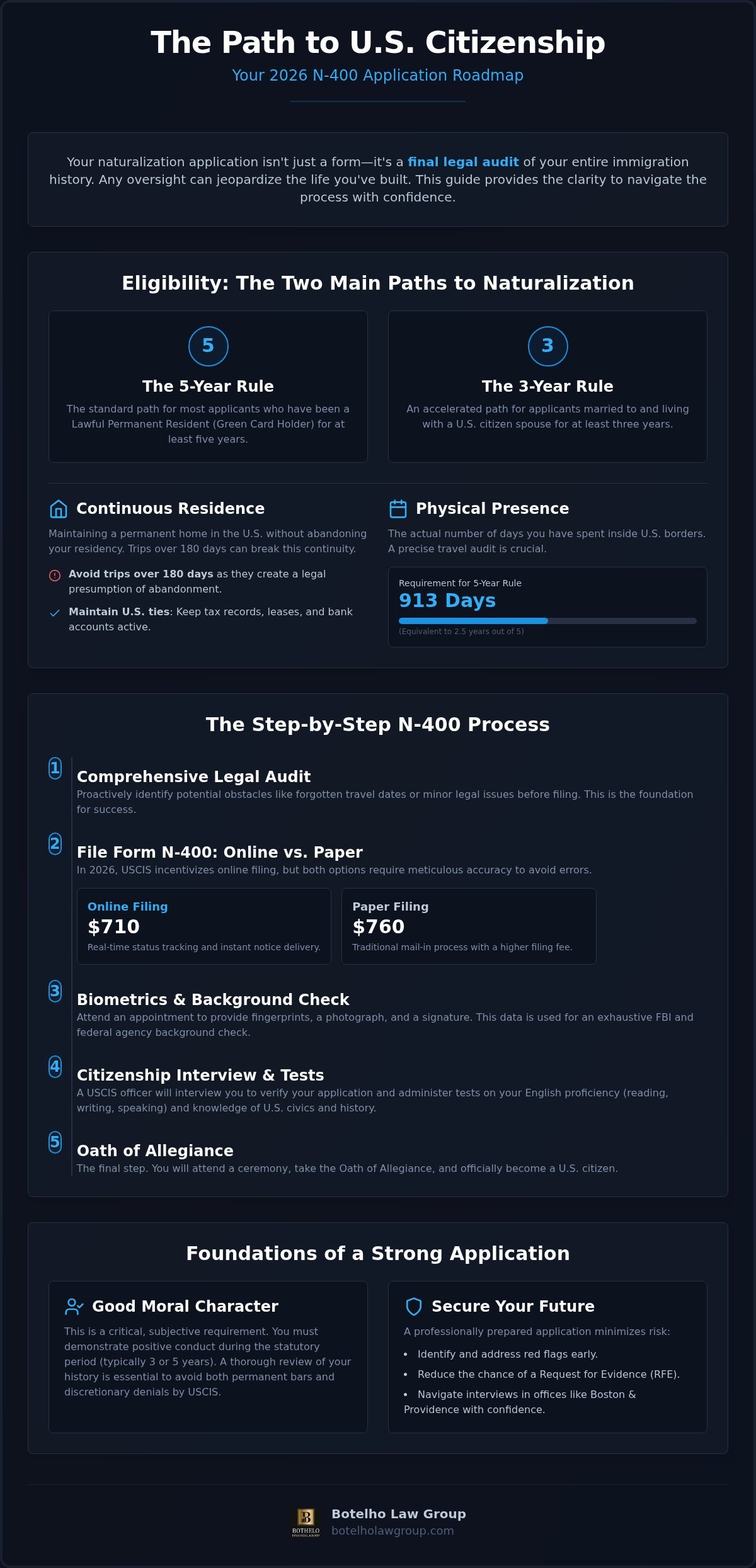
Before you learn how to apply for US citizenship, you must confirm you meet the strict eligibility criteria set by USCIS for the 2026 filing year. The foundation of these rules rests on U.S. nationality law, which dictates who qualifies for naturalization. At a minimum, you must be at least 18 years old and have been a Lawful Permanent Resident for a specific duration. Most applicants fall under the 5-Year Rule, meaning they’ve held a Green Card for five years before filing. If you’re married to a U.S. citizen, you may qualify for the 3-Year Rule. You also need to demonstrate basic English proficiency and a knowledge of U.S. history, unless you qualify for an age-based waiver.
Continuous Residence and Physical Presence
Many applicants confuse these two distinct legal concepts. Continuous residence refers to the total time you’ve maintained a permanent home in the U.S. since becoming a permanent resident. Physical presence is the actual number of days you’ve spent inside the country’s borders. For the 5-year rule, you generally need 913 days of physical presence. If you’re out of the country for more than six months in a single trip, you risk breaking your residency chain. This creates a legal presumption that you’ve abandoned your residence. We recommend a precise travel audit for anyone with frequent international trips to ensure their travel math is bulletproof.
To maintain your eligibility, follow these travel guidelines:
- Avoid trips over 180 days: These almost always disrupt continuous residence.
- Track every departure: USCIS scrutinizes the exact dates of entry and exit.
- Maintain U.S. ties: Keep your tax records, lease agreements, and bank accounts active while traveling.
Special Eligibility: Marriage and Military Service
If you’re married to a U.S. citizen, the path is faster but requires substantial documentation. You must prove you’ve lived in marital union with your spouse for at least three years before applying. This means more than just being legally married; you must reside together in the same household. Military service members have even more streamlined options. Active-duty members and certain veterans can often apply without meeting standard residency requirements. There are also specific exceptions for individuals working abroad for the U.S. government or recognized research institutions. Understanding these nuances is critical when determining how to apply for US citizenship without unnecessary delays. We focus on these complex exceptions to ensure no applicant misses an opportunity for an accelerated path.
The Step-by-Step N-400 Application Process
Navigating the naturalization journey requires a disciplined, methodical approach. While the process appears linear, each stage serves as a critical checkpoint where USCIS evaluates your fitness for citizenship. Success starts with a comprehensive legal audit of your entire immigration history before you ever sign a document. This proactive strategy identifies potential obstacles, such as forgotten travel dates or minor legal encounters, that could derail your case. Once your history is verified, you move to the preparation and filing of Form N-400. This is followed by a biometrics appointment, a high-stakes interview featuring English and civics tests, and finally, the Oath of Allegiance ceremony.
Filing Your Form N-400: Online vs. Paper
Shortly after filing, you’ll receive a notice to attend a biometrics appointment at a local Application Support Center. During this visit, USCIS captures your fingerprints, photograph, and signature. This isn’t just a routine clerical task. These records are used to run an exhaustive background check through FBI databases and other federal agencies. This audit covers your entire criminal and immigration history, not just the period you’ve lived in the U.S. If discrepancies arise, USCIS may issue a Request for Evidence (RFE), which demands immediate and precise legal clarification. For a more detailed overview of these procedural steps, you can consult the USCIS Guide to Naturalization.
Understanding how to apply for US citizenship involves more than just submitting a form; it’s about preparing a defense for your residency. When you’re ready to move forward with the support of a dedicated advocate, our team is here to ensure your application is bulletproof. To protect your status and secure your future, consider seeking expert naturalization representation before you file.
Good Moral Character: The Foundation of Your Application
Good Moral Character (GMC) is the most subjective and potentially dangerous part of the naturalization process. While you are researching how to apply for US citizenship, you must recognize that USCIS evaluates your character during a specific “statutory period.” For most, this covers the five years immediately preceding your application. However, an officer’s discretion allows them to look beyond this window if your past conduct reflects poorly on your current character. This holistic review ensures that an applicant’s behavior aligns with the standards of the average citizen in their community.
Understanding the distinction between permanent bars and discretionary denials is vital. Permanent bars, such as a conviction for murder or an aggravated felony, result in an automatic rejection. Discretionary denials are more nuanced, involving issues like multiple DUIs, illegal gambling, or failing to tell the truth during an interview. These decisions often hinge on how your evidence is presented and argued. To navigate these complexities, see our good moral character for citizenship lawyer checklist for more details on what officers look for during this high-stakes evaluation.
Criminal Records and Naturalization Risks
A common misconception is that sealed or expunged records don’t need to be disclosed. This is a critical error. Federal authorities have access to your entire history, and failing to list a prior arrest on Form N-400, Application for Naturalization is often viewed as “false testimony” to gain an immigration benefit. This can lead to an immediate denial and, in severe cases, trigger removal proceedings. A naturalization attorney acts as your protective advocate, reviewing your records to determine if filing now is safe or if you risk losing your residency status entirely.
Addressing Taxes, Child Support, and Selective Service
Your financial and civic responsibilities are just as important as your criminal record. USCIS requires proof that you’ve filed all required federal, state, and local tax returns. If you owe back taxes, you must provide a signed agreement from the IRS showing you’re on a payment plan and making timely payments. Similarly, failing to pay court-ordered child support is a frequent cause for GMC denials. Men who lived in the U.S. between the ages of 18 and 26 must also demonstrate they registered for the Selective Service. If you didn’t register, you’ll need to provide a “Status Information Letter” and a sworn statement explaining why. When determining how to apply for US citizenship, addressing these civic obligations early prevents an officer from questioning your commitment to the laws of the United States.
Mastering the Citizenship Interview and Civics Test
Entering the USCIS Field Office in Boston or Providence marks the final, most intense phase of your naturalization journey. This is not merely a formality; it’s a formal examination conducted under oath. The officer will evaluate your English proficiency through three distinct components: speaking, reading, and writing. You must demonstrate an ability to understand and respond to ordinary usage of the English language. Additionally, the 2026 Civics Test requires you to answer at least six out of ten questions correctly from a predetermined list of 100. While these tests are standardized, the atmosphere of the interview remains high-pressure, requiring absolute composure and precision.
The most critical portion of the encounter is the “Review of the Application.” The officer will meticulously cross-reference your verbal answers with the data provided on your N-400. They’re trained to identify inconsistencies regarding your travel history, employment, and residential records. Any deviation from your written submission can be interpreted as a lack of candor, which directly impacts your Good Moral Character evaluation. Understanding how to apply for US citizenship means recognizing that your interview performance is just as important as the documents you filed months earlier.
Interview Preparation Strategies
Preparation must go beyond memorizing history facts. You must be ready to discuss sensitive topics, such as past legal issues or extended trips abroad, without hesitation or contradiction. Consistency is your best defense against an aggressive line of questioning. We provide focused advocacy by conducting rigorous practice sessions to ensure your testimony is accurate and confident. The value of a mock interview with a citizenship interview preparation attorney can’t be overstated; it identifies weaknesses in your delivery before you face a federal officer.
Exemptions and Accommodations
Certain applicants may qualify for exceptions to the standard testing requirements based on age and length of residency. The “50/20” rule applies to those over age 50 who have lived as permanent residents for 20 years, while the “55/15” rule applies to those over 55 with 15 years of residency. These individuals may take the civics test in their native language with an interpreter. Applicants with documented physical or developmental disabilities can also submit Form N-648 for a medical waiver. This legal tool allows for reasonable accommodations or a full exemption from the English and civics requirements when a medical condition prevents compliance.
Your future status depends on a successful interview outcome. Don’t leave your performance to chance or rely on guesswork. If you want to ensure you’re fully prepared for the scrutiny of a USCIS officer, contact us for professional naturalization interview representation today.
Why Legal Representation is Vital for Your American Dream
While software-based services often market themselves as a cheaper alternative to legal counsel, they cannot advocate for you when a crisis arises. These platforms typically verify that your forms are complete, but they lack the strategic foresight to identify “red flags” that trigger a denial. An attorney’s role goes far beyond clerical accuracy; it involves conducting a deep dive into your history to uncover issues like inconsistent testimony from prior visa applications or minor legal encounters that might be interpreted as a lack of good moral character. When you are determining how to apply for US citizenship, the goal isn’t just to file a form, but to ensure that your application is resilient enough to withstand a federal audit.
A primary benefit of legal representation is the strategic organization of evidence. If your travel history is complex or your tax records show past liabilities, a simple submission of documents is rarely enough. We organize your evidence into a structured legal brief that addresses potential USCIS concerns before they become grounds for a Request for Evidence (RFE). During the interview itself, your attorney’s presence serves as a safeguard. We ensure that the officer adheres to USCIS protocols, remains within the scope of the law, and treats you with the professional respect your residency deserves.
The stakes are highest if your application faces a rejection. A denial doesn’t just end your citizenship path; it can sometimes lead to the loss of your Green Card. In these high-stakes scenarios, an N-400 denial appeal lawyer can save your case by filing a Form N-336. This request for a hearing allows us to argue your case before a senior officer, providing a vital opportunity to correct legal errors or present new evidence that was previously overlooked.
Botelho Law Group: Your Local Fall River Advocate
Our firm brings a specialized, results-oriented approach to naturalization cases throughout Massachusetts and Rhode Island. We maintain a deep familiarity with the specific practices of the Boston and Providence USCIS field offices, giving our clients a distinct advantage. Because we also specialize in asset protection and family-based petitions, we understand how your citizenship status impacts your broader legal and financial security. This multidisciplinary expertise ensures that your naturalization isn’t handled in a vacuum but as a critical part of your family’s long-term stability. Many applicants don’t realize they can work with an immigration lawyer for all 50 states, meaning you aren’t limited to local counsel when seeking the most specialized representation for your case.
Taking the Next Step
Securing your future as a U.S. citizen requires more than just knowing how to apply for US citizenship; it requires a dedicated strategist. We invite you to schedule a consultation where we will review your eligibility, identify potential risks, and outline a clear path forward. Professional case management provides the peace of mind that your status is protected at every stage. Contact Botelho Law Group today to start your path to U.S. citizenship with the support of a focused advocate.
Securing Your Future as a United States Citizen
Naturalization is a transformative legal milestone that demands absolute precision. This roadmap has outlined why a successful application relies on a meticulous audit of your immigration history and a proactive defense of your good moral character. Whether you’re navigating the standard five-year residency rule or an accelerated path through marriage, the process remains a rigorous test of your past conduct and your commitment to the laws of this nation. Understanding how to apply for US citizenship is only the first step; protecting your residency during the process is what ensures your ultimate success.
Our firm provides expert representation for applicants across all 50 states, specializing in complex cases and N-400 denial appeals. With our multilingual legal team in Fall River, MA, we act as your dedicated advocate from the initial filing to the final oath. Don’t leave your status to chance when you can have a seasoned strategist by your side. Secure Your American Dream: Consult with a Fall River Citizenship Attorney Today. Your path to citizenship is a high-stakes journey, and we’re here to ensure you reach the finish line with confidence.
Frequently Asked Questions
How much does it cost to apply for U.S. citizenship in 2026?
As of August 2026, the standard fee for filing Form N-400 online is $710, while paper filings cost $760. This amount includes the biometrics service fee. Applicants with household incomes between 150% and 400% of the Federal Poverty Guidelines may qualify for a reduced fee of $380. Those below 150% or receiving means-tested benefits can request a full fee waiver. Military members and certain veterans are often exempt from these costs entirely.
Can I apply for citizenship if I have a criminal record?
You can apply with a criminal record, but absolute disclosure is mandatory to avoid a “false testimony” denial. Certain offenses, like aggravated felonies, create a permanent bar to citizenship. Other infractions may lead to a discretionary denial based on Good Moral Character standards. Before deciding how to apply for US citizenship with a record, a legal audit is essential to ensure you don’t inadvertently trigger removal proceedings or jeopardize your current residency status.
How long does the naturalization process take from start to finish?
The naturalization process generally takes between 7 and 17 months from the date of filing to the Oath of Allegiance. This timeframe varies significantly based on the caseload of your local field office, such as those in Boston or Providence. While the national median processing time is approximately 5 to 6 months, local backlogs often extend the duration. Monitoring your USCIS online account provides the most accurate real-time estimate for your specific case.
What happens if I fail the civics or English test during my interview?
If you fail any portion of the English or civics test, USCIS provides one additional opportunity to be re-tested. This second interview typically occurs between 60 and 90 days after your initial appointment. You will only be re-examined on the specific portion you failed. If you fail the re-test, your application will be denied, and you must file a new Form N-400 and pay the required fees again to restart the process.
Do I need an attorney to apply for U.S. citizenship?
While legal representation isn’t a requirement, an attorney is vital for identifying “red flags” that lead to denials. Self-filing carries significant risks if you have complex travel history, prior arrests, or tax liabilities. A dedicated advocate ensures your evidence is strategically organized and represents you during the interview to protect your rights. This professional oversight minimizes the chance of receiving a Request for Evidence and provides a defense for your residency status. Because federal law permits an immigration lawyer for all 50 states to represent clients nationwide, you are not limited to practitioners in your local area when seeking specialized expertise.
Can I travel outside the U.S. while my N-400 application is pending?
You may travel abroad while your application is pending, but you must continue to meet all residency requirements. Ensure your total time outside the U.S. doesn’t exceed the physical presence threshold or break your continuous residence. You must also be present for your biometrics and interview appointments. Missing a scheduled USCIS notice can result in the administrative closure of your case, so it’s critical to have a reliable way to receive government correspondence.
What should I do if my N-400 application is denied?
If your application is denied, you have the right to request a hearing before a senior immigration officer by filing Form N-336. This administrative appeal must be filed within 30 days of receiving the denial notice. During this hearing, your attorney can present new evidence or argue that the initial decision was legally incorrect. Understanding how to apply for US citizenship successfully after a denial requires a precise strategy to address the specific reasons for the rejection.
How do I update my address with USCIS after filing my application?
You are legally required to notify USCIS of any address change within 10 days of moving by filing Form AR-11. If you filed your application online, you can update your information directly through your USCIS online account. Failing to update your address can lead to missed interview notices or biometrics appointments, which often results in an automatic denial. Maintaining accurate contact information is a critical component of managing your naturalization case effectively.