
Imagine spending decades paying off your mortgage only to see your family home sold to satisfy a single year of nursing home expenses. For many, this isn’t just a fear; it’s a mathematical reality under current state regulations. Most homeowners agree that the prospect of losing a lifetime of equity to long-term care costs is unacceptable. Securing an irrevocable trust Massachusetts residents can rely on is the most effective way to prevent this outcome while ensuring your legacy remains intact.
This guide promises to demystify the legal strategies required to shield your property from creditors and qualify for MassHealth without exhausting your life savings. We’ll provide a structured breakdown of the five-year lookback rule, the methods for avoiding the Massachusetts probate process, and how to maintain a sense of security while protecting your assets. By the end of this article, you’ll understand exactly how to use a trust as a strategic defensive perimeter for your home in 2026. We’ll move logically through the complexities of asset preservation to give you the clarity needed to act decisively.
Key Takeaways
- Understand the legal distinction between personal ownership and trust ownership to create a strategic barrier for your family assets.
- Recognize why an irrevocable trust Massachusetts plan is necessary for creditor protection, whereas a revocable trust remains vulnerable to long-term care liens.
- Determine how to properly navigate the 60-month MassHealth lookback window to secure your eligibility for benefits without losing your home.
- Learn the critical steps for funding your trust to ensure your property and savings are legally transferred into the protective entity.
- Evaluate the essential responsibilities of a trustee to choose a representative who can manage your estate with precision and legal compliance.
What is an Irrevocable Trust in Massachusetts?
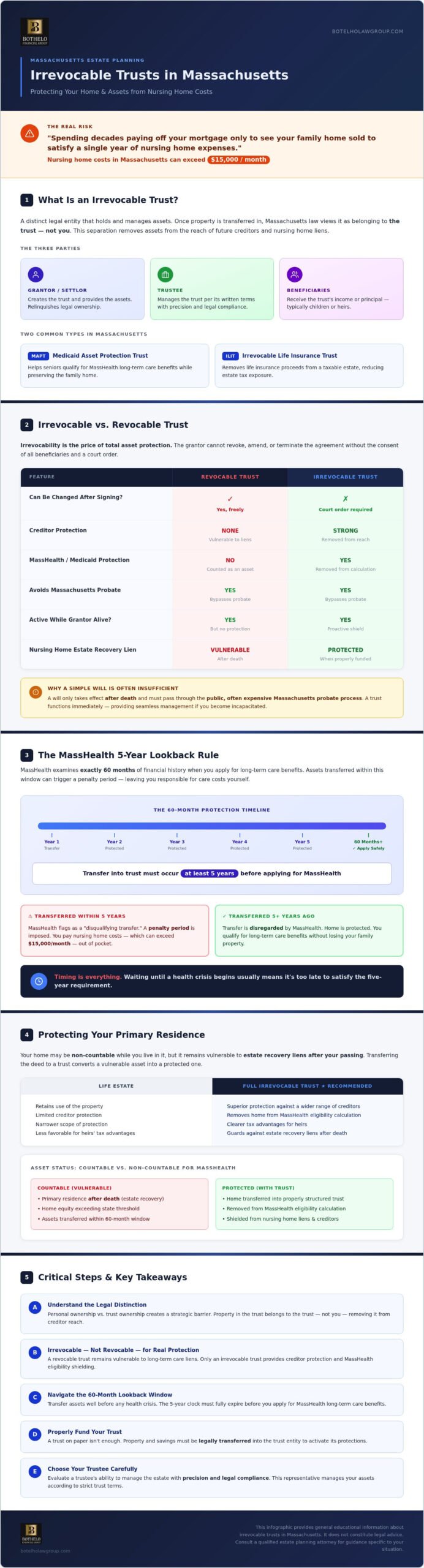
An irrevocable trust is a distinct legal entity created to hold and manage assets for the benefit of specific individuals or organizations. Unlike a standard bank account or a deed in your own name, once you transfer property into an irrevocable trust Massachusetts law views that property as belonging to the trust itself. This separation is the foundation of asset protection. By relinquishing legal ownership, you effectively remove those assets from the reach of future creditors and nursing home liens.
Three primary parties define this structure. The Grantor (or Settlor) is the person who creates the trust and provides the assets. The Trustee is the individual or professional entity responsible for managing the trust according to its written terms. Finally, the Beneficiaries are those designated to receive the trust’s income or principal, often the Grantor’s children or heirs. In Massachusetts, homeowners typically utilize two specific variations. The Medicaid Asset Protection Trust (MAPT) is designed to help seniors qualify for long-term care benefits while preserving the family home. Conversely, an Irrevocable Life Insurance Trust (ILIT) focuses on removing life insurance proceeds from a taxable estate.
The Legal Mechanics of Irrevocability
Establishing this trust requires a permanent commitment. Under Massachusetts trust laws, the settlor’s intent is paramount; once the document is executed and funded, the Grantor generally cannot revoke, amend, or terminate the agreement without the consent of all beneficiaries and a court order. This lack of control is a deliberate choice. Irrevocability is the price of total asset protection.
Why a Simple Will is Often Insufficient
Many residents mistakenly believe a last will and testament provides adequate protection. However, a will only takes effect after death and must pass through the public, often expensive, Massachusetts probate process. A trust functions immediately. It provides a seamless transition for asset management if you become incapacitated, a role often supported by a Simple Will vs Trust Massachusetts strategy that includes a durable power of attorney. While a will is a letter of intent for the court, an irrevocable trust Massachusetts homeowners use is a proactive shield that operates while you’re still alive.
Asset Protection and the MassHealth Five-Year Lookback Rule
MassHealth doesn’t just evaluate your current financial status when you apply for long-term care benefits. They look back exactly 60 months into your financial history to identify any “disqualifying transfers.” If you’ve transferred property into an irrevocable trust Massachusetts law requires that transfer to have occurred at least five years before your application to be disregarded. Any assets moved within this window can trigger a penalty period, leaving you responsible for nursing home costs that often exceed $15,000 per month in the Commonwealth.
Understanding the distinction between countable and non-countable assets is the first step in defensive planning. While your primary residence is often considered non-countable while you live in it, it remains vulnerable to estate recovery liens after your passing. By transferring the deed to a trust, you convert a vulnerable asset into a protected one. Properly structured trusts must adhere to specific federal guidelines to ensure they aren’t viewed as fraudulent. Reviewing IRS guidance on irrevocable trust tax treatment confirms that these entities are legally recognized when they’re established for legitimate estate preservation rather than tax evasion. Timing is everything. Waiting until a health crisis begins usually means it’s too late to satisfy the five-year requirement.
Protecting the Primary Residence in Bristol County
For homeowners in Bristol County, particularly in areas like Fall River where property values have steadily climbed, the home equity limit for MassHealth eligibility is a major concern. If your equity exceeds the state’s established threshold, you may be denied benefits until you “spend down” that value. An irrevocable trust Massachusetts residents use can effectively remove the home from this calculation. While some consider a “Life Estate” to retain use of the property, a full irrevocable trust offers superior protection against a wider range of creditors and provides clearer tax advantages for your heirs.
Navigating the Lookback Period Timeline
Achieving full protection requires a methodical approach. You can’t rush the legal clock, so following these steps early is vital:
- Step 1: Identify assets. Determine which properties and savings accounts are “countable” and need the trust’s protection.
- Step 2: Establish the trust. Draft a document that names an independent Trustee to manage the assets, ensuring you don’t retain prohibited control.
- Step 3: Fund the trust. This is the most critical phase. A trust is just paper until you re-title your home and accounts into the trust’s name.
- Step 4: Maintain the 60-month wait. Once funded, the clock starts. After five years, these assets are generally invisible to MassHealth.
Consulting with an expert on Massachusetts estate planning can help you navigate these strict timelines before a medical emergency forces your hand.
Irrevocable vs. Revocable Trusts: The Protection Trade-off
The primary difference between trust structures lies in the level of control you retain versus the level of protection you receive. Revocable trusts are often marketed as the standard solution for avoiding the Massachusetts probate process. They’re flexible and allow you to change terms or reclaim assets at any time. However, because you retain this total control, creditors and MassHealth view those assets as your personal property. If you can reach the money, so can they. An irrevocable trust Massachusetts residents choose specifically sacrifices the right to “take back” the property in exchange for a definitive legal shield.
Tax implications also vary between these two paths. Many homeowners worry that moving a house into an irrevocable trust will trigger massive capital gains taxes for their children. In most properly drafted asset protection trusts, the Grantor retains enough specific powers to ensure the heirs still receive a “step-up in basis” upon the Grantor’s death. This means your children inherit the home at its current market value rather than what you paid for it decades ago, potentially saving them hundreds of thousands in taxes. While revocable trusts are suitable for those solely concerned with probate, irrevocable trusts are the necessary choice for anyone facing the rising costs of long-term care or potential liability.
The Control Myth: What Can You Still Do?
Relinquishing legal ownership doesn’t mean losing your home. You can still live in a residence owned by your trust for the rest of your life. Many residents utilize an “Income Only” trust variant, which allows the Grantor to receive any income the trust generates, such as dividends or rent, while keeping the principal (the house itself) safely out of reach. You’ll continue to pay property taxes and handle routine maintenance just as you did before. The trust holds the title, but your daily life remains largely unchanged.
Creditor Shielding and Legal Resilience
An irrevocable trust provides superior shielding against lawsuits and unexpected judgments. Most of these documents include a “spendthrift clause,” which prevents a beneficiary’s creditors from reaching the trust’s assets to satisfy debts. This legal wall is essential for homeowners who want to ensure a single accident or legal dispute doesn’t wipe out their legacy. Our firm’s deep experience in Personal Injury Litigation reinforces our belief that proactive asset protection is the only way to truly secure a family’s financial future against the unpredictable nature of civil liability.
Drafting and Funding Your Massachusetts Trust
A legal document is merely the blueprint for protection. The actual structure is built during the funding phase. For an irrevocable trust Massachusetts residents use to be effective, assets must be legally retitled from your personal name into the name of the trust. If you sign the documents but never transfer the deed to your home or update your bank account ownership, the trust remains unfunded and offers zero protection against MassHealth or creditors. It’s a common misconception that the mere existence of the document provides a shield; in reality, the trust only protects what it legally owns.
The modern irrevocable trust Massachusetts homeowners rely on often includes a Trust Protector. This is a third-party individual who holds the power to remove a trustee or amend the trust to comply with changing state laws. This role provides a necessary safety valve, ensuring the trust remains functional even if family dynamics or legal regulations shift over the decades. It allows for flexibility in an otherwise rigid legal framework, giving families peace of mind that their strategy can adapt to future challenges.
Selecting the Right Trustee in Fall River
In a standard asset protection trust, the Grantor cannot serve as the Trustee. Retaining this level of control would allow MassHealth to argue that the assets are still countable for your care. You must appoint a reliable individual or a professional entity to hold legal title. This Trustee owes a fiduciary duty to the beneficiaries, meaning they’re legally required to act in their best interests. When choosing a family member, consider their financial literacy and their ability to remain impartial during high-stakes decisions. The Trustee’s role carries significant legal weight, as they can be held personally liable in Massachusetts for mismanagement or breaches of fiduciary duty.
Avoidable Mistakes in Trust Execution
The most common failure in Bristol County is neglecting to record the new deed at the Registry of Deeds. This oversight leaves the property in your name and fully exposed to liens. Another frequent error is commingling personal funds with trust assets. Once a trust is established, it must have its own tax identification number and separate bank accounts to maintain its legal integrity. Relying on generic DIY trust kits is a dangerous gamble in Massachusetts because they often lack the specific language required to survive a rigorous MassHealth audit. Professional drafting ensures every technical requirement is met to withstand legal challenges. If you’re ready to secure your property, contact the team at Botelho Law Group to begin your asset protection plan.
Securing Your Legacy with Botelho Law Group
Botelho Law Group operates as a dedicated representative for homeowners facing high-stakes legal decisions. Our Fall River team applies a serious, results-oriented approach to every irrevocable trust Massachusetts residents entrust to us. We don’t just draft documents; we build defensive perimeters. By synthesizing state-specific MassHealth regulations with federal tax codes, we ensure your trust stands up to scrutiny from both local and national authorities. This dual-layered expertise is critical because a trust that satisfies the IRS might still fail a MassHealth audit if it isn’t tailored to local standards.
Our methodical process begins with a comprehensive evaluation of your estate’s vulnerability. We analyze your property deeds, financial accounts, and long-term care goals to determine the most resilient path forward. This systematic approach transforms a complex legal burden into a manageable strategy. We act as a focused advocate for your interests, ensuring that every clause in your trust serves a specific protective purpose. Whether you’re managing a single family home or a diverse portfolio of assets, our firm provides the sophisticated legal strategy required to navigate the Commonwealth’s rigorous systems.
A Local Partner for South Coast Homeowners
Our deep roots in the Fall River and Bristol County legal community provide us with a unique perspective on local property values and court procedures. We understand that many of our clients lead complex lives that require more than just a basic will. For multi-generational families, we often bridge the gap between different legal needs, such as combining Immigration Lawyer Expertise with sophisticated estate planning. This holistic view is essential for families looking to secure their American dream while protecting their elders’ assets. Unlike large-scale estate planning “mills” that prioritize volume, we focus on precision and localized advocacy that treats every case with individual seriousness.
Start Your Asset Protection Plan Today
The most dangerous obstacle to asset protection is procrastination. Every month you delay is a month stolen from your 60-month lookback period. Establishing an irrevocable trust Massachusetts families can rely on requires immediate action to start that legal clock. When you’re ready to move forward, your initial consultation will involve a thorough audit of your current holdings. To make this session as productive as possible, please bring your current property deeds, recent bank statements, and a list of your intended beneficiaries. We’ll use this information to draft a blueprint that secures your home and qualifies you for the benefits you’ve earned. Don’t let your home become a statistic of the state’s estate recovery program. Contact Botelho Law Group for an Estate Planning Consultation to begin the process of securing your legacy today.
Take Control of Your Legacy Today
Securing your home from the rising costs of long-term care is a matter of strategic timing and legal precision. The five-year lookback rule makes immediate action the only way to ensure your property remains a family asset rather than a state recovery target. Establishing an irrevocable trust Massachusetts residents use for protection requires more than just signatures; it demands a disciplined approach to funding and trustee selection. By separating your primary residence from your personal estate, you create a definitive shield against creditors and nursing home liens.
Botelho Law Group provides the focused advocacy Massachusetts homeowners need to navigate these complex systems. Our firm offers deep expertise in asset protection and Bristol County probate law, ensuring that your plan is built on a foundation of local and federal compliance. We deliver comprehensive legal support for complex family legacies, helping you move from anxiety to certainty. Don’t wait until a health crisis dictates your financial future. Secure Your Family’s Future; Schedule an Estate Planning Consultation with Botelho Law Group. It’s time to protect what you’ve spent a lifetime building.
Frequently Asked Questions
Can I change an irrevocable trust in Massachusetts if all beneficiaries agree?
Yes, you can often modify the terms through a legal process known as decanting or by obtaining a court order. Massachusetts recognizes the “Claflin Doctrine,” which allows for changes if all beneficiaries and the trustee consent and the modification doesn’t frustrate the trust’s material purpose. However, any changes must be executed with extreme caution. Improper modifications can inadvertently compromise your asset protection status or trigger negative consequences for MassHealth eligibility.
Does an irrevocable trust protect my house from a nursing home lien?
An irrevocable trust Massachusetts residents establish can effectively shield a primary residence from nursing home liens once the five-year lookback period expires. Because the trust holds the legal title, the home is no longer considered your personal property. MassHealth cannot place a lien on assets you don’t own. This strategy prevents the state from forcing a sale to recover care costs, ensuring the property passes directly to your designated heirs.
Who pays the taxes on an irrevocable trust in MA?
Tax responsibility typically depends on how the trust is structured for federal purposes. Most asset protection trusts are “Grantor trusts,” meaning you report the trust’s income on your personal tax return using your social security number. This arrangement preserves your ability to use the capital gains tax exclusion if the home is sold. If the trust is a “Non-Grantor” entity, it must file its own fiduciary return and pay taxes at separate rates.
Can I be the trustee of my own irrevocable trust in Massachusetts?
You shouldn’t serve as your own trustee if your goal is Medicaid planning or creditor protection. Retaining the power to manage and distribute trust assets to yourself allows MassHealth to argue that those funds are still “countable” for eligibility purposes. To maintain a valid legal shield, you must appoint an independent trustee. This individual, often an adult child or professional fiduciary, holds the legal authority to manage assets according to the trust’s written instructions.
What happens to the irrevocable trust after I pass away?
The trust continues to operate as a probate avoidance vehicle, distributing assets to your beneficiaries without the need for court intervention. Because the trust owns the property, the transition is immediate and private. You can choose to have the trust terminate and distribute everything at once, or it can remain in place to protect your children’s inheritance from their own creditors, lawsuits, or future legal disputes. This ensures your legacy remains intact.
Is an irrevocable trust better than a life estate for MassHealth planning?
An irrevocable trust generally provides more robust protection than a simple life estate deed. While a life estate avoids probate, it may still be subject to certain estate recovery claims or tax complications if the property is sold while you’re alive. A trust offers a superior defensive perimeter against a wider range of creditors. It also provides greater flexibility for managing the property’s value without jeopardizing your eligibility for long-term care benefits in the future.
How much does it cost to set up an irrevocable trust in Massachusetts?
The total cost depends on the complexity of your family’s needs and the specific assets being protected. Professional fees cover the strategic consultation, the drafting of the trust, and the critical process of re-titling deeds at the Registry of Deeds. While some seek DIY options, these generic kits often fail to meet strict Massachusetts Medicaid standards. Investing in professional drafting ensures your trust withstands a rigorous state audit, protecting your home’s entire equity.
Can I sell my house if it is in an irrevocable trust?
Yes, the trustee has the legal authority to sell the home on behalf of the trust. The sale proceeds must be paid directly to the trust’s bank account to maintain their protected status. You can then use those funds to purchase a replacement residence or pay for trust-related maintenance. Selling the property doesn’t restart your five-year lookback clock, provided the money stays within the trust structure and isn’t distributed back to you.