
A trust isn’t automatically the simpler or safer choice. If you’re weighing simple will vs trust Massachusetts options, the right plan depends on more than avoiding probate. Your family circumstances, property ownership, and willingness to maintain a trust all matter.
It’s reasonable to worry that probate could delay or complicate matters for your heirs, while a trust may involve added administration. The documents serve different purposes: a will directs how probate assets are distributed, while a trust can manage assets transferred into it and may help avoid probate for those assets. Neither document automatically protects every asset or addresses every incapacity concern.
This article explains what wills and trusts can and can’t do under Massachusetts law. It covers probate exposure, control, trust maintenance, and family and property factors that may call for individualized estate-planning advice.
Key Takeaways
- A “simple” will describes the scope of its instructions. It doesn’t guarantee that settling an estate will be simple.
- To assess probate exposure, review how each asset is owned and whether it has a beneficiary designation.
- When comparing simple will vs trust Massachusetts options, weigh privacy, control, incapacity planning, and the ongoing work of maintaining a trust.
- Before choosing a plan, take inventory of family responsibilities, Massachusetts real estate, jointly held property, beneficiary-designated accounts, and business interests.
- Individualized legal guidance can help you check that your documents fit your circumstances and current Massachusetts requirements.
Simple Will vs. Trust in Massachusetts: How They Work
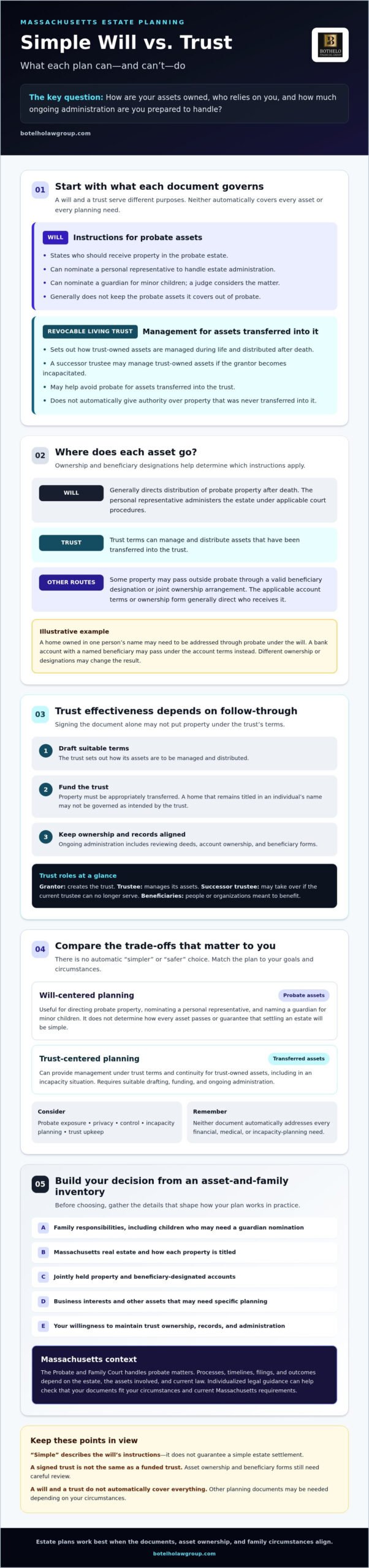
The right choice depends on what you want your plan to accomplish, what you own, who relies on you, and how much ongoing administration you’re prepared to handle. In the simple will vs trust Massachusetts decision, “simple” describes a will with straightforward instructions. It isn’t a legal category or a guarantee that settling an estate will be simple. The outcome also depends on how assets are titled and which documents apply to them.
A revocable living trust holds and manages assets under written terms. For a general overview of what a trust is, consider how the roles work together: the grantor creates the trust, the trustee manages its assets, a successor trustee may take over if the current trustee can no longer serve, and beneficiaries are the people or organizations meant to benefit.
What can a Massachusetts will accomplish?
A will can state who should receive assets in your probate estate and nominate a personal representative to handle estate administration. In Massachusetts, the Probate and Family Court oversees probate matters, including the process through which a personal representative’s authority is established.
Parents can use a will to nominate a guardian for minor children, but the nomination doesn’t bypass court involvement. A judge considers the matter. A will also generally doesn’t keep the probate assets it covers out of probate. Assets passing directly through a beneficiary designation, joint ownership arrangement, or trust may follow different instructions.
What does a revocable living trust accomplish?
A trust can set out how assets transferred into it are managed during the grantor’s lifetime and distributed after death. If the grantor becomes incapacitated, a successor trustee may manage trust-owned assets under the trust’s terms. This can provide continuity for those assets, but it doesn’t automatically give the successor trustee authority over property that was never transferred to the trust.
A trust’s effectiveness depends on suitable drafting, proper funding, and ongoing administration, including keeping ownership and records aligned with the plan. It may address management of assets it owns, but neither a will nor a trust automatically covers every financial, medical, or incapacity-planning need. Other planning documents may be necessary, depending on your circumstances.
How Wills, Trusts, and Probate Work for Massachusetts Families
In Massachusetts, probate matters are handled through the Probate and Family Court. The process depends on the estate, the assets involved, and current law. For an overview of relevant statutes and resources, see Massachusetts law about wills and estates. A will is important, but it doesn’t determine how every asset passes.
Some property may pass outside probate through a valid beneficiary designation, joint ownership arrangement, or trust. The controlling document or ownership form generally directs who receives that property. Other property may be part of the probate estate and handled under the will, subject to applicable court procedures. This distinction is central to the simple will vs trust Massachusetts decision: your plan should account for how each asset is actually titled and designated.
What happens to property under a will?
A will gives instructions for probate property after death; it doesn’t transfer title during the person’s lifetime. The personal representative administers the estate under applicable court procedures, addressing matters such as estate assets and distribution. The filings and steps depend on the circumstances.
Consider this illustrative example, not individualized legal advice. A Massachusetts resident owns a home in their name alone and has a bank account with a named beneficiary. The will may direct who should receive the home, but that property may need to be addressed through probate. The account may pass to its designated beneficiary under the account terms instead of the will. The result may differ if ownership or designations differ.
Probate timelines, filings, and outcomes vary with the estate and current law. A will doesn’t guarantee a particular schedule or result, and family disagreements, asset questions, or other circumstances may affect administration.
Why trust funding matters in Massachusetts
Signing a trust document alone may not transfer existing property into the trust. For example, if a home remains titled in an individual’s name, the trust’s terms may not govern it as intended without appropriate steps. Accounts and beneficiary designations also need careful review, not assumptions.
Review deeds, account ownership, and beneficiary forms with qualified professional guidance. The goal is to align your documents with how property is held and who is meant to receive it. Trust ownership may affect how particular assets are administered, but it doesn’t mean every asset or the entire estate will avoid court involvement.
For families whose property or circumstances need individualized review, Massachusetts estate-planning guidance can help connect document choices with ownership details and family needs.
Will vs. Trust in Massachusetts: Compare Probate, Control, and Upkeep
The simple will vs trust Massachusetts decision isn’t a choice between a plan that works and one that doesn’t. A trust isn’t automatically necessary, and a will alone may not address every family or asset-management need. Compare the trade-offs with your priorities and review the applicable legal framework through Massachusetts law on wills and estates.
| Planning factor | Will-centered plan | Revocable living trust |
|---|---|---|
| Probate exposure | Property governed by a will generally goes through probate. | Assets properly transferred to the trust may be administered under its terms without probate for those assets. |
| Privacy | A will and related information may become part of court records. The implications depend on what is filed and applicable procedures. | Trust terms may allow administration of trust-owned assets outside probate, but this doesn’t make every asset or document private. |
| Control | Sets out distribution instructions for probate property after death. | Can set management and distribution terms for assets held in the trust. |
| Incapacity continuity | A will takes effect at death and does not, by itself, provide ongoing management of assets during incapacity. | A successor trustee may manage trust-owned assets under the trust’s terms if the current trustee cannot serve. |
| Upkeep and administration | Requires coordination with ownership and beneficiary designations; probate administration may still be needed. | Requires appropriate funding, recordkeeping, and updates as assets or circumstances change. |
When might a will-centered plan be appropriate?
Straightforward assets and family instructions may make a will-centered plan worth considering, but they aren’t a legal test. Check how each asset is titled, whether it has a beneficiary, and whether co-owners’ rights affect its transfer. A will doesn’t guarantee that court administration, delay, or disputes will be avoided. The fit depends on the full picture, not simply the number of assets.
When might a trust merit consideration?
A trust may merit discussion if you value continuity of management, want to plan distributions over time, or have privacy concerns about probate. Owning property in more than one jurisdiction is another reason to ask counsel about potential probate implications. Weigh these goals against the work of drafting, funding, keeping records, and amending the trust when circumstances change.
Don’t treat a revocable trust as automatic creditor or tax protection. Its effect depends on its terms, the assets involved, and applicable law. Focus on matching the documents and ownership arrangements to your family’s needs.
How to Decide Between a Simple Will and Trust for Your Situation
Start by organizing the facts before choosing documents. This four-part inventory can help you prepare for a focused discussion about the simple will vs trust Massachusetts decision. It identifies questions for counsel, not an individual legal outcome or a substitute for advice based on your circumstances.
- Family responsibilities: List the people who depend on you, who you would want to manage property, and whether any beneficiary may need distributions in stages rather than all at once.
- Asset ownership: Record Massachusetts real estate, jointly held property, accounts with beneficiary designations, and business interests. Note how each asset is titled and who is named to receive it.
- Administration priorities: Consider how much you value continuity of management, privacy, and reducing the burden on the people handling your affairs. Note concerns about court involvement or coordination among beneficiaries and co-owners.
- Maintenance capacity: Assess whether you can keep documents, account details, ownership records, and beneficiary designations updated as your assets or family situation changes.
Marriage, separation, a new child, relocation, or an inheritance can prompt a review. A change may affect who should benefit, who should manage property, or whether existing ownership and beneficiary choices still reflect your intentions.
What family and property questions should you ask?
Ask who needs financial support, who should manage property, and whether beneficiaries should receive assets outright or over time. Before selecting documents, gather information about ownership and existing beneficiary designations. Also identify questions about incapacity planning, guardian nominations for minor children, or asset protection. These concerns may require separate advice beyond the choice between a will and trust.
What should you bring to an estate-planning discussion?
Prepare an asset and account list, copies of existing estate documents, and available beneficiary information. Add a short outline of your priorities, family concerns, and questions about administration. For incapacity planning, review the separate considerations in this Power of Attorney Lawyer Fall River article.
Organized information helps an attorney assess how your family circumstances and property ownership fit together. For guidance tailored to your estate-planning questions, discuss your Massachusetts estate plan with an attorney.
Plan Your Massachusetts Will or Trust With Clear Next Steps
The decision isn’t simply whether a will or trust is better. A sound plan matches documents to your property, family needs, administration priorities, and ability to keep records current. That is the practical focus of the simple will vs trust Massachusetts question. Depending on your circumstances, a coordinated plan may include a will, a trust, a review of beneficiary designations, and separate documents for incapacity planning. In addition to legal instruments, many individuals outline their final arrangements in advance; to explore end-of-life options like direct burials and cremations, discover Horizon Funeral Home.
How to prepare for an estate-planning review
Gather information showing how your plan works on paper and how your property is held. Bring existing wills or trusts, deeds, account details, and current beneficiary designations. Identify who you want to manage your affairs and receive property, including alternate choices if someone you name can’t serve or receive it.
Use the discussion to clarify practical next steps. Ask how each document should be signed and stored under current Massachusetts requirements, how a trust should be funded, and what records need to be maintained. Also ask when documents and beneficiary choices should be reviewed. Don’t rely on a document’s title alone to determine whether it remains suitable for your family or assets.
When to seek individualized legal guidance
Some circumstances make tailored advice especially important. Blended families, minor children, complex assets, or property in multiple states can raise questions about who should receive or manage property and how administration may work. A marriage, separation, birth, relocation, inheritance, or other change in family or financial circumstances may also justify reviewing existing documents.
Bring your questions forward, even if you’re unsure whether a trust is necessary. An attorney can assess how your documents, ownership arrangements, and priorities fit together. The goal is not to add complexity for its own sake, but to make deliberate choices under current Massachusetts law.
Botelho Law Group provides estate-planning and asset-protection services and is headquartered in Fall River, Massachusetts. To discuss which planning approach may fit your circumstances, contact Botelho Law Group about estate planning.
Choose an Estate Plan That Fits Your Life
The right choice in the simple will vs trust Massachusetts decision depends on how your property is owned, who you want to provide for, and how you want affairs managed. A will can direct probate assets, while a trust may manage assets transferred into it under its terms. Neither document automatically addresses every financial, medical, or incapacity-planning need.
Before deciding, review your family responsibilities, property, beneficiary designations, and willingness to maintain documents over time. Massachusetts requirements and the way assets are titled can affect how your plan works. Individualized legal guidance can help align the pieces without assuming that everyone needs a trust.
Botelho Law Group provides estate planning and asset-protection services and is headquartered in Fall River, Massachusetts. Discuss your Massachusetts estate-planning options with Botelho Law Group to consider a plan that reflects your family and assets.
Frequently Asked Questions
Is a simple will enough in Massachusetts?
A simple will may be suitable if its instructions match your family and the assets it governs, but “simple” doesn’t guarantee uncomplicated administration. A will can direct probate assets and nominate a personal representative, but generally doesn’t keep those assets out of probate. Before deciding, consider how property is titled, whether accounts name beneficiaries, and whether you need incapacity planning or ongoing asset management.
Does a trust avoid probate in Massachusetts?
A trust may help avoid probate for assets properly transferred into it, but it doesn’t automatically keep every asset or the entire estate out of court. Property left in your individual name may still require probate, depending on ownership and applicable procedures. Beneficiary designations and jointly owned property may pass differently. Review deeds, account ownership, and designations to determine which assets the trust governs.
Can I use both a will and a trust?
Yes. A will and trust can serve different roles in a coordinated estate plan. A revocable trust can direct management and distribution of assets transferred into it, while a will can address probate property and nominate a personal representative. Some plans use a pour-over will to direct certain overlooked assets to a trust, though those assets may still require probate first. Review the documents and asset ownership together.
Does a revocable living trust protect assets from creditors or taxes?
Don’t assume that a revocable living trust automatically shields assets from creditors or reduces taxes. Its main function is to provide terms for managing and distributing assets transferred to it. Creditor exposure and tax consequences depend on individual circumstances, the trust’s terms, asset ownership, and applicable law. If creditor protection or estate-tax planning is a goal, ask an attorney to assess those issues separately rather than relying on the trust alone.
What happens if I own a Massachusetts home but have only a will?
If the home is titled in your name alone, a will can state who should receive it, but the property generally remains subject to probate administration. The will doesn’t transfer title during your lifetime or itself bypass the court process. The outcome may differ if the home is jointly owned or held in a trust. Have the deed and your estate documents reviewed together to understand how ownership affects your plan.
Does a trust replace a power of attorney in Massachusetts?
No. A trust generally governs assets transferred to it, while a power of attorney is a separate document addressing an agent’s authority to act on your behalf as described in that document. A successor trustee may manage trust-owned assets under the trust’s terms, but that doesn’t necessarily cover property outside the trust or every financial matter. Ask an attorney how incapacity documents should work alongside your will and trust.
How often should I review my Massachusetts will or trust?
Review your documents after major changes, such as marriage, separation, a new child, relocation, inheritance, or a substantial change in property ownership. These events can affect your intended beneficiaries, decision-makers, or the way assets pass. Check that deeds, account ownership, and beneficiary designations still align with your plan. Ask an attorney whether changes in Massachusetts law or your circumstances warrant updates.