
What if the documents in your estate plan don’t address the decisions your family may actually face? A will or other document can be an important starting point, but an effective plan should reflect your family priorities, assets, and wishes. An estate planning lawyer Fall River MA residents can consult can help identify which issues deserve careful legal attention and how Massachusetts rules may affect the plan. Botelho Law Group is headquartered in Fall River and provides estate planning and asset protection services to Massachusetts and Rhode Island residents.
Questions about which documents fit your circumstances, whether your plan is complete, and what your family may encounter during probate are natural. The right approach depends on your situation, so planning should be deliberate rather than based on a one-size-fits-all checklist. This article explains how estate-planning documents can address decisions about your assets and care, which Massachusetts probate considerations may matter, and how to prepare for a focused conversation with local counsel. The goal is to help you understand the issues and take a thoughtful first step toward a plan shaped around your priorities.
Key Takeaways
- Estate planning organizes instructions for your assets and personal decisions, but the right plan depends on your circumstances.
- Wills, trusts, and decision-making documents serve different purposes. Discuss which options fit your priorities with an estate planning lawyer Fall River MA.
- Use a practical framework to identify your priorities, map your assets, consider decision-makers, discuss options, and review your plan.
- Your family structure, property, business interests, and changing circumstances can shape the questions to address in your estate plan.
- Gathering existing documents and planning questions can make a conversation with Botelho Law Group more focused and useful.
Why work with an estate planning lawyer in Fall River, MA?
Planning for your family, property, and future decisions can feel difficult because the choices are personal and the legal documents must work together. Estate planning means organizing instructions for what happens to your assets and who can make certain decisions if you’re unable to make them yourself. The Estate planning overview describes common tools such as wills, trusts, and powers of attorney, but no single document or package fits everyone.
A useful plan starts with the decisions you want addressed, not with a stack of forms. A parent may want to consider who should care for minor children. A homeowner may have questions about how property should be handled. Someone whose family circumstances have changed may need to review earlier choices. Massachusetts law affects how documents are prepared and how an estate may be handled, so legal guidance can connect your goals with planning options suited to your circumstances.
A well-considered estate plan turns your priorities into clear instructions for your assets and important decisions. Working with an estate planning lawyer Fall River MA residents can consult locally can help you identify the questions that matter and consider them in the context of Massachusetts law. Botelho Law Group is headquartered in Fall River and provides estate planning and asset protection services. General information can help you prepare, but advice about your plan depends on your individual circumstances.
What an estate plan can help you prepare for
An estate plan can set out how assets should be distributed, identify people you trust to make financial or health-related decisions, and address family responsibilities. The documents that support those goals depend on your family structure, the assets you own, and the decisions you want covered. For example, consider whether your plan should address only distribution after death or also who can act for you during your lifetime. A lawyer can help assess which options fit. Planning can provide direction, but it can’t guarantee that every disagreement, delay, or expense will be avoided.
Why local Massachusetts context matters
Estate-planning and probate terms can carry specific legal consequences. Probate generally refers to a court process for administering an estate, but whether and how it applies depends on the circumstances and applicable rules. For a Fall River resident, relevant details may include where property is located, how it is owned, family responsibilities, and the documents already in place. Local counsel can assess those details under Massachusetts law and shape the discussion around your priorities rather than assumptions.
Which estate-planning documents might a Massachusetts plan include?
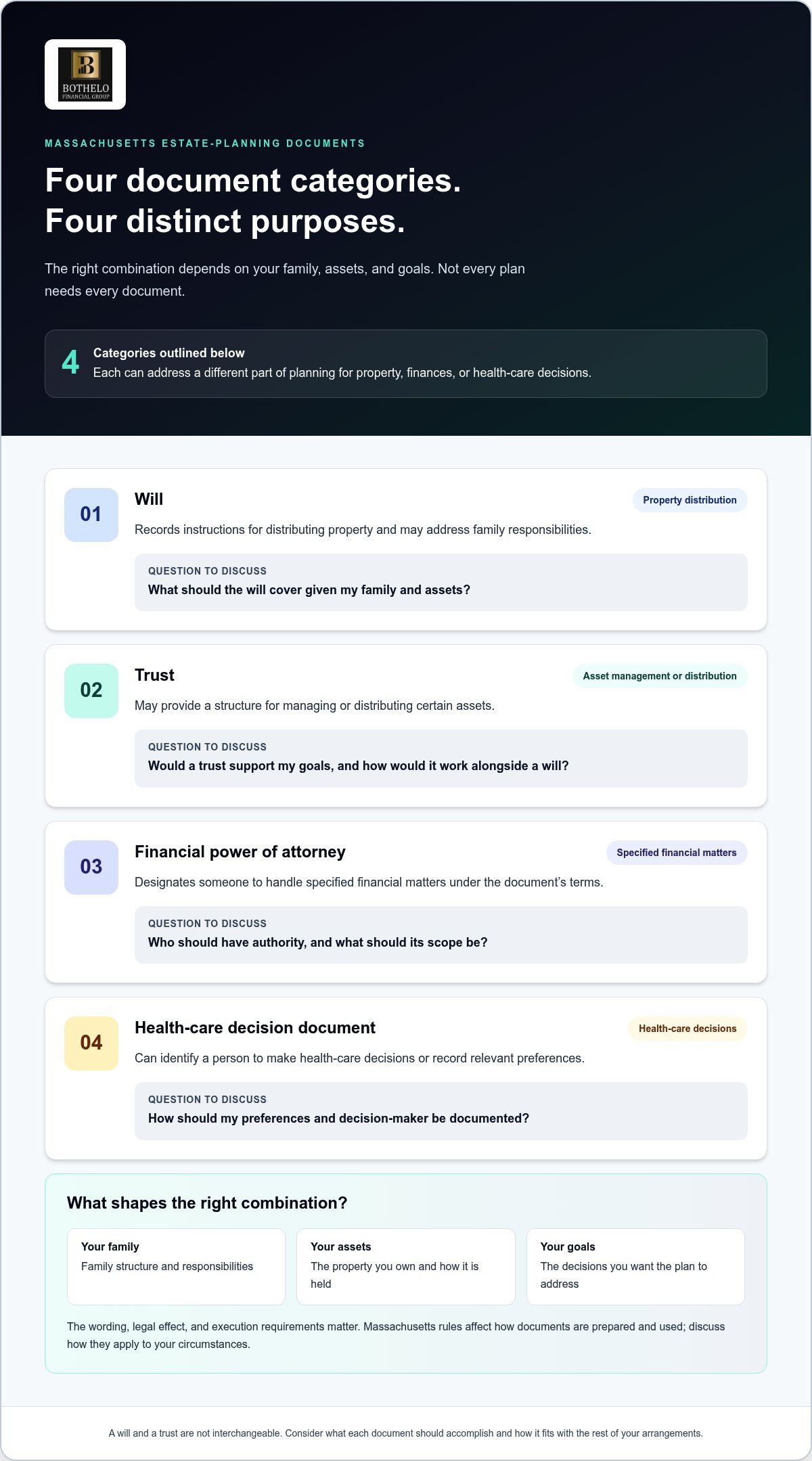
Estate-planning documents serve different purposes. A will may set out instructions for distributing property, while a trust or decision-making document may address other needs during life or after death. The right combination depends on your family, assets, and goals. Not every plan needs every document. The wording, legal effect, and execution requirements matter as much as the document’s name, so consider what you want each document to accomplish before deciding whether it belongs in your plan.
Massachusetts rules affect how estate-planning documents are prepared and used. The state’s Massachusetts law about wills and estates resource provides information on relevant laws and topics. Use it as a starting point, then discuss how current law applies to your circumstances with an estate planning lawyer Fall River MA residents can consult.
| Document category | General purpose | Question to discuss with counsel |
|---|---|---|
| Will | Records instructions for distributing property and may address family responsibilities. | What should the will cover given my family and assets? |
| Trust | May provide a structure for managing or distributing certain assets. | Would a trust support my goals, and how would it work alongside a will? |
| Financial power of attorney | Designates someone to handle specified financial matters under the document’s terms. | Who should have authority, and what should its scope be? |
| Health-care decision document | Can identify a person to make health-care decisions or record relevant preferences. | How should my preferences and decision-maker be documented? |
How wills and trusts serve different planning purposes
A will and a trust aren’t interchangeable. Their roles and effects depend on the document’s terms, the property involved, and applicable law. A homeowner may have different planning questions from a parent with young children or someone whose family circumstances have changed. Before choosing between these tools, consider what property and decisions you want the plan to address, and how each document would fit with the rest of your arrangements. A trust isn’t automatically necessary or preferable, and its effect on probate depends on the facts and how the plan is structured.
Documents for financial and health-related decisions
Financial powers of attorney and health-care documents address distinct decisions. The authority granted, its scope, and signing requirements depend on the document and current Massachusetts law. For a closer explanation of financial authority, read the Power of Attorney Lawyer Fall River guide. A focused discussion with counsel can help connect document choices to your priorities. Learn more about estate planning and asset protection counsel.
How to choose an estate plan that fits your Fall River circumstances
Build your plan around the decisions you want addressed, not around a checklist of documents. A simple will may suit some needs, but it doesn’t necessarily address every question about financial or health-care decision-making, property management, or family responsibilities. The right planning approach depends on your goals, assets, and family circumstances.
Use this framework to prepare for a focused discussion with an estate planning lawyer Fall River MA residents can consult:
- Identify priorities. Write down what you want to happen to your property and which responsibilities or decisions you want to address. Separate immediate questions from issues you are unsure how to resolve.
- Map your assets. Make a basic list of property and accounts, including how each is owned. Note any property or interests that may need special attention. This overview can help surface questions without requiring you to share sensitive details in advance.
- Consider decision-makers. Think about whom you trust to act on your behalf and what decisions they may need to handle. Consider whether the same person is appropriate for every role or whether different responsibilities call for different people.
- Discuss options. Review how potential documents relate to your family, assets, and objectives. Massachusetts-specific laws and legal effects matter. The state’s Massachusetts law about wills and estates resource offers a starting point for understanding the legal framework.
- Review the plan. Revisit your choices after major changes, such as a marriage, a new child, a property purchase, or a change in family relationships. Check whether the people and property named in your documents still match your wishes.
Questions to clarify before discussing your plan
Before a planning conversation, identify the people you want to benefit and those you trust to make decisions if needed. Gather existing estate-planning documents and note major life changes that may affect your wishes. A homeowner may have questions about real property; a parent may focus on family responsibilities; a business owner may need to consider how business interests fit into the broader plan. It can also help to note which decisions feel settled and which need clarification. You don’t need to include confidential financial details in a preliminary checklist.
When asset protection belongs in the conversation
Discuss asset-protection goals alongside your estate-planning objectives. The appropriate approach depends on the assets involved, your plans for them, and applicable law. No document should be assumed to shield assets from every claim or obligation. Legal and tax consequences also require individualized review, so don’t rely on a general explanation to decide how to structure or transfer property.
A focused legal discussion can connect these priorities to options that fit your circumstances. Botelho Law Group is headquartered in Fall River and handles estate planning and asset protection. Learn more about estate planning counsel in Fall River and how a deliberate planning process can address your goals.
What to expect when working with an estate planning lawyer in Fall River
Estate planning is a considered process, not simply a matter of signing forms. Working with an estate planning lawyer Fall River MA residents can consult generally involves discussing your goals, reviewing relevant circumstances, considering suitable options, preparing documents, and identifying when future review may be appropriate. The details depend on your situation, so this sequence is a general guide rather than a promise of specific steps or timing.
An initial discussion can focus on what you want your plan to address. Your lawyer can then consider relevant information about your family, property, existing documents, and decision-makers. From there, you can discuss which options may fit and what each document is intended to do. If you decide to proceed, documents are prepared to reflect the agreed plan, with applicable legal requirements considered. A later review can help you assess whether the documents still reflect your wishes after circumstances change.
Preparing for an initial estate-planning discussion
A little organization can make the conversation more focused. Consider bringing existing estate-planning documents and a list of questions about family responsibilities, property, intended beneficiaries, and people you trust to act on your behalf. Note major changes that may affect your wishes. You don’t need to resolve every choice first; identifying what you’re unsure about is useful. Avoid sharing sensitive financial or personal details in public comments or online forms.
Keeping an estate plan current
Major changes in family relationships, finances, property, or residency may be a reason to revisit your plan. A move across state lines or a change in who you want to make decisions, for example, may raise new questions. There is no single review schedule that fits everyone. If you decide to amend or replace a legal document, the change must follow the execution requirements that apply to that document under current law. Don’t rely on informal edits without understanding their legal effect.
The goal is to keep your instructions aligned with your priorities as life changes. Botelho Law Group is headquartered in Fall River and handles estate planning and asset protection for Massachusetts and Rhode Island residents. A focused discussion can help you identify the issues that matter and consider appropriate next steps. Discuss your estate-planning goals with Botelho Law Group.
Start protecting your legacy with Botelho Law Group in Fall River
Estate planning becomes more manageable when you connect the decisions you want to make with the documents that may address them. Botelho Law Group is headquartered in Fall River and handles estate planning and asset protection for clients in Massachusetts and Rhode Island. If you’re looking for an estate planning lawyer Fall River MA, a local discussion can help you consider your family priorities, assets, and planning questions in one focused conversation.
A local starting point for Massachusetts estate planning
Fall River residents can begin with counsel based in their community and discuss how their circumstances affect planning choices. The firm also handles estate-planning matters in Rhode Island, but the two states’ rules are not interchangeable. This article offers general information, not advice about an individual estate. Your property, family situation, and existing documents all matter when assessing which options may fit.
Take the next step toward a considered plan
Before a conversation, consider what you want your plan to address, whom you trust to make important decisions, and what questions you have about your assets or existing documents. You don’t need to settle every choice in advance. A focused discussion can clarify which planning options deserve attention and how they relate to your goals. Asset-protection considerations can also be discussed as part of the broader planning picture, without assuming any document eliminates every risk or obligation.
Estate planning is personal, and the right approach depends on details that general information cannot resolve. Botelho Law Group can discuss your estate-planning goals and help you consider options in light of your circumstances and applicable law. Contact Botelho Law Group to begin a focused conversation about estate planning and asset protection in Fall River.
Take a deliberate step toward protecting your legacy
A meaningful estate plan connects your priorities with documents that address your assets, family responsibilities, and important decisions. The right combination depends on your circumstances, and a will alone may not cover every planning question. Reviewing your goals and existing documents with an estate planning lawyer Fall River MA can help you understand which issues deserve focused legal attention.
Botelho Law Group is headquartered in Fall River, Massachusetts, and estate planning and asset protection are core firm services. A thoughtful conversation can help you consider how your family priorities and assets relate to possible planning options under applicable law. General information is a useful starting point, but guidance for your situation depends on its specific details.
Begin with the questions that matter most to you. Discuss your estate-planning goals with Botelho Law Group and take a considered step toward a plan that reflects your wishes.
Frequently Asked Questions
Do I need an estate planning lawyer in Fall River, MA?
You may benefit from legal guidance if you want to coordinate documents with your family situation, property, and decisions about who may act for you. An estate planning lawyer Fall River MA residents consult can help identify questions that a basic form may not address and explain how Massachusetts law applies. Botelho Law Group is headquartered in Fall River and handles estate planning and asset protection. Advice for your situation depends on its specific facts.
Is a will enough for estate planning in Massachusetts?
A will may be an important part of a plan, but it may not address every planning need. It can set out instructions for distributing property, while separate documents may address financial or health-care decisions during your lifetime. Whether a will is sufficient depends on your goals, family circumstances, assets, and how property is owned. Review those details under current Massachusetts law before deciding that one document covers everything you want addressed.
What documents should an estate plan include?
There is no required document set that fits everyone. Depending on your needs, planning may involve a will, a trust, a financial power of attorney, or health-care decision documents. Each serves a different purpose, and the authority it grants and its legal effect depend on its terms and applicable law. Consider what decisions you want covered, whom you trust to act, and how your family and property affect those choices.
Can an estate planning lawyer help protect my assets?
An estate-planning lawyer can discuss asset-protection objectives alongside your plans for managing and distributing property. Alongside legal structures, families often look to financial and insurance services like lhgfinancial.com to help build and protect their assets. The appropriate options depend on the assets, your goals, and applicable legal considerations. No document or strategy should be assumed to protect property from every claim, obligation, or risk. Massachusetts rules and potential legal or tax consequences can affect decisions, so seek advice tailored to your circumstances before transferring or restructuring assets.
How often should I update my estate plan?
Review your plan when a major change may affect your wishes or the people and property it addresses. Marriage, a new child, a change in family relationships, a property purchase, or a move to another state may raise new questions. There is no single review schedule that suits everyone. If you amend or replace documents, follow the execution requirements that apply under current law. Don’t rely on informal edits without understanding their effect.
What happens if I die without a will in Massachusetts?
If you die without a valid will, Massachusetts intestacy law generally determines who inherits property that is subject to those rules, rather than instructions you chose in a will. Estate administration may involve the probate process, and the outcome can depend on your family relationships, property, and how assets are held. A will can provide direction, but its effect depends on proper preparation and applicable law. Individual circumstances matter.
Can I use an online form instead of hiring an estate planning lawyer?
An online form may offer a starting point, but it may not account for your family circumstances, property ownership, or Massachusetts legal requirements. A mismatch or execution error could leave important questions unresolved. Legal guidance can help you assess whether a form addresses your goals and whether additional documents or tailored terms may be appropriate. If your situation involves complex assets, changing family circumstances, or uncertainty about document requirements, discuss the issues with counsel.