
In Massachusetts, a health care proxy names one agent to make health care decisions if the person who signed it cannot make or communicate those decisions. The proxy must be in writing and signed before two witnesses who are not the named agent or alternate; the agent may act only after the attending physician determines in writing that the person lacks decision-making capacity. The Massachusetts General Court identifies Chapter 201D as the state’s Health Care Proxy Law, and a healthcare proxy lawyer in MA can explain how its requirements apply to your circumstances.
Signing the document is only one part of preparing a health care proxy. The people who may need it should know where to find it, and accessible copies can help avoid confusion when care decisions arise. This article explains what an agent can do, who you may appoint, how to change or revoke a proxy, and how it differs from a durable power of attorney. It also explains why sharing copies matters and what the document does not decide, so you can understand how your health care choices may be represented.
Key Takeaways
- A Massachusetts health care proxy appoints one agent to make health care decisions when you can’t make or communicate them yourself.
- Choose an agent who understands your priorities and can communicate your wishes, and consider naming an alternate in case your first choice is unavailable.
- A health care proxy addresses medical decisions; a durable power of attorney generally addresses financial and legal matters.
- You can revoke a proxy while you have capacity. Keep the people involved in your care informed when you change or revoke it.
- Sharing copies with your agent and relevant care providers can help make the document accessible when decisions need to be made.
What is a Health Care Proxy?
A Massachusetts health care proxy is a written document naming an agent to make health care decisions when you cannot make or communicate them yourself. Choosing the right person, following the signing requirements, and coordinating related documents help clarify who can act and when.
Selecting a Health Care Agent
A health care agent is the person you authorize to make medical decisions on your behalf if you become unable to decide or communicate your wishes. Massachusetts allows you to name one agent, so choose someone who understands your priorities and can communicate clearly with doctors.
Consider how the person might handle difficult choices, including decisions about life-sustaining treatment. Your Massachusetts agent may make health care decisions you could have made yourself, including these decisions. Discuss your values and preferences in advance, then name an alternate in the document in case your chosen agent cannot serve.
Your agent must be at least 18 years old, according to the Massachusetts General Court. A health care facility administrator, operator, or employee generally cannot serve unless that person is your blood relative, spouse, or adoptive relation. These limits matter when a trusted person works where you receive care.
Signing and Witnessing the Proxy
A Massachusetts health care proxy must be in writing and signed by you, or at your direction, before two witnesses. According to the Massachusetts General Court, the witnesses cannot be the named agent or alternate. The proxy does not have to be notarized.
Both witnesses should observe the signing and complete the document’s witness section. This formal step helps establish that you appointed the agent. Keep the signed original with your estate planning documents, and give copies to your agent and doctors.
You can prepare a proxy yourself or with an attorney. Legal guidance can help when coordinating it with a durable power of attorney or deciding who should serve. The documents have different roles: a proxy covers health care decisions, while a power of attorney generally covers financial and legal matters.
Decisions When a Person Cannot Decide
Signing the proxy does not immediately transfer decision-making authority. Your agent may act only after your attending physician determines in writing that you cannot make or communicate your own health care decisions. If you regain that ability, authority returns to you and your agent’s authority is suspended.
Once authorized, your agent may speak with doctors, review medical records, and make decisions guided by your goals and choices. For example, the agent may weigh treatment options against preferences you have discussed. The proxy appoints the decision-maker, but does not explain your values; discuss your preferences and record helpful guidance separately.
A proxy executed in another state in compliance with that state’s law is generally enforceable in Massachusetts, subject to limited exceptions. If you receive care in Massachusetts after moving or traveling from another state, keep the document accessible and tell your agent where to find it. A durable power of attorney can address financial matters alongside the proxy, but does not replace the health care authority granted by the proxy.
Massachusetts health care proxy law
Massachusetts law provides a framework for appointing someone to make health care decisions when you cannot make or communicate them. A proxy is also part of broader estate planning, but it does not control financial matters.
Massachusetts Proxy Law and Purpose
Massachusetts’s Health Care Proxy Law is Chapter 201D of the Massachusetts General Laws, according to the Massachusetts General Court. It lets a person appoint an agent to make health care decisions during a period of incapacity. The document identifies who may speak for you, rather than leaving that role to family assumptions.
A Massachusetts healthcare agent must be at least 18 years old, according to the Massachusetts General Court. A spouse, relative, or friend does not automatically gain authority just because of that relationship. The proxy names the decision-maker and should clearly identify the person granting authority and the chosen agent.
Proxy Authority and Activation
Your agent’s authority begins only after your attending physician determines in writing that you cannot make or communicate your own health care decisions. Signing the proxy alone does not transfer control. If you regain the ability to decide, authority returns to you and your agent’s authority is suspended.
Once activated, your agent may make decisions you could have made, including decisions about life-sustaining treatment. The agent can speak with doctors and review medical records. Discussing your priorities beforehand helps the agent relate treatment choices to your values, since the proxy itself does not provide detailed guidance about your wishes.
You can prepare a Massachusetts health care proxy yourself or work with an attorney. Legal assistance can help if you have questions about who should serve, how the proxy fits with other documents, or how it interacts with your estate plan. A new proxy automatically revokes an earlier one, so coordinate updates and make the current version accessible.
For legal assistance, the cost depends on the case and is provided after a quote request; the scope of work and complexity of your estate planning needs affect the cost. A health care proxy and durable power of attorney serve different purposes, so reviewing them together can help clarify who handles medical decisions and who handles financial matters. Estate Planning and Asset Protection can address the broader planning context when these documents need coordination.
Changing or revoking a proxy
A Massachusetts health care proxy can change as your choices or relationships change. You may appoint a different health care agent, revoke the document, or regain decision-making authority after incapacity. Understanding which event applies helps prevent an outdated proxy from guiding care decisions.
According to the Massachusetts General Court, § 7 was repealed; a principal who has capacity can revoke a Massachusetts health care proxy at any time. The listed ways include speaking the revocation, putting it in writing, or taking an action that clearly shows intent to revoke. According to the Massachusetts General Court, a principal with capacity may revoke a Massachusetts health care proxy at any time, orally, in writing, or through an act that clearly shows intent to revoke.
Massachusetts law gives you flexibility in how to communicate a change. For example, you may state clearly that you are revoking the proxy, sign a written revocation, or take another clear action showing that intent. A change of mind alone may not tell your agent or care team that the document should no longer guide decisions. Communicating the change helps prevent reliance on an outdated copy.
To appoint a replacement agent, complete a new Massachusetts proxy naming the person you want to act. A new proxy automatically revokes an earlier proxy. A replacement document is a clear way to record your changed choice, especially if the former agent still has a copy. Give the current document to your new agent and share it with the people involved in your care.
Some changes happen automatically under Massachusetts law. A proxy is automatically revoked if you legally separate from or divorce a spouse named as your agent. Review the document after a separation or divorce, and consider whether to appoint someone else. The change affects the named spouse’s authority, so relying on an old copy can create uncertainty about who should communicate your choices.
Revocation and regaining capacity are different. If you regain the ability to make health care decisions, authority returns to you and your agent’s authority is suspended. You do not need to revoke the proxy for this change in authority to occur. If you later become unable to decide again, the proxy may become relevant again, provided it remains in effect.
After any change, tell your former agent, current agent, and relevant doctors which document reflects your decision. Retrieve or replace copies where practical, and keep the current version with your estate planning documents. Review the named agent and alternate when circumstances change. A spouse’s separation, a changed relationship, or an agent who can no longer serve may signal that your proxy needs attention.
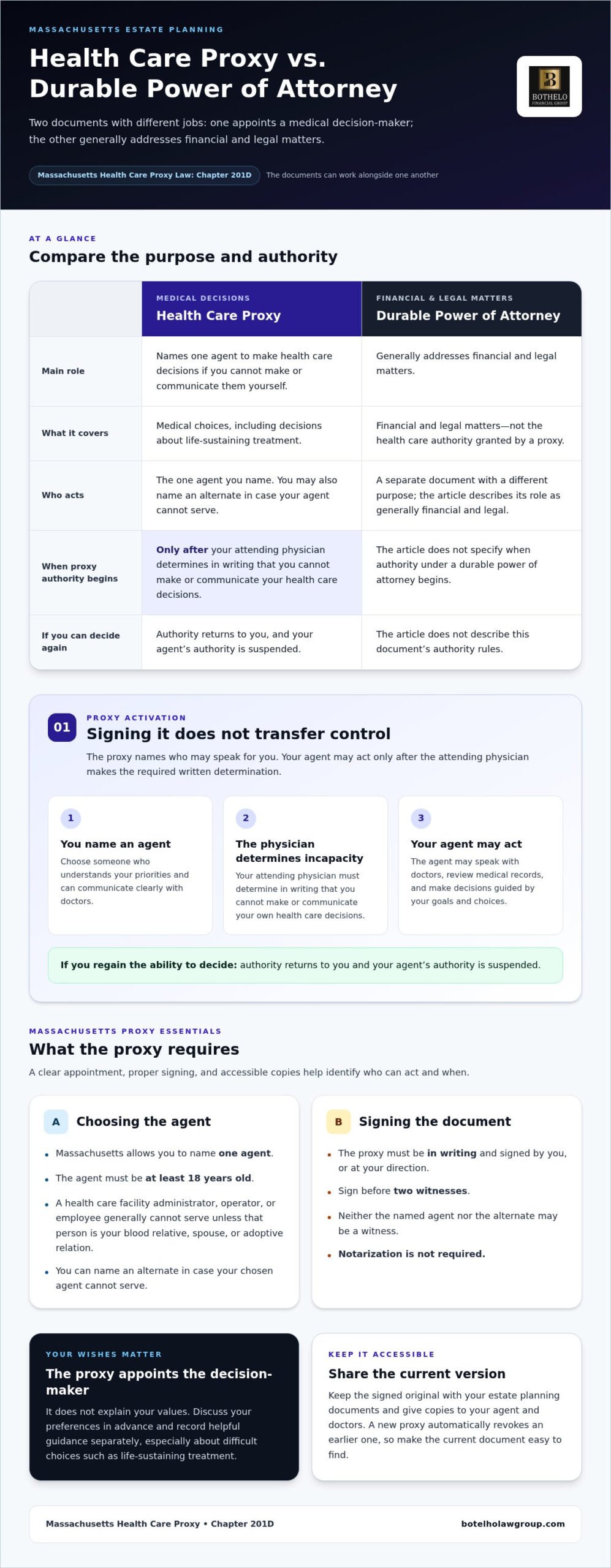
Is the Proxy the same as a Durable Power of Attorney?
No. A Massachusetts health care proxy authorizes an agent to make health care decisions when you cannot decide or communicate; a durable power of attorney generally addresses financial and legal matters. A living will expresses care wishes but isn’t legally binding on doctors in Massachusetts, though it can provide evidence of those wishes.
Proxy and Durable Power of Attorney Differences
A health care proxy and a durable power of attorney are separate legal documents with different responsibilities. The proxy names the person who can make medical choices after the required incapacity determination. A durable power of attorney gives an agent authority over matters defined in that document, such as handling financial affairs. Keeping both documents clear can help prevent confusion about who handles a medical decision and who manages a bill.
Power of Attorney Scope and Types
A power of attorney’s scope depends on the authority its document grants. Massachusetts powers of attorney are addressed in M.G.L. c. 190B, Article V, and durable powers of attorney are addressed in MGL c. 190B, Art. V, Pt. 5, §§ 5-501 through 5-507. A power of attorney is generally durable unless the document states otherwise. Read its terms to understand which financial or legal actions the agent may take.
“Durable” describes the power of attorney’s continued effect if the person granting authority becomes incapacitated, unless the document says otherwise. It doesn’t make the document a health care proxy. For example, authority to manage financial transactions does not, by itself, authorize an agent to consent to medical treatment. The proxy covers that separate decision-making role.
Massachusetts law doesn’t require an attorney to complete a health care proxy; you can prepare one yourself or with legal assistance. An attorney can help when you’re coordinating several documents, have questions about the authority you want to grant, or need to understand how a proxy fits your estate plan. Make sure each document names the intended decision-maker and describes the intended authority.
Review the documents together, but don’t assume one substitutes for another. A living will can record treatment preferences, while a proxy identifies the agent who can make decisions during incapacity. Since a living will isn’t legally binding on Massachusetts doctors, it serves a different purpose from the proxy. Share your wishes with your agent so they understand how to apply those preferences when medical choices arise.
Sharing copies of the proxy
A signed Massachusetts health care proxy is useful only if the people involved in your care can find it. Give a copy to your named agent and make sure they know where the signed document is kept. Share another copy with your doctors or care facility so it is available if you become unable to communicate your wishes.
Ask your agent to keep an accessible copy and tell them where to find the original. You might keep the signed document with your estate planning papers and provide copies to the people likely to need them. If you change agents or revoke the proxy, distribute the updated document and explain which version should guide care decisions.
Share the proxy with the medical providers involved in your current care, not only your primary doctor. For example, if you see a specialist or enter a hospital, provide the document to that care team. Ask whether the copy can be added to your medical record. When care moves between facilities, tell your agent where the current version is stored and provide it to the new team.
A health care proxy gives the named agent decision-making authority after the required incapacity determination. A HIPAA release serves a different purpose: it can allow others to communicate with medical personnel and access medical records without giving them authority to make decisions. If you want a relative to receive updates but not decide about treatment, a separate release may address that need.
Copies also help your agent understand the wishes they may need to represent. The proxy names the decision-maker but does not explain your values or preferences. Discuss your views on treatment, including life-sustaining treatment, and share any written guidance with your agent. An advance directive or personal statement can provide context alongside the proxy.
Review your proxy every year. Confirm that contact information is current and that your named agent is still willing to serve. If the agent’s circumstances change, update the document and distribute the replacement. A yearly review also gives you a chance to confirm that your doctors and agent can find the current copy.
The federal Patient Self-Determination Act requires almost all hospitals, nursing homes, health plans, and home care agencies to ask whether people have completed an advance directive. Keeping a copy accessible helps you answer and supports communication with providers. For guidance coordinating a proxy with broader estate planning and asset protection, take the next step by discussing how your documents work together.
Botelho Law Group: Estate Planning and Asset Protection
Botelho Law Group provides Estate Planning and Asset Protection services to help Massachusetts residents organize health care and financial documents. If you need to prepare a proxy, update an agent, or coordinate health care instructions with a durable power of attorney, estate planning can bring those decisions into one plan.
Consider legal guidance if your family circumstances have changed, your current documents name someone who can no longer serve, or you want your agent to understand your preferences. A clear plan distinguishes who may make health care decisions from who handles financial matters, while keeping your choices central.
Contact Botelho Law Group to discuss your Massachusetts estate planning and asset protection needs.
Make Your Health Care Plan Work for You
A useful next step is to decide what you want your agent to understand beyond the paperwork. Consider writing down the principles that should guide difficult choices, such as how you weigh independence, comfort, and life-sustaining treatment. Share that guidance directly with your agent and discuss questions before a medical crisis forces a decision. Clear conversations can help your chosen representative understand the reasoning behind your preferences.
If you’re considering a healthcare proxy lawyer in MA, focus on how the proxy fits your wider estate plan and whether your documents reflect your current priorities. Botelho Law Group provides Estate Planning and Asset Protection services to Massachusetts residents. The firm also handles Family-Based Green Card Petitions and Naturalization and Citizenship Applications.
Contact Botelho Law Group to discuss your estate planning needs. Taking this step can help you approach future decisions with greater clarity and confidence.
Frequently Asked Questions
Can I make changes on the document?
Yes, you can change or revoke your Massachusetts proxy while you have capacity. You may communicate revocation orally, in writing, or through an act that clearly shows your intent. To appoint a replacement, completing a new proxy can make your current choice clear; a new Massachusetts proxy automatically revokes an earlier one. Give the updated document to your agent and relevant care providers so outdated copies don’t cause confusion.
Can I name more than one person as my Agent?
No. Massachusetts allows one health care agent to hold decision-making authority under the proxy. You can name an alternate or successor to serve if your primary agent can’t act. The alternate isn’t a co-agent, so the document still identifies one person to communicate decisions to providers. You may ask relatives or friends for input, but clarify which person has authority to speak for you.
Can my doctor refuse to honor my Agent’s decision?
Your agent’s authority depends on the required written determination that you can’t make or communicate your health care decisions. Once authorized, the agent may make decisions you could have made, including decisions about life-sustaining treatment. If a doctor questions whether the proxy is active, ask what determination or document is needed and request an explanation. This can clarify whether the issue concerns the agent’s authority or the proposed care.
Choosing an Agent: What Does an Agent Do?
Your agent communicates with doctors, reviews medical records, and makes health care decisions on your behalf when you can’t decide or communicate. For example, the agent may discuss treatment options and explain how your preferences apply. Choose someone willing to take on that responsibility and able to communicate your wishes clearly. Discuss your priorities in advance, especially if family members may disagree about care.
Do I need a lawyer or a Notary Public?
No, Massachusetts doesn’t require a lawyer or notary to complete a health care proxy. You must sign the document, or direct someone to sign it for you, before two witnesses who aren’t the named agent or alternate. A lawyer can help if you’re coordinating the proxy with a durable power of attorney or other estate documents. A healthcare proxy lawyer in MA may also clarify how the documents fit together.
Does a power of attorney cover medical decisions in Massachusetts?
A durable power of attorney generally covers financial and legal matters, not health care decisions. Massachusetts addresses durable powers of attorney in MGL c. 190B, Art. V, Pt. 5, §§ 5-501 through 5-507. Review the document’s language to understand the authority it grants. If you want someone to make medical decisions during incapacity, the health care proxy serves that distinct purpose.
What does a Massachusetts healthcare proxy do?
A Massachusetts proxy appoints an agent to make health care decisions when you’re unable to make or communicate them yourself. It identifies who can speak with your doctors and make decisions within the agent’s authority. The document doesn’t explain your values in detail, so discuss your preferences separately. For instance, tell your agent how you want your personal priorities considered when treatment choices arise.
Who can serve as a healthcare agent in Massachusetts?
A Massachusetts health care agent must be at least 18 years old, according to the Massachusetts General Court. A health care facility administrator, operator, or employee generally can’t serve unless that person is your blood relative, spouse, or adoptive relation. Consider whether your chosen person understands your preferences and can communicate with providers. You may also name an alternate to serve if your first choice is unavailable.