
The government filing fee for a K-1 petition is $675, accurate as of March 2025, but it’s only one part of the total budget. The fiancé visa lawyer cost depends on the legal work involved, and attorney fees are separate from government charges. Medical exams and expenses for accompanying children can add to the overall cost.
It’s understandable to want a clear picture of the expenses before beginning. A K-1 visa is a nonimmigrant visa for the foreign fiancé(e) of a U.S. citizen, and the process includes both a petition and later steps toward a green card after marriage. This article explains how those stages affect the budget.
This guide explains the main fiancé visa lawyer cost categories, including attorney fees, child-related expenses, government filing fees, and costs that may arise later. Understanding how these expenses fit together can help you plan for the legal and administrative steps ahead.
Key Takeaways
- A K-1 visa is for the foreign fiancé(e) of a U.S. citizen, and the sponsor begins the process by filing Form I-129F with U.S. Citizenship and Immigration Services.
- Separate attorney fees from government filing fees when estimating the total cost; the listed K-1 petition filing fee is $675, accurate as of March 2025.
- Account for child-related expenses separately, since accompanying children can add legal and visa costs to the family’s budget.
- Medical exams, translations, and travel may add expenses beyond the petition and legal work, so map out each stage before filing.
Attorney fee for a K-1 fiancé visa with adjustment of status
Budget for two legal stages: the K-1 petition and the foreign fiancé’s later adjustment of status after marriage. Separate attorney fees from government charges, and compare written service scopes before deciding what representation you need.
Attorney Consultation and Pricing
A Massachusetts immigration attorney consultation can help identify the work involved in a K-1 case. Bring the relationship timeline, records of prior immigration filings, and documents about past legal issues. These details help clarify which parts of the case need attention, including whether the later adjustment-of-status stage is part of your plan.
The fiancé visa lawyer cost depends on the agreed scope and case needs. Compare written terms for the work included, payment timing, and separately billed services. A Massachusetts consultation and one elsewhere may cover similar issues, but the agreement defines the attorney’s responsibilities.
K-1 Petition Attorney Fees
A U.S. citizen sponsoring a K-1 visa must file Form I-129F with U.S. Citizenship and Immigration Services. Attorney work may include reviewing documents, organizing relationship evidence, preparing forms, and assembling the petition. The written agreement should identify which tasks the attorney handles and which records the couple must provide.
The petition is one stage of the process. After the foreign fiancé enters the United States and the couple marries, the spouse may pursue adjustment of status. Confirm whether the legal scope covers only the K-1 petition or also the later green-card application. These are distinct stages, so one fee should not be assumed to cover both.
Flat Fee Services and Extra Charges
A flat-fee agreement should describe the work in practical terms, such as document review, form preparation, petition assembly, and filing support. It should also clarify whether responding to a Request for Evidence (RFE) or preparing for and attending an interview is included. The written scope, not the “flat fee” label, defines the services covered.
Does a lawyer charge extra for an RFE response or interview? The engagement agreement should state whether those services are included or billed separately. Review the terms before signing, including the scope of representation if USCIS requests additional evidence or schedules an interview.
Comparing Lawyer Costs
Compare K-1 attorney fees by matching written scopes, not headline amounts. Check whether each agreement covers petition preparation, adjustment of status, RFE responses, interview support, and government charges. This side-by-side review can reveal when one quote excludes work another includes, helping you understand the actual services covered.
Do costs vary by state or city? Attorney billing arrangements can vary based on the case and the scope of work. For Massachusetts couples, compare written proposals that cover the same stages and responsibilities rather than assuming that similar fee labels mean equivalent representation.
Can you apply without a lawyer, and when might legal help be useful? Couples can prepare forms and organize documents themselves. Legal assistance may be useful when there are prior filings, complex relationship evidence, or questions about adjustment of status that make the process harder to manage.
Additional fees for children
Children can add legal and government expenses to a K-1 family’s immigration budget. A child may qualify to accompany the foreign fiancé under K-2 status if unmarried and under age 21. Count each child separately when estimating legal work, gathering records, and planning application expenses.
This is separate from the adult’s legal fee and from government immigration fees. The legal fee for a joint sponsor package depends on the case and is provided after a quote request; relevant factors include the sponsor’s financial documents and the work needed to prepare the package.
Organize each child’s documents separately, even if the child is traveling with family. Create a file with identity records and documents supporting the family relationship. Check that names and personal details are consistent across the child’s records and the parent’s petition. This can help identify missing information before applications are submitted.
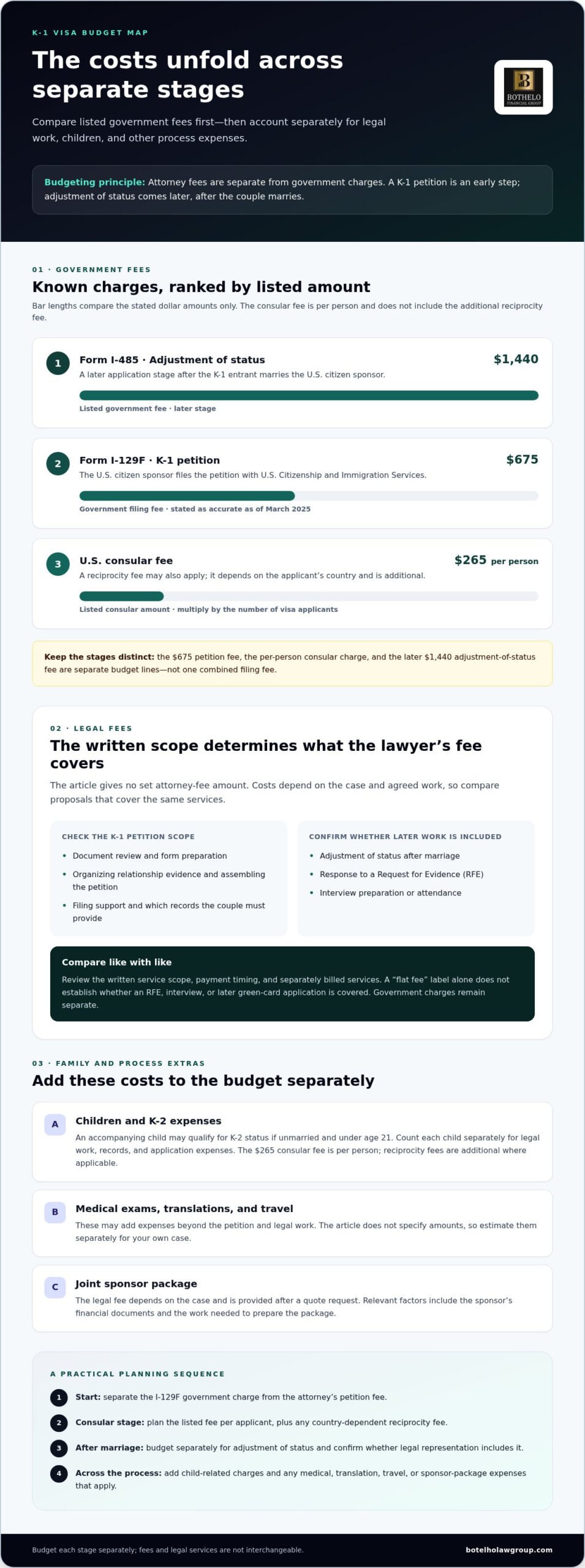
Government application fees are distinct from attorney charges. The listed USCIS fee for the K-1 petition is $675, while the listed U.S. consular fee is $265 plus a reciprocity fee per person. The consular amount is stated per person, so include the number of visa applicants when planning that charge. Reciprocity fees depend on the applicant’s country and are additional to the listed consular fee.
Adjustment of status is a later step after the K-1 entrant marries the U.S. citizen sponsor. The listed government fee for Form I-485 is $1,440. Treat that as a separate stage in the family budget, rather than combining it with the initial petition. Children’s eligibility and filing needs should be assessed individually, because their age and marital status affect whether they qualify under K-2.
Add a separate line for any joint sponsor package. This makes it easier to see which charges apply to the family, which apply per person, and which belong to a later application stage. For guidance on the legal steps involving a fiancé and spouse, explore K-1 and spouse visa representation.
What government filing fees are required for a K-1 fiancé visa?
Government charges arise at different stages, so a single petition-fee figure does not represent the full immigration process. The initial K-1 filing, consular visa application, and later adjustment of status are separate steps. Keep each charge in its own budget line, and distinguish government fees from attorney fees and other case expenses.
The listed USCIS filing fee for the K-1 petition is $675, accurate as of March 2025. This charge applies to the petition stage. It is separate from the consular fee that follows, and it does not cover legal representation or later green-card filing costs. Include the petition fee when the U.S. citizen sponsor prepares the initial filing budget.
At the visa application stage, the listed U.S. consular fee is $265 per person, plus a reciprocity fee. The reciprocity amount depends on the applicant’s country. Because the consular fee applies per person, include each K-1 applicant when estimating this part of the budget. A fiancé visa applicant’s child may have separate application expenses, so do not treat the adult’s fee as covering the entire family.
After the couple marries, the foreign fiancé may apply for adjustment of status. The listed government fee for Form I-485 is $1,440, accurate as of March 2025. This is a later green-card application charge, not part of the initial K-1 petition fee. Plan for it as a separate stage rather than assuming the first filing completes the process.
Use this sequence to organize the government charges:
- Petition: Set aside the listed $675 USCIS filing fee.
- Consular application: Budget $265 per person, plus the applicable reciprocity fee.
- Adjustment of status: Include the $1,440 Form I-485 fee after marriage.
That calculation adds $675, $265, and $1,440; it is not a complete estimate for every couple. Additional applicants, child-related costs, medical examinations, translations, and travel can affect the overall budget.
Before filing, list government charges separately from attorney fees. For each fee, note the filing stage, who pays it, and whether it applies per applicant. Government fees can change, so confirm the amount that applies to the specific filing and date. This breakdown helps distinguish the petition charge from later visa and green card application fees.
What services are typically included in a fiancé visa lawyer’s flat fee?
A flat fee sets a defined legal scope for a K-1 matter, but the label alone does not identify each task. Read the engagement agreement for exactly which steps the attorney will handle, from reviewing documents to preparing the petition. A clear scope also identifies work that falls outside the fee, such as later adjustment of status.
Petition preparation may involve reviewing the couple’s information, organizing relationship evidence, completing forms, and assembling the filing package. The agreement should clarify whether attorney review continues through filing or ends when the package is submitted. It should also make clear which records the U.S. citizen sponsor and foreign fiancé(e) are responsible for collecting.
Check that the agreement explains how communication will work, including how the attorney receives documents, answers routine questions, and shares important case updates. It may also clarify whether the attorney reviews a draft relationship timeline or only the evidence submitted with the petition. Specific descriptions help couples understand what the flat fee covers.
Some legal work may arise after filing. An RFE may require additional documents and a written response. Interview preparation or attendance may also be separate from petition preparation. The agreement should state whether these tasks are included, excluded, or billed separately. Do not assume an RFE response or interview service is covered by the initial flat fee.
Adjustment of status is another important scope boundary. After the K-1 entrant marries the U.S. citizen sponsor, the spouse may pursue a green-card application. A fee agreement limited to the K-1 petition does not automatically cover that later stage. Identify whether adjustment-of-status forms, supporting-document review, and follow-up representation appear in the written scope.
Before signing, use a short scope checklist:
- Petition work: Identify form preparation, document review, evidence organization, and filing support.
- Case communications: Clarify how questions and status updates are handled.
- Later events: Define the treatment of an RFE, interview preparation, and interview attendance.
- Post-marriage work: Separate K-1 representation from adjustment-of-status services.
A clearly defined agreement helps couples compare the same stages of legal work instead of relying on fee labels. One proposal may cover petition preparation only, while another may include additional case support. Compare each task, responsibility, and exclusion in writing to understand the attorney’s role at every stage.
What additional costs can arise during the K-1 visa process, such as translations, medical exams, or travel?
Attorney and government fees are only part of a K-1 budget. Medical exams, translations, and travel can add separate expenses at different stages. List each item by applicant and purpose, then update the budget as appointments and travel plans become clearer.
The medical examination expense can depend on the examination and its location. Budget for it separately from petition and consular charges, and account for the appointment required during the visa process.
Translation costs depend on which records need translation and how much material is involved. Review documents before filing and identify any written in a language other than English. Civil records or relationship evidence, for example, may need translation. List the translator’s charge and any related delivery costs separately in your budget.
Travel expenses may arise for the foreign fiancé(e)’s medical appointment, consular interview, or move to the United States. The route, distance, lodging needs, and timing all affect the budget. First map the expected appointments, then estimate transportation and accommodation for each trip. Include any accompanying child in the family’s travel plan.
Other practical expenses may include obtaining record copies, sending documents, and traveling to appointments. Track these costs separately from legal fees as they arise. A simple worksheet can separate:
- Translations: List each document requiring translation and its related expense.
- Travel: Note the appointment destination, transportation, and lodging needs.
- Document handling: Track copies, delivery, and other filing-related expenses.
Timing affects when these expenses arise. A medical appointment may require travel before the consular interview, while the move to the United States is a separate travel stage. Keep receipts and appointment details together to distinguish expenses already paid from those you expect to incur.
Families preparing for relocation can also consider how long-term planning protects their financial interests. Explore estate planning and asset protection as part of a broader plan for the household.
Botelho Law Group: Estate Planning and Asset Protection
Botelho Law Group can assist couples planning beyond the K-1 process through Family-Based Green Card Petitions and Estate Planning and Asset Protection. After marriage, a couple may need to address the foreign spouse’s next immigration stage while also considering how to organize and protect household assets. These are separate legal needs, but both can become part of building a shared life in the United States.
As your family’s needs change, Botelho Law Group handles family-based green card petitions and estate planning and asset protection. These services address different legal matters, so the appropriate next step depends on what needs attention now. Contact Botelho Law Group to discuss your immigration or Massachusetts estate-planning needs.
Plan the Next Stage With Confidence
Choosing legal support means deciding how you want to manage the next steps in your relationship and immigration process. Consider whether the attorney’s role matches your immediate needs and your plans as a couple. A clear discussion of responsibilities can help you understand the fiancé visa lawyer cost and the work it covers.
Botelho Law Group handles family-based green card petitions and naturalization and citizenship applications, as well as Massachusetts estate planning and asset protection. These services address different stages and concerns, so consider what matters most to your family now.
Contact Botelho Law Group to discuss your legal needs and determine a practical path forward. Thoughtful planning can help you approach the next stage with greater clarity.
Frequently Asked Questions
What is a K-1 Visa?
A K-1 visa is a nonimmigrant visa for the foreign fiancé(e) of a U.S. citizen. The U.S. citizen files a petition, and the couple must intend to marry and be legally able to do so. Generally, they must have met in person during the two years before applying. After arriving in the United States, the fiancé(e) must marry the sponsor within 90 days.
How do I begin the process?
Begin with the U.S. citizen sponsor filing Form I-129F with U.S. Citizenship and Immigration Services. Organize relationship evidence and personal documents before preparing the petition, so the information is consistent across the filing. After approval, the foreign fiancé(e) applies for the visa through consular processing. The applicant has six months from approval of the initial I-129F form to enter the United States.
How much do U.S. fiancé visa lawyers charge for a K-1 visa case?
Market offers for K-1 attorney services typically range between $2,900 and $5,600. That range describes legal services, not government charges or the full cost of the process. A couple comparing the fiancé visa lawyer cost should compare the same scope, such as petition preparation, document review, and any later-stage representation. For Botelho Law Group, fees depend on the case and are provided after a quote request.
What is the average total cost of hiring a K-1 visa attorney?
There is no single total that fits every K-1 case, because the attorney’s work is only one part of the budget. Separate legal representation from government charges and personal expenses, then add only the services and stages that apply to your case. For example, a quote limited to petition preparation differs from one that also covers later adjustment-of-status work.
Do K-1 visa attorneys charge flat fees or hourly rates?
Both arrangements are used. Botelho Law Group charges flat rates for specific immigration filings and uses hourly billing for complex matters. Before agreeing to representation, review the engagement terms for the work covered, how additional tasks are billed, and where the attorney’s role ends. Petition preparation and a later adjustment-of-status application, for example, may have separate scopes of work.
How much does adjustment of status cost after entering the U.S. on a K-1 visa?
The listed government fee for Form I-485 is $1,440, accurate as of March 2025. That filing charge is separate from attorney fees for preparing an adjustment-of-status application. Legal fees depend on the case and the scope of representation; Botelho Law Group provides its pricing after a quote request. When planning, distinguish the government charge from legal services and other case expenses.