
Winning asylum in 2026 isn’t just about the strength of your story; it’s a high-stakes race against strict filing deadlines and evolving federal fees. With the mandatory $100 Form I-589 fee and the shifting requirements of the Annual Asylum Fee, the margin for error has vanished. Securing the services of a seasoned asylum lawyer Massachusetts is often the only way to bridge the gap between vulnerability and legal safety.
You likely feel the weight of the one-year filing deadline and the confusion surrounding new state protections like the PROTECT Act. It’s natural to worry that language barriers or administrative errors might jeopardize your family’s future in the United States. This guide provides the precise legal strategies and procedural clarity needed to secure your status and protect you from removal. We’ll examine the critical steps for filing Form I-589, the impact of recent Massachusetts injunctions on asylum fees, and the specific path toward obtaining your work authorization and eventual Green Card.
Key Takeaways
- Identify the strategic differences between affirmative applications through USCIS and defensive filings used to halt active removal proceedings.
- Learn how to align your personal history with the five statutory protected grounds to build a rigorous, evidence-based legal case.
- Navigate the 2026 procedural requirements for Form I-589, including strict adherence to the one-year filing deadline and mandatory fee protocols.
- Discover the advantages of partnering with a specialized asylum lawyer Massachusetts to handle high-stakes litigation and secure legal work permits.
- Establish a clear trajectory toward permanent residency and family reunification following a successful asylum grant.
Understanding Asylum Protections in Massachusetts
Asylum is a specific legal status granted to individuals who are physically present in the United States and can demonstrate a well-founded fear of persecution in their home country. This protection is not a general humanitarian benefit; it’s a rigorous legal standard rooted in international treaty obligations and domestic law. Navigating the asylum process in the United States requires a disciplined approach to evidence and a deep understanding of how federal statutes apply to personal trauma. As a dedicated asylum lawyer Massachusetts, our firm focuses on transforming complex personal histories into cohesive legal arguments that meet these strict federal requirements.
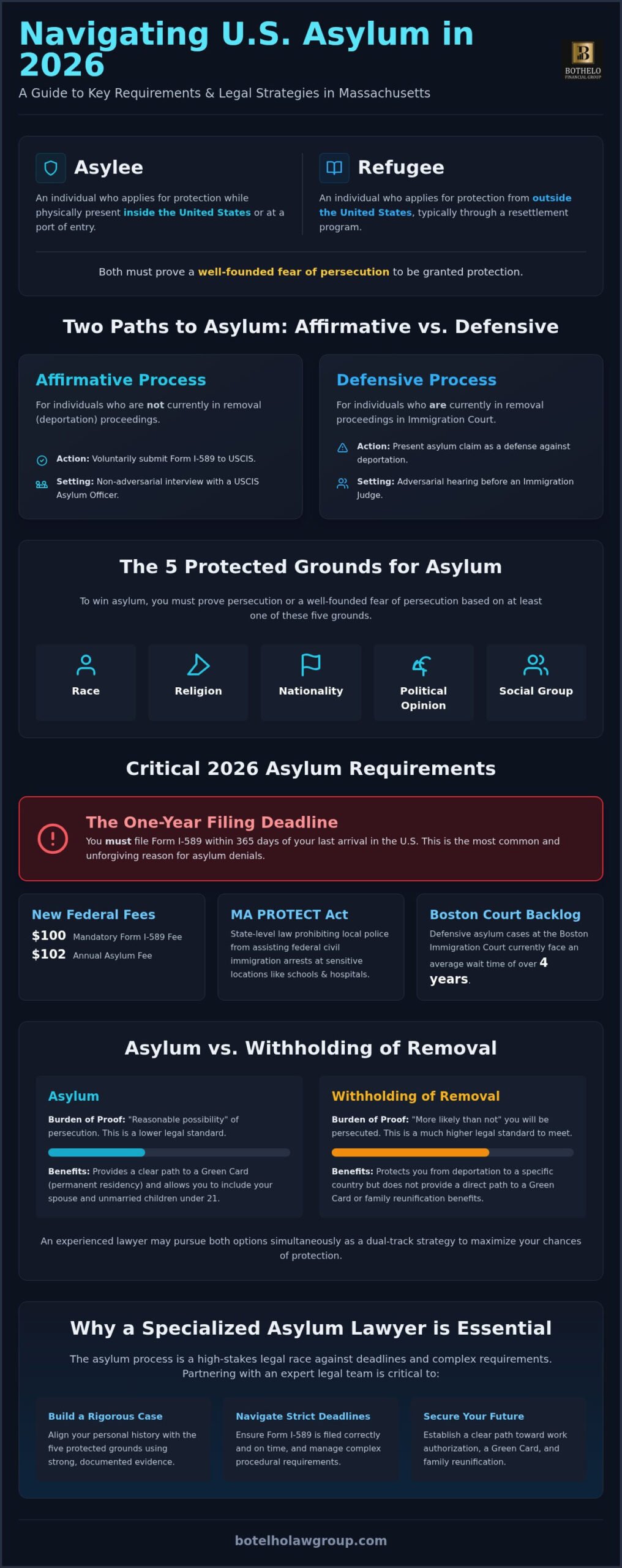
There’s often confusion regarding the difference between a refugee and an asylee. While both must meet the same legal criteria for protection, their status depends entirely on their location. A refugee is someone who applies for protection from outside the United States, often through a resettlement program. An asylee is an individual who has already reached a U.S. port of entry or is currently inside the country. Both must prove they’re unable or unwilling to return to their home country because of persecution or a well-founded fear of persecution.
Massachusetts serves as a critical jurisdiction for these cases. The 2026 legal landscape has introduced new challenges, including a mandatory $100 filing fee for Form I-589 and a $102 Annual Asylum Fee. While a Massachusetts District Court issued an injunction in August 2026 to pause the harshest consequences of non-payment, the underlying requirements remain in flux. Additionally, the Massachusetts PROTECT Act, signed in late 2026, provides state-level safeguards by prohibiting local law enforcement from participating in federal civil immigration arrests at sensitive locations like schools and hospitals. These local protections make the state a unique environment for those seeking safety, even as federal backlogs at the Boston Immigration Court continue to average over four years for defensive cases.
The Legal Definition of a Refugee
To secure protection, you must prove your fear is well-founded. This means your fear must be subjectively genuine and objectively reasonable. You don’t need to prove that persecution is certain; you only need to show a reasonable possibility of harm. This standard can be met by documenting past persecution or by showing a clear pattern of targeting against people in your specific situation. The First Circuit Court of Appeals defines persecution as a persistent and serious threat to life or freedom that exceeds mere harassment or isolated incidents of discrimination.
Asylum vs. Withholding of Removal
Asylum is the preferred status because it offers a clear path to a Green Card and allows you to include your spouse and children in your application. However, some individuals may only qualify for “Withholding of Removal.” This is a narrower form of protection with a much higher burden of proof. While asylum requires a “reasonable possibility” of persecution, withholding requires you to show it’s “more likely than not” you’d be harmed. A seasoned immigration lawyer Fall River MA will evaluate your case to determine if you should pursue both options. This dual-track strategy ensures that even if you’re barred from asylum due to technicalities, you may still receive protection from deportation.
Affirmative vs. Defensive Asylum: Which Path Are You On?
The legal framework for seeking protection in the United States is split into two distinct procedural tracks. Your specific situation determines whether you follow the affirmative or defensive path. Understanding these differences is vital; a mistake in positioning can lead to immediate complications with your status. An experienced asylum lawyer Massachusetts ensures that your application is filed correctly to maximize your chances of a favorable outcome from the start.
The most critical hurdle in either path is the “One-Year Filing Rule.” Federal law requires you to file your Form I-589, Application for Asylum within exactly 365 days of your last arrival in the country. This deadline is the most common reason for application denials. While limited exceptions exist for “changed circumstances” or “extraordinary circumstances,” they’re notoriously difficult to prove without sophisticated legal representation.
The Affirmative Process through USCIS
The affirmative process applies if you’re not currently in removal proceedings. You voluntarily submit your application to U.S. Citizenship and Immigration Services (USCIS). This stage involves a non-adversarial interview with an Asylum Officer. The environment is less formal than a courtroom, but the legal stakes are just as high. If the officer doesn’t grant your application, they’ll “refer” your case to the Immigration Court. This referral isn’t a final denial; it’s a transfer of jurisdiction. However, it means you’ll have to present your case again, this time before a judge. Accuracy in your initial filing is paramount because any contradictions between your written application and your court testimony can destroy your credibility.
Defensive Asylum in Removal Proceedings
Defensive asylum occurs when you’re already in removal proceedings and use your asylum claim as a shield against deportation. This process takes place within the Executive Office for Immigration Review (EOIR), commonly known as Immigration Court. Unlike the USCIS interview, this is an adversarial proceeding. A Department of Homeland Security (DHS) trial attorney acts as a prosecutor, looking for reasons to deny your claim.
In this high-pressure environment, you need a deportation defense lawyer who understands how to counter the government’s arguments. Botelho Law Group manages the entire transition if your case moves from USCIS to the court system. We provide the disciplined advocacy required to navigate complex litigation and protect your right to stay in the country. If you’re unsure which path applies to your case, consulting with a legal expert early can prevent costly procedural errors.
The Five Protected Grounds: Building a Winning Case
To win an asylum case in Massachusetts, your testimony must link your fear of harm to one of the five protected grounds for asylum. It isn’t enough to show that your home country is dangerous or experiencing general unrest; you must prove you’re being targeted specifically because of who you are or what you believe. An asylum lawyer Massachusetts builds this link by mapping your personal experiences to these statutory categories through a disciplined, evidence-based legal architecture.
The protected grounds include race, religion, nationality, political opinion, and membership in a particular social group (PSG). While race and religion often involve documenting systemic targeting by the state or extremist groups, political opinion claims can be more nuanced. These claims include “imputed” opinions, where a persecutor assumes you hold a certain view and targets you for it, regardless of your actual beliefs. In 2026, PSG claims remain the most complex and heavily litigated area of immigration law. A valid PSG must be socially visible and defined by an immutable characteristic that members cannot or should not be required to change. This category often covers survivors of domestic violence or individuals targeted due to their sexual orientation or gender identity.
Strategic Evidence Gathering
Success depends on a three-pronged evidentiary approach that goes beyond your personal testimony. We utilize Department of State Country Condition Reports and NGO data as a baseline to prove that your fears are objectively reasonable. We then assist you in crafting a detailed personal affidavit that provides a precise, chronological narrative of the harm you’ve faced. To strengthen the case, we gather corroborating evidence such as:
- Witness statements from individuals with firsthand knowledge of the threats.
- Medical records and forensic evaluations documenting physical or psychological trauma.
- Police reports or evidence showing that reporting the crime was futile.
Proving State Inability or Unwillingness
Establishing that you were harmed is only half the battle. You must also prove that the government in your home country was unable or unwilling to protect you. This is a critical requirement in cases involving non-state actors like cartels, gangs, or private individuals. If the police are complicit in the violence or simply lack the resources to intervene, your claim requires expert witness testimony to explain this local context to the judge. We act as a focused advocate to demonstrate that internal relocation within your home country isn’t a safe or viable option, ensuring the court understands the gravity of your situation.
The Asylum Application Timeline: Filing Form I-589 in 2026
The procedural path to legal protection is defined by rigid deadlines and specific administrative requirements. In 2026, the process begins with the meticulous preparation of Form I-589. This application must include the mandatory $100 filing fee, which cannot be waived. As your asylum lawyer Massachusetts, we ensure every detail in your written narrative aligns with the evidence to prevent discrepancies that could damage your credibility during future testimony.
Once the application is drafted, the timeline follows a structured sequence of federal interactions:
- Step 1: Submission. Filing occurs through the USCIS online portal for affirmative cases or the EOIR dedicated portal for defensive cases.
- Step 2: Biometrics. You’ll attend an appointment to provide fingerprints and photographs for mandatory security and background checks.
- Step 3: Initial Appearance. Affirmative applicants attend an interview at the asylum office, while defensive applicants attend a Master Calendar Hearing in Immigration Court.
- Step 4: The Individual Hearing. This is the merits hearing, essentially a trial where a judge or officer makes a final determination on your case.
Current data for 2026 shows that affirmative cases generally take one to three years to process. However, defensive cases in the Boston Immigration Court face significant backlogs, with average wait times reaching 4.3 years. This extended timeline makes the management of your interim legal rights essential.
Applying for Work Authorization (EAD)
One of the most critical milestones in the timeline is the 180-day asylum clock. You’re eligible to apply for an Employment Authorization Document (EAD) exactly 180 days after your Form I-589 is successfully filed. It’s vital to remember that any delay you cause, such as requesting a hearing postponement, can stop this clock and delay your ability to work legally. Securing a social security number through this process is the first step toward settling your family in Massachusetts and achieving financial independence. If you’re approaching the 180-day mark, contact Botelho Law Group to ensure your work permit application is filed without error.
Preparing for the Individual Hearing
The Individual Hearing is an intensive trial where you’ll face direct examination from your attorney and cross-examination from a government trial attorney. The judge will scrutinize your testimony for consistency against your original 2026 filing. Credible testimony is defined as testimony that’s believable, consistent, and sufficiently detailed to provide a plausible account of your fear of persecution. We conduct rigorous preparation sessions to ensure you’re ready to communicate your story calmly and accurately under the pressure of a courtroom environment.
Why Choose Botelho Law Group for Asylum Representation?
Choosing a legal representative for an asylum claim is a decision that impacts the trajectory of your entire life. At Botelho Law Group, we act as a focused advocate for individuals facing the severe consequences of removal. Our firm specializes in high-stakes litigation, providing the disciplined representation required to navigate the federal immigration system. As a seasoned asylum lawyer Massachusetts, we prioritize client safety and trust through every phase of the legal process. We treat every case with individual seriousness, ensuring that the gravity of your situation is met with sophisticated legal strategy.
Navigating the Boston Immigration Court requires more than a general knowledge of the law. It requires an understanding of the specific procedural expectations and evidentiary standards prioritized in this jurisdiction. We provide comprehensive support from the initial filing of Form I-589 through any necessary appeals. We manage the systematic breakdown of your case, ensuring that every witness statement and country report is presented with maximum impact. Our experience with local judges and government trial attorneys allows us to anticipate challenges before they arise, positioning you for the best possible outcome.
A Results-Oriented Approach to Immigration
Our firm handles the gravity of asylum cases with a professional intensity that reflects the high stakes involved. We don’t settle for superficial representation; we act as relentless fighters for our clients’ interests. This results-oriented approach is why we’re trusted to handle complex federal immigration matters in all 50 states. Whether your case is heard in Massachusetts or elsewhere, our strategic depth remains consistent. We also prepare our clients for the long-term reality of life in the U.S. If you eventually face challenges during the naturalization process, our expertise as an N-400 denial appeal lawyer ensures you have a dedicated guide to fight for your citizenship.
Schedule Your Consultation in Fall River
Preparation is the cornerstone of a successful claim. When you visit our Fall River office for an initial evaluation, please bring any existing immigration documents, police reports from your home country, and a rough timeline of the events that led to your departure. We maintain a methodical communication rhythm, ensuring you feel fully informed through the disciplined delivery of information. Our goal is to make complex systems feel manageable and systematic. We provide the calm, composed guidance you need during this high-stakes period. Contact Botelho Law Group today for a confidential evaluation of your asylum claim.
Securing Your Status in an Evolving Legal Landscape
Winning an asylum case requires a disciplined alignment of personal history with federal statutory requirements. The margin for error in 2026 is non-existent. This is particularly evident regarding the one-year filing rule and the evolving evidentiary standards for social group claims. Whether you’re pursuing an affirmative path through USCIS or a defensive strategy in the Boston Immigration Court, the precision of your legal representation determines your success.
Botelho Law Group provides the authoritative expertise and protective advocacy needed for these high-stakes matters. We offer federal representation across all 50 states and specialize in the focused deportation defense required to halt removal proceedings. Partnering with a dedicated asylum lawyer Massachusetts ensures that your case is handled with the professional intensity it deserves. We manage the systematic complexities of your application so you can focus on building a stable life for your family.
Your path to safety and legal work authorization is achievable with the right strategist by your side. Secure Your Future—Schedule an Asylum Consultation with Botelho Law Group. We’re ready to stand as your focused advocate and guide you toward a permanent future in the United States.
Frequently Asked Questions
Can I apply for asylum if I entered the U.S. illegally?
Yes, you can apply for protection regardless of your manner of entry. The law allows any individual physically present in the United States to seek asylum, provided they meet the statutory requirements. However, if you’re in removal proceedings due to an unauthorized entry, your claim will likely be defensive. This requires a disciplined legal strategy to protect your rights while navigating the Immigration Court system before the one-year filing deadline expires.
How long does the asylum process take in Massachusetts in 2026?
Processing times depend on whether your case follows the affirmative or defensive path. Affirmative cases through USCIS currently take between one and three years. Conversely, defensive cases in the Boston Immigration Court face significant backlogs, with average wait times reaching 4.3 years. An asylum lawyer Massachusetts can help you manage your legal status and maintain work authorization throughout this extended period of administrative waiting.
What happens if my asylum application is denied by the judge?
A denial isn’t always the end of your legal journey. You have the right to appeal the decision to the Board of Immigration Appeals (BIA) within 30 days of the judge’s order. If the BIA issues a denial, you may be able to petition for a review in the U.S. Court of Appeals for the First Circuit. These appeals are highly technical and require a sophisticated legal strategist to identify procedural errors.
Can I include my spouse and children in my asylum application?
Yes, you can include your spouse and unmarried children under 21 as derivatives on your application if they’re in the United States. If you’re granted asylum, you can also petition for family members who are still abroad. This is accomplished by filing Form I-730, Refugee/Asylee Relative Petition, within two years of your grant. There is no filing fee for this specific family based petition under current federal regulations.
Do I need a lawyer for my asylum interview?
While representation isn’t legally required, it’s highly recommended due to the high stakes of the interview. An asylum lawyer Massachusetts ensures your testimony is consistent with your written application and helps clarify complex legal issues for the officer. Having a professional advocate present can prevent administrative errors that lead to referrals or denials. We provide the protective advocacy needed to navigate these high pressure environments successfully.
What is the one-year filing deadline for asylum?
You must file Form I-589 within exactly 365 days of your most recent arrival in the United States. Missing this deadline is the most common reason for application rejection. Limited exceptions exist for changed country conditions or extraordinary circumstances, but they’re difficult to prove. It’s vital to submit your application and the mandatory $100 filing fee before this critical window closes to maintain your eligibility for legal protection.
Can I travel outside the U.S. while my asylum case is pending?
Traveling outside the country while your application is pending is generally discouraged and can jeopardize your claim. If you must travel, you’re required to obtain Advance Parole by filing Form I-131 before you leave. Returning to your home country while seeking protection is particularly risky. The government may interpret such travel as proof that your fear of persecution isn’t genuine or well founded, leading to a denial.
How do I prove a ‘well-founded fear’ if I don’t have police reports?
Police reports aren’t the only way to establish a credible claim. You can use detailed personal affidavits, witness statements, and medical records to document your experiences. We also utilize Department of State Country Condition Reports to show that your fears are objectively reasonable. Proving that your government is unable or unwilling to protect you often requires expert testimony that explains the local context of violence in your home country.