
Did you know that even with a valid will, your family could wait over fourteen months to access the home you left behind? In Massachusetts, the probate process is often a slow, public, and expensive ordeal that drains thousands of dollars from an estate before a single heir receives their inheritance. If you are a homeowner, understanding how to avoid probate in Massachusetts is not just a financial choice; it’s a necessary step to protect your family from unnecessary legal gridlock and rising court fees.
We understand the anxiety that comes with complex estate laws and the fear that your hard-earned assets will be consumed by administrative costs. You deserve a plan that offers certainty rather than confusion. This guide provides a clear roadmap to securing your legacy through proven legal mechanisms. You’ll discover which specific assets bypass the court system entirely, the strategic benefits of life estates, and how a revocable living trust can provide immediate protection. We will also examine how a Fall River attorney can help you execute a precise plan that keeps your private matters out of the Bristol County probate court, ensuring your property remains a blessing to your heirs rather than a legal burden.
Key Takeaways
- Learn why a simple will is often insufficient to prevent a public court process and how it functions merely as a guide for a judge.
- Discover how to avoid probate in Massachusetts by implementing a revocable living trust to ensure a seamless and private transfer of property.
- Explore the legal structure of life estates to protect your primary residence while clearly defining the future rights of your heirs.
- Identify specific asset classes that utilize ‘Payable on Death’ designations to bypass the lengthy timelines of the Massachusetts Uniform Probate Code.
- Establish a structured inventory of your assets to determine whether a trust or a life estate best serves your family’s specific protection needs.
What is Probate and Why Do Massachusetts Homeowners Avoid It?
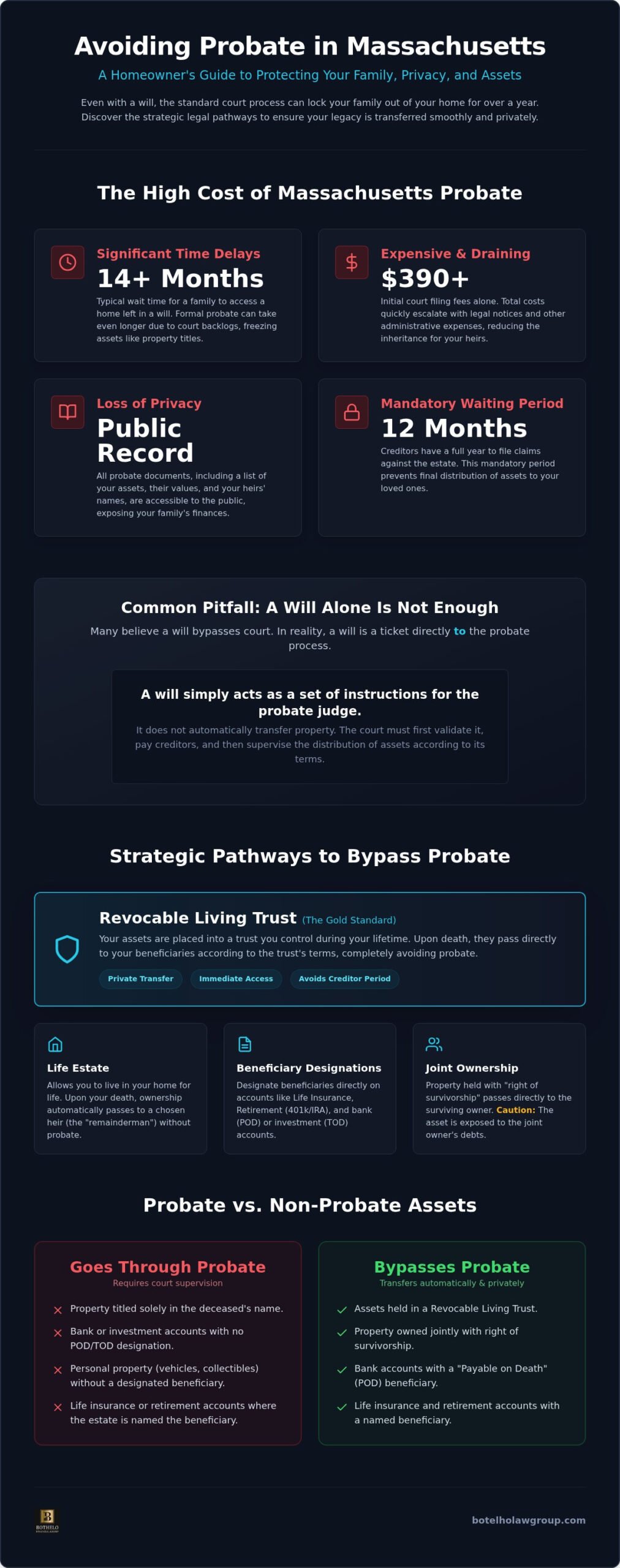
In Massachusetts, probate is the court-supervised process used to validate a will and distribute a deceased person’s assets. The Massachusetts Uniform Probate Code (MUPC), adopted in 2012, governs these proceedings. While the MUPC introduced “informal probate” to streamline simple estates, the process remains inherently bureaucratic. Learning how to avoid probate in Massachusetts is essential for homeowners who wish to maintain their family’s privacy and financial security. Because probate is a court action, every document filed, including your list of assets, their values, and the names of your heirs, becomes a public record. Anyone can access this information, which exposes your family’s private business to public scrutiny. What is Probate in the context of family privacy? It is a loss of control over who knows your financial business.
Homeowners in Bristol County often face significant delays. In 2026, even a straightforward informal probate typically takes between nine and fourteen months to conclude. If the estate requires formal probate, the timeline often stretches beyond a year due to court backlogs. The financial burden is equally pressing. Filing fees for a standard petition start at $390, consisting of a $375 petition fee and a $15 surcharge. These costs escalate quickly when you factor in mandatory legal notices in local newspapers and potential formal citation fees. These “probate taxes” reduce the total inheritance before your family receives a single dollar.
The Hidden Costs of the Massachusetts Probate Process
The most significant drain on an estate isn’t just the filing fees. It’s the administrative overhead and the mandatory waiting periods. Under Massachusetts law, creditors have a 12-month window from the date of death to file claims against the estate. This mandatory waiting period often prevents executors from making final distributions to heirs. For homeowners, this is particularly damaging. Probate can effectively freeze the title of a property, making it nearly impossible to sell or refinance the family home for over a year. During this time, the estate must continue paying property taxes, insurance, and maintenance, which often leads to a liquidity crunch for the family.
Probate vs. Non-Probate Assets
Understanding how to avoid probate in Massachusetts requires distinguishing between assets that require court intervention and those that do not. Assets held solely in the name of the deceased, such as a primary residence without a survivorship deed, must go through probate. Conversely, assets can pass by “operation of law” if they are structured correctly. Non-probate assets are those that transfer automatically to a direct beneficiary or a joint survivor without court oversight. By re-titling property or using beneficiary designations, you ensure that these assets bypass the Bristol County probate court entirely, allowing for a more efficient transfer of wealth.
Strategic Methods to Bypass Probate in Massachusetts
Strategic asset re-titling is the most effective way to ensure property transfers immediately upon death. While many residents believe a will suffices, a will actually guarantees a trip to court. To understand how to avoid probate in Massachusetts, you must focus on assets that pass by contract or operation of law. Joint Ownership with Right of Survivorship is a common tool for married couples. It allows the surviving spouse to take full ownership automatically. However, this method carries risks. If a joint owner faces a lawsuit or bankruptcy, the property could be subject to their creditors’ claims.
Financial accounts offer a simpler solution through Payable on Death (POD) or Transfer on Death (TOD) designations. These allow you to name specific individuals who will inherit the account balance without court oversight. Similarly, retirement accounts and life insurance policies utilize beneficiary designations to bypass the Massachusetts Uniform Probate Code entirely. These designations take precedence over whatever is written in your will.
The Revocable Living Trust Advantage
A revocable living trust is often the gold standard for comprehensive estate planning. Unlike a will, which only takes effect after death and court approval, a trust is an active legal entity that holds your assets. This structure creates a private bypass lane around the courthouse. For Fall River residents, a trust offers significantly more protection than a simple will because it remains private and avoids the one year creditor period. It also provides a clear framework for managing your affairs if you become incapacitated.
A critical benefit involves MassHealth estate recovery. Following a significant policy change in late 2024, Massachusetts now limits estate recovery to assets that pass through probate. By placing your home in a trust, you effectively shield it from these recovery claims. Consulting a revocable living trust attorney Fall River can help you structure these documents to maximize protection and ensure your home stays in the family.
Titling and Beneficiary Designations
Updating your accounts is a precise process. You must contact each financial institution to request POD or TOD forms. A common mistake is naming a minor as a direct beneficiary. Since minors cannot legally own property in Massachusetts, the court will still intervene to appoint a guardian, defeating the purpose of probate avoidance. We also recommend using ‘per stirpes’ designations. This legal term ensures that if a named beneficiary predeceases you, their share passes to their own children rather than being redistributed. If you are unsure if your current titles are correct, you should speak with an estate planning specialist to audit your plan.
Understanding the Life Estate: A Property Protection Tool
A life estate is a specialized deed that divides property ownership into two distinct timeframes. The original owner, known as the “Life Tenant,” retains the legal right to live in and use the property for the remainder of their life. Upon their passing, the property transfers automatically to the “Remainderman” without the need for court intervention. This mechanism is a powerful strategy for those researching how to avoid probate in Massachusetts because the transfer happens by operation of law at the moment of death. It bypasses the court entirely, ensuring that your home remains within the family without the delays of the Bristol County probate system.
One of the most significant advantages of this structure is the tax treatment. When the remainderman inherits the property, they typically receive a “step-up in basis.” This means the property’s value for capital gains tax purposes is adjusted to its fair market value at the time of the life tenant’s death, rather than the original purchase price. For a home in the Greater Boston area that has appreciated significantly, this can save heirs hundreds of thousands of dollars in taxes. It effectively combines probate avoidance with sophisticated tax planning.
Is a Life Estate Right for Your Massachusetts Home?
The primary draw of this tool is the immediate transfer of the deed. A life estate is a deeded interest that expires upon the grantor’s death. Unlike a trust, which requires ongoing management and oversight, a life estate is largely a permanent adjustment to the property title. However, it is not without risks. Once you record a life estate deed, you no longer have full control over the property. You cannot sell or mortgage the home without the written consent of the remainderman. If your relationship with your heirs is strained, this lack of autonomy can become a significant legal hurdle that prevents you from accessing your home’s equity.
MassHealth and Life Estates
In Massachusetts, planning for long-term care is often as important as probate avoidance. A life estate can protect your home from MassHealth estate recovery, but timing is everything. MassHealth applies a strict 5-year look-back period for Medicaid eligibility. If you transfer your property into a life estate less than five years before applying for benefits, you may face a period of ineligibility. Because of the permanent nature of these deeds and the complexity of state regulations, consulting an asset protection lawyer Massachusetts is vital before signing any documents. They can ensure that your deed is drafted correctly to satisfy both probate avoidance goals and long-term care eligibility requirements.
Common Pitfalls: Why a Simple Will is Not Enough
Many Massachusetts residents operate under the dangerous assumption that a last will and testament is a complete solution. In reality, a will is merely a set of instructions directed to a probate judge. It does not transfer property on its own. If you are researching how to avoid probate in Massachusetts, you must realize that a will actually guarantees court involvement. The court must validate the document, appoint the personal representative, and oversee the distribution of assets. This public process invites delays and provides a platform for disgruntled heirs to initiate “will contests.” These disputes can paralyze an estate for years, especially as court backlogs in 2026 continue to challenge the efficiency of the legal system.
Updating your legal strategy is the only way to ensure you actually achieve your goal of how to avoid probate in Massachusetts. Relying on an outdated document from a decade ago exposes your family to modern administrative hurdles. A will is a starting point, but it’s not a shield against the costs and public scrutiny of the probate court.
The Limitations of a Simple Will
A standard will offers no immediate relief for your loved ones. When a homeowner passes away, bank accounts held solely in their name are typically frozen. This means heirs cannot access funds to pay for funeral expenses or mortgage payments on the family home until the court issues “Letters of Authority.” This process often takes weeks or months. Additionally, a will provides zero protection while you are still alive. It only speaks after death. To ensure your plan is comprehensive, we recommend reviewing this Massachusetts homeowner estate planning checklist. It highlights the critical gaps that a simple will leaves wide open.
Incapacity and Probate: The Missing Link
Probate isn’t just about what happens after death. If you become incapacitated due to illness or injury, your family may face “living probate.” This is a court-supervised guardianship or conservatorship proceeding required to manage your assets and medical care. It is public, expensive, and often emotionally draining for everyone involved. You can avoid this by working with a power of attorney lawyer Fall River to establish durable documents. Combining these with healthcare directives ensures that your autonomy is preserved without court interference. If you want to secure your legacy and protect your family from these pitfalls, schedule a consultation with our estate planning team today.
Taking Action: Building Your Probate-Free Estate Plan
Building an effective plan begins with a comprehensive inventory of your assets. You must document every piece of real estate, financial account, and insurance policy you own. The critical step is reviewing how these items are currently titled. If an asset is held solely in your name, it is a primary candidate for probate. By identifying these gaps early, we can determine the most efficient path for how to avoid probate in Massachusetts based on your specific portfolio and family dynamics.
Matching the right strategy to your family goals requires a nuanced analysis. While a revocable living trust provides maximum privacy and control, a life estate might be more suitable for a homeowner whose primary concern is protecting a single residence. We examine your total estate value, which is particularly important given the $2 million Massachusetts estate tax exemption in 2026. Professional drafting is non-negotiable. Massachusetts has strict requirements for the execution of deeds and trust documents. A single missing signature or an improperly notarized page can lead to an “invalid execution,” forcing your estate back into the very court system you intended to bypass.
Botelho Law Group streamlines this transition by acting as your protective advocate. We don’t just draft documents; we ensure your assets are properly aligned with your new legal structure. This process, often called “funding the trust,” is where many DIY plans fail. We provide the technical oversight necessary to ensure that how to avoid probate in Massachusetts becomes a reality for your family rather than just a theoretical goal.
The Consultation Process in Fall River
When you visit our office for your initial estate planning meeting, we ask that you bring copies of your property deeds, recent bank statements, and any existing legal documents. This allows us to evaluate your tax and family situation with precision. We don’t believe in one-size-fits-all solutions. Our team creates a structured timeline for your document execution, ensuring that every asset is properly titled. This methodical approach is designed to prevent future court backlogs from impacting your heirs and to ensure your plan is ready for the 2026 legal environment.
Securing Your Legacy Today
Proactive planning offers a level of peace of mind that a simple will cannot provide. In the 2026 legal landscape, where court delays are common, the most compassionate gift you can leave your family is an estate that requires no judicial intervention. By acting now, you take a defensive stance against rising fees and public scrutiny. We invite you to take the first step toward a secure future. Contact Botelho Law Group for a comprehensive estate review to ensure your assets are protected and your family’s privacy is maintained.
Securing Your Legacy Through Strategic Planning
Effective estate planning in 2026 requires more than just a standard will. Relying on a document that guarantees court involvement only invites unnecessary delays and public scrutiny. By utilizing revocable living trusts and life estates, you can ensure your home and assets transfer immediately to your heirs. Mastering how to avoid probate in Massachusetts is about taking control before the court system dictates your family’s financial timeline.
Botelho Law Group provides focused advocacy for Massachusetts homeowners. We offer deep expertise in Bristol County Probate Court procedures and provide comprehensive trust and life estate planning tailored to your specific goals. You don’t have to navigate these complex legal requirements alone. Secure your legacy and avoid the stress of probate; schedule your consultation with Botelho Law Group today. Taking this proactive step today ensures your hard-earned assets remain a protected source of support for your loved ones for generations to come.
Frequently Asked Questions
Does a will avoid probate in Massachusetts?
No, a will does not avoid probate; it serves as the primary document that initiates the process. The Massachusetts Uniform Probate Code requires that a will be filed and validated by the court before assets are distributed. If your goal is learning how to avoid probate in Massachusetts, you should look beyond a simple will. Relying solely on a will ensures your estate remains a public record and subjects your heirs to court timelines.
How much does an estate have to be worth to go to probate in MA?
There is no minimum dollar threshold that triggers probate in Massachusetts. If you own any asset solely in your name, such as a bank account or a home, your family must go through court to transfer the title. Even an estate with minimal value requires a filing. For estates with personal property valued at $25,000 or less and no real estate, a simplified voluntary administration process is available, but it is still a court filing.
Can I avoid probate by putting my house in a life estate?
Yes, a life estate is an effective tool to ensure your home bypasses the courtroom. By recording a life estate deed, you maintain the right to live in the property while naming a remainderman who inherits it automatically upon your death. This transfer occurs by operation of law, meaning the house never becomes part of your probate estate. It’s a direct strategy for homeowners focused on how to avoid probate in Massachusetts.
Is a revocable living trust better than a life estate in Massachusetts?
A revocable living trust generally offers superior flexibility and protection compared to a life estate. While a life estate is specific to real property and requires the heir’s permission to sell the home, a trust covers all your assets and keeps you in total control. Trusts also provide for incapacity planning, which a life estate cannot do. Most homeowners find that a trust’s comprehensive nature justifies the setup over the narrower life estate deed.
What happens if I die without a will or trust in MA?
Dying without a plan means your estate is intestate, and assets are distributed according to strict state laws. This often leads to results you didn’t intend, such as a spouse sharing the estate with children from a previous marriage. Intestate estates are frequently 20% to 40% more expensive to settle because they require more court oversight and potential bond requirements. Your family also loses the ability to choose who manages your private affairs.
How long do you have to file probate after death in Massachusetts?
Under Massachusetts law, the person in possession of a will must deliver it to the probate court within 30 days of the death. While there isn’t a strict deadline for opening the full probate administration, delays can complicate the payment of taxes and creditors. Filing the estate tax return, Form M-706, is required within nine months of death. Waiting too long to initiate the process can lead to interest penalties and frozen financial assets.
Are joint bank accounts subject to probate in MA?
Joint bank accounts with a right of survivorship are not subject to probate and transfer automatically to the surviving owner. This is one of the simplest non-probate transfers available. However, you should be cautious when adding children to accounts. This action exposes your funds to their creditors or potential legal judgments. While it avoids court, it introduces liability risks that a trust or beneficiary designation would otherwise prevent for your family.
What is the small estate limit for probate in Massachusetts?
The small estate limit for voluntary administration in Massachusetts is $25,000 in personal property, excluding the value of one motor vehicle. To qualify for this streamlined process, the estate must not contain any real estate. If the deceased owned a home, the estate must go through formal or informal probate regardless of the personal property’s value. This highlights why homeowners must use deeds or trusts to keep their real property out of court.