
Receiving a Notice to Appear in immigration court is not merely a legal summons; it’s a direct threat to the life you’ve built in the United States. In the current climate of 2026, where filing fees for Form EOIR-42B have risen to $1,690, securing a specialized cancellation of removal lawyer is the most critical step in protecting your future. You likely feel the heavy weight of potential family separation and uncertainty about how past criminal records might impact your case. It’s a rational fear because cancellation of removal is a once-in-a-lifetime form of relief. If your application is denied, you cannot apply again.
You deserve a defense that treats your case with the gravity it requires. This guide demonstrates how expert legal representation can stop the deportation process and secure your legal status through strategic hardship advocacy. Whether you’re a permanent resident protecting your existing Green Card or a non-LPR seeking a path to stay, we provide the clarity you need. We will examine the specific eligibility requirements, the critical role of quantifying “exceptional and extremely unusual hardship,” and the systematic approach needed to navigate the Executive Office for Immigration Review.
Key Takeaways
- Understand that cancellation of removal is a specific form of relief reserved for individuals already in removal proceedings before an immigration judge.
- Learn how a specialized cancellation of removal lawyer identifies jurisdictional defects in your Notice to Appear to build a robust defense strategy.
- Distinguish between the eligibility requirements for Lawful Permanent Residents (42A) and the 10-year physical presence rule for non-permanent residents (42B).
- Gain insight into the high evidentiary bar for proving “exceptional and extremely unusual hardship” to qualifying U.S. citizen or permanent resident family members.
- Explore the benefits of protective advocacy in navigating the complex Executive Office for Immigration Review (EOIR) system to secure your legal status.
What is Cancellation of Removal and How Does It Work?
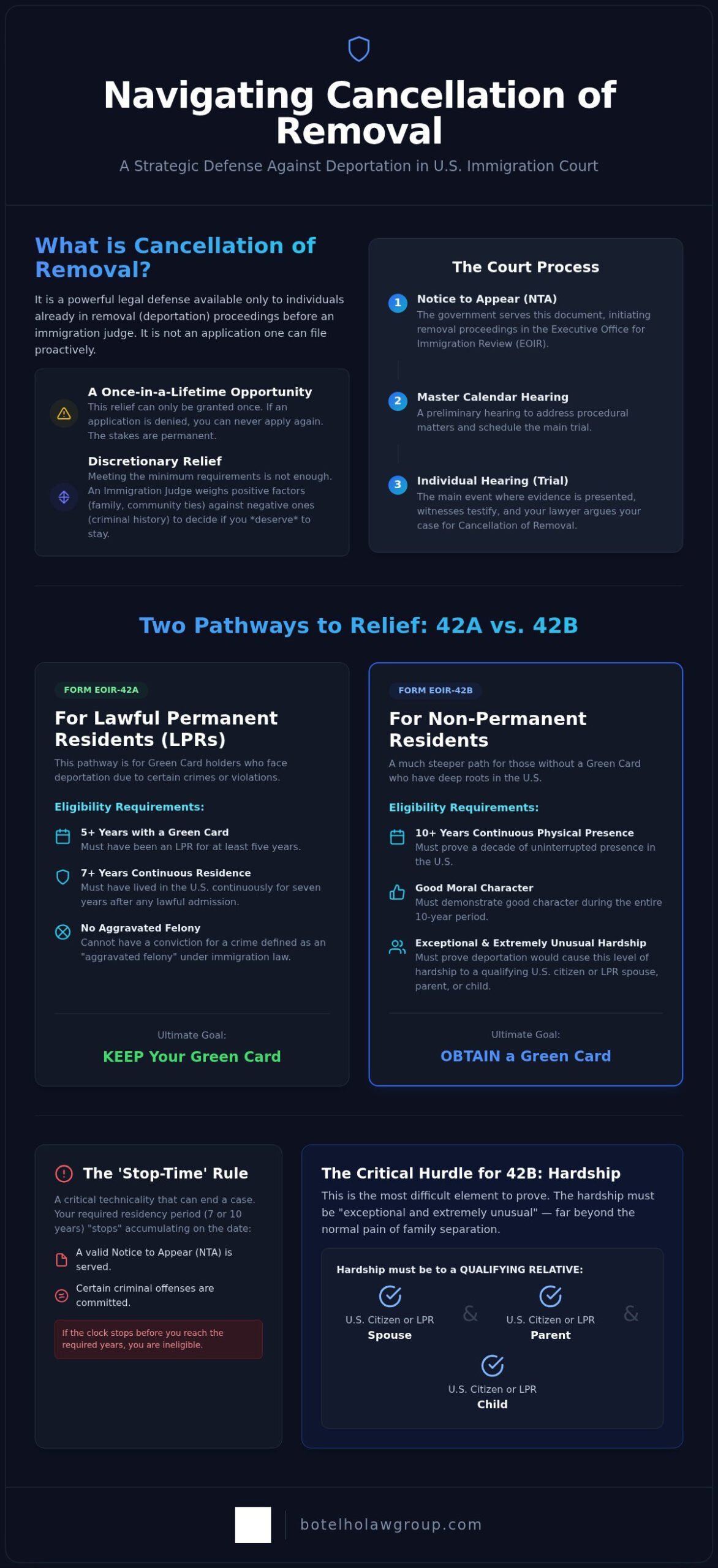
Cancellation of removal serves as a powerful defensive mechanism for individuals facing deportation. Under the Immigration and Nationality Act (INA), this form of relief allows an immigration judge to cancel the removal of a person and grant them permanent residency or allow them to keep their existing Green Card. It’s a high-stakes litigation battle rather than a standard administrative process. To qualify, you must already be in active removal proceedings. If you are wondering What is Cancellation of Removal?, it’s essentially a legal second chance granted by the court. You must understand that this is often a one-shot opportunity; if you fail to present a complete case, the consequences are permanent.
The system recognizes two primary pathways. Form EOIR-42A is designed for Lawful Permanent Residents (LPRs) who have committed certain crimes or violations. Form EOIR-42B is for non-permanent residents who have lived in the U.S. for at least a decade. A cancellation of removal lawyer must precisely determine which path applies to your specific history, as the legal standards differ significantly between the two. This distinction is critical because applying for the wrong relief can lead to an immediate denial of your case.
The Role of the Immigration Court (EOIR)
Your case begins when the government serves you with a Notice to Appear (NTA). This document lists the charges and initiates formal litigation. Unlike a standard visa application, this is a trial within the Executive Office for Immigration Review (EOIR). You will first attend a Master Calendar Hearing to address procedural matters. The real battle happens during the Individual Hearing. This is the trial where your cancellation of removal lawyer presents evidence and examines witnesses. The judge acts as the sole decision-maker throughout this process.
Why This is “Discretionary” Relief
Winning requires more than meeting basic residency rules. Cancellation of removal is “discretionary” relief. This means the judge isn’t legally required to grant your application even if you meet every technical rule. You must prove you deserve a “favorable exercise of discretion” based on your character and community contributions. Discretion refers to the judge’s power to weigh positive factors against negative ones. Your legal team must systematically highlight your family obligations and rehabilitation to ensure the judge sees you as an asset to the country.
Eligibility Requirements: 42A vs. 42B Pathways
Qualifying for relief depends entirely on your current legal status and your history within the United States. For Lawful Permanent Residents, the 42A pathway requires you to have held your Green Card for at least five years. Additionally, you must demonstrate seven years of continuous residence in the U.S. after being lawfully admitted in any status. You cannot have a conviction for an aggravated felony. The legal definition of cancellation of removal establishes these as baseline thresholds. If you meet these technical marks, the court then evaluates your case through a discretionary lens to decide if you deserve to keep your status.
Non-permanent residents face a much steeper climb under the 42B pathway. You must prove ten years of continuous physical presence in the United States. During this entire decade, you must maintain “Good Moral Character.” The court evaluates this by reviewing your criminal record, tax filings, and community involvement. Finally, you must prove that your deportation would cause “exceptional and extremely unusual hardship” to a qualifying relative. These relatives are strictly limited to a U.S. citizen or LPR spouse, parent, or child. If you do not have a relative in one of these specific categories, you are generally ineligible for 42B relief.
The Stop-Time Rule: A Case-Ending Trap
The “Stop-Time Rule” is a technicality that often ends cases before they truly begin. Your residency clock stops the moment the government serves you with a valid Notice to Appear (NTA) or when you commit certain criminal offenses. Recent Supreme Court rulings, specifically Pereira v. Sessions and Niz-Chavez v. Garland, have redefined these requirements. An NTA must be a single, complete document containing the time and place of the initial hearing to effectively stop your clock. A cancellation of removal lawyer will perform a forensic audit of your NTA. If the document was defective, your residency clock may have continued to run, potentially making you eligible for relief you previously thought was unavailable.
Criminal Disqualifications and Aggravated Felonies
Not every criminal conviction is fatal to a case, but “aggravated felonies” act as permanent bars. Offenses like murder, rape, or high-value theft fall into this category. However, many offenses that make you “deportable” do not necessarily make you “disqualifying” for 42B relief. This distinction is subtle but vital for your defense. A “Cradigraduation” analysis is required to determine how a specific state conviction translates into federal immigration law. If you are facing charges, you should consult with a focused advocate who understands how to navigate these overlapping legal systems.
Proving “Exceptional and Extremely Unusual Hardship”
For non-permanent residents, the core of a 42B case rests entirely on the hardship faced by qualifying relatives rather than the applicant. You must demonstrate that your removal would cause “exceptional and extremely unusual hardship” to a spouse, parent, or child who is a U.S. citizen or Lawful Permanent Resident. According to the Cancellation of Removal Definition, this is a significantly higher legal bar than the “extreme hardship” standard applied in standard inadmissibility waivers. It’s not enough to show that your family will be sad or face financial struggle; you must prove the impact would be substantially beyond the ordinary consequences of deportation.
Immigration judges do not look at any single factor in isolation. Instead, they evaluate the totality of circumstances. This means your cancellation of removal lawyer must weave together multiple threads of your family’s life to present a compelling narrative of necessity. The court considers the age, health, and circumstances of your qualifying relatives to determine if the collective weight of these factors meets the high statutory threshold. If you fail to connect these dots through a systematic presentation of evidence, the judge may find the hardship insufficient to warrant relief.
Categories of Hardship Evidence
Building a successful case requires detailed documentation across several categories. Medical hardship is often the most persuasive, particularly when a relative suffers from a chronic illness that requires specialized U.S. healthcare unavailable in your home country. Educational factors also carry significant weight, especially for special needs children who rely on Individualized Education Programs (IEPs) or those who have spent their entire lives in the U.S. and don’t speak the language of your country of origin. Finally, we must document the psychological and financial impact on your family if they lose their primary caregiver or breadwinner.
Quantifying the Narrative
A seasoned cancellation of removal lawyer uses expert testimony to turn personal stories into undeniable legal facts. We often involve psychologists to assess the trauma children might face or medical doctors to testify about the necessity of specific treatments. Additionally, we use country condition reports to prove that relocating your family would be dangerous or would result in a complete lack of essential services. Standard hardships like economic loss are rarely enough to win without a lawyer. You must provide the court with objective, third-party data that validates the severity of your family’s specific situation.
The Legal Strategy: How a Lawyer Defends You in Court
A cancellation of removal lawyer initiates your defense by performing a forensic audit of the Notice to Appear (NTA). We scrutinize this document for jurisdictional defects or factual errors that could lead to a dismissal of the charges. Once the foundation is set, we move to the formal filing of Form EOIR-42A or EOIR-42B. In 2026, these filings require a significant financial commitment, with total fees set at $730 for permanent residents and $1,690 for non-permanent residents following the implementation of the One Big Beautiful Bill Act. These applications must be filed directly with the immigration court, accompanied by an evidence package that often exceeds several hundred pages of documented proof.
The core of our strategy involves preparing you for the Individual Hearing. This is a full trial where your testimony is scrutinized by both the judge and the government. We meticulously organize your evidence, ranging from medical records to community letters, ensuring every claim of hardship is backed by objective data. Preparation isn’t limited to what you say; it includes anticipating the specific inquiries the judge will make based on their previous rulings and legal philosophy. Our goal is to present a narrative so thorough that it compels a favorable exercise of discretion.
Navigating the Boston Immigration Court
If your case is heard at the JFK Federal Building in Boston, local expertise is indispensable. The Boston Immigration Court has its own unique communication rhythm and procedural preferences. Having an immigration lawyer in Fall River MA provides a distinct logistical advantage. We understand the tendencies of the local EOIR judges and the regional DHS prosecutors, allowing us to tailor your defense to the specific environment of the Massachusetts court system. This localized knowledge ensures that no procedural detail is overlooked during your high-stakes litigation.
Cross-Examining the DHS Prosecutor
DHS prosecutors are trained to identify inconsistencies in your story to undermine your credibility. A specialized cancellation of removal lawyer acts as your shield during this aggressive questioning. If you become overwhelmed or confused, we intervene to rehabilitate your testimony through redirect examination. We also monitor every piece of evidence the government attempts to introduce, objecting to inadmissible or prejudicial information that could unfairly damage your standing before the judge. This protective advocacy is what separates a successful defense from a deportation order. To secure your future in the United States, you should consult with a dedicated legal strategist before your next court date.
Why Botelho Law Group is Your Focused Advocate
Botelho Law Group operates as a sophisticated legal strategist for those facing the most severe immigration consequences. We prioritize a results-oriented approach that balances technical legal precision with a deep understanding of the human stakes involved. As a cancellation of removal lawyer, we recognize that your case isn’t just a file number; it’s the preservation of your family’s future. While we are based in Fall River, Massachusetts, our authority extends nationwide. We represent clients in all 50 states for federal immigration matters, providing a powerful, stable presence in any immigration court across the country.
Our communication style is direct and serious. We don’t offer vague promises; we deliver structured, evidence-based litigation. This professional intensity ensures that every client feels fully informed and prepared for the rigors of the Executive Office for Immigration Review. We position ourselves as your relentless fighter, ensuring that the government’s arguments are met with a disciplined and comprehensive defense. Our firm strikes the balance between being a large-scale authority and a localized, accessible partner for every family we represent.
A Comprehensive Defense Strategy
Successful removal defense requires looking beyond the courtroom. We are a full-service firm, which means we understand how deportation impacts your family’s assets and long-term security. Our team integrates insights from an estate planning lawyer to ensure your autonomy and property are protected regardless of the case’s outcome. We take a methodical approach to building your hardship narrative, quantifying the “exceptional and extremely unusual” factors with expert precision. This top-down strategy transforms a chaotic legal threat into a manageable, systematic defense plan.
Contacting Our Fall River Office
Time is your most critical asset when you receive a Notice to Appear. Missing a court deadline or failing to file your application correctly can lead to an immediate order of removal. When you hire a cancellation of removal lawyer from our firm, you gain a partner who understands the urgency of these proceedings. Our initial consultation process is designed to audit your history and identify the most viable path to legal status. We act as your dedicated guide through these complex systems, providing the protective advocacy you need to stay in the United States. Schedule your deportation defense consultation with Botelho Law Group today.
Securing Your Future Through Strategic Litigation
Navigating the immigration court system requires more than just meeting residency requirements. It demands a systematic defense that transforms your personal history into a compelling legal narrative. You’ve learned that whether you’re an LPR or a non-permanent resident, the standard for relief is high and the opportunity is singular. Success hinges on your ability to quantify hardship and survive aggressive cross-examination by government prosecutors. Don’t leave your status to chance when the legal consequences are permanent.
Securing a specialized cancellation of removal lawyer is the most decisive action you can take to protect your family from separation. Botelho Law Group provides the focused advocacy required for such high-stakes litigation. We represent clients in all 50 states and offer full-service legal support to address the broader impacts on your family and estate. Our team is ready to act as your dedicated guide through these complex federal systems, providing the stable and reliable presence your case requires.
Contact Botelho Law Group for Expert Removal Defense and take the first step toward securing your right to stay in the United States. We are committed to fighting for your future with the precision and intensity your case deserves.
Frequently Asked Questions
Can I apply for cancellation of removal if I don’t have a Green Card?
Yes, you can apply through the 42B pathway designed for non-permanent residents. This process requires you to prove ten years of continuous physical presence in the United States and maintain good moral character. You must also demonstrate that your deportation would cause “exceptional and extremely unusual hardship” to a qualifying U.S. citizen or Lawful Permanent Resident relative. This is a defensive application filed only after you are placed in removal proceedings.
What is the “10-year rule” for deportation defense?
The “10-year rule” refers to the mandatory period of continuous physical presence required for non-permanent residents to seek relief. You must have lived in the U.S. for at least a decade before the government serves you with a Notice to Appear (NTA). Under the “stop-time rule,” the clock stops the moment the NTA is issued or when certain crimes are committed, making the timing of your entry critical to your eligibility.
Will a criminal record prevent me from winning cancellation of removal?
A criminal record is not always a disqualifier, but certain offenses create permanent bars. Aggravated felonies will prevent you from seeking this relief entirely. For other crimes, a cancellation of removal lawyer must perform a detailed analysis to determine if the offense impacts your “good moral character” or makes you legally ineligible. Specialist expertise in defense strategies, such as that offered by SLKQ Lawyers, is often necessary to interpret how past charges affect current proceedings. The judge has the discretion to weigh your past mistakes against your positive contributions to your community and family.
Yes, you are eligible to apply for an Employment Authorization Document (EAD) once your EOIR-42A or 42B application is formally filed with the immigration court. This permit allows you to work legally in the United States while your litigation proceeds. Given that cases in the Boston Immigration Court can take several years to conclude, this work authorization provides essential financial support for your family during the high-stakes legal process.
What happens if the Immigration Judge denies my cancellation of removal application?
If the judge denies your application, they will typically issue an order of removal. However, you have the right to appeal this decision to the Board of Immigration Appeals (BIA) within 30 days. Filing a timely appeal usually stays the deportation, allowing you to remain in the country while the BIA reviews the case for legal errors. This stage of litigation is highly technical and requires a sophisticated legal strategy to succeed.
Is there a limit on how many cancellation of removal cases are granted each year?
Yes, there is a statutory cap for non-permanent residents applying under the 42B pathway. Congress limits these grants to 4,000 per fiscal year for the entire United States. Because the number of qualified applicants often exceeds this limit, you may receive a “grant in principle” from a judge but face a waiting period of several years before your Green Card is officially issued and your status is finalized.
Do I need a lawyer for my Master Calendar Hearing in Boston?
While representation is not legally required, appearing without a cancellation of removal lawyer at the JFK Federal Building is extremely risky. The Master Calendar Hearing is where you must plead to the government’s charges and formally request your path to relief. Any procedural errors or admissions made during this hearing can permanently damage your defense. Local counsel from Fall River understands the specific tendencies and procedural expectations of Boston immigration judges.
What counts as “exceptional and extremely unusual hardship”?
This standard is a very high legal bar that goes beyond the normal pain of family separation. It typically involves severe circumstances, such as a child with a chronic medical condition requiring specialized U.S. care or a relative with unique educational needs that cannot be met abroad. Judges evaluate the totality of the circumstances, including the health, age, and financial dependence of your qualifying U.S. citizen or permanent resident relatives.