
What if the most important part of your citizenship interview preparation is making sure your answers match the facts in your N-400? It’s understandable to feel uncertain about the questions, required documents, or what to do if your memory differs from what you wrote on the application. A citizenship interview preparation attorney can help you review those details and prepare to answer truthfully and clearly.
The naturalization interview generally includes a review of your N-400, an English test, and a civics test. Careful preparation can help you understand the process, organize relevant records, and discuss your application accurately. It can also help you identify concerns that may call for individual legal review, such as extended absences or a complicated immigration history.
This article explains what to expect, how to prepare your documents and answers, and when an attorney’s guidance may be useful. Botelho Law Group, based in Fall River, Massachusetts, represents naturalization and citizenship applicants nationwide, providing case-specific review and organized guidance without promising a particular outcome.
Key Takeaways
- A naturalization interview focuses on your N-400 and eligibility; it is different from a marriage-based green card interview.
- Review your submitted N-400 for updates or answers that may need explanation, and organize the interview notice and documents USCIS requests.
- Prepare in sequence: review your application, practice clear and truthful answers, then study the English and civics requirements that apply to your case.
- A citizenship interview preparation attorney can provide case-specific guidance, especially when your immigration history includes issues that may require careful review.
- On interview day, follow your notice, bring requested materials, and ask respectfully for clarification if you do not understand a question.
U.S. Citizenship Interview: Process and Attorney Prep
A naturalization interview is a USCIS appointment where an officer reviews your Form N-400 and assesses your eligibility for citizenship. The officer may confirm your identity, go through information in your application, and ask follow-up questions when an answer needs clarification. This is a general description, not a guaranteed script. The interview details and applicable testing requirements can depend on your circumstances and current USCIS procedures.
The purpose differs from a marriage-based green card interview. A marriage interview generally concerns eligibility for permanent residence based on a marital relationship. A naturalization interview focuses on your citizenship application and the legal requirements for naturalization. For broader background on citizenship and naturalization, see this overview of U.S. nationality law.
How the N-400 interview generally works
Expect the officer to use your submitted N-400 as a central reference, but don’t assume every applicant will be asked questions in the same order. The officer may review identity information and application responses, then ask follow-up questions about entries that are unclear or need updating. For example, an answer about travel, employment, or family circumstances may prompt a request for more detail. Listen carefully and answer based on what you know, rather than trying to predict a fixed list of questions.
Interview procedures and test rules can change, and individual circumstances may affect what applies. Review your appointment notice and current USCIS instructions before relying on specific steps or testing details.
What an attorney can help you prepare
A citizenship interview preparation attorney can review your N-400 with you, identify answers that may need clarification, and help you organize a clear, truthful way to explain relevant facts. Preparation should not mean memorizing a script. Rehearsing answers word for word may leave you less prepared if the officer phrases a question differently or asks for additional context.
An attorney’s role is to help you understand your application, prepare to explain it accurately, and address case-specific concerns before the interview. That review can be especially useful if you notice a possible error, an answer that has changed since filing, or a complicated part of your immigration history. Counsel can help you consider how to address those issues carefully. Preparation supports informed participation, but it does not guarantee an outcome.
What should you review before your citizenship interview?
Start with the version of Form N-400 you submitted, not a blank copy or memory alone. Read each answer carefully and compare it with your current circumstances and any records that may help confirm dates or details. The goal is to identify what needs an update or explanation before the appointment, not to make an accurate answer sound more favorable.
Review Form N-400 against your current circumstances
Mark any dates you’re unsure about, information that may have been omitted, and answers that have changed since you filed. For example, note a move after filing or a change in employment or family circumstances. Be prepared to distinguish between what was true when you submitted the form and what is true now. Don’t alter an accurate past answer to match your present situation. Flag the difference and determine how to explain it truthfully.
Keep two kinds of notes: facts you can verify and questions you need to resolve. A citizenship interview preparation attorney can review potential inconsistencies with you and help assess whether an issue calls for legal guidance before the interview. If the concern involves a complicated history or an answer with possible legal consequences, avoid relying on guesswork. USCIS explains its general interview and testing information in The Naturalization Interview and Test; your appointment notice provides instructions specific to your case.
Organize documents and a clear personal timeline
Use the interview notice as your starting point. Follow its instructions about documents to bring rather than assuming every applicant needs the same materials. Document requests can vary, so a universal checklist may leave out what matters in your case or prompt you to carry unnecessary records.
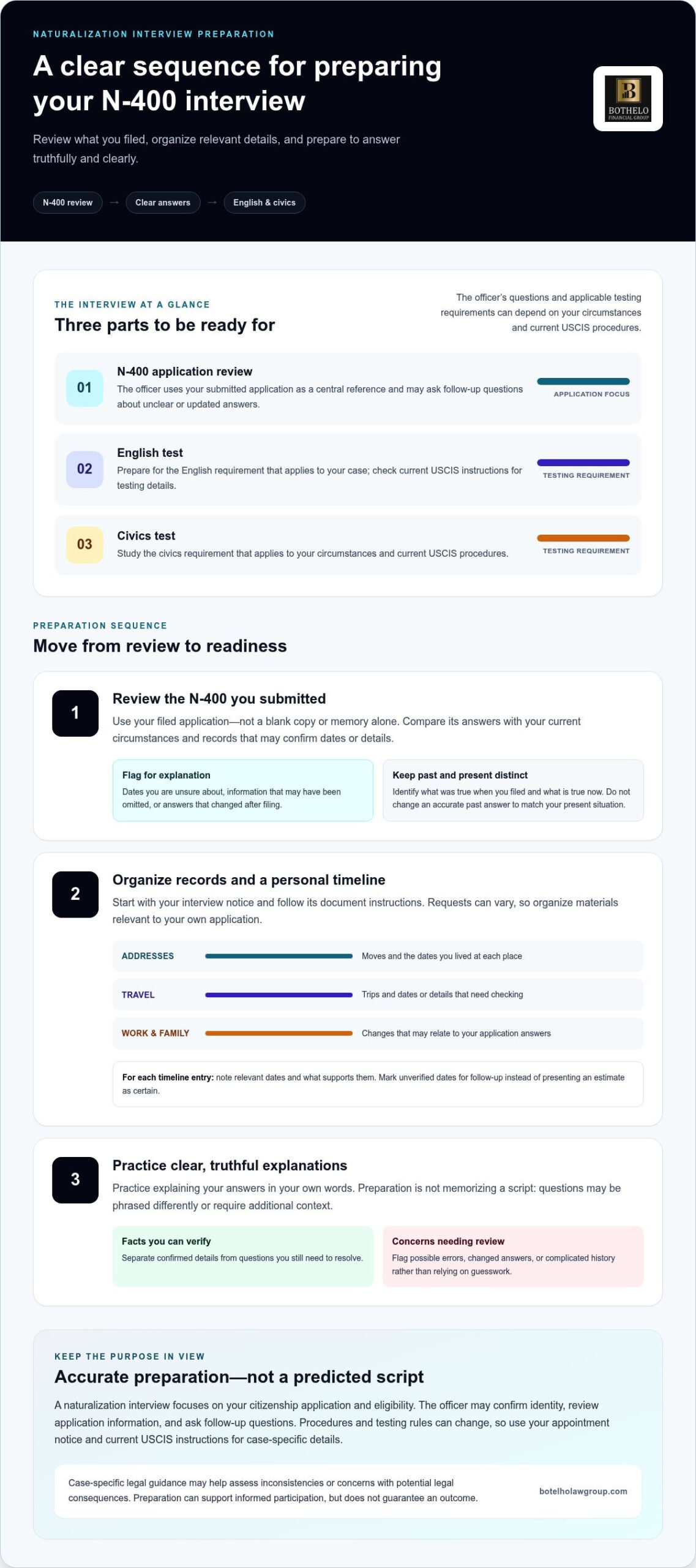
Organize relevant materials by topic, such as address history, travel, employment, or family changes. Label folders or sections clearly so you can locate a record if the officer asks about it. A short timeline can also make preparation more manageable. Include relevant dates and events, then note what supports each entry. If you can’t verify a date, mark it for follow-up instead of presenting an estimate as certain.
- Addresses: List moves and the dates you lived at each place.
- Travel: Note trips and any dates or details that need checking.
- Work and family: Record changes that may relate to your application answers.
Clear organization helps you respond accurately without treating every uncertainty as a legal problem. For case-specific guidance reviewing a naturalization application, see Botelho Law Group’s naturalization representation.
How do you prepare for N-400 questions, English, and civics testing?
Use a consistent sequence: review your filed N-400, practice explaining your answers, then study the test rules that apply to your case. This keeps preparation grounded in your actual application instead of a generic question list. The English and civics portions are part of the naturalization process for many applicants, but applicable requirements can depend on filing date and individual circumstances.
Practice discussing your own N-400 answers
Use your submitted application as the basis for practice. Read each response, then explain it aloud in your own words. Focus on details that may need a clear account, such as dates, travel, or a change since filing. If you don’t remember a date precisely, don’t guess. Say what you know accurately and explain what you’re uncertain about. If you don’t understand a question during the interview, ask the officer to clarify or repeat it.
Practice builds familiarity with your facts; memorizing scripted answers can make it harder to respond accurately when a question is phrased differently. A citizenship interview preparation attorney can help identify application topics that may require careful explanation and prepare you to discuss them truthfully, without coaching you to give a particular answer.
Prepare for the English and civics portions
The English test generally involves speaking, reading, and writing, while the civics portion assesses knowledge of U.S. government and history. Which civics test applies depends on when you filed Form N-400. Under current guidance described by USCIS, applicants who filed on or after October 20, 2025, take the newer test: from a bank of 128 questions, the officer asks 20, and applicants must answer 12 correctly. Applicants who filed before that date take the 2008 version, with 10 questions drawn from a pool of 100 and 6 correct answers required to pass.
These details can change. Confirm the test version and current rules directly with USCIS, including whether an exemption or accommodation may apply to your situation. Don’t rely on a study guide that may describe a different test version.
- Review: Read your N-400 and identify answers you need to explain.
- Practice: Give clear, truthful responses aloud, then revisit areas where you feel unsure.
- Study: Use current official USCIS materials for the test that applies to your filing.
Short, regular study sessions can help you build recall while leaving time to review application details. Keep practice manageable and focused. Accurate answers and an understanding of the applicable test rules matter more than rehearsing a polished script.
When is an attorney especially helpful for citizenship interview preparation?
Not every naturalization applicant needs the same level of legal preparation. If your application is complete, your answers remain accurate, and your history is straightforward, you may focus mainly on understanding the interview and preparing for the tests. A history with unresolved questions, however, can call for individualized review before the appointment. The right level of support depends on the facts, not a one-size-fits-all checklist.
Circumstances that may warrant individualized legal review
Consider seeking case-specific advice if you find an unclear answer, discover a possible omission, or realize that important information has changed since you filed. Prior immigration complications, extended absences, or a criminal-history concern may also deserve careful review. None of these facts alone determines eligibility or predicts an outcome. Their significance depends on the details and how they relate to your application.
Be especially cautious before deciding how to address a sensitive disclosure. Don’t omit information or revise an answer simply because you’re concerned it could be unfavorable. An attorney can review the relevant history, help identify what needs explanation, and advise you on how to approach the issue truthfully. The purpose is informed preparation, not a promise of approval or assurance that every concern can be resolved.
Preparing independently versus working with counsel
Independent preparation can help you learn the general interview format, review current USCIS testing materials, and practice speaking clearly. It can familiarize you with the process, but it cannot by itself determine the legal significance of an unusual fact or resolve uncertainty in an individual application.
A citizenship interview preparation attorney can focus on application-specific concerns: comparing answers with your history, identifying inconsistencies that may need context, and helping you prepare an accurate explanation. Counsel can also help you separate a question of ordinary recall from one that calls for legal analysis. Representation does not guarantee approval or prevent every issue, but it can provide structured guidance tailored to your circumstances.
Botelho Law Group, based in Fall River, Massachusetts, represents naturalization and citizenship applicants nationwide, including clients across all 50 states. If an application answer, past immigration matter, or other concern feels difficult to assess alone, explore immigration legal support from Botelho Law Group for case-specific guidance before your interview.
What should you do on interview day and after the USCIS appointment?
Use your appointment notice as the authority for where to go, when to arrive, and what to bring. Give yourself enough time to travel and follow any location-specific instructions. A calm, organized arrival can help you focus on listening carefully and answering the officer’s questions accurately.
A practical checklist for the appointment
Before leaving, review the notice and confirm that you have the identification and any documents USCIS specifically requested. Don’t assume every applicant needs the same materials. Prepare according to your notice and your case, not a generic checklist copied from someone else.
- Recheck the appointment date, time, location, and instructions.
- Bring the identification and documents requested for your appointment.
- Plan your route and allow time to arrive as directed.
- Listen to each question, answer truthfully, and ask respectfully if you need a question repeated or clarified.
If you realize that you don’t know or remember a detail, don’t guess to fill the silence. Explain what you know as clearly as you can. A citizenship interview preparation attorney can help you prepare for issues you’ve identified in advance, but the interview itself calls for direct, honest answers rather than a memorized script.
After the interview: understand the next communication
The appointment may not be the final step. USCIS may communicate a decision or provide further instructions, and what happens next depends on the agency’s review and your individual case. An interview approval does not itself complete naturalization; applicants who are approved must complete the oath ceremony to become U.S. citizens.
Read every notice carefully, keep copies with your immigration records, and respond to any request by the deadline stated. If you receive a decision you don’t understand or have concerns about a denial, review the notice promptly and consider obtaining legal advice. You can read more about N-400 denial appeal guidance.
For case-specific help reviewing your N-400 and preparing to discuss it with USCIS, you can discuss citizenship interview preparation with Botelho Law Group. The firm represents immigration clients nationwide, with guidance tailored to the applicant’s circumstances and no promise of a particular outcome.
Prepare with Clarity for Your N-400 Interview
A focused interview plan starts with an accurate review of your N-400, organized documents, and truthful practice explaining your answers. You’ll also want to study the English and civics requirements that apply to your case, since USCIS procedures and individual circumstances can affect what to expect.
A citizenship interview preparation attorney can provide case-specific guidance when an answer is unclear, your circumstances have changed, or your immigration history raises questions. Botelho Law Group represents naturalization and citizenship applicants across all 50 states from its headquarters in Fall River, Massachusetts. Legal preparation can help you approach the process with greater clarity, but no attorney can promise an outcome.
Discuss your citizenship interview preparation with Botelho Law Group to consider guidance tailored to your application. With careful preparation and a clear understanding of your next steps, you can approach the interview with greater confidence.
Frequently Asked Questions
What does an attorney do to prepare someone for a citizenship interview?
A citizenship interview preparation attorney can review your filed Form N-400, identify answers that may need clarification, and help you prepare to discuss your history truthfully. Preparation may also include reviewing the interview notice, organizing documents USCIS requested, and checking the testing rules that apply to your case. This guidance is tailored to your circumstances. It can help you prepare, but it can’t guarantee a particular decision from USCIS.
What questions are asked at a U.S. citizenship interview?
A USCIS officer may ask about your Form N-400, background, and eligibility for naturalization. The appointment may also include applicable English and civics testing. Questions can vary based on the information in your application and your individual circumstances, so prepare by understanding your own submitted answers rather than memorizing a fixed script. Check current USCIS guidance before the interview because procedures and test requirements may change.
Can I bring an attorney to my naturalization interview?
You may be able to have an attorney or accredited representative accompany you, subject to the rules and procedures that apply to your USCIS appointment. Review current USCIS instructions and your interview notice before relying on this. An attorney can provide legal representation and guidance, but you remain responsible for answering questions about your application and history. Counsel cannot answer in your place or guarantee that USCIS will approve your application.
What documents should I bring to my citizenship interview?
Start with your interview notice and bring the documents it specifically requests. Review your N-400 and organize relevant records that may help clarify an answer or a change since filing. For example, you might group records by topic so you can locate them if needed. Document needs depend on your circumstances, so a general online checklist shouldn’t replace your notice, individualized legal guidance, or current USCIS instructions.
Is there an English and civics test at the naturalization interview?
Naturalization applicants may need to complete English and civics testing as part of the process. The applicable requirements can depend on individual circumstances, including whether an exemption or accommodation applies, and on current USCIS rules. Check official USCIS guidance for the test requirements and study materials relevant to your case. Don’t assume an exception applies without confirming it under current guidance, especially if you’re relying on it to prepare.
What happens if my answers at the interview differ from my N-400?
A difference may lead the officer to ask for clarification. Before your appointment, review the N-400 you filed and note any changes, errors, or answers you may need to explain. At the interview, answer truthfully and don’t guess or conceal information. If you discover a material inconsistency or aren’t sure how to address it, seek individualized legal advice before the appointment rather than relying on a rehearsed explanation.
Should I hire a citizenship interview preparation attorney if my case seems straightforward?
Not every applicant needs the same level of legal preparation. You may feel comfortable reviewing your application and studying official materials independently, while unclear answers, changes since filing, or prior immigration concerns may call for individualized guidance. An attorney can review the facts and explain relevant options, but can’t guarantee an interview result. Botelho Law Group is based in Fall River, Massachusetts, and represents immigration clients across all 50 states.