
Winning your personal injury case is only half the battle. The real fight often begins when hospitals and insurance companies attempt to claim every dollar of your recovery before you even see it. You’re likely exhausted from aggressive debt collectors and the constant anxiety of medical liens appearing on your credit report while you’re still trying to heal. It’s frustrating to watch a hard-won settlement vanish into a maze of hospital billing departments. This is why securing a dedicated compensation for medical bills lawyer is the most critical step in protecting your financial future in 2026.
We understand the weight of these financial pressures. Our goal is to ensure that your settlement serves its true purpose: providing for your recovery and long-term stability. You’ll discover how a specialized attorney negotiates medical liens and secures maximum compensation so your settlement stays in your pocket, not the hospital’s. This guide examines the strategic reduction of medical debt, the decision to use health insurance versus settlement funds, and the protective advocacy required to secure a settlement that covers both past bills and your future care needs.
Key Takeaways
- Discover how a compensation for medical bills lawyer manages aggressive debt collectors and complex billing systems to safeguard your financial standing.
- Understand how medical expenses establish the baseline for settlement negotiations and why reducing these costs directly increases your net recovery.
- Identify specific legal strategies, such as the Common Fund Doctrine, used to negotiate medical liens and secure discounts from healthcare providers.
- Navigate the complexities of Massachusetts no-fault laws, including the $8,000 PIP limit and its interaction with private health insurance.
- Leverage a focused advocate approach that utilizes contingency-based fees, providing expert representation with no financial risk to you.
What Does a Compensation for Medical Bills Lawyer Do?
A compensation for medical bills lawyer serves as a specialized strategist whose primary objective is to protect your financial recovery from being consumed by healthcare costs. While many people believe a personal injury lawyer only focuses on the accident itself, a dedicated advocate spends significant resources managing the aftermath of treatment. They act as a sophisticated problem-solver, identifying every liable party responsible for your expenses while providing a necessary buffer between you and aggressive hospital billing departments. This protective advocacy ensures that the legal system works for you, not against your financial interests.
Managing the “billing chaos” is a core function of this role. When you are injured, bills arrive from multiple sources: surgeons, radiologists, physical therapists, and ambulance services. Each of these entities often has different billing cycles and collection protocols. Your attorney takes over all communication with these providers and debt collectors. This direct intervention ensures that you can focus on physical recovery without the constant harassment of phone calls or the threat of medical liens damaging your credit. The ultimate goal isn’t just a high settlement number; it’s maximizing the “net” amount that actually reaches your bank account.
Managing the Paperwork and Collection Calls
To stop immediate collection efforts, your lawyer issues “Letters of Protection.” These legal documents are formal agreements that notify healthcare providers that the bill will be paid from the future settlement. This allows you to receive necessary care without upfront costs. Additionally, attorneys organize complex medical coding, specifically ICD-10 codes, to verify that every treatment session is accurately documented. This level of precision is vital for proving that specific treatments were directly caused by the accident. It leaves no room for insurance companies to dispute the necessity of your care or the validity of your expenses.
Identifying All Sources of Compensation
A thorough investigation often reveals “hidden” coverage that a layperson might overlook. Beyond the immediate driver or property owner, a compensation for medical bills lawyer examines third-party liability, such as vehicle manufacturers or commercial entities. They also coordinate between multiple insurance policies, utilizing underinsured or uninsured motorist coverage (UIM/UM) when the primary policy is insufficient to cover extensive medical shortfalls. This methodical approach ensures that no potential source of funding is left untapped. By finding these additional layers of coverage, your legal team builds a more robust foundation for your financial recovery.
How Medical Bills Impact Your Personal Injury Settlement
Medical bills represent the most significant component of “special damages” in any personal injury litigation. These are quantifiable financial losses resulting directly from the accident. In the eyes of insurance adjusters, the total cost of your medical treatment often sets the “floor” for settlement negotiations. Without a high volume of documented medical expenses, insurers often argue that the injury was minor, regardless of your actual physical pain. However, high medical debt carries its own risks. If left unmanaged by a professional, these costs can lead to “negative settlements” where the total debt exceeds the available insurance policy limits.
Medical debt functions as a statutory or contractual lien against your future recovery, meaning healthcare providers have a legal right to be paid directly from your settlement funds before you receive a single dollar. This legal reality makes the negotiation of these bills just as important as the negotiation of the settlement itself. Without a strategic approach, a successful case could result in the hospital receiving the entire payout while you are left with nothing to cover your lost wages or emotional distress.
The Difference Between Gross and Net Recovery
The “headline” number you see on a settlement check is the gross recovery. It’s rarely the amount you actually take home. Before funds are disbursed to you, several critical deductions occur. These include attorney contingency fees, litigation costs such as filing fees or expert testimony, and the repayment of medical liens. A sophisticated advocate ensures you understand your “walk-away” number. This is the net amount remaining after all obligations are satisfied. Signing a release without calculating this figure can leave you with nothing but a cleared debt and no funds for your actual recovery.
Accounting for Future Medical Care Expenses
Accepting a quick settlement is often a multi-million dollar mistake because it fails to account for future medical care. In 2026, healthcare inflation continues to rise, making long-term treatment more expensive than ever. If your injury requires lifelong physical therapy, future surgeries, or permanent home care—which may require specialized renovations to adapt older properties for accessibility, a service provided by firms like River City Construction Inc—these costs must be projected and included in your current claim. Once you sign a settlement agreement, you cannot go back for more money if your condition worsens.
Our firm utilizes medical experts to build comprehensive life care plans. These plans document the anticipated costs of your care over several decades. We ensure that the settlement accounts for future inflation so you aren’t left paying for accident-related treatment out of your own pocket years later. Engaging a compensation for medical bills lawyer allows you to look beyond current invoices to protect your long-term financial health through precise, data-driven projections.
How Lawyers Reduce Medical Bills Through Negotiation
Negotiation is a precise legal exercise. A compensation for medical bills lawyer utilizes specific doctrines to protect your settlement from being depleted by healthcare providers. One primary tool is the Common Fund Doctrine. This principle argues that if an attorney’s work creates a settlement fund, any party seeking payment from that fund, such as a hospital or medical group, must contribute to the legal costs. This often results in a significant reduction of the lien immediately, ensuring the burden of legal fees is shared rather than falling solely on the injured party.
We also perform rigorous audits of every invoice received during the litigation process. Hospitals frequently use “chargemaster” rates, which are essentially inflated list prices that do not reflect the actual cost of care. These rates often exceed what is considered reasonable and customary in the medical industry. By auditing for “upcoding” or duplicate charges, your compensation for medical bills lawyer ensures you only pay for the care you actually received. Offering a lump-sum payment from the settlement in exchange for a significant discount is another effective strategy. Hospitals often prefer a guaranteed, immediate payment over the risk of a long-term, uncertain collection process.
Understanding and Challenging Medical Liens
Massachusetts law distinguishes between statutory and consensual liens. Statutory liens are created by law, typically for hospitals or public entities, while consensual liens are agreements you sign with a specific provider to receive care. A personal injury lawyer Fall River MA meticulously reviews these filings to ensure they are “perfected.” To be valid, a hospital must file the lien with the appropriate authorities within strict statutory deadlines. If these procedures aren’t followed precisely, the lien may be legally unenforceable, allowing you to retain a larger portion of your recovery.
Subrogation: When Insurance Wants Their Money Back
Subrogation occurs when your health insurance provider, such as Blue Cross Blue Shield or MassHealth, seeks reimbursement for bills they paid related to your accident. These entities have a contractual or legal right to your settlement funds. ERISA-governed plans are particularly aggressive and governed by complex federal laws that often override state protections. We negotiate these reimbursement claims by highlighting the “procurement costs.” Since our firm did the work to secure the settlement, the insurer shouldn’t receive a windfall without sharing the cost of the legal representation. This systematic approach ensures that every dollar saved in negotiations is a dollar that stays in your pocket.
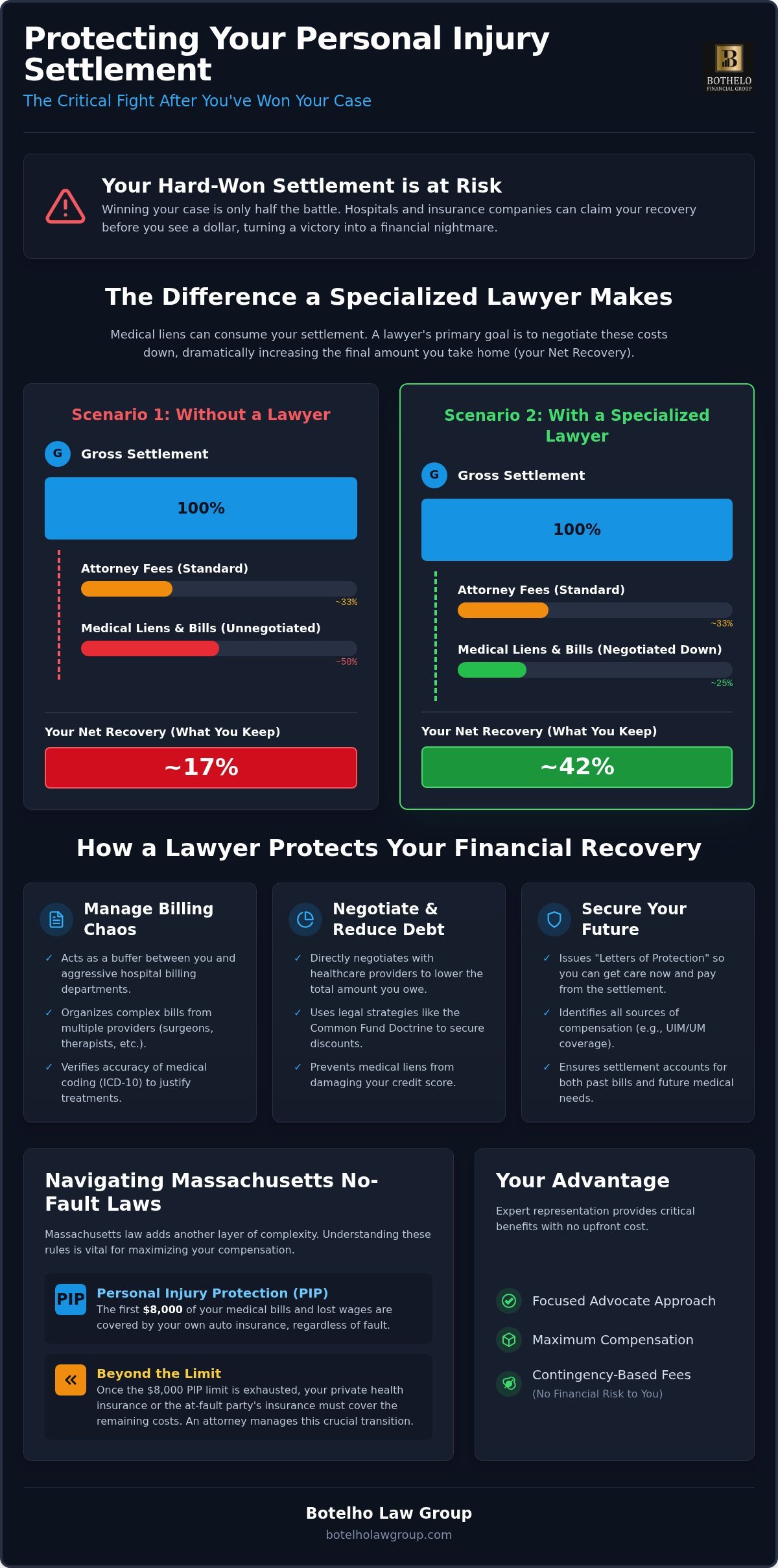
Massachusetts No-Fault Laws and Medical Bill Compensation
Massachusetts operates under a unique “No-Fault” insurance system. This means your own insurance policy’s Personal Injury Protection (PIP) coverage is the primary source of payment for your initial medical expenses. Regardless of who caused the accident, your insurer is responsible for the first layer of costs. This system is designed to provide immediate relief, but it often creates a complex web of billing requirements that require a compensation for medical bills lawyer to navigate effectively. Without professional oversight, providers may bill the wrong entity, leading to unnecessary denials and credit damage.
The standard PIP limit in Massachusetts is $8,000. However, its interaction with private health insurance is where many victims encounter obstacles. Typically, PIP pays the first $2,000 of medical bills. After that, bills must be submitted to your health insurance provider. If the health insurer denies a claim or requires a co-pay, PIP may cover those remaining costs until the $8,000 cap is reached. Understanding the “Tort Threshold” is also vital. In Massachusetts, you generally cannot pursue a claim against the at-fault driver for pain and suffering unless your reasonable medical expenses exceed $2,000 or the injury involves specific permanent damages. A full service law firm Fall River MA provides the necessary coordination between these competing insurance interests to ensure no bills are left unpaid. Riders injured in collisions face these same no-fault complexities with additional challenges, which is why working with a dedicated Fall River motorcycle accident lawyer is essential for navigating how PIP rules apply differently to bikers.
The Role of Personal Injury Protection (PIP)
PIP is more than just medical coverage. It’s a mandatory benefit that provides a safety net for several accident-related losses. These include:
- Medical Expenses: Direct payments for doctors, hospitals, and therapy.
- Lost Wages: Reimbursement for 75% of your average weekly gross wages if you’re unable to work.
- Replacement Services: Payments for someone to perform household tasks you can no longer do.
Beware the “PIP Deductible” trap. If you selected a high deductible on your own policy to save on premiums, you’re responsible for the first few thousand dollars of your own care. You must also apply for these benefits within a strict timeframe after the accident. Missing the application window can result in a total loss of coverage, leaving you personally liable for your treatment.
When Medical Bills Exceed Policy Limits
A significant crisis occurs when a defendant carries only the state-minimum $25,000 liability policy, but your hospital bill reaches $100,000. In these high-stakes scenarios, we look beyond the primary policy. We explore “stacking” multiple policies if applicable or pursuing the personal assets of the defendant. Underinsured Motorist (UIM) coverage is also a critical lifeline. If your own policy includes UIM, it can fill the gap between the defendant’s low limits and your actual medical debt. This is especially common in motorcycle crash cases, where catastrophic injuries frequently exceed minimum policy limits and victims benefit from the strategic approach of an experienced Fall River motorcycle accident lawyer who understands how to pursue every available dollar. If you’re facing mounting debt after a collision, contact a compensation for medical bills lawyer to review your policy and identify every available dollar for your recovery.
Why Choose Botelho Law Group for Your Medical Bill Recovery
Selecting the right legal team is a critical decision that directly impacts the net value of your recovery. Our firm operates as a “Focused Advocate,” providing the aggressive representation necessary to ensure that hospital billing departments don’t dictate the terms of your settlement. As a compensation for medical bills lawyer, we understand that our responsibility involves more than just proving liability. It requires a meticulous, results-oriented approach to debt reduction and lien negotiation. We’ve built a reputation in the Fall River community for solving complex financial problems for our clients while they focus on their physical healing.
Our experience extends into specialized areas of personal injury litigation, including cases involving non-citizens and complex immigration statuses. We recognize that the intersection of healthcare, insurance, and immigration law presents unique challenges that standard personal injury firms often overlook. Whether you’re dealing with a local provider or a national insurance carrier, our team provides the sophisticated strategy needed to protect your assets. We maintain a steady, disciplined communication rhythm with our clients, ensuring you’re fully informed at every stage of the negotiation process.
The Contingency Fee Advantage
We believe that high-quality legal representation should be accessible to everyone, regardless of their current financial situation. This is why we operate strictly on a contingency fee basis. This model eliminates the financial barrier to entry, as you aren’t required to pay any upfront legal fees. We only receive payment if we successfully recover compensation for you. This structure ensures that our interests are perfectly aligned with your own: the more debt we negotiate away and the higher the settlement we secure, the better the outcome for everyone involved. To understand exactly how this “no win, no fee” structure works and what fee limits apply in Massachusetts, learn more about working with a no upfront fee personal injury lawyer and how contingency agreements protect your access to justice.
Beyond the fee structure, our firm advances all litigation costs throughout the life of your case. This includes paying for expert medical testimony, filing fees, and the detailed accident reconstruction often required to win high-stakes claims. By absorbing these costs, we allow you to pursue justice without the stress of mounting legal expenses. Our goal is to maximize your take-home recovery by providing the resources of a large-scale authority with the individual attention of a localized partner.
Schedule Your Free Consultation Today
Navigating the complex MA/RI legal landscape requires a guide who understands the specific local statutes and insurance protocols. When you contact our office, you gain direct access to lead attorneys who provide a clear, no-nonsense evaluation of your claim. We don’t use vague qualifiers or empty promises. Instead, we offer a structured breakdown of your rights and a systematic plan for recovery. If you’re struggling with aggressive debt collectors or confusing medical liens, take the first step toward peace of mind. Contact Botelho Law Group for a free case evaluation and discover how a dedicated compensation for medical bills lawyer can protect your settlement and your future.
Protecting Your Financial Recovery in 2026
Securing a significant settlement figure is only the first stage of a successful personal injury claim. To truly protect your future, you must aggressively manage the medical liens and insurance subrogation claims that threaten to consume your recovery. We’ve explored how strategic negotiation can reduce inflated hospital rates and how navigating the complex PIP limits in Massachusetts requires precise legal coordination. By auditing every invoice and challenging unperfected liens, you ensure that the final payout serves your long-term needs rather than just satisfying hospital billing departments.
The path to financial stability after an accident shouldn’t be navigated alone. As your compensation for medical bills lawyer, we provide the focused advocacy required for complex litigation across Massachusetts and Rhode Island. Our firm operates on a contingency fee basis; there is no fee unless we successfully recover funds for you. We advance all litigation costs so you can focus entirely on your physical rehabilitation while we secure the maximum net settlement possible. Secure your settlement today. Contact Botelho Law Group for a free consultation. You deserve an advocate who fights to keep your recovery in your pocket.
Frequently Asked Questions
Should I use my health insurance to pay for accident-related medical bills?
You should generally use your health insurance once your Personal Injury Protection (PIP) benefits reach their initial threshold. In Massachusetts, PIP typically pays the first $2,000 of bills before your health insurer becomes the primary payer. Utilizing your health insurance ensures that providers receive timely payment; this prevents accounts from being sent to aggressive debt collectors while your legal case is pending.
What happens if my medical bills are higher than the insurance settlement?
If your medical expenses exceed the available insurance coverage, your attorney will explore additional avenues for recovery. This includes searching for additional policies or utilizing Underinsured Motorist (UIM) coverage from your own policy. A compensation for medical bills lawyer also negotiates with healthcare providers to reduce the total debt, ensuring that the remaining settlement funds are distributed to cover your other losses.
Can a hospital put a lien on my house because of unpaid accident bills?
A hospital typically cannot place a lien on your primary residence for unpaid accident bills without first obtaining a separate court judgment. Most medical liens are statutory and attach specifically to the proceeds of your personal injury settlement or judgment. However, unmanaged debt can eventually lead to lawsuits that might threaten your assets, which is why professional lien management and proactive asset protection through Emro Law are vital components of your long-term financial strategy.
Do I have to pay my lawyer if we don’t win the personal injury case?
No, you don’t have to pay legal fees if your attorney doesn’t successfully recover compensation for you. Our firm operates on a contingency fee basis, meaning our payment is a percentage of the final settlement. We also advance all litigation costs, such as filing fees and expert witness expenses. You only reimburse these costs and pay the fee if we win your case.
How long does it take to get compensation for medical bills after an accident?
The timeline for receiving compensation varies based on the duration of your medical treatment. Most cases don’t settle until you reach Maximum Medical Improvement (MMI). This allows your lawyer to calculate the full cost of both past and future care. Once treatment is concluded and a demand is sent, the negotiation process with the insurance carrier can take several months to finalize.
Can a lawyer help reduce the amount I owe to the hospital?
Yes, a lawyer can significantly reduce the amount you owe to a hospital through strategic negotiation. We audit bills for duplicate charges and “upcoding” while leveraging legal principles like the Common Fund Doctrine. By offering a guaranteed lump-sum payment from the settlement, we often persuade providers to accept a discounted rate that is much lower than the original list price.
What is a ‘Letter of Protection’ and how does it help me?
A Letter of Protection is a legally binding contract between you, your attorney, and your healthcare provider. It allows you to receive necessary medical treatment without paying upfront by promising that the provider will be paid directly from your future settlement. This document is a critical tool for injured parties who lack immediate funds but require specialized care to recover from their injuries.
Will my car insurance rates go up if I use my PIP coverage for medical bills?
Your car insurance rates generally won’t increase if you use PIP coverage for an accident where you weren’t at fault. Massachusetts law prevents insurers from applying a surcharge for claims made under the no-fault system if the driver is less than 50 percent responsible for the collision. Using the benefits you’ve already paid for through your premiums is a standard part of the recovery process.