
An appeal is not a second trial. A deportation appeal lawyer reviews the immigration judge’s decision and hearing record for potential legal or procedural errors. The issues preserved in the record and the filing deadline can shape what happens next.
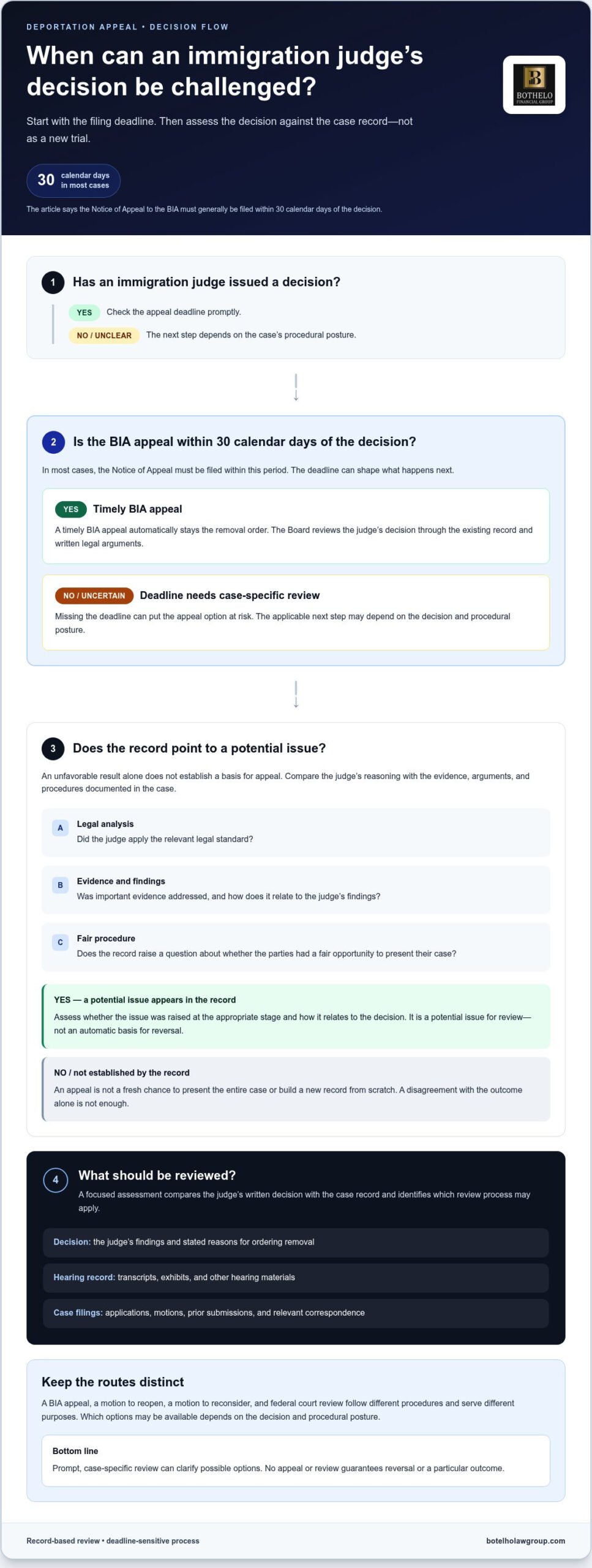
It’s understandable to fear removal and wonder whether the judge’s decision can be challenged. In most cases, a Notice of Appeal to the Board of Immigration Appeals (BIA) must be filed within 30 calendar days of the decision, and a timely BIA appeal automatically stays the removal order. Missing the deadline can put this option at risk, so prompt, case-specific review matters.
This article explains what the BIA reviews, how an appeal differs from a motion to reopen or a petition for review in federal court, and which procedural issues may affect your options. You’ll also learn how counsel can assess the record, identify potential grounds for appeal, and clarify next steps. Botelho Law Group handles deportation defense and represents immigration clients across the United States from its Fall River, Massachusetts base.
Key Takeaways
- A deportation appeal lawyer can examine the judge’s written decision and hearing record for potential legal, factual, or procedural issues.
- Preserve the written order, hearing documents, prior applications, and relevant correspondence for a focused case review.
- Appeals, motions to reopen, motions to reconsider, and federal court review follow different procedures and serve different purposes.
- Identify which deadline applies to your case promptly. Available next steps may depend on the decision and procedural posture.
- Case-specific legal review can clarify possible options, but it cannot guarantee a particular outcome.
What Does a Deportation Appeal Lawyer Do After an Immigration Judge’s Decision?
An immigration judge’s removal decision may be challenged through an administrative appeal, commonly before the Board of Immigration Appeals (BIA). An appeal asks the BIA to review the judge’s decision. It is not a fresh opportunity to present the entire case as though the original hearing never happened. The BIA generally evaluates the issues using the existing case record and written legal arguments.
That distinction matters. In the initial immigration court proceedings, deportation defense may involve presenting evidence, calling witnesses, and asking the judge to consider available forms of relief. An appeal instead examines whether the decision should be changed based on issues preserved in the proceedings and reflected in the record. The BIA does not automatically reach a different result, and an appeal cannot guarantee that removal will be avoided.
What does the Board of Immigration Appeals review?
The BIA reviews immigration judge decisions by considering legal and factual issues through the record and arguments submitted. Materials may include hearing transcripts, exhibits, motions, and the judge’s written decision. The process and scope of review can vary by case, so don’t assume every appeal includes the same steps or an oral hearing.
What can a deportation appeal lawyer contribute?
A deportation appeal lawyer can compare the judge’s reasoning with the evidence and arguments in the record. Counsel can identify issues that may warrant review, explain procedural requirements, and help develop written arguments that address the decision. This analysis can clarify possible next steps, but it cannot promise reversal or continued presence in the United States.
A focused review starts by comparing the decision with what happened in court. For example, counsel may examine whether the judge applied the relevant legal standard, addressed important evidence, or gave the parties a fair opportunity to present their case. These are potential issues for legal analysis, not automatic grounds for a successful appeal. The record matters because the BIA generally considers what was presented in the proceedings rather than treating the appeal as an opportunity to build a new case from scratch.
Counsel can also organize the appeal around the issues the record can support. This may involve locating relevant hearing documents, reviewing prior filings, and distinguishing a legal argument from a disagreement with the judge’s assessment of the evidence. The aim is to present a clear, record-based challenge and explain why the issue matters to the decision.
- Review the decision: Identify the judge’s findings and stated reasons for ordering removal.
- Examine the record: Compare those reasons with hearing materials, evidence, and prior filings.
- Assess procedure: Determine which review process may apply and what requirements it involves.
Botelho Law Group handles deportation defense and represents immigration clients across the United States from its Fall River, Massachusetts base. A case-specific assessment can clarify the issues and procedural options that may be available without assuming an appeal will change the outcome.
Which Legal Errors or Case Issues Can Support a Deportation Appeal?
An unfavorable decision alone does not establish a basis for appeal. The review must identify a potential issue in the judge’s legal analysis, factual findings, or handling of the proceedings, and connect that issue to the decision. These are possible areas for legal review, not automatic grounds for reversal. The U.S. Department of Justice’s overview of the Board of Immigration Appeals explains the Board’s administrative role and review process.
How might a legal or procedural error matter?
A deportation appeal lawyer can compare the judge’s reasoning with the applicable law and the steps documented in the case. For example, a hypothetical appeal might question whether the judge used the correct legal standard, considered significant evidence, or gave the parties a fair opportunity to address an issue. An argument must be grounded in the record and relevant law. Simply disagreeing with the outcome is not enough.
The type of ruling also shapes the analysis. If the judge found a person removable but denied an application for relief, the review may focus on how the eligibility rules were applied or how evidence relevant to that relief was assessed. A challenge to a procedural ruling, by contrast, may concern whether required steps were followed and whether the issue affected the decision. The right questions depend on the specific ruling and applicable procedure.
Identifying a possible error does not prove that it changed the outcome or that the BIA will grant the appeal. Counsel must evaluate the issue in context, including whether it was raised at the appropriate stage and how it relates to the judge’s findings. This analysis helps distinguish a potentially reviewable issue from a concern that cannot be established through the appeal record.
Why does the immigration court record matter?
The record provides the factual and procedural context for assessing the decision. It may include hearing transcripts, exhibits, applications for relief, motions, written submissions, and the judge’s decision. Prior filings can show which arguments were presented and how the case developed. Reviewing these materials together helps counsel determine what the judge considered, what findings were made, and where a proposed appeal can be supported.
An appeal generally does not provide an automatic opportunity to submit new evidence or hold another hearing. If a person has new documents or circumstances, those may raise a separate procedural question that requires legal analysis. The distinction matters: an appeal challenges the decision based on reviewable issues, while other procedures may address a different basis for seeking further consideration.
Criminal history can also affect immigration analysis, including the consequences of a conviction and the availability of relief. Its immigration significance may depend on the record and the specific offense, so a general description of a charge or conviction is not enough to determine its effect. A lawyer should review the relevant documents and how the immigration judge addressed that history, without assuming the same result applies in every case.
The written decision and underlying filings can reveal issues that aren’t apparent from a brief summary. Gather those documents for a case-specific review. Botelho Law Group represents immigration clients nationwide in deportation defense. Learn about the firm’s immigration representation.
How Does a Deportation Appeal Work, and Which Deadlines Matter?
After an immigration judge issues a removal decision, the next steps may move quickly. For an appeal of an immigration judge’s decision to the Board of Immigration Appeals (BIA), the general deadline to file a Notice of Appeal is 30 calendar days from the decision. This deadline is strict and cannot be extended. Other decisions and procedural routes may have different requirements, so don’t rely on a general summary to calculate the deadline for a particular case.
A deportation appeal lawyer can help assess the decision, identify the applicable filing rules, and organize the record and arguments. The process may involve submitting a notice of appeal, receiving a briefing schedule, and presenting written arguments. Forms, filing methods, briefing deadlines, and any government response depend on current rules and the case’s procedural posture.
What should someone do immediately after an adverse decision?
Preserve the written decision and related documents. Record the date of the decision and when it was issued or received, then seek prompt legal review to determine which deadline applies. The date and type of decision matter. A deadline for one appeal route may not apply to a motion or a later stage of review.
Gather the materials that can help counsel assess the case’s procedural posture:
- The immigration judge’s written decision and any hearing notice
- Prior applications, motions, and filings submitted to the court
- Hearing-related documents and correspondence about the case
- Any notice or instruction concerning appeal rights or filing requirements
Keep the original documents and make a clear record of relevant dates. Organizing materials promptly can make it easier to assess available options within a strict filing period.
What happens after an appeal is filed?
After a Notice of Appeal is filed, the BIA process may include review of the immigration court record, a schedule for written legal arguments, and an opportunity for the government to respond. The sequence and timing can vary. When the BIA sets a briefing schedule, both sides submit briefs within 20 days, and reply briefs are not permitted unless requested. Filing requirements can change, so have counsel review the current instructions and schedule before preparing or submitting documents.
A timely BIA appeal automatically stays the removal order under the applicable rules. That protection should not be assumed for every procedural route: a petition for review in federal court, for example, does not automatically stay removal. A stay may require separate action. Have the applicable stay rules assessed promptly, especially if removal is imminent. Filing an appeal is not a substitute for determining whether removal is paused in a specific case.
Because deadline calculations, required filings, and stay rules turn on the decision and procedural posture, prompt case-specific review is essential. Have counsel assess the record and next steps before a deadline passes.
Appeal, Motion to Reopen, or Federal Review: Which Route May Fit?
After an adverse immigration decision, several procedures may be considered, but they serve different purposes. An appeal generally asks the Board of Immigration Appeals (BIA) to review an immigration judge’s decision. A motion asks the appropriate decision-maker to reopen or reconsider a matter under specific rules. Federal court review is a separate form of judicial review that may become relevant after administrative proceedings. None automatically reopens the entire case or guarantees that removal will be paused.
| Procedure | General purpose | Decision-maker and timing |
|---|---|---|
| Appeal | Challenges an immigration judge’s decision based on issues in the case record. | The BIA generally reviews the judge’s decision. The applicable filing deadline depends on the decision and procedure. |
| Motion to reopen | Asks to revisit a matter based on new evidence or changed circumstances that may affect the case. | Filed with the relevant immigration authority under rules that set requirements and deadlines. A motion to reopen is generally due within 90 days of the final removal order, subject to applicable rules. |
| Motion to reconsider | Asks the decision-maker to reconsider a decision based on an alleged legal or factual error. | Filed with the authority that issued the decision, subject to its procedural rules and deadline. |
| Federal court review | Asks a federal court to review a qualifying final administrative decision, often raising legal issues. | A U.S. Court of Appeals may review the case, subject to jurisdictional limits and strict filing requirements. |
How does an appeal differ from a motion?
An appeal and a motion are not interchangeable. An appeal challenges a decision through administrative review; a motion seeks a particular form of reconsideration or reopening under applicable rules. New evidence may raise a different question from an argument that the decision-maker misapplied the law. Which procedure may fit depends on the decision, the record, and the reason further review is sought.
Immigration relief is also distinct from the procedure used to challenge a ruling. For example, cancellation of removal concerns a form of relief, while an appeal or motion concerns how a decision may be reviewed or reconsidered. A deportation appeal lawyer can assess these issues together, but no route should be selected without reviewing the individual decision and record.
When might federal court review become relevant?
Federal court review may be considered after administrative proceedings, but it is not an automatic next step or a guaranteed remedy. A petition for review is subject to jurisdictional limits, filing deadlines, and rules governing which issues the court can consider. A petition also does not automatically stay removal. Whether separate action is needed to seek a stay must be assessed promptly under the applicable rules.
Because the decision-maker, available arguments, deadlines, and potential effect on removal differ by procedure, have the requirements reviewed before filing. Botelho Law Group represents immigration clients nationwide in deportation defense. Request a case-specific review of your appeal options to clarify which procedural routes may warrant consideration.
How a Deportation Appeal Lawyer Can Assess Your Next Steps
After an immigration judge’s decision, uncertainty can make it difficult to know what to do first. A deportation appeal lawyer can review the written order, case record, and relevant dates to assess which procedures may be available and what deadlines apply. The review depends on the decision and procedural posture. It can clarify possible next steps, but it cannot guarantee that an appeal will succeed or prevent removal.
Preparation can make that assessment more focused. Gather the documents you have, note important dates, and flag upcoming deadlines or government notices. You don’t need to resolve the legal questions on your own before seeking review.
What information can help an initial case review?
Organize documents by date where possible. A simple timeline can explain how the case reached its current stage, including when hearings took place and when decisions or notices were issued. Include documents even if you’re unsure whether they matter. Counsel can assess how they relate to the record and potential procedural options.
- The immigration judge’s written decision or order
- Hearing notices and documents related to court proceedings
- Applications, motions, and other filings submitted in the case
- Notices or correspondence from immigration authorities or the government
- A chronology of hearings, decisions, filings, and other key dates
These materials may contain sensitive personal information. Keep them organized and share them through an appropriate secure channel when providing documents for legal review. Avoid sending confidential records through public forums or including unnecessary sensitive details in an initial message.
How can Botelho Law Group help evaluate an appeal?
Botelho Law Group handles deportation defense and represents immigration clients throughout the United States from its Fall River, Massachusetts base. Counsel can review the decision and available records, assess the procedural posture, and identify questions that may affect the next step. This may include evaluating whether an appeal, a motion, or another process warrants consideration and clarifying what information is needed to assess it.
Immigration matters can involve overlapping filings and deadlines. A useful review connects the judge’s order to the history of the proceedings rather than relying only on a short description of what happened. Learn more about the firm’s Fall River immigration representation.
If you’ve received an adverse decision, act promptly to preserve relevant documents and have the applicable deadlines assessed. Botelho Law Group represents immigration clients nationwide and can review your circumstances to help clarify potential next steps. No outcome is assured, but timely legal review can help you understand which options may still be available.
Take the Next Step With a Clear Plan
A removal decision can leave you weighing difficult choices under pressure. Rather than assume one procedure fits every case, have the decision and procedural posture examined together. A deportation appeal lawyer can assess what the record supports and identify questions that need timely attention. That review can provide direction without promising a particular result.
Gather the documents you have and note upcoming dates or communications from immigration authorities. Then seek a focused legal assessment before deciding how to proceed. Clear information about your case can help counsel evaluate possible options and explain the considerations involved.
Request a review of your immigration case with Botelho Law Group. You don’t have to make sense of the process alone. A careful review can help you approach the next decision with greater clarity.
Frequently Asked Questions
How long does a deportation appeal take?
There is no fixed completion date for a deportation appeal. Timing depends on the issues raised, the time needed for briefing, whether the record is complete, and the Board’s schedule. A case may require additional procedural steps that affect its progress. For Massachusetts residents, the location of counsel does not set the federal review schedule. Ask counsel to explain the case’s current stage and what event is pending rather than relying on an estimated finish date.
Can I appeal a deportation order if I missed the filing deadline?
Missing the appeal deadline does not automatically mean every possible avenue is closed, but an ordinary appeal may no longer be available. Whether another procedure can be considered depends on the order, case history, reason for delay, and applicable rules. Don’t assume a late filing will be accepted. A deportation appeal lawyer can promptly examine notices and filing records to identify any remaining options, without promising an exception or outcome.
Can new evidence be submitted in a BIA appeal?
A BIA appeal generally relies on materials already in the immigration court record, so it isn’t ordinarily the place to add evidence that was never presented. If a new document or changed circumstance could affect the case, a motion to reopen may raise a separate question, subject to procedural requirements. Keep the original document and note when it became available, then obtain case-specific advice before filing anything.
Do I have to attend an in-person hearing for a deportation appeal?
Usually, a BIA appeal is handled through review of the record and written submissions rather than a new in-person immigration court hearing. Oral argument may be allowed in some circumstances, but it isn’t a routine step in every appeal. If a notice or order mentions a hearing, appearance, or other instruction, follow its terms and have counsel determine whether it applies to the appeal or another proceeding.
Can a family member file a deportation appeal for someone else?
A family member can help collect records, track correspondence, and share practical information, but being related doesn’t automatically authorize someone to act as legal counsel or file on another person’s behalf in every proceeding. Who may sign, file, or represent a respondent depends on the applicable court or agency rules and the person’s role. Before a relative submits forms or speaks for the respondent, seek case-specific guidance to avoid procedural confusion.
Can someone appeal an in absentia removal order?
An in absentia removal order may be challenged through procedures distinct from a standard appeal, but the applicable route depends on why the person missed court and the circumstances surrounding notice or absence. Different situations can involve different requirements and time limits. Preserve hearing notices, address-change records, relevant medical or emergency documentation, and the order itself. Then seek prompt legal review rather than assuming the order cannot be challenged.
Is a deportation appeal the same as a motion to reopen?
No. An appeal asks an appellate body to review a decision, while a motion to reopen asks the appropriate authority to reconsider the case based on qualifying new evidence or changed circumstances. The procedures involve different decision-makers, filing rules, and deadlines, so one should not be substituted for the other without reviewing the order. The distinction may matter if the concern is a new development rather than an alleged error in the original ruling.