
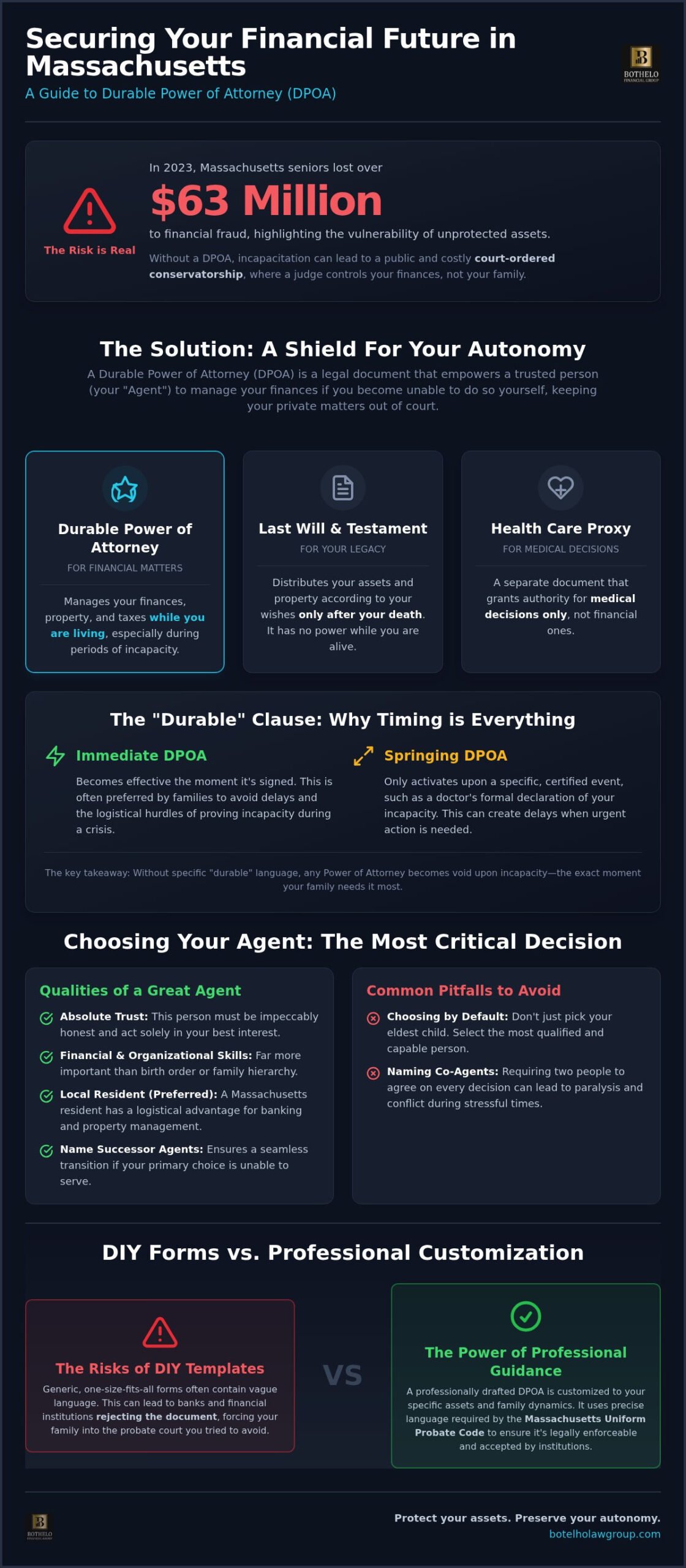
In 2023, Massachusetts residents lost over $63 million to elder financial fraud; a staggering figure that highlights the vulnerability of unprotected assets. You likely recognize that a standard will handles your legacy after death, yet it offers zero protection if you become incapacitated tomorrow. The prospect of the Massachusetts probate court taking control of your finances is a legitimate source of anxiety for many families. Without a durable power of attorney in Massachusetts, your loved ones could face the crushing expense and public scrutiny of a court-ordered conservatorship just to pay your monthly bills or taxes.
You deserve a clear plan for financial continuity that keeps your private matters out of the courtroom. This 2026 legal guide provides a sophisticated framework for securing your estate and protecting your family from unnecessary legal complexity. We’ll examine the critical differences between standard and durable agreements, the importance of specific durability language under state law, and how to select an agent who will act as a relentless advocate for your interests. By the end of this guide, you’ll understand how to maintain total control over your financial destiny.
Key Takeaways
- Understand how the Massachusetts Uniform Probate Code (MUPC) governs your rights and why specific durability language is mandatory to maintain control during incapacity.
- Learn how a durable power of attorney Massachusetts empowers your chosen attorney-in-fact to manage high-stakes financial duties, including real estate and tax filings, without court interference.
- Identify the signing formalities and witness requirements necessary to ensure your document remains legally enforceable and recognized by various financial institutions.
- Discover how a DPOA integrates with broader estate planning to protect your home and trigger critical Medicaid planning protections if long-term care becomes necessary.
- Recognize the risks associated with generic DIY templates and why professional customization is essential to prevent banks from rejecting your legal documents.
What is a Durable Power of Attorney in Massachusetts?
Under the Massachusetts Uniform Probate Code (MUPC), a power of attorney is a formal legal instrument where you, the principal, grant an attorney-in-fact the authority to act on your behalf. A What is a Power of Attorney? overview explains that this creates a fiduciary relationship where the agent must act in your best interests. It’s a dedicated financial tool, but you must recognize that a standard version is often insufficient for long-term protection. A durable power of attorney Massachusetts is specifically drafted to include language that keeps the agent’s authority intact if you become incapacitated. This document manages bank accounts, real estate, and tax filings; however, it doesn’t grant authority over medical decisions. For health matters, you must execute a separate Health Care Proxy.
The “Durable” Clause: Why Timing Matters
The “durable” designation is the most critical component of this document. Without it, the agent’s power terminates the moment you’re no longer able to make your own decisions, leaving your family forced to petition the probate court for a conservatorship. In 2026, legal experts often distinguish between “immediate” and “springing” powers. An immediate DPOA is effective the moment it’s signed, while a springing power only activates upon a certified event, such as a doctor’s letter. Many families prefer immediate powers to avoid the logistical hurdles of proving incapacity during a crisis. Massachusetts courts generally define incapacity as a state where an individual cannot receive and evaluate information or communicate decisions effectively enough to manage their own financial resources.
DPOA vs. Wills: Clearing the Confusion
Many individuals mistakenly believe that a will covers all legal needs, but a DPOA and a will serve entirely different stages of life. A DPOA is strictly for the living; its authority evaporates instantly upon the principal’s death. Once you pass away, the legal framework shifts to your probate documents. This is where the distinction between a simple will vs trust Massachusetts becomes vital for asset distribution. A will governs what happens to your property after death, while a DPOA ensures your bills are paid and your home is protected while you’re alive but unable to act. Using both tools creates a seamless shield for your legacy, preventing gaps in management that could lead to financial loss or court intervention.
Selecting Your Attorney-in-Fact: Roles and Responsibilities
The choice of an agent is the most consequential decision in the estate planning process. This individual, legally referred to as your attorney-in-fact, assumes a strict fiduciary duty. They are legally bound to act solely in your best interest, putting your needs above their own. A durable power of attorney Massachusetts grants this person immense power over your life’s work. They will manage your banking, execute real estate transactions, file your taxes, and even oversee litigation if necessary. Because of this broad access, absolute trust is the baseline requirement for any candidate you consider.
You must also name successor agents in your document. If your primary agent is unavailable or unable to serve, a successor ensures the transition remains seamless. Without a clear line of succession, the probate court may still intervene to appoint a conservator, defeating the primary purpose of the document. Strategic planning now prevents the administrative paralysis that often occurs during a medical crisis.
Criteria for Choosing a Reliable Agent
Many people default to family hierarchy, choosing the eldest child regardless of their aptitude. This is a mistake. Financial literacy and organizational skills are far more important than birth order. Your agent needs to understand complex billing, navigate government bureaucracies, and keep meticulous records. Choosing a local Massachusetts resident offers significant logistical advantages. They can physically visit banks, meet with real estate agents, and manage property without the delays of interstate travel. We also strongly advise against naming co-agents; requiring two people to agree on every financial decision often leads to paralysis and family conflict during high-stress periods.
The Scope of Authority: What Can They Actually Do?
The scope of a well-drafted document is comprehensive. Your agent can sell or mortgage your home to fund long-term care, ensuring you have access to the best medical facilities. They also handle government benefits, including Social Security, Medicare, and Veterans benefits, which often require specific authorizations to manage. One nuanced area is the power to make gifts. You might grant this power to allow for tax planning or to qualify for certain benefits, but it must be handled with extreme caution to prevent asset depletion. If you are unsure which specific powers to include, consulting with a protective advocate can help you tailor the document to your specific asset profile and family dynamics.
Massachusetts Legal Requirements and Signing Formalities
Executing a durable power of attorney Massachusetts requires strict adherence to the Massachusetts Uniform Probate Code (M.G.L. c. 190B). For the document to be legally binding, the principal must possess a “sound mind” at the moment of execution, demonstrating an understanding of the authority being granted. While the law provides the framework, the practical reality of having your document accepted by financial institutions requires more than just a signature. A sophisticated approach to document preparation, exemplified by the professional legal support offered by MZ-Law, ensures that your directives aren’t just legal on paper, but actionable in the real world when high-stakes decisions are on the line.
A notary public is a non-negotiable requirement for any durable power of attorney intended to survive a challenge. While some statutes are silent on notarization for basic validity, a document cannot be recorded at a Massachusetts Registry of Deeds without a proper notary acknowledgment. This is vital if your agent needs to sell or mortgage real estate. Beyond the notary, we recommend having at least two disinterested witnesses present during the signing. This creates a secondary layer of defensive evidence to prevent future litigation from disgruntled heirs who might claim undue influence or lack of capacity. Massachusetts law operates under a presumption of competence, meaning the burden of proof rests on the challenger to demonstrate that a principal lacked the mental capacity to execute the document at the moment of signing.
Recording the Document: When and Where?
You don’t always need to record your DPOA immediately after signing. However, recording becomes mandatory the moment your attorney-in-fact engages in a real estate transaction. As of August 2026, the standard fee to record a document at a Massachusetts Registry of Deeds is generally $105. Failing to record the document correctly can stall a home sale or prevent your family from accessing equity needed for medical care. You should also be wary of “stale” documents. Even if a DPOA is technically valid for life, many banks are hesitant to honor documents that are more than five or ten years old. Working with an estate planning lawyer Fall River MA ensures your documents are recorded properly and updated to reflect current state regulations and banking policies. This proactive maintenance prevents the administrative friction that often complicates emergency financial management.
Integrating DPOA with Asset Protection for Homeowners
A well-drafted DPOA ensures your agent has the specific authority to file a “Homestead Declaration,” which protects up to $500,000 of your home’s equity from most creditors. If you own rental properties or vacation homes in the Commonwealth, your agent can manage leases, collect rents, and authorize repairs without interruption. This authority is especially critical when dealing with properties held in a Life Estate or an Irrevocable Trust. While a Trustee manages the trust assets, the attorney-in-fact manages the assets held outside the trust, ensuring a unified defense against financial instability. If your estate includes multiple properties, securing a custom durable power of attorney is the only way to ensure your agent has the precise language needed to interact with local registries and tax authorities.
Avoiding Conservatorship and Guardianship
The most significant benefit of a DPOA is the avoidance of the Massachusetts Probate Court. A court-ordered conservatorship is a public, adversarial, and expensive process. It requires annual accounts, fiduciary bonds, and court permission for major financial decisions. In contrast, a DPOA is a private document that keeps your financial affairs within the family. Contested conservatorships can quickly drain an estate through legal fees and administrative costs, often totaling thousands of dollars before a judge reaches a decision. By executing a DPOA now, you preserve family privacy and ensure that your financial advocate is someone you chose, rather than a court-appointed stranger. This proactive step is the most effective way to safeguard your autonomy in Fall River and across the state.
Professional Representation vs. DIY Forms: Why Customization Wins
The accessibility of generic online templates often masks the catastrophic risks associated with improper legal documentation. A durable power of attorney Massachusetts must be more than a fill-in-the-blank form; it must be a precise legal instrument capable of withstanding the scrutiny of skeptical financial institutions. Many residents believe a downloaded form is sufficient, only to discover that major banks frequently reject generic documents that lack specific indemnification language or granular authority. By the time these deficiencies are identified, the principal has often already lost capacity. This leaves the family with no legal recourse other than entering the public and expensive probate court system to seek a conservatorship.
Common Pitfalls of Online Templates
Generic templates frequently omit critical “hot powers,” such as the authority to change beneficiaries on retirement accounts or the power to create and fund trusts. These omissions can paralyze a comprehensive estate plan during a medical crisis. Additionally, as of 2026, Massachusetts has standardized its requirements for Remote Online Notarization (RON) and electronic signatures. Generic forms rarely comply with these specific regulatory updates, leading to documents that are technically invalid or unrecordable at the Registry of Deeds. The financial cost of correcting a flawed DPOA through a court-ordered conservatorship far outweighs the initial investment in professional drafting. A single missing clause can result in thousands of dollars in unnecessary legal fees and months of administrative delays.
The Botelho Law Group Approach
At Botelho Law Group, we treat every document as a high-stakes shield for your autonomy. Our approach goes beyond basic financial management to include modern legal necessities like digital asset access for cryptocurrency and online accounts. We also integrate specific tax-mitigation strategies that allow your agent to protect your wealth from unnecessary depletion. We act as a relentless fighter for our clients’ interests, ensuring your agent has the specific, declarative authority needed to manage your estate without friction. This level of protective advocacy provides the peace of mind that comes from knowing your future is secured by a seasoned legal strategist.
If you are ready to secure your legacy with a document that actually works, Schedule your estate planning consultation with Botelho Law Group today. Our firm provides the results-oriented representation Fall River residents need to navigate complex legal systems with confidence. We focus on creating manageable, systematic plans that prioritize your family’s privacy and financial security.
Securing Your Autonomy and Financial Legacy
A durable power of attorney Massachusetts is far more than a simple administrative form; it’s a sophisticated defense against state intervention and financial paralysis. We’ve analyzed how professional drafting prevents the public expense of probate court and ensures your agent has the precise authority to protect your family home. Relying on generic templates invites unnecessary risk, whereas a customized plan provides the specific “hot powers” required by 2026 legal standards and banking policies. By integrating these protections now, you ensure that your assets remain under the control of those you trust most.
At Botelho Law Group, we provide the localized expertise and protective advocacy necessary to safeguard your legacy in Fall River and across the Commonwealth. Our focus remains on asset protection and the total avoidance of court-ordered conservatorships. Don’t leave your family’s future to chance or generic documents that may fail when they’re needed most. Contact Botelho Law Group for a Secure Massachusetts Estate Plan today. Taking this proactive step provides the certainty and peace of mind you deserve.
Frequently Asked Questions
Does a durable power of attorney expire in Massachusetts?
A durable power of attorney doesn’t have a statutory expiration date in Massachusetts. It remains legally valid until the principal passes away or explicitly revokes the document in writing. However, many financial institutions are hesitant to honor “stale” documents that are more than ten years old. Periodically updating your document ensures it complies with the latest state regulations and remains readily accepted by modern banking systems during a crisis.
Can an agent under a DPOA change my will?
No, an attorney-in-fact has no legal authority to create, modify, or revoke your last will and testament. Testamentary acts are personal to the principal and cannot be delegated to an agent under any circumstances. While your agent can manage assets, pay bills, and handle property transactions, they cannot dictate how your estate is distributed after your death. This legal boundary ensures your final wishes remain protected from unauthorized changes.
What is the difference between a durable and a non-durable power of attorney?
The primary difference involves what happens if you lose mental capacity. A standard or non-durable power of attorney terminates immediately if you become incapacitated, leaving your family without a legal advocate. In contrast, a durable power of attorney Massachusetts contains specific language ensuring the agent’s authority continues regardless of your mental state. This durability is the essential feature that prevents your family from needing to seek a court-ordered conservatorship.
Can I revoke a durable power of attorney if I change my mind?
Yes, you can revoke the document at any time as long as you possess the mental capacity to do so. You should sign a formal written revocation and deliver copies to your agent and any financial institutions where the original was on file. If the document was previously recorded at a Registry of Deeds, the revocation must also be recorded there to provide public notice that the agent’s authority has officially ended.
Does a Massachusetts DPOA need to be notarized?
While state law doesn’t strictly require notarization for the document to be valid between parties, it’s a non-negotiable practical requirement. Banks and insurance companies almost universally require a notary’s seal before they’ll grant an agent access to your accounts. Additionally, if the document involves real estate, it must be notarized to be recordable at the Registry of Deeds. Without a notary, the document is essentially non-functional for asset protection.
What happens if I become incapacitated without a durable power of attorney?
Your family will be forced to petition the Massachusetts Probate and Family Court for a conservatorship to manage your finances. This process is public, time-consuming, and significantly more expensive than drafting a protective document in advance. A judge will appoint a person to manage your money, and that individual must file annual reports with the court. Executing a durable power of attorney Massachusetts allows you to choose your advocate privately and avoid these burdens.
Can my agent sell my house in Massachusetts using a DPOA?
Yes, provided the document explicitly grants the power to manage and convey real estate. The attorney-in-fact can sign deeds, negotiate sales, and manage mortgages on your behalf. To execute a sale, the original DPOA must be recorded at the local Registry of Deeds where the property is located. This authority is critical for families who need to liquidate assets to pay for long-term medical care or other urgent expenses.
How much does it cost to have a lawyer draft a DPOA in Fall River?
Legal fees for drafting a durable power of attorney vary based on the complexity of your estate and the specific protective clauses required. While generic online forms might seem cheaper initially, they often lead to expensive court battles if rejected by banks. A professionally drafted document by a local attorney ensures compliance with the Massachusetts Uniform Probate Code and includes modern digital asset protections. You should contact our firm directly to discuss your specific needs.