
A U.S. citizen who is over 21 can petition for a parent’s green card, according to U.S. Citizenship and Immigration Services. An attorney for a green card for parents can help assess whether the family relationship qualifies and how to document it. A green card for a parent is generally sought through the immediate relative category.
It’s understandable to focus on the petition form, but evidence of your relationship to your parent is just as important. The documents you need depend on whether the relationship is biological, through marriage, or through adoption.
This article explains who may petition, how the family-based process works, and what income and relationship evidence may be required. It also covers how a parent’s location and immigration history can affect the path to permanent residence.
Key Takeaways
- A U.S. citizen must be over 21 to petition for a parent, according to U.S. Citizenship and Immigration Services.
- Each parent’s case begins with a separate Form I-130 petition filed with U.S. Citizenship and Immigration Services.
- Prepare evidence that clearly establishes the parent-child relationship, including records relevant to biological, stepparent, or adoptive relationships.
- Review household income and sponsorship obligations early; U.S. Citizenship and Immigration Services sets the income requirement at 125% of the federal poverty guidelines.
Who is Eligible to File a Petition for an Immigrant Relative?
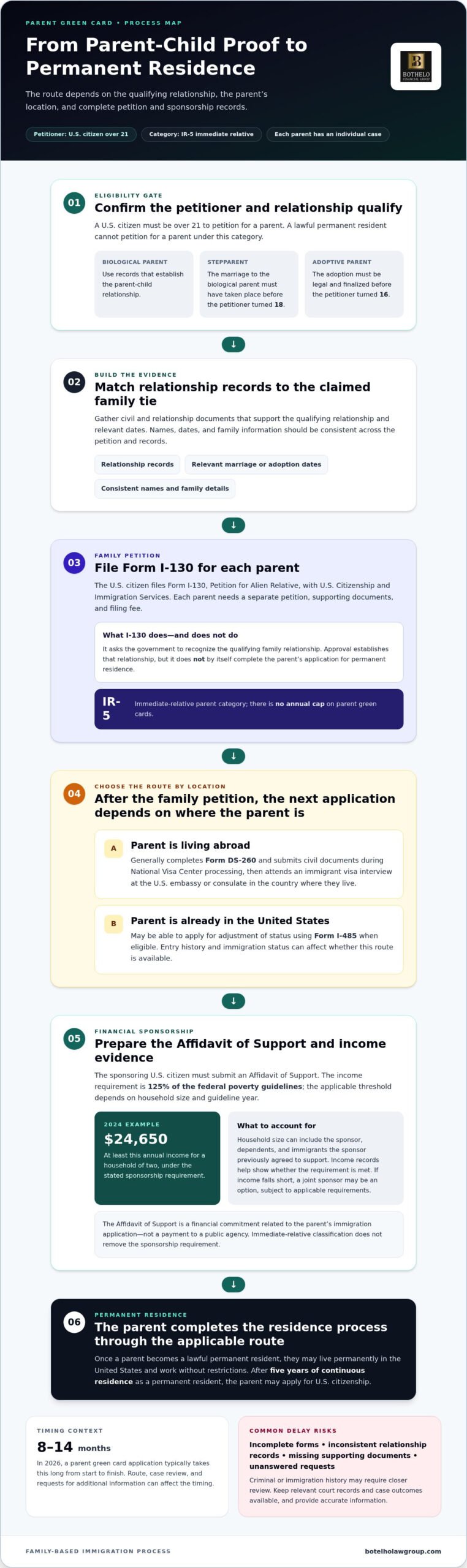
A U.S. citizen must be over 21 to sponsor a parent for a green card, according to U.S. Citizenship and Immigration Services. The petitioner must establish both citizenship and the qualifying parent-child relationship. A lawful permanent resident cannot petition for a parent under this parent category. The parent’s immigration status and location affect which permanent residence process applies.
The relationship can be biological, adoptive, or through a stepparent. A stepparent qualifies only if the marriage to the petitioner’s biological parent took place before the petitioner turned 18. For an adoptive-parent petition, the adoption must be legal and finalized before the petitioner turned 16. Records showing the relationship and relevant dates help support the application.
Parents of U.S. citizens may qualify for the IR-5 immediate relative category. Each parent has an individual case, and a parent’s eligibility does not automatically establish the other parent’s eligibility. A parent who becomes a lawful permanent resident may live permanently in the United States and work without restrictions. After five years of continuous residence as a permanent resident, a parent may apply for U.S. citizenship.
In 2026, a parent green card application typically takes 8 to 14 months from start to finish. The route, case review, and any requests for additional information can affect how long the process takes.
Incomplete forms, inconsistent relationship records, missing supporting documents, and unanswered requests from immigration officials can cause delays or denials. A criminal history may also require closer review. Keep court records and case outcomes available so an immigration attorney can assess how they may affect the application.
Criminal history does not affect every case in the same way. The specific record, its resolution, and the parent’s immigration history all matter. Providing accurate information helps assess eligibility before filing.
What is a Family-Based Visa Petition?
A family-based petition asks the government to recognize a qualifying relationship between a U.S. citizen and a relative seeking permanent residence. For a parent, U.S. Citizenship and Immigration Services says the citizen begins by filing Form I-130, Petition for Alien Relative. This petition establishes the family relationship; it is not itself the parent’s application for lawful permanent residence.
Each parent needs a separate Form I-130, supporting documents, and filing fee. A petition for one parent does not include the other. The supporting record should match the relationship claimed and the details entered on the form. For example, names, dates, and family information should remain consistent across the petition and civil records.
The parent’s location affects what happens after the I-130 is approved. The process generally has two steps: the family petition, followed by the parent’s application for permanent residence. A parent living abroad generally completes Form DS-260 and submits civil documents during National Visa Center processing. The parent then attends an immigrant visa interview at the U.S. embassy or consulate in the country where they live.
A parent already in the United States may be able to apply for adjustment of status using Form I-485 when eligible. In some situations, an adjustment-of-status application may be submitted before or together with a family petition. Entry history and immigration status can affect whether adjustment is available, so the correct route matters before submitting forms.
The IR-5 parent category is an immediate relative category and has no annual cap on parent green cards. Approval of the I-130 therefore establishes the qualifying relationship, but does not by itself complete the parent’s application for permanent residence. A well-organized petition helps keep the relationship evidence and later processing aligned. For guidance on preparing a family-based petition, focus on the parent’s location, the relationship documents, and the next application required.
Income and Affidavit of Support requirements
A U.S. citizen sponsoring a parent must submit an Affidavit of Support as part of the financial sponsorship process. U.S. Citizenship and Immigration Services sets the sponsor’s income requirement at 125% of the federal poverty guidelines. The relevant threshold depends on household size and the applicable guideline year, so income evidence should match the sponsor’s household circumstances.
For 2024, a household of two needed annual income of at least $24,650 to meet the stated sponsorship requirement. Household size can include the sponsor, dependents, and immigrants the sponsor has previously agreed to support. The sponsor’s income records help show whether the requirement is met. If income falls short, a joint sponsor may be an option, subject to the applicable requirements.
The Affidavit of Support is a financial commitment related to your parent’s immigration application, not a payment to a public agency. Before signing, a sponsor should understand the responsibility and provide complete, consistent financial information. Immediate-relative classification does not eliminate the sponsorship requirement. In consular processing, financial documents become part of the parent’s case after the family petition is approved.
You are not required to hire an attorney to file immigration forms or represent yourself before U.S. Citizenship and Immigration Services. An attorney representing someone in the United States must be eligible to practice and in good standing with a state or territorial bar, or the District of Columbia. DOJ-accredited representatives may also represent people through recognized organizations.
When looking for a reputable immigration attorney, check that the person is authorized to practice in the United States, in good standing, and experienced with family-based immigration filings. Ask how the attorney will explain sponsorship evidence, review the parent’s country-specific consular process, and keep you informed about the case.
Be cautious about relying on a notary public for immigration law advice. In the United States, a notary public is not an attorney and cannot represent someone in an immigration matter. A person who is not an eligible representative may provide limited help completing forms, but cannot give legal advice or represent the applicant.
Evidence of a parent-child relationship
A parent’s case depends on evidence connecting the petitioner to the parent named in the application. For a biological parent, a birth certificate naming the petitioner and parent can help establish that connection. Compare the names and dates on the certificate with the Form I-130 and other records. If names differ, records explaining the change can help clarify the file.
Stepparent cases require evidence of both the family connection and the marriage that created it. The marriage to the petitioner’s biological parent must have occurred before the petitioner turned 18. A marriage certificate can document the date, while the petitioner’s birth record can establish their age at that time. Together, these records help show whether the claimed stepparent relationship meets the applicable rule.
For an adoptive parent, the adoption must have been legal and finalized before the petitioner turned 16. The petitioner must provide proof of that legal, finalized adoption. An adoption decree is a central record to organize; related court or civil records may help explain the adoption’s completion and the parties named in it. Dates matter, so ensure the documents support the same timeline.
Build a clear record rather than submitting documents without context. Check that names, dates, and family details match across the evidence. If a record uses a different name or format, include relevant documentation to explain the difference. Keep copies of everything submitted, since U.S. Citizenship and Immigration Services may request more information during review.
The relationship evidence supports the petition, while the parent’s location determines the next stage. A parent eligible to apply in the United States may pursue adjustment of status; a parent abroad generally proceeds through consular processing. The same core relationship must remain clear through later steps, including any interview. Organizing the documents by relationship type can make the record easier to follow. Get help preparing family relationship evidence before submitting the application.
Botelho Law Group: Estate Planning and Asset Protection
Botelho Law Group assists families with Family-Based Green Card Petitions when relationship evidence, immigration history, or the choice between adjustment and consular processing raises questions. The firm can help you understand the petition process and prepare a case based on your parent’s circumstances. A parent’s immigration matter is separate from planning how to manage and protect family assets.
Botelho Law Group also provides Estate Planning and Asset Protection for people addressing those distinct concerns under Massachusetts law. If a parent later seeks citizenship, the firm handles Naturalization and Citizenship Applications. These services address different legal needs, so the appropriate next step depends on the issue you are working through.
For guidance on a parent’s petition or related planning needs, contact Botelho Law Group.
Plan the Next Step With Clarity
A parent’s immigration matter can shape decisions beyond the petition itself. Consider how your family will manage practical responsibilities during processing and after your parent joins the household. Clear planning can connect immigration decisions with longer-term family priorities.
If relationship records or immigration history raise concerns, an attorney for a parent’s green card can assess the case and identify issues to address. Families searching for a green card for parents attorney should look for experience with family-based immigration and an understanding of the parent’s circumstances. Botelho Law Group handles Family-Based Green Card Petitions, Naturalization and Citizenship Applications, and Estate Planning and Asset Protection.
The right next step depends on your parent’s situation and your family’s goals. A focused review can clarify the process and identify questions to resolve before moving forward.
Contact Botelho Law Group to discuss your family’s immigration matter and next steps. Careful preparation can help you approach the process with greater confidence.
Frequently Asked Questions
What Is a Green Card for Parents?
A parent green card is lawful permanent resident status obtained through a qualifying U.S. citizen child. The parent category is known as IR-5 and is classified as an immediate relative. It allows an eligible parent to live permanently in the United States. For a Massachusetts family, the parent’s location and immigration history help determine whether the case proceeds inside the country or through a U.S. consulate abroad.
What is the process of obtaining lawful permanent residence?
The process begins with a family petition and continues with the parent’s application for permanent residence. U.S. Citizenship and Immigration Services receives the Form I-130 petition. If the parent is abroad, later processing generally includes National Visa Center document submission and an interview at a U.S. embassy or consulate. If the parent is in the United States, adjustment of status may be available when the parent qualifies.
When can my son or daughter petition me?
Your son or daughter can petition for you after becoming a U.S. citizen and turning 21. U.S. Citizenship and Immigration Services identifies those conditions for a parent petition. A child who is a lawful permanent resident cannot petition for a parent through this category. The child must also document the qualifying relationship, so the parent’s records and the petitioner’s civil documents should support the same family history.
Can U.S. citizens sponsor their parents for a green card?
Yes. A U.S. citizen who meets the age requirement can petition for a qualifying parent, including a biological parent, eligible stepparent, or adoptive parent. Each parent requires an individual case. Sponsorship also involves financial obligations, so the petitioner should understand the Affidavit of Support before signing. A Massachusetts petitioner follows the federal immigration process, while the parent’s location affects later processing.
What are the eligibility requirements to petition for a parent’s green card?
The petitioner must be a U.S. citizen over 21, and the claimed parent-child relationship must qualify. Stepparent eligibility depends on when the marriage to the biological parent occurred. An adoptive-parent case requires a legal adoption finalized before the petitioner turned 16. The parent must also qualify for the applicable immigration process. Prior immigration history and criminal records can affect the case and should be reviewed accurately.
How does the parent green card application process work step by step?
First, the U.S. citizen submits a separate I-130 petition for each parent with relationship evidence. Next, after petition approval, the case proceeds according to the parent’s location. A parent abroad completes consular processing, including required documents and an interview. A parent in the United States may seek adjustment of status if eligible. For a Massachusetts family, deciding the correct route before filing helps keep later steps aligned.