
Filing Form N-400 doesn’t remove the need to track your Green Card. After you properly file, the receipt notice automatically extends your Green Card for 2 years from its expiration date. Naturalization application assistance can help you understand how the filing process and your status fit together.
It’s reasonable to want clear answers before submitting a high-stakes naturalization application. Eligibility depends on your residence history and other details, and the questions require accurate, complete responses. Applying online can make filing more convenient, but it does not replace careful preparation.
This guide explains the main eligibility routes, how to approach Form N-400 questions, and what to know about online filing. It also covers how to keep your Green Card validity in mind while your application is pending, so you can prepare each step with greater confidence.
Key Takeaways
- Compare your residence history and circumstances with the naturalization eligibility route that may apply to you.
- Review each Form N-400 question carefully and prepare consistent, complete answers before submitting.
- Understand what online filing involves, including how to organize your application and supporting documents.
- Plan around your Green Card’s expiration date: a properly filed N-400 receipt notice automatically extends it for 2 years from the card’s expiration date.
Naturalization eligibility
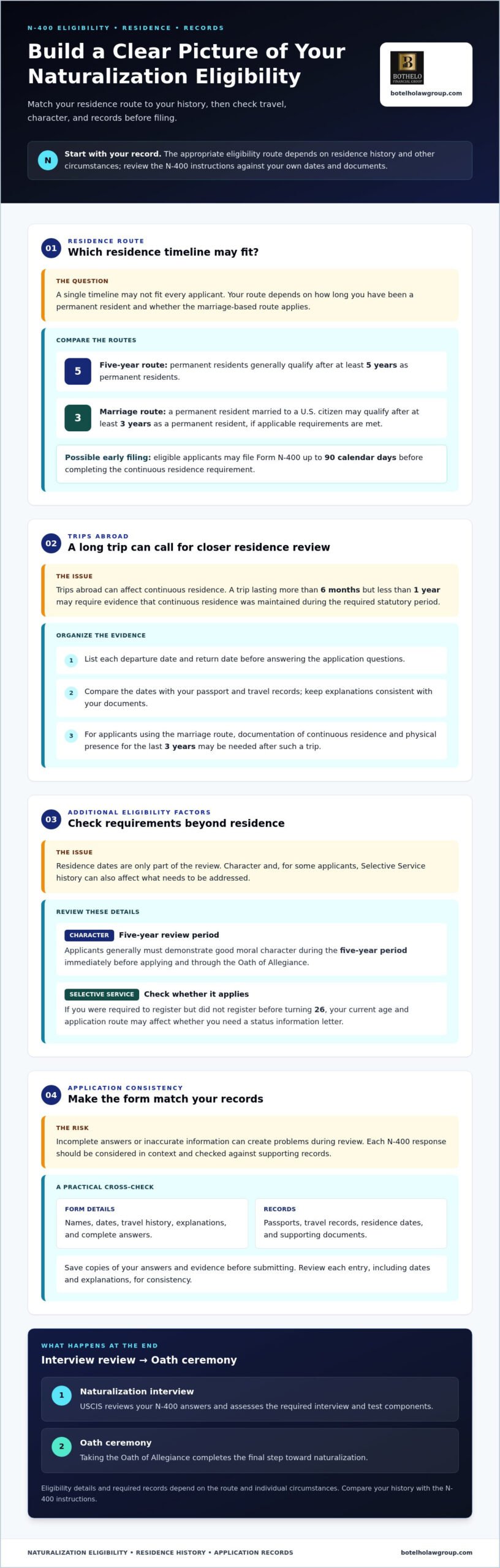
Start by identifying the eligibility route that fits your record. In the United States, permanent residents generally qualify under the five-year route after at least 5 years as permanent residents. A permanent resident married to a U.S. citizen may qualify after at least 3 years as a permanent resident, if the applicable requirements are met. According to U.S. Citizenship and Immigration Services, eligible applicants may file Form N-400 up to 90 calendar days before completing the continuous residence requirement.
Residence history needs careful review. Trips abroad can affect continuous residence, so list each departure and return date before answering application questions. A trip lasting more than 6 months but less than 1 year may require evidence that you maintained continuous residence during the required statutory period. For applicants using the marriage route, documentation of continuous residence and physical presence for the last 3 years may be needed after such a trip.
Assess other eligibility factors with the same care. Applicants generally must demonstrate good moral character during the five-year period immediately preceding the application and through the Oath of Allegiance. If you were required to register with Selective Service but did not register before turning 26, your current age and application route may affect whether you need a status information letter.
Use the naturalization eligibility worksheet as a resource to organize your review. Compare your permanent residence dates, travel history, marital circumstances, and required records against the N-400 instructions. Naturalization application assistance can help identify inconsistencies before filing, especially where travel, Selective Service, or character issues need careful explanation.
At the naturalization interview, USCIS reviews your N-400 answers and assesses the required interview and test components. At the oath ceremony, you take the Oath of Allegiance, completing the final step toward naturalization.
For a U.S. citizen’s spouse, qualifying overseas employment must be scheduled to last at least 1 year from N-400 filing date. Eligible lawful permanent residents can access interview and test resources, including English-language learning resources.
Plain-language citizenship application questions
Read each N-400 question in context, then match your answer to your records. The form covers eligibility, personal history, and supporting details.
Form N-400 Application Assistance
For the five-year residence route, permanent residents generally qualify after at least 5 years, according to U.S. Citizenship and Immigration Services. A permanent resident married to a U.S. citizen may qualify after at least 3 years, according to U.S. Citizenship and Immigration Services. Eligible applicants may file up to 90 calendar days before completing continuous residence, according to U.S. Citizenship and Immigration Services. Review travel dates and every answer before filing.
Application assistance can help organize records, interpret questions, and identify answers that need clarification. For example, compare each trip date with your passport and travel records. Keep explanations consistent across the form and documents. If you need case-specific legal guidance, naturalization and citizenship applications are an option for support.
English and Civics Tests
Prepare for the English and civics components of the naturalization interview using USCIS study resources. English and civics exemptions depend on whether an applicant meets applicable USCIS criteria; review the current N-400 instructions for the rules that fit your circumstances. The USCIS Citizenship Resource Center offers free study materials. Practice explaining your N-400 answers clearly, not only memorizing test content.
Filing fees depend on the filing method: the listed online fee is $710, while the paper fee is $760. The listed reduced fee is $380; applicants requesting a reduced fee or fee waiver must file on paper. For free study preparation, use the USCIS Citizenship Resource Center. We Are CASA can refer applicants to an immigration attorney when needed.
Before submission, check names, dates, travel history, and supporting records for inconsistencies. Incomplete answers or inaccurate information can create problems during review. Form N-600 is a separate citizenship certificate application for people who believe they obtained citizenship through a parent, rather than by applying to naturalize. After naturalization, contact the Social Security Administration to update your citizenship status and ask what proof it requires.
Online naturalization application guidance
Online filing can make Form N-400 easier to organize and monitor. Choose a filing method that lets you manage records and notices consistently.
Online and Mail Filing Options
Eligible applicants can apply for U.S. naturalization online by filing Form N-400, according to U.S. Citizenship and Immigration Services. A USCIS online account lets applicants complete the form, submit documents, and follow case notices in one place. Save copies of your answers and evidence before submitting. Review each entry carefully, including dates and explanations, before finalizing the application.
Paper filing remains necessary for applicants requesting a reduced fee or fee waiver. The listed online filing fee is $710; the paper filing fee is $760, and the reduced fee is $380. Applicants seeking a reduced fee or waiver must submit Form N-400 on paper. Applicants generally must provide biometrics unless USCIS waives that requirement.
Processing Time and Case Status
Naturalization processing time varies with case circumstances and USCIS workload. Check your USCIS online account for notices and case updates. If you filed on paper, use your receipt notice to access case-status information. Keep the receipt notice and copies of submitted documents together. Respond promptly to requests, and update your records when USCIS issues a new notice.
If USCIS denies your application, read the written decision closely. Identify the stated reasons, compare them with your N-400 and evidence, and act within any deadline in the notice. A denial may involve eligibility, incomplete evidence, or answers USCIS found inconsistent. Preserve the decision and related records as you assess the available response.
Build a clear filing routine: gather evidence, complete the form, review your answers, submit it using your chosen method, then monitor USCIS notices. For example, an online applicant can keep a saved copy of the submitted form alongside travel records and supporting documents. An organized file can help you prepare for later requests, an interview, or a case-status review.
Green Card validity while an N-400 application is pending
A properly filed Form N-400 triggers an automatic Green Card extension. The receipt notice extends the card for 2 years from its expiration date. The period runs from the card’s expiration, not the N-400 filing date. Keep the notice with your expired card, and note both dates in your immigration records.
This extension matters if your physical Green Card expires during naturalization processing. If the card expires while USCIS is reviewing your application, use the expiration date to understand the extension period. The notice documents the extension. Keep the original notice and a readable copy in an organized file with your application receipt.
Separate the card’s validity from the application’s progress. A pending N-400 is not a naturalization approval, and the receipt notice is not a citizenship certificate. Continue tracking USCIS communications, appointments, and requests while relying on the notice’s stated extension. If a notice contains an error, keep it and the filing records together for review.
Use a simple document organization system: store the Green Card, N-400 receipt notice, and USCIS correspondence together. Record the card expiration date and the extension endpoint calculated from it. Check that the name and identifying details match across your documents. Bring the relevant records when an agency or organization needs to assess your lawful permanent resident documentation.
Keep the notice accessible throughout the pending period, including when traveling or handling employment-related paperwork. The extension applies from the card expiration date, so filing earlier or later does not change that starting point. Do not confuse an application update with a new Green Card or a final citizenship decision. For help with pending naturalization matters, request naturalization application assistance.
Botelho Law Group: Estate Planning and Asset Protection
Botelho Law Group assists individuals with Naturalization and Citizenship Applications when eligibility, travel history, application responses, or a pending N-400 raise legal questions. Its immigration representation can help applicants assess their circumstances and prepare for the naturalization process. If an application involves complicated records or concerns about how a past event may affect eligibility, legal guidance can help clarify the issues before taking the next step.
Estate Planning and Asset Protection addresses a separate need: organizing plans to protect assets and provide for the future. Botelho Law Group also handles Family-Based Green Card Petitions, which may be relevant to families pursuing a different immigration process. For naturalization application assistance, contact Botelho Law Group to discuss your application.
Move Forward With a Clear Plan
Your next step is to make sure your application reflects your full history and current circumstances. Before submitting or responding to USCIS, organize the records that support your answers and identify any issue that needs careful legal review. Naturalization application assistance from Botelho Law Group can help you approach those decisions with greater clarity.
Botelho Law Group handles Naturalization and Citizenship Applications, alongside Family-Based Green Card Petitions and Estate Planning and Asset Protection. If your citizenship application raises questions, or your broader plans involve family immigration or protecting assets, consider whether legal guidance fits your needs.
Contact Botelho Law Group to discuss your naturalization matter and determine a practical next step. Careful preparation can help you move forward with a more organized plan.
Frequently Asked Questions
Who is eligible to apply for U.S. naturalization and what are the requirements?
Eligibility depends on your permanent residence history and whether you qualify through a spouse. U.S. Citizenship and Immigration Services says permanent residents generally qualify under the five-year route after at least 5 years; a permanent resident married to a U.S. citizen may qualify after at least 3 years. Applicants must also demonstrate good moral character during the applicable period and through the Oath of Allegiance.
How do I apply for U.S. citizenship using Form N-400?
Complete Form N-400 through a USCIS online account or submit a paper application. First, select the eligibility route that matches your circumstances. Then answer each question, gather relevant supporting records, and review your entries for accuracy before filing. Save a copy of the submitted form and notices. If you request a reduced fee or fee waiver, submit the application on paper.
What documents are needed for a naturalization application?
Prepare documents that support your answers and eligibility route, such as your permanent resident card and a record of travel outside the United States. Applicants using the marriage route may need evidence of their spouse’s U.S. citizenship for the last 3 years. Certain applicants living abroad may need two passport-style photographs. Organize records by the question they support, so details are easier to locate.
How can I find an accredited immigration representative or reputable naturalization attorney?
Look for a representative whose work includes naturalization and citizenship applications. Ask how they will review your eligibility, explain Form N-400 questions, and prepare you for USCIS communication. Clarify who will handle your matter and how you will receive updates. Clients across the United States can consider Botelho Law Group for professional naturalization application assistance.