
Three years is the starting point, but not always the whole answer. The Massachusetts statute of limitations personal injury claims generally gives an injured person three years from when the claim accrues to file a lawsuit. Identifying that date can take more than counting forward from the day an accident happened.
If you’re receiving medical treatment, making an insurance claim, or discussing a settlement, you may wonder whether the deadline has started or whether negotiations affect it. An insurance claim or settlement discussion generally doesn’t pause the time to file in court. Waiting for an insurer’s response can put a potential claim at risk.
This guide covers the usual three-year deadline, when the clock may begin, and how rules for minors, medical malpractice, wrongful death, and claims against government entities can change the analysis. Deadlines depend on the facts and type of claim. A case-specific review can help identify which rules may apply and what steps to take before time runs out.
Key Takeaways
- Massachusetts personal injury claims generally have three years to file, but determining when a claim accrued can require careful legal analysis.
- Delayed discovery may affect when the filing period begins, but it doesn’t automatically extend every deadline.
- Wrongful death, medical malpractice, and claims against public entities can involve distinct deadlines or procedural requirements.
- For government-related injuries, identify the public entity promptly because written notice may be required before filing a lawsuit.
- Organize key dates, parties, and records, then seek a case-specific review to assess which deadline rules may apply.
What Is the Massachusetts Statute of Limitations for Personal Injury?
A statute of limitations sets the legal time limit for starting a lawsuit. It gives an injured person a deadline to bring a claim in court, rather than an unlimited period to decide whether to sue. For a general overview of the concept, see Statute of Limitations.
For many personal injury claims, Massachusetts General Laws chapter 260, section 2A provides a three-year period after the cause of action accrues. In practical terms, the law generally allows three years to commence a lawsuit. The correct start date and applicable deadline depend on the claim and its circumstances.
As a general rule, a Massachusetts personal injury lawsuit must be commenced within three years after the claim accrues under Massachusetts General Laws chapter 260, section 2A, subject to applicable exceptions and claim-specific rules.
What does the three-year personal injury deadline mean?
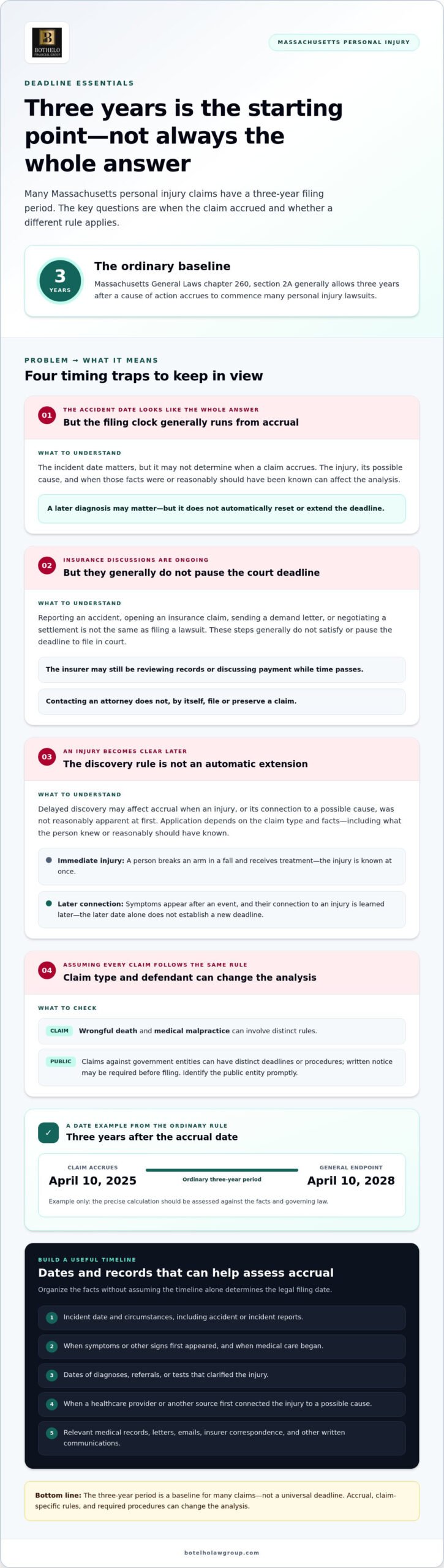
The three-year period is a filing deadline, not a recommended waiting period or a guarantee that every injury claim has three years from the accident date. Accrual can require legal analysis, and some claims follow different rules. For example, if a claim accrued on April 10, 2025, the ordinary three-year period would generally point to April 10, 2028. The precise calculation should be assessed against the facts and governing law.
The deadline concerns starting a lawsuit in court. Reporting an accident, opening an insurance claim, sending a demand letter, or negotiating a settlement is not the same as filing a lawsuit and generally does not satisfy or pause the court deadline. An insurer may still be reviewing records or discussing payment while time passes. Contacting an attorney also does not, by itself, file or preserve a claim.
That distinction matters even when discussions seem productive. If a claimant assumes an insurer’s ongoing review protects the right to sue, the filing period may continue to run. Missing the applicable deadline can prevent a court from hearing the claim, regardless of the injury’s seriousness or the strength of the evidence. Exceptions may apply, but don’t assume one applies without reviewing the facts.
Does the same deadline apply to every injury case?
No. The three-year period is a baseline for many ordinary personal injury claims, not a universal deadline. The type of claim and identity of the defendant can affect both the filing period and required steps. Wrongful death, medical malpractice, and claims involving public entities have distinct rules that require separate analysis.
Those differences can affect what must happen, and when, to protect a claim. A case-specific review should identify the likely claim type, assess when the cause of action accrued, and account for any special procedure that may apply. The next sections explain these timing questions and claim-specific rules in more detail.
When Does the Massachusetts Personal Injury Filing Clock Start?
The incident date is often an important reference point, but it doesn’t always determine when a claim’s filing period begins. Under Massachusetts law, the limitations period generally runs from when a cause of action accrues. Determining accrual can require a closer look at the injury, what caused it, and when those facts were or reasonably should have been known. The governing statute is Massachusetts General Laws Chapter 260, Section 2A, but applying it to a particular timeline takes more than counting forward from the accident date.
The start of the Massachusetts statute of limitations personal injury period depends on the facts that establish when the claim accrued, so the incident date alone may not answer the deadline question. The relevant date can vary with the injury and type of claim. A later diagnosis, for example, may matter to the analysis, but it doesn’t automatically reset or extend the filing period.
How can the discovery rule affect a claim?
The discovery rule may affect accrual when an injury or its connection to a potential cause wasn’t reasonably apparent at first. It is not an automatic extension for anyone who learns more about an injury later. Its application depends on the claim type and specific facts, including what a person knew or reasonably should have known. The rule must be assessed under the Massachusetts law that controls the particular claim.
Consider two situations. A person who breaks an arm in a fall and receives immediate treatment knows about the injury at once. By contrast, someone might experience symptoms after an event but learn later that they reflect an injury connected to it. That difference could matter to accrual, but the later discovery date does not, by itself, establish a new deadline. The legal analysis must account for the evidence and applicable law.
What dates and records help assess the deadline?
Start by creating a timeline, without assuming it determines the legal filing date. Gather dates and documents that may help explain when the injury occurred, how it developed, and when its possible cause became known:
- The date and circumstances of the incident, including any accident or incident reports.
- When symptoms or other signs of injury first appeared, and when medical care began.
- Dates of diagnoses, referrals, or tests that clarified the nature of the injury.
- When a healthcare provider or another source first connected the injury to a possible cause.
- Relevant written communications, such as medical records, letters, emails, or insurer correspondence.
Keep original records where possible and note when each item was created or received. Medical records may show when symptoms were reported or a diagnosis was made. Written communications may help establish what was understood at different points in time. Neither type of document necessarily proves the accrual date on its own. A lawyer reviewing a potential Massachusetts injury claim can compare the timeline with the governing law before estimating a filing deadline. A review of your injury claim can help identify which dates need closer legal analysis.
Which Massachusetts Personal Injury Claims May Have Different Deadlines?
The three-year period is a useful starting point for many injury claims, but it doesn’t resolve every deadline question. The type of claim and who may be legally responsible can bring separate time limits or procedural steps into play. The table below is an issue-spotting guide, not a calculation of your filing deadline. A Massachusetts statute of limitations personal injury analysis should account for the facts and rules governing the specific claim.
| Claim type | General timing rule | Key issue to review |
|---|---|---|
| General negligence | Generally, three years from when the cause of action accrues under Massachusetts General Laws chapter 260, section 2A. | Accrual may depend on the injury and when relevant facts became known or reasonably knowable. |
| Wrongful death | Generally, three years from the date of death under Massachusetts General Laws chapter 229, section 2. | The date of death, rather than simply the date of the underlying incident, is central to this statutory period. |
| Medical malpractice | Generally, three years from the act or omission, or from when the patient knew or should have known of the injury, subject to a seven-year statute of repose. | The repose period and its limited exception for a foreign object left in the body require separate review. Special rules apply to children injured before age six. |
| Claim involving a government entity | Generally, written presentment is required within two years; the lawsuit must still be filed within the applicable three-year period. | Identify the proper recipient and comply with notice requirements. Certain snow- or ice-related injuries on public ways may involve a 30-day written-notice requirement. |
Do wrongful death and medical malpractice claims follow the same rule?
They require separate analysis. A wrongful death claim has its own statutory framework, with the general three-year period running from the person’s death. Medical malpractice has its own limitations and repose rules, and the discovery principle doesn’t eliminate the repose limit in most circumstances. For a child injured by malpractice before age six, the stated rule allows filing until the child’s ninth birthday. These rules are claim-specific, not universal extensions.
What changes when a government entity may be responsible?
The Massachusetts Tort Claims Act creates procedures that can apply to claims against public entities. Presentment and filing a lawsuit are separate requirements. Generally, written presentment must reach the appropriate executive officer within two years of the injury, while the lawsuit remains subject to the applicable three-year limit. A notice requirement may also apply to injuries involving snow or ice on a public street or sidewalk. The correct recipient, notice content, and deadline depend on the circumstances, so identify any public-entity connection promptly.
These timelines are starting points, not a substitute for reviewing the claim’s facts, accrual date, defendant, and required procedures. A missed notice deadline or court-filing deadline can seriously affect a claim, even when another part of the timeline appears to fit the general rule.
How to Protect a Massachusetts Injury Claim Before Time Runs Out
A deadline review is more useful when it starts with an organized record of what happened and when. Take these steps promptly, even if you’re still receiving treatment or an insurer is discussing payment. The Massachusetts statute of limitations personal injury deadline depends on the claim’s facts. A checklist can prepare you for legal review, but it can’t determine the filing date by itself.
What should you gather for a deadline review?
Build a dated timeline and preserve the underlying records. Keep original files where possible, and avoid editing photographs, messages, or documents. If a wrongful death claim may be involved, note the date of death as well as the incident date because that claim has a separate statutory framework.
- Record key dates. Note the incident, when symptoms began, medical visits, diagnoses, and when you first learned information about a possible cause.
- Identify potentially responsible parties. Write down the people, businesses, property owners, or organizations involved. Note whether a city, town, or other public entity may have responsibility.
- Preserve supporting evidence. Keep medical records, photographs, accident reports, witness names and contact details, and relevant physical or digital documents.
- Save communications. Retain letters, emails, texts, and insurer correspondence, including dates and details of calls. A brief note made soon after a conversation can help preserve what was discussed.
- Seek case-specific legal review. Share the timeline and records so a lawyer can assess the claim type, parties, accrual issues, and any special notice or filing rules.
Keep a copy of the timeline and documents in one secure place. If you don’t have every record yet, start with what you have and update the file as new information arrives. Don’t wait until treatment ends to ask how the deadline applies to your circumstances.
Why should you not rely on insurance negotiations?
An insurer’s investigation and settlement discussions are separate from commencing a lawsuit in court. A phone call, claim form, demand letter, or accident report generally doesn’t start a court case or ensure that the filing period has stopped. Negotiations can continue while a legal deadline approaches, so their status alone shouldn’t be treated as protection for a potential claim.
Prompt review doesn’t mean assuming the worst. It means checking the timeline before delays or decisions narrow your options. A lawyer can evaluate how the applicable rules fit the documented dates and explain what steps may be needed. Botelho Law Group handles personal injury matters in Massachusetts, including for people in Fall River. Request a Massachusetts injury deadline review to discuss the timeline and records relevant to your potential claim.
Get a Case-Specific Massachusetts Personal Injury Deadline Review
General deadline rules can identify potential issues, but they can’t determine the filing date for an individual claim. A case-specific review connects the legal rules to the timeline, records, and parties involved. This matters because an incorrect assumption about when a claim accrued or which procedure applies can affect the steps needed to protect it.
What can a lawyer assess about your filing deadline?
A lawyer can review the incident date, when symptoms appeared, treatment and diagnosis records, and any information about when the injury’s possible cause became known. The review can also consider the claim’s legal category and identify individuals, businesses, or public entities that may be responsible. These details help frame the deadline analysis; they don’t, by themselves, establish that a claim is timely or will succeed.
Some claims require attention to more than the date for filing a lawsuit. For example, a claim involving a government entity may raise a separate presentment or notice issue. Wrongful death and medical malpractice claims also have distinct statutory frameworks. Counsel can identify which rules may apply and whether additional procedural requirements need prompt attention. The goal is to assess the facts and deadlines carefully, not to assume an exception applies.
How can Fall River residents take the next step?
Before discussing a potential claim, organize the basic information that can help explain its timeline. You don’t need to resolve every legal question first. Start with what you know and be clear about what remains uncertain.
- When and where did the incident happen?
- When did symptoms begin, and when did you seek care or receive a diagnosis?
- Who may have been involved, and could a public entity be responsible?
- What records, photographs, witness details, or written communications do you have?
- Have you reported the incident or spoken with an insurer, and on what dates?
These details can help counsel assess the timeline and determine what further records may be relevant. If treatment is ongoing or settlement discussions are underway, don’t assume you must wait for either to conclude before asking about the filing deadline. A review can clarify the issues that need attention without guaranteeing a particular legal outcome.
Botelho Law Group represents people in Massachusetts personal injury matters, including residents of Fall River. The firm uses contingency fees for personal injury representation, with no upfront legal fees unless it successfully recovers compensation. The Massachusetts statute of limitations personal injury analysis is specific to each claim, so share the key dates and circumstances with counsel as soon as you can. Contact Botelho Law Group to discuss your potential claim and its timing.
Take the Next Step With a Clearer Timeline
A filing deadline is not just a date on a calendar. It can depend on facts that are still unfolding, records that need context, or procedural rules tied to the responsible party. If you’re uncertain how the Massachusetts statute of limitations personal injury applies to your situation, don’t let that uncertainty keep you from getting a careful assessment. Organizing the dates and documents you already have can help start that conversation.
Botelho Law Group represents people pursuing personal injury claims in Massachusetts, including Fall River residents. Representation is contingency-based, with no upfront legal fees unless compensation is recovered. A review can’t guarantee a particular outcome, but it can help clarify the issues and potential next steps based on your circumstances.
Discuss your Massachusetts personal injury claim with Botelho Law Group. Taking a timely step now can help you move forward with greater clarity and confidence.
Frequently Asked Questions
How long do I have to file a personal injury lawsuit in Massachusetts?
For many claims, you generally have three years from when the cause of action accrues to commence a lawsuit under Massachusetts General Laws chapter 260, section 2A. The Massachusetts statute of limitations personal injury cases follow is a starting point, not a universal deadline. The claim type, accrual date, and identity of the defendant can change the analysis, so don’t rely on the accident date alone to set your final filing date.
When does the statute of limitations start after an accident in Massachusetts?
It generally starts when the cause of action accrues, which often relates to when the injury and its connection to the event were known or reasonably should have been known. For an obvious injury treated immediately, the incident date may be central. If symptoms or their cause become apparent later, the timeline may need closer review. Keep dated treatment and diagnosis records to help assess what was knowable and when.
Can insurance negotiations extend the Massachusetts personal injury deadline?
Generally, no. Discussions with an insurer, a demand letter, or an open insurance claim don’t themselves commence a lawsuit or stop the court-filing period. For example, an adjuster may still be reviewing medical records while the legal deadline continues to approach. Keep records of communications, but don’t treat a pending offer or ongoing negotiations as an extension. Have the filing timeline reviewed independently of the insurance process.
What happens if I miss the personal injury filing deadline in Massachusetts?
A lawsuit filed after the applicable limitations period may be dismissed as untimely, which can prevent recovery through that claim. The outcome depends on the applicable law and facts, including whether a recognized exception affects the deadline. If you think time may have passed, don’t assume the claim is automatically barred or that an exception applies. A prompt review of the dates and claim type can clarify the issue.
Is the deadline different if a Massachusetts government entity caused my injury?
It can involve an earlier procedural deadline in addition to the lawsuit deadline. Under the Massachusetts Tort Claims Act, written presentment generally must be made to the appropriate executive officer within two years of the injury, while the lawsuit remains subject to the applicable three-year limit. Certain snow- or ice-related injuries on public ways may require written notice within 30 days. Identify the responsible public entity promptly, since the recipient and requirements matter.
Does Massachusetts give minors more time to file personal injury claims?
Generally, the limitations period for a minor’s personal injury claim is tolled, or paused, until the child turns 18. Under the general rule, this can allow a lawsuit to be filed up to the child’s 21st birthday. Don’t assume that calculation applies to every claim or resolves other procedural requirements. The injury type, responsible party, and any applicable exceptions should be reviewed before relying on a specific deadline.
Is a wrongful death claim subject to the same deadline as a personal injury lawsuit?
Wrongful death has a separate statutory deadline: generally, the lawsuit must be brought within three years of the person’s death under Massachusetts General Laws chapter 229, section 2. That date may differ from the date of the incident that caused the death. Families should preserve records of both dates and seek a claim-specific review, since the applicable framework and parties may differ from those in an injured person’s own claim.