
A single inheritance of just $2,001 can instantly strip a disabled family member of their MassHealth coverage and monthly SSI income. This “inheritance trap” is a harsh reality for many Massachusetts families who realize too late that a well-intentioned gift has disqualified a loved one from essential government support. You’ve worked hard to provide for your family, and the thought of that legacy causing more harm than good is understandably distressing. It’s a high-stakes legal environment where a minor oversight leads to a total loss of benefits.
Securing your child’s financial future requires a sophisticated, results-oriented strategy. By partnering with an experienced special needs trust attorney MA, you can establish a legally airtight shield that protects assets while maintaining eligibility for vital programs. You’ll learn exactly how to leverage the 2026 ABLE Age Adjustment Act expansion and the latest MassHealth estate recovery reforms to your advantage. This article provides a clear, systematic plan for navigating the complexities of third-party trusts and choosing a reliable trustee. We’ll examine the critical differences between trust types and the precise steps needed to ensure your loved one receives the lifelong care they deserve without compromise.
Key Takeaways
- Understand how a Special Needs Trust acts as a protective shield, preventing the “Inheritance Trap” that can disqualify loved ones from MassHealth and SSI benefits.
- Learn the critical distinction between First-Party and Third-Party trusts to ensure family wealth remains within the family rather than being subject to state payback.
- Discover how to structure discretionary distributions so that assets remain unavailable to the beneficiary, preserving their eligibility for essential government programs in 2026.
- Identify the mandatory legal requirements for drafting a valid trust, including specific spendthrift clauses and irrevocable status as guided by a special needs trust attorney MA.
- Gain insights into why local expertise in Bristol County is vital for navigating regional probate courts and integrating trusts into a holistic estate plan.
The Inheritance Trap: Why Massachusetts Families Need a Special Needs Trust
A Special Needs Trust (SNT) is a sophisticated legal vehicle designed to hold and manage assets for the benefit of an individual with disabilities. For many, this special needs trust overview highlights how these structures ensure that a beneficiary remains eligible for means-tested government programs. Without this protection, a direct inheritance acts as a double-edged sword. It provides immediate cash but simultaneously triggers a disqualification from vital support systems. Consulting a special needs trust attorney MA is the most effective way to prevent this outcome and secure a stable future.
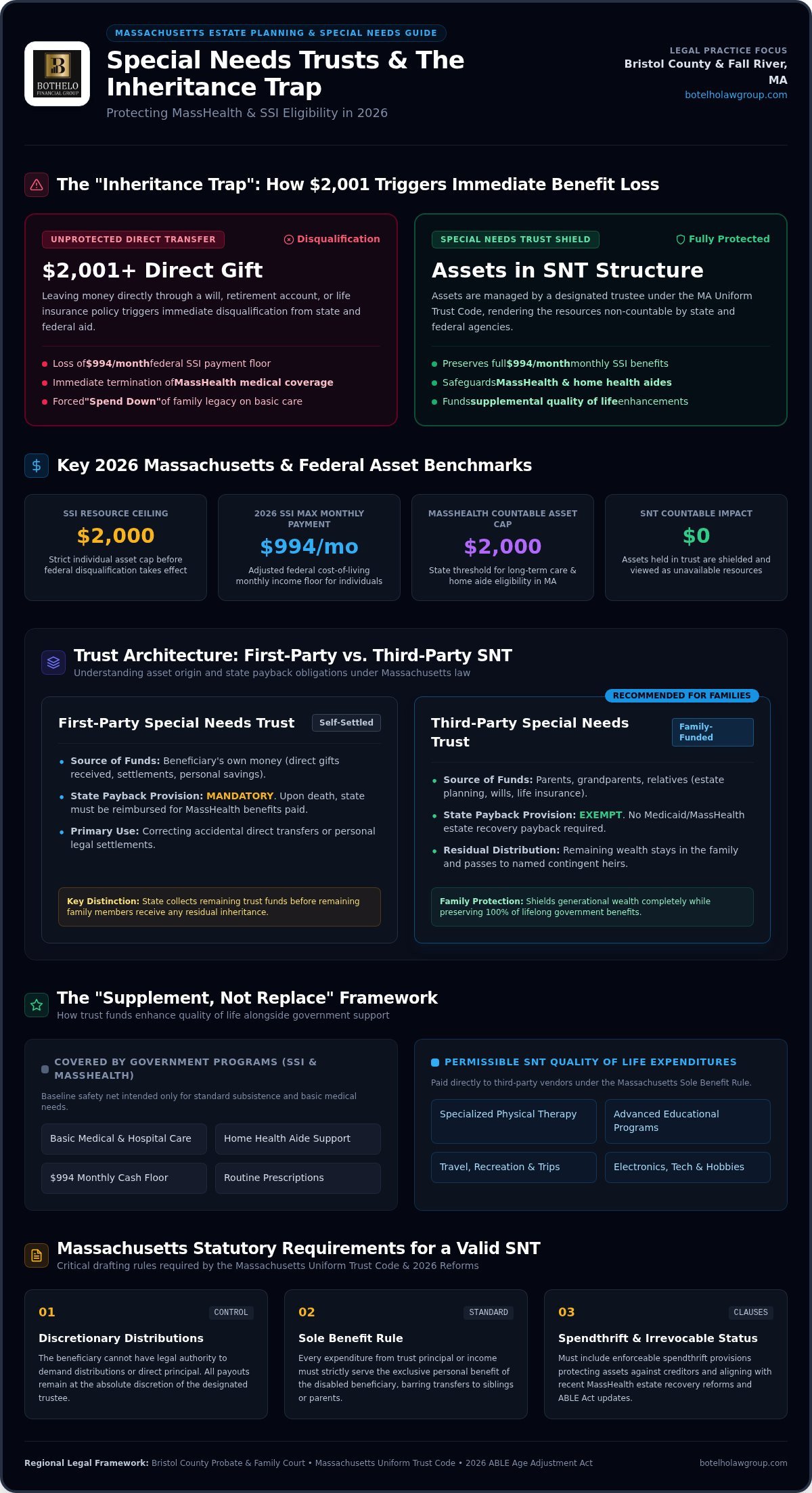
The “Inheritance Trap” occurs when a well-meaning relative leaves money directly to a person with a disability through a will, retirement account, or life insurance policy. In Massachusetts, most essential benefits are restricted to individuals with very few assets. Receiving even a modest gift can immediately push a beneficiary over these strict limits. This forces the individual to “spend down” their entire inheritance on basic medical bills before they can re-qualify for state aid. It’s a cycle that depletes family wealth without improving the beneficiary’s quality of life. A trust changes this dynamic by providing “supplemental” care, which covers things the government doesn’t, while preserving “basic” support from the state.
Understanding Supplemental Security Income (SSI) Limits in MA
In 2026, the federal resource limit for Supplemental Security Income (SSI) remains at a strict $2,000 for an individual. While the maximum monthly federal payment has adjusted to $994 for individuals to reflect cost-of-living changes, the asset ceiling hasn’t moved in decades. If a loved one receives a $5,000 gift, they’ll likely lose their $994 monthly check and the linked MassHealth coverage. A special needs trust attorney MA structures the trust so the assets are not “countable” by the Social Security Administration. This allows the funds to pay for education, electronics, or recreation while the government continues to provide the monthly income floor.
MassHealth Eligibility and the Role of the Trust
MassHealth coverage is often far more valuable than the cash value of an inheritance. For residents in Fall River and across Bristol County, MassHealth provides the foundation for long-term medical care, home health aides, and specialized support services. The state applies a $2,000 countable asset cap for most disabled applicants. A properly drafted trust ensures that the state cannot count these assets toward that limit. This creates a permanent shield for the beneficiary’s inheritance. It ensures the money remains available for lifelong care and comfort rather than being exhausted on routine medical expenses that the state would otherwise cover.
How a Special Needs Trust Protects Benefits in 2026
A special needs trust functions as an essential barrier between the beneficiary and the assets meant for their care. To preserve eligibility for means-tested benefits, the beneficiary cannot have any legal authority to direct trust funds or access the principal. Instead, the assets are held by a trustee who manages them according to the Massachusetts Uniform Trust Code. This structure ensures that state agencies like MassHealth view the trust assets as unavailable resources. By removing the individual’s direct control, the trust prevents the “Inheritance Trap” discussed previously from ever taking effect.
The “Sole Benefit” rule is a cornerstone of Massachusetts trust law. It mandates that every expenditure from the trust must be for the exclusive benefit of the person with the disability. If a trustee uses funds to benefit a sibling or a parent, they risk disqualifying the beneficiary from their benefits. A special needs trust attorney MA ensures that the trust document is drafted with precise language to satisfy these strict regulatory requirements. This level of precision is vital for maintaining the protective shield over family wealth.
Permissible Expenses: Enhancing Quality of Life
Trust funds are intended to supplement, not replace, government assistance. While programs like SSI cover basic survival needs, the trust provides for the “extras” that make life fulfilling. This includes specialized physical therapy, advanced educational programs, travel expenses, and high-quality electronics. However, trustees must be cautious when paying for food or shelter. Under Social Security Administration rules, these payments can be considered In-Kind Support and Maintenance, which often results in a reduction of the beneficiary’s monthly SSI payment. A discretionary distribution is the primary legal tool used to protect benefits by giving the trustee full control over how and when funds are spent.
The Trustee’s Critical Role in MA Trusts
Selecting the right trustee is a high-stakes decision. Families often choose between a trusted relative or a professional fiduciary. While a family member understands the beneficiary’s personal needs, a professional fiduciary brings expertise in complex MassHealth reporting and tax compliance. The trustee must provide annual accountings and ensure that every distribution complies with the “Sole Benefit” rule. Prohibited distributions, such as giving cash directly to the beneficiary, can trigger an immediate suspension of benefits. If you’re concerned about how to structure these roles, consulting a qualified estate planning advocate can help you establish a secure framework for lifelong care.
First-Party vs. Third-Party Special Needs Trusts in MA
The primary differentiator between special needs trusts in Massachusetts is the source of the assets used to fund the vehicle. Identifying the correct trust type is a critical first step for any special needs trust attorney MA. The legal requirements, tax implications, and eventual distribution of remaining funds depend entirely on whose money is being placed into the trust. While both types protect eligibility for means-tested benefits, they operate under distinct statutory mandates. According to the Social Security Administration POMS trust guidelines, the funding source dictates whether the state of Massachusetts is entitled to reimbursement for medical expenses after the beneficiary passes away.
Third-Party SNTs: The Gold Standard for Estate Planning
Third-party special needs trusts are funded with assets belonging to anyone other than the beneficiary. This typically includes parents, grandparents, or other relatives who wish to leave a legacy. These trusts are the most common tool used in comprehensive disability planning because they offer maximum flexibility. Because the beneficiary never owned the assets, Massachusetts law does not require a “Medicaid payback” clause. This means that when the beneficiary passes away, any remaining funds can be distributed to other family members or charities. Integrating this tool into a broader Massachusetts estate planning lawyer strategy allows families to dictate exactly where their wealth goes. It provides a permanent shield for the inheritance without the risk of state recovery.
First-Party SNTs and Personal Injury Settlements
First-party special needs trusts, often referred to as d4A trusts, are funded with assets that already belong to the disabled individual. This situation frequently arises when a beneficiary receives a direct inheritance, a back-payment of Social Security benefits, or a legal settlement. Often, these trusts are established following a successful litigation outcome managed by a personal injury lawyer Fall River MA. Unlike third-party trusts, federal law mandates that first-party trusts include a state payback provision. Upon the beneficiary’s death, the trustee must use the remaining funds to reimburse MassHealth for all medical assistance provided during the beneficiary’s lifetime. Only after the state is fully compensated can the remaining assets pass to other heirs. A special needs trust attorney MA ensures these trusts are established before the beneficiary reaches age 65 to remain valid under federal law.
Key Requirements for Drafting a Valid SNT in Massachusetts
Drafting a special needs trust in Massachusetts is a high-stakes legal process. A single drafting error can lead to the immediate loss of benefits for a vulnerable family member. To ensure the trust is legally airtight, it must be established as an irrevocable entity. This means the grantor cannot unilaterally reclaim the assets. If the funds were accessible to the grantor or the beneficiary, MassHealth would count them as available resources. A professional special needs trust attorney MA also integrates specific “Spendthrift” clauses required by the Massachusetts Uniform Trust Code. These clauses prevent creditors from attaching to the trust assets, ensuring the legacy remains dedicated solely to the beneficiary’s care.
The document must include a clear “Supplemental Needs” statement of intent. This clause explicitly instructs the trustee that the funds are intended to enhance the beneficiary’s quality of life. It clarifies that the trust doesn’t replace basic government support. Precision in naming the beneficiary and the trustee is equally vital. Ambiguity in these roles can lead to administrative delays or legal challenges in the Bristol County Probate and Family Court on Rock Street.
Integrating Real Estate and the Family Home
Protecting the family residence is a primary concern for Fall River families. While a special needs trust can hold real estate, some families choose to pair the trust with other asset protection tools. Understanding what is a life estate is essential for homeowners who want to ensure their child has a place to live while shielding the property from MassHealth estate recovery. Since Massachusetts limited estate recovery to probate assets under Chapter 197 of the Acts of 2024, keeping the home out of probate is a critical defensive strategy for any middle-class family.
Compliance with the Massachusetts Uniform Trust Code
The 2026 legal landscape requires rigorous administrative compliance. Trustees must fulfill strict reporting requirements to the Social Security Administration to verify that the trust remains an exempt resource. DIY trust forms frequently fail MassHealth scrutiny because they lack the specific language required by Massachusetts law. These generic documents often omit the necessary spendthrift protections or fail to account for the state’s unique five-year look-back periods. It’s a risk that can jeopardize a lifetime of savings. To secure your family’s future, you should consult with a dedicated asset protection strategist to review your existing plans.
Why a Local Fall River Special Needs Trust Attorney is Essential
Securing a legacy for a disabled family member is not a task for a generic, nationwide document service. It requires the precise, localized expertise of a special needs trust attorney MA who understands the specific administrative hurdles within the Commonwealth. National firms often overlook the procedural nuances of regional MassHealth offices or the specific filing requirements of the Bristol County Probate and Family Court. A local advocate provides more than just paperwork; they offer a sophisticated understanding of how local financial institutions and state agencies interact with these complex legal structures. This deep regional knowledge is what prevents the administrative delays that can jeopardize a beneficiary’s access to care.
Effective disability planning is never a standalone effort. It must be part of a holistic strategy that addresses every aspect of a family’s legal needs. This includes integrating the trust with a comprehensive power of attorney lawyer Fall River setup to ensure that if a parent or guardian becomes incapacitated, there is a clear, legally binding plan in place. By coordinating these documents, families can avoid the chaos of emergency guardianship proceedings and ensure that the special needs trust remains funded and managed without interruption. This personalized advocacy is vital for families across Fall River, Boston, and Providence who demand results-oriented protection.
Navigating the Bristol County Probate System
The Bristol County Probate and Family Court, located at 289 Rock Street in Fall River, has its own rhythm and set of expectations. A local firm understands these procedural nuances, which can often be the difference between a smooth trust administration and a costly delay. Beyond the courtroom, a local attorney ensures the trust is recognized by local banks and investment firms. These institutions are sometimes hesitant to work with complex trusts drafted by out-of-state entities or generic online templates. By using a firm rooted in the South Coast community, you ensure that your trustee has the local support needed to manage assets effectively from day one.
Securing Your Legacy with Botelho Law Group
Botelho Law Group delivers a results-oriented approach to asset protection that prioritizes the long-term stability of your most vulnerable family members. Our firm acts as a dedicated guide through the complex intersection of estate law and government benefits. We take the burden off your family by handling the intricate document preparation and ensuring full compliance with the latest 2026 regulatory changes, such as the MassHealth estate recovery rollbacks. This protective advocacy ensures that your child’s inheritance remains a source of comfort rather than a legal liability. Contact our Fall River office today to establish a secure, legally airtight framework for your loved one’s lifelong care.
Securing Your Family Legacy for the Next Generation
Protecting a disabled family member’s future requires a strategic approach that balances long-term asset protection with continued eligibility for essential government programs. By establishing a properly structured trust, you avoid the inheritance trap and ensure that family wealth remains a source of lifelong support. Whether you need to manage a personal injury settlement or preserve a legacy through a third-party vehicle, precision in drafting is mandatory to satisfy 2026 regulatory standards. Our experienced Massachusetts estate planning team provides the focused advocacy Bristol County families need to navigate these high-stakes decisions.
Partnering with a dedicated special needs trust attorney MA ensures your plan complies with both the Massachusetts Uniform Trust Code and regional MassHealth requirements. This specialized guidance transforms a complex legal burden into a clear, manageable roadmap for your loved one’s care. Secure your loved one’s future—schedule a consultation with a Botelho Law Group special needs trust attorney today. You’ve worked hard to build a foundation for your family, and we’re here to make sure that foundation stays protected for years to come.
Frequently Asked Questions
Can I be the trustee of my child’s Special Needs Trust?
Yes, you can serve as the trustee of your child’s trust, but it requires strict adherence to fiduciary standards. You’ll be responsible for managing assets, filing taxes, and ensuring every distribution follows the “sole benefit” rule. Many parents in Fall River choose to appoint a professional co-trustee to handle complex MassHealth reporting. This ensures the trust remains compliant while you focus on your child’s daily care and well-being.
How much money can be put into a Special Needs Trust in Massachusetts?
There is no maximum legal limit on the amount of money you can place into a Third-Party Special Needs Trust. Whether you’re contributing $10,000 or $2 million, the assets remain non-countable for SSI and MassHealth eligibility. However, First-Party trusts are limited to the beneficiary’s own assets, such as a personal injury settlement. A special needs trust attorney MA can help you determine the optimal funding level to provide for a lifetime of supplemental care.
Does a Special Needs Trust end when the beneficiary turns 18?
A Special Needs Trust does not expire when the beneficiary reaches the age of 18. In fact, these legal vehicles often become more essential during the transition to adulthood. This is the stage when individuals typically apply for adult Supplemental Security Income and MassHealth. The trust is designed to provide financial protection and quality-of-life enhancements for the beneficiary’s entire life, regardless of their age or the status of their guardians.
Can a Special Needs Trust buy a house or a car for the beneficiary?
Yes, a trust can purchase a home or a vehicle for the beneficiary’s use as these are generally considered non-countable assets. The trustee must ensure the title is held in the name of the trust to prevent the asset from being counted against the $2,000 resource limit. Proper structuring is vital to avoid penalties. Consulting a special needs trust attorney MA ensures these major purchases don’t accidentally trigger a reduction in monthly SSI payments.
What is the difference between an ABLE account and a Special Needs Trust?
The primary differences involve contribution limits and age requirements. In 2026, ABLE accounts are limited to a $20,000 annual contribution, whereas trusts have no funding ceiling. ABLE accounts now allow for disability onset before age 46, but they include a mandatory Medicaid payback clause. Trusts offer more robust asset protection for larger inheritances and don’t always require state reimbursement, depending on whether they’re funded by a third party or the beneficiary themselves.
What happens to the money in an SNT when the beneficiary passes away?
The distribution of remaining funds depends entirely on the type of trust established. In a Third-Party SNT, the person who created the trust decides who receives the leftover assets; there’s no requirement to reimburse the state. In a First-Party SNT, Massachusetts law mandates a payback provision. This means the trustee must use remaining funds to reimburse MassHealth for medical expenses paid during the beneficiary’s life before any heirs can receive a distribution.
Is a Special Needs Trust public record in Massachusetts?
Standalone special needs trusts are private documents and are not typically part of the public record in Massachusetts. This privacy protects the beneficiary’s financial details and personal information from outside scrutiny. However, if a trust is testamentary, meaning it’s created within a will, it becomes a public record when the will is filed for probate at the Bristol County Probate and Family Court. Most families prefer creating a separate, private trust to maintain confidentiality.
Can I change an irrevocable Special Needs Trust once it is created?
Modifying an irrevocable trust is a complex process that usually requires court intervention. Massachusetts doesn’t have a broad decanting statute, so changes often involve filing a petition with the probate court. You might be able to include a trust protector provision during the initial drafting phase to allow for future administrative adjustments. Because these documents are difficult to change, it’s critical to ensure the initial language is precise and accounts for long-term needs.