
An L-1 visa isn’t merely a corporate transfer permit; it’s a high-stakes strategic asset that determines the trajectory of your multinational expansion in 2026. With USCIS scrutiny reaching new heights, particularly regarding specialized knowledge and new office petitions, a single administrative oversight can derail your entire corporate timeline. Partnering with an experienced L-1 visa lawyer ensures that your petition isn’t just filed, but is architected to withstand the rigorous demands of current immigration policy.
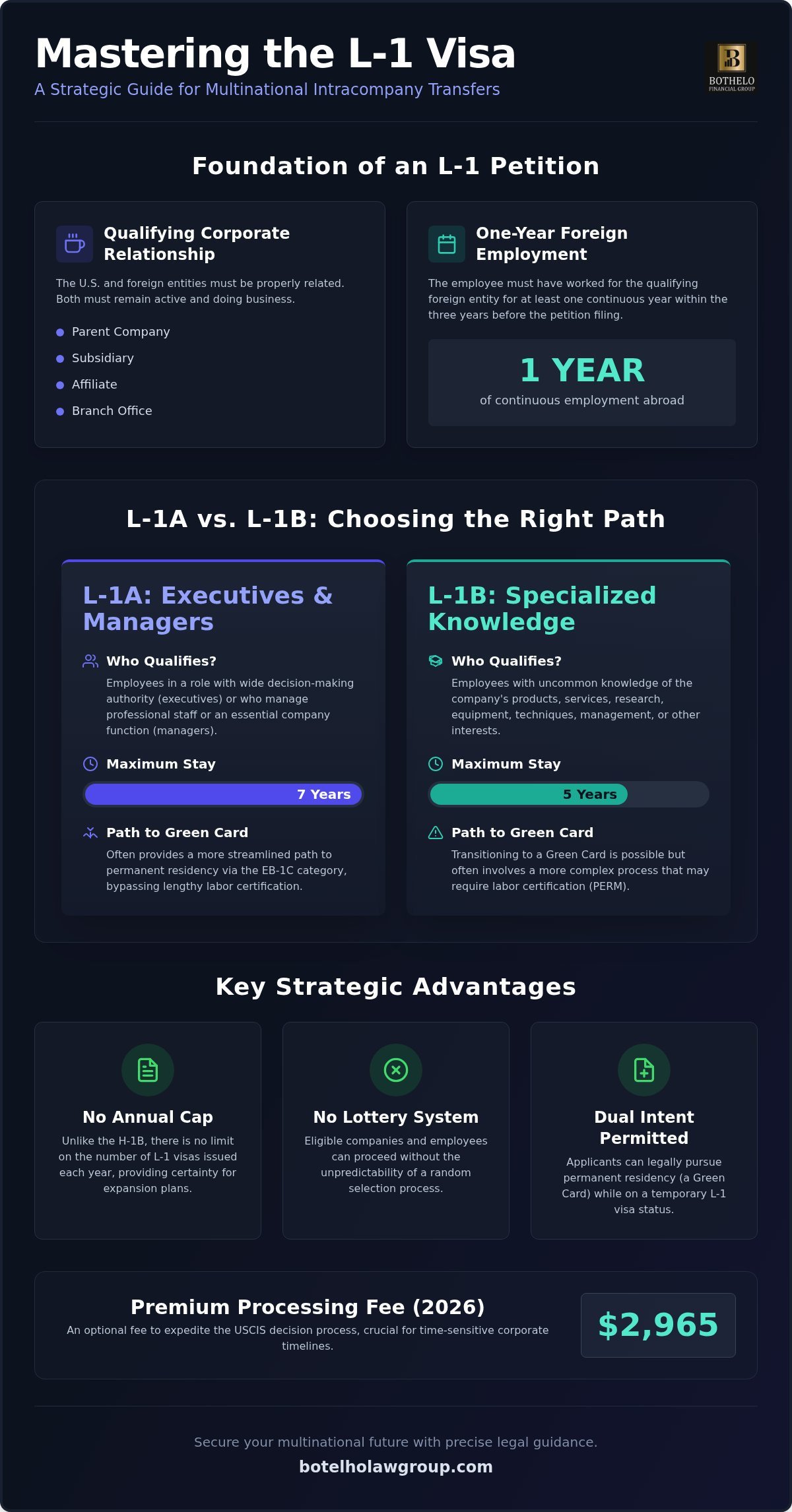
We understand the anxiety that comes with the one-year foreign employment rule or the looming threat of a Request for Evidence (RFE). You likely feel that the margin for error has never been thinner, and you’re right. This guide provides an authoritative roadmap to mastering L-1A and L-1B complexities. You’ll learn how to navigate the 2026 fee structures, including the $2,965 premium processing rate, while building a clear path toward U.S. permanent residency. We’ll break down eligibility requirements, the filing process, and the specific evidence needed to prove managerial or specialized expertise to ensure your global talent remains where it’s needed most.
Key Takeaways
- Understand how the L-1 visa serves as a premier tool for multinational businesses to transfer key talent and scale operations across borders.
- Identify the critical distinctions between L-1A managers and L-1B specialized knowledge workers to secure the most advantageous path to permanent residency.
- Verify your organization’s eligibility by examining the strict requirements for qualifying corporate relationships and active business operations in multiple countries.
- Leverage the dual intent provision with the guidance of an L-1 visa lawyer to transition seamlessly from a non-immigrant status to a U.S. Green Card.
- Discover how protective advocacy and precise document preparation can mitigate the risk of USCIS delays and streamline consular processing for employees located abroad.
Understanding the L-1 Visa: A Strategic Intracompany Transfer Tool
The L-1 visa serves as a primary mechanism for multinational corporations to mobilize their most valuable human assets. It facilitates the temporary transfer of foreign employees to a related U.S. entity, ensuring that institutional knowledge and leadership styles remain consistent across borders. For a growing business, this is a strategic maneuver. Unlike the H-1B program, the L-1 classification has no annual cap and no lottery system. This predictability allows companies to execute expansion plans without the uncertainty of a random selection process. Consulting an L-1 visa lawyer early in the process helps businesses map out these transfers with surgical precision.
The program specifically targets three groups: executives, managers, and employees with specialized knowledge. Each role requires a distinct evidentiary standard to prove that the transfer is legitimate and necessary for the U.S. operation’s success. By leveraging this tool, companies maintain their competitive edge in a global economy that demands rapid deployment of expertise.
The Concept of the Qualifying Relationship
Establishing a qualifying relationship is the foundation of any successful petition. Immigration authorities recognize four primary structures: parent companies, subsidiaries, affiliates, and branch offices. To qualify, the U.S. employer and the foreign entity must share common ownership and control. A common pitfall occurs when corporate documentation fails to clearly demonstrate this link, especially in complex multi-tiered corporate structures. Additionally, the foreign entity must continue to operate as a viable business while the employee is stationed in the U.S. If the foreign office closes, the status typically becomes invalid. Our role as your L-1 visa lawyer is to meticulously document these corporate ties to survive intense USCIS scrutiny.
The One-Year Foreign Employment Rule
Eligibility hinges on a specific look-back period. The beneficiary must have been employed by the foreign entity for at least one continuous year within the three years immediately preceding the petition. This requirement ensures the individual has already integrated into the company’s culture and possesses the specific expertise required for the U.S. role. While brief trips to the U.S. for business or pleasure don’t break the “continuous” nature of the employment, they generally don’t count toward the one-year total. Precise calculation of these dates is essential to avoid a summary denial. For employees already in the U.S. on other non-immigrant visas, specific nuances apply that may allow them to meet this requirement without departing the country.
L-1A vs. L-1B: Distinguishing Executives, Managers, and Specialized Knowledge
Selecting the appropriate sub-category for an intracompany transfer is a critical strategic decision. The L-1 program is divided into two distinct paths: the L-1A for executives and managers, and the L-1B for workers with specialized knowledge. This choice dictates the beneficiary’s maximum duration of stay and their future eligibility for U.S. permanent residency. While L-1A holders can remain in the country for up to seven years, L-1B workers are restricted to a five-year limit. For many, the L-1A is the preferred route because it often leads to a more streamlined Green Card process through the EB-1C category, which bypasses the lengthy labor certification requirement. An experienced L-1 visa lawyer ensures that your employee’s role is mapped correctly to avoid unnecessary limitations on their stay.
L-1A for Executives and Managers
The L-1A nonimmigrant classification requires a high degree of authority within the organization. Executive capacity involves wide latitude in decision-making with minimal oversight from higher-level individuals. Managerial capacity typically focuses on the supervision of professional staff or the management of a specific department. However, companies can also utilize the “functional manager” designation. This allows a manager to qualify by overseeing an essential organizational function or process, even if they don’t directly supervise a large team of employees. This nuance is particularly valuable for lean, high-tech firms where senior leaders manage critical systems rather than headcounts.
L-1B for Specialized Knowledge Workers
Specialized knowledge refers to an uncommon degree of expertise regarding the petitioning organization’s specific products, services, or internal processes that is not widely held within the general industry. To qualify, the knowledge must be proprietary or advanced compared to what’s standard in the marketplace. USCIS applies intense scrutiny to these petitions, often questioning whether the skill set is truly unique or simply a common industry proficiency. This skepticism has led to a historically high rate of Requests for Evidence (RFE) for L-1B filings. Proving that an employee’s knowledge is indispensable requires detailed evidence of internal training, proprietary systems, and the specific impact of their work. Securing the help of a dedicated L-1 visa lawyer can help your firm build a robust evidentiary file to overcome these administrative hurdles and secure a successful adjudication.
Core Eligibility Requirements for Multinational Entities
Eligibility for an intracompany transfer isn’t just about the employee’s credentials; the corporate structure itself must be legally sound. The U.S. employer must maintain a qualifying relationship with the foreign entity and remain active in at least two countries for the duration of the transferee’s stay. This “doing business” requirement means the regular, systematic, and continuous provision of goods or services. Documentation of ownership and control is non-negotiable, as USCIS looks for a clear link between the entities. An L-1 visa lawyer provides the oversight needed to ensure these corporate ties meet USCIS L-1A requirements. Additionally, the U.S. entity must demonstrate financial viability to support the transferee’s compensation and provide evidence of physical premises, such as a signed commercial lease, to prove the office is ready for operations.
The ‘New Office’ L-1 Petition
For companies expanding into the U.S. market with less than one year of domestic operations, the “New Office” petition is the standard entry point. This classification grants an initial one-year stay, acting as a probationary period to prove the business can survive. The burden of proof is exceptionally high. You must submit a comprehensive business plan demonstrating that the new office will grow enough to support an executive or managerial position within that first year. If the office fails to meet these projected milestones, USCIS will likely deny the extension. We focus on drafting these plans with the precision required to justify the hire from day one, ensuring the U.S. branch is positioned for long-term growth.
The Blanket L-1 Petition for Large Corporations
Large, established organizations can bypass individual petition hurdles by securing a “Blanket” L-1 approval. To qualify, a company must have at least three domestic and foreign branches, subsidiaries, or affiliates. It must also meet specific size thresholds, such as $25 million in combined annual sales or a U.S. workforce of at least 1,000 employees. The primary benefit is speed. Once the corporate relationship is pre-certified, the company can send transferees directly to the consulate without waiting for individual USCIS petition approvals. While this streamlines the process for global giants, small to mid-sized firms typically rely on individual petitions, which require the specific expertise of an L-1 visa lawyer to navigate the unique challenges of smaller corporate structures.
The “dual intent” doctrine is a cornerstone of U.S. business immigration that sets the L-1 classification apart from many other non-immigrant categories. While visitors or students must generally prove they don’t intend to stay in the U.S. permanently, L-1 holders have the legal right to hold their temporary status while actively seeking a Green Card. This provides a layer of security that isn’t available with TN or E-3 visas, where an application for permanent residency can jeopardize future border crossings. Working with an L-1 visa lawyer allows you to leverage this protection, ensuring your corporate transfer serves as a stable foundation for long-term U.S. residency.
Strategic timing is essential when managing this transition. Most multinational firms begin the residency process shortly after the employee’s arrival to account for USCIS processing backlogs. An employment based visa attorney plays a vital role here, synchronizing the company’s business needs with the transferee’s personal immigration goals to avoid any gaps in work authorization.
The EB-1C Green Card for Executives and Managers
L-1A holders are uniquely positioned to apply for the EB-1C “Multinational Executive or Manager” category. This is often the most efficient path to a Green Card because it doesn’t require the PERM labor certification process. Bypassing PERM saves the organization significant time and expense; it also avoids the requirement to test the U.S. labor market to prove no qualified U.S. workers are available. While L-1A and EB-1C requirements are similar, they aren’t identical. The EB-1C requires the U.S. company to have been doing business for at least one year and demands a more rigorous demonstration of the executive’s high-level authority.
L-1B to Green Card: The PERM Process
Transferees on an L-1B visa typically pursue residency through the EB-2 or EB-3 categories. Unlike the L-1A path, these classifications require the employer to complete the PERM labor certification process. This involves a supervised recruitment period to demonstrate that the specialized knowledge worker isn’t displacing a qualified U.S. applicant. A common challenge arises when the “specialized knowledge” used for the L-1B petition is so niche that it conflicts with the “minimum job requirements” stated in the PERM application. An L-1 visa lawyer must carefully align these descriptions to ensure consistency across both filings. If you’re ready to secure your future in the United States, contact our firm to discuss your residency strategy.
Navigating the L-1 Filing Process with Botelho Law Group
Securing an intracompany transfer requires more than just administrative filing; it demands a sophisticated legal strategy. As your L-1 visa lawyer, Botelho Law Group provides protective advocacy that prioritizes your company’s operational continuity. From our headquarters in Fall River, Massachusetts, we represent corporate clients in all 50 states, ensuring that every petition meets the highest standards of legal precision. We also assist with consular processing for transferees currently located abroad, managing the coordination between U.S. entities and foreign embassies.
Our firm recognizes that business immigration often involves broader financial implications. Because many transferees are high-net-worth executives, we can integrate your immigration path with the expertise of an estate planning lawyer Fall River MA. This comprehensive approach ensures that your assets and family interests are protected as you establish your presence in the United States.
For executives and companies focusing their expansion in the Florida market, AHL HardMoney, llc offers specialized hard-money financing solutions to help secure commercial or residential real estate assets during the transition.
Initial Consultation and Strategic Role-Mapping
The success of your petition is often decided before the first form is signed. We begin with a rigorous assessment to determine whether L-1A or L-1B eligibility is the most viable path. This phase involves:
- Drafting job descriptions that align precisely with USCIS’s strict “managerial” or “specialized knowledge” definitions.
- Reviewing corporate structure documents to verify a qualifying relationship between the foreign and domestic entities.
- Identifying potential evidentiary gaps in the employee’s one-year foreign employment history.
By mapping the role strategically from the outset, we build a narrative that justifies the transfer as an essential business necessity. We don’t just fill out forms; we architect a case that withstands the scrutiny of the 2026 immigration landscape.
Managing the USCIS Relationship and RFEs
USCIS frequently uses Requests for Evidence (RFEs) to challenge the legitimacy of specialized knowledge or the depth of managerial authority. Our proactive strategy focuses on minimizing this risk through meticulous document preparation that anticipates adjudicator concerns. If USCIS does issue a challenge, we respond with authority and precision. The expertise of a dedicated L-1 visa lawyer is essential when responding to these high-stakes inquiries. We deploy detailed legal briefs and supplemental evidence to address every point of contention, defending your right to transfer key talent. Contact Botelho Law Group today for a comprehensive L-1 visa evaluation.
Securing Your Multinational Future in the United States
The L-1 visa remains a powerful instrument for companies to deploy their most essential talent across U.S. borders. By understanding the nuances of executive role-mapping and the dual intent doctrine, your organization can transform a temporary transfer into a permanent corporate advantage. Navigating the 2026 regulatory landscape requires more than just compliance; it demands a sophisticated legal strategy that protects both the business and the individual transferee. Whether you’re managing a new office petition or a complex blanket transfer, the guidance of a dedicated L-1 visa lawyer is indispensable for mitigating risks like specialized knowledge RFEs. For L-1B holders planning their path to permanent residency, working with an experienced PERM labor certification lawyer is equally critical to avoiding the costly errors and delays that can derail a multi-year investment.
Botelho Law Group provides nationwide representation across all 50 states and full-service support for consular processing. We also offer integrated business services, including estate planning for high-net-worth transferees, to ensure every aspect of your relocation is legally sound. Your global expansion deserves a representative who fights for your interests with precision and authority. Schedule a Consultation with a Strategic L-1 Visa Lawyer and take the next step in your American journey with confidence.
Frequently Asked Questions
Can a spouse of an L-1 visa holder work in the United States?
Yes, spouses of L-1 visa holders, classified as L-2 dependents, are authorized to work upon entry to the U.S. based on their status. Their valid I-94 record serves as automatic evidence of work authorization, so they don’t need to apply for a separate Employment Authorization Document. This policy facilitates a smoother relocation for families, allowing spouses to seek employment immediately without administrative delays.
What is the maximum duration I can stay in the U.S. on an L-1 visa?
The maximum stay depends on your specific classification. L-1A executives and managers can remain in the U.S. for a total of seven years. L-1B workers with specialized knowledge are limited to a five-year maximum stay. Once these limits are reached, the individual must generally reside and be employed outside the U.S. for at least one year before becoming eligible for a new L-1 status.
Is there a minimum salary requirement for an L-1 visa holder?
There is no specific “prevailing wage” requirement for L-1 visas like there is for H-1B petitions. However, the employer must demonstrate the financial ability to pay the transferee. The salary should be consistent with a managerial or specialized knowledge position. USCIS may question a petition if the compensation seems insufficient to support the claimed level of authority or expertise within the corporate structure.
Can a small business or a startup qualify for an L-1 visa?
Small businesses and startups can qualify through the “New Office” L-1 petition. This allows a foreign company to send an executive or manager to the U.S. to establish operations. These petitions are initially granted for one year. The company must provide a detailed business plan and evidence of physical premises to prove the new branch will support a managerial position within that first year of operation.
What happens if my L-1 visa extension is denied?
If an extension is denied, your legal status in the U.S. typically expires on the date listed in the denial notice or your current I-94. You may be required to depart the country immediately to avoid accruing unlawful presence. Consulting an L-1 visa lawyer is critical in these situations to evaluate options such as filing a motion to reopen or reapplying from abroad through consular processing.
How long does the L-1 visa application process take in 2026?
Processing times vary based on USCIS caseloads and the specific service center. In 2026, premium processing is available for a fee of $2,965, which guarantees action within 15 business days. Standard processing can take several months. Consular processing times also depend on the specific U.S. embassy or consulate in the applicant’s home country, where wait times for interviews can fluctuate significantly based on local demand.
Do I need a university degree to qualify for an L-1B specialized knowledge visa?
A university degree isn’t a strict legal requirement for the L-1B category. Eligibility is based on possessing “specialized knowledge” of the company’s products, services, or proprietary processes. While a degree can help support the claim of advanced expertise, USCIS primarily looks for evidence of extensive experience or specialized training within the multinational organization that isn’t easily found in the general U.S. labor market.
Can I travel outside the U.S. while my L-1 petition is pending?
Traveling while a change of status petition is pending generally results in the abandonment of the request to change status. If you’re applying for an extension of stay, you can often travel, but you’ll need a valid visa to re-enter. It’s vital to coordinate with your L-1 visa lawyer before departing. International travel during a pending petition can lead to complex procedural delays or denial of entry.