
The visa specifically designed to expedite your spouse’s arrival in the United States might actually be the slowest path to reunification in 2026. While the K-3 nonimmigrant visa was created to bridge the gap during long processing times, current data shows that only a handful are actually issued each year because the underlying green card petition often finishes first. This paradoxical shift leaves many couples stranded in a cycle of administrative closures and redundant fees. Partnering with a specialized K-3 spouse visa attorney is no longer just about filing paperwork; it’s about strategic positioning to ensure you don’t lose months to a technicality.
We understand the emotional toll that long-term marital separation takes on your family. It’s exhausting to weigh conflicting advice about K-3 and CR-1 visas while your life remains on hold. This guide provides a clear, authoritative comparison of your options to help you secure the fastest possible entry into the U.S. without document errors. We’ll break down the 2026 processing timelines, explain why the K-3 often acts as a tactical insurance policy rather than a primary route, and identify the exact steps required to bring your spouse home safely.
Key Takeaways
- Compare current 2026 processing timelines between K-3 and CR-1 visas to identify the most efficient path for your family.
- Understand how a K-3 spouse visa attorney navigates the “administrative closure” rule to prevent your petition from being stalled by USCIS.
- Identify the comprehensive filing fees and new 2026 requirements, such as the Visa Integrity Fee, to avoid costly document errors.
- Master the dual-filing strategy that utilizes the I-129F as a tactical insurance policy alongside the primary I-130 petition.
- Learn why professional legal representation is essential for managing complex consular processing and federal filings across all 50 states.
Understanding the K-3 Spouse Visa in 2026
The K-3 visa is a non-immigrant classification that allows the spouse of a U.S. citizen to enter the United States while awaiting the approval of an immigrant visa petition. This category was specifically designed to reduce the period of physical separation between legally married couples. While the K-1 visa serves those intended to marry within 90 days of arrival, the K-3 requires a valid marriage to have already taken place. For families with minor children, the K-4 visa provides a pathway for the spouse’s children to accompany them, ensuring the family unit remains intact during the transition.
The Legal Foundation of Spousal Reunification
To qualify for this pathway, the petitioner must be a U.S. citizen. Lawful permanent residents cannot utilize the K-3 process. The marriage must meet strict legal standards; it must be valid in the jurisdiction where it was performed and recognized under U.S. federal immigration law. Most importantly, a K-3 petition cannot be filed independently. It’s a process that requires proof that a Form I-130, Petition for Alien Relative, has already been submitted to USCIS and is currently pending. Engaging a K-3 spouse visa attorney ensures that these foundational documents are filed correctly to avoid immediate rejection or lengthy requests for evidence (RFE).
Why K-3 Visas Exist (And Why They Are Rare)
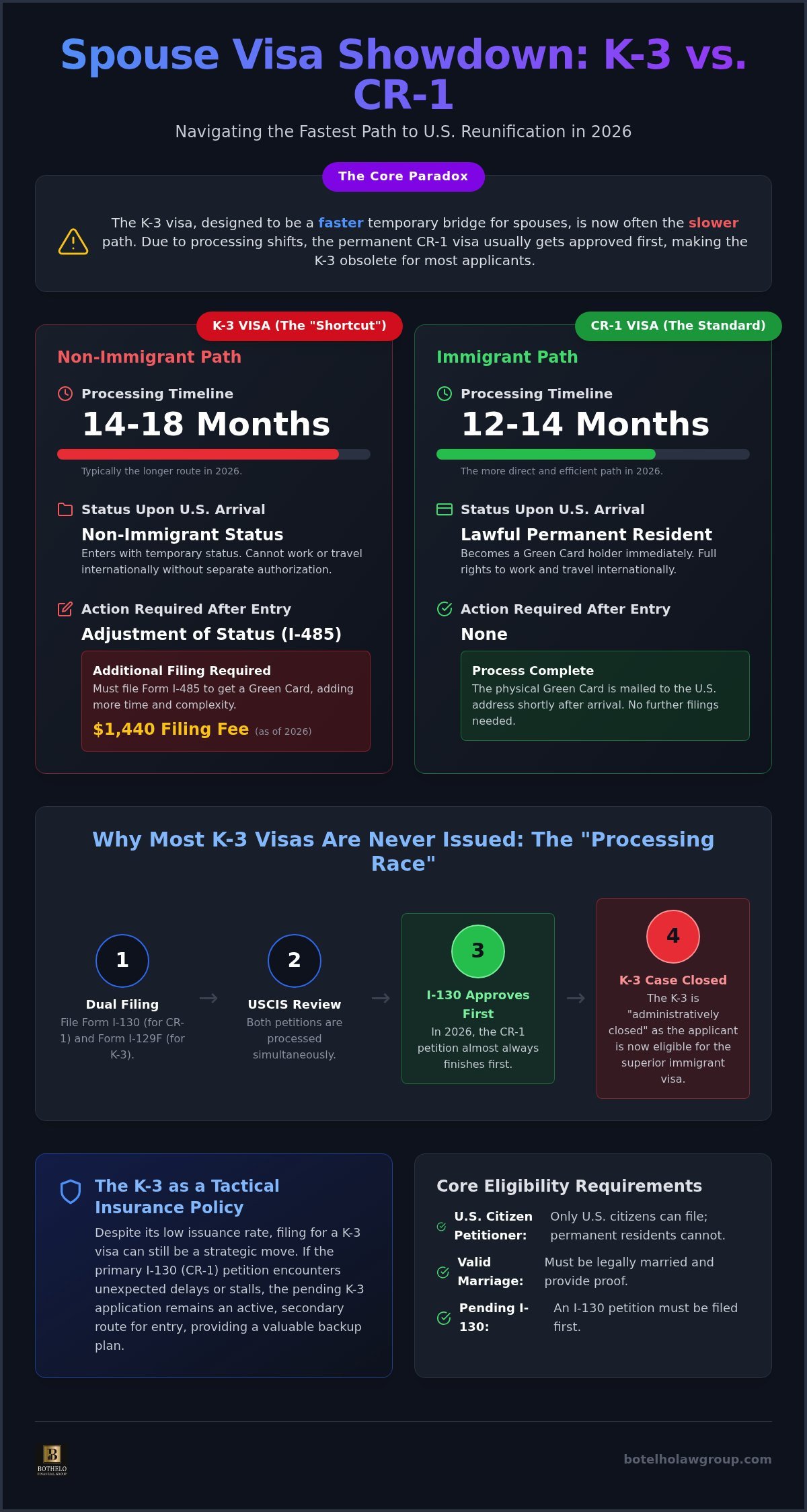
The Legal Immigration Family Equity Act, commonly known as the LIFE Act, established the K-3 visa in 2000. At that time, immigrant visa processing took years, making a temporary “bridge” visa essential for humanitarian reasons. The K-3 is a bridge visa for spouses that allows them to wait for their green card while they’re physically present in the United States. However, in 2026, these visas are increasingly rare. USCIS often approves the underlying I-130 petition before the K-3 application’s even processed. When this happens, the National Visa Center (NVC) administratively closes the K-3 case because the applicant is now eligible for a superior immigrant visa.
Despite the high closure rate, some families still view the K-3 as a tactical backup. If the primary immigrant petition stalls, the K-3 filing remains active as a secondary route for entry. A dedicated K-3 spouse visa attorney can evaluate your specific timeline to determine if the additional filing fee for the I-129F is a prudent investment or a redundant expense. This decision is critical in 2026, as processing times continue to fluctuate based on consulate backlogs and federal policy changes.
K-3 vs. CR-1 Immigrant Visas: Which is Faster?
Choosing between a K-3 non-immigrant visa and a CR-1 immigrant visa is a high-stakes decision that dictates how quickly your family reunites on U.S. soil. While the K-3 was originally designed to be a faster shortcut, the 2026 landscape has shifted significantly. In most modern cases, the CR-1 immigrant visa is actually the more efficient and cost-effective path for spousal reunification.
The Speed Factor: 2026 Processing Realities
Current data indicates that CR-1/IR-1 spousal visas generally process within 12 to 14 months. In contrast, K-3 visa processing now stretches between 14 and 18 months. This inversion of timelines means the intended “shortcut” often takes longer than the standard immigrant route. A seasoned K-3 spouse visa attorney monitors these fluctuations daily to prevent clients from choosing a path that inadvertently extends their separation.
The National Visa Center (NVC) often approves the underlying I-130 petition while the I-129F is still pending with USCIS. When the immigrant visa is ready first, the K-3 case is terminated. This “race to the finish” makes the K-3 a rare outcome in the current system. You can review the official USCIS stance on K-3/K-4 Nonimmigrant Visas to understand why these petitions are frequently administratively terminated before they can be issued.
Status Upon Arrival: Green Card vs. Non-Immigrant
The most critical difference between these paths is the legal status your spouse holds upon entry. A CR-1 visa holder enters as a lawful permanent resident. They receive their physical green card shortly after arrival and can work or travel internationally immediately. This provides instant stability and security for the family unit.
K-3 holders enter under a non-immigrant status. To stay permanently, they must file Form I-485 for an Adjustment of Status, which carries a $1,440 filing fee in 2026. This adds a secondary, expensive layer to the legal process. Until the adjustment’s approved, the spouse may face significant restrictions on employment and travel outside the U.S.
From a cost perspective, the CR-1 is typically superior. The initial I-130 fee is $625 for online filing, whereas a K-3 requires both the I-130 and a separate $675 fee for the I-129F. When you factor in the subsequent $1,440 for adjustment of status, the K-3 becomes a much more expensive endeavor. A K-3 spouse visa attorney typically recommends filing both petitions only as a tactical insurance policy. This ensures that if the primary I-130 stalls, the I-129F acts as a safety net to keep the case moving forward through the federal system.
Eligibility and the USCIS ‘Administrative Closure’ Challenge
The primary hurdle for K-3 applicants in 2026 isn’t just qualifying; it’s the high probability of administrative closure. When a U.S. citizen files both the I-130 and the I-129F, they enter a dual-track system. If USCIS approves the I-130 immigrant petition first, the National Visa Center (NVC) will administratively close the K-3 case. This policy ensures that the applicant moves toward a permanent green card rather than a temporary non-immigrant status. While this seems efficient, it often leads to frustration for couples who expected to use the K-3 as a faster entry point.
Navigating the National Visa Center (NVC)
The NVC acts as a gatekeeper for both petitions. When they receive an approved I-129F, they cross-reference it with the pending I-130. The NVC administratively closes a K-3 petition if the underlying I-130 is approved and received by the NVC before or at the same time as the I-129F. This notification process is often abrupt, leaving families wondering if their case has been denied. A K-3 spouse visa attorney helps clients interpret these notices, ensuring the transition to the CR-1 immigrant visa process is seamless and that no time is lost to administrative errors.
Why file if the closure rate is so high? It serves as a tactical insurance policy. If the primary I-130 petition gets stuck in a specific service center backlog, the K-3 might move forward. Having both petitions in the system allows you to take advantage of whichever path opens first. This strategy requires precise timing and a deep understanding of federal processing trends.
Overcoming Common Eligibility Obstacles
Eligibility extends beyond simply being married. You must prove a “bona fide” marriage to federal standards, demonstrating that the relationship wasn’t entered into solely for immigration benefits. This requires a robust portfolio of evidence, such as joint financial records, shared leases, and a documented history of time spent together. A K-3 spouse visa attorney acts as a focused advocate, curating this evidence to withstand intense federal scrutiny.
Handling previous marriages is another area where petitions often fail. You must provide certified legal dissolutions for every prior marriage of both the petitioner and the beneficiary. Any discrepancy in dates or lack of proper certification can trigger an immediate rejection. Additionally, if you have children, the K-4 visa allows them to accompany the spouse. However, if the K-3 is administratively closed, the K-4 is also terminated. In these instances, the children must be properly transitioned to the I-130 immigrant visa process to avoid family separation.
The Step-by-Step Filing Strategy for US Citizens
Successfully bringing a spouse to the United States in 2026 requires a disciplined, multi-stage approach. A K-3 spouse visa attorney orchestrates this by managing two parallel petitions to minimize the risk of procedural delays. This dual-track strategy ensures that if one federal office experiences a backlog, the other petition serves as a vital safety net to keep your case moving forward.
The process begins with the submission of Form I-130, Petition for Alien Relative. In 2026, filing this form online costs $625, while paper filing remains $675. Once USCIS accepts this petition, you’ll receive a Form I-797, Notice of Action. This receipt notice is the prerequisite for the second stage: filing Form I-129F. This second petition, which carries a $675 fee, officially initiates the K-3 non-immigrant track. If the I-129F is approved before the I-130, the case moves to the National Visa Center (NVC) and eventually to the U.S. Embassy or Consulate in your spouse’s home country.
Documenting Your Relationship for USCIS
A petition is only as strong as the evidence supporting it. USCIS requires definitive proof that your marriage is bona fide and not entered into for immigration benefits. Primary evidence includes your official marriage certificate and birth certificates, but secondary evidence is often what secures an approval. We focus on organizing a comprehensive portfolio of financial commingling, such as joint bank statements, shared insurance policies, and joint lease agreements. Professional document translation is mandatory for any records not in English; even minor errors in translation can lead to a Request for Evidence (RFE) that stalls your case for months.
Preparing for the Consular Interview
The final hurdle is the consular interview, where a government official will verify the legitimacy of your relationship. Your spouse must complete the DS-160 online application and pay the $265 fee. Additionally, they must undergo a medical examination by a designated physician, which typically costs between $200 and $500. Effective October 2025, a new $250 Visa Integrity Fee also applies at the time of visa issuance. During the interview, the officer will ask specific questions about your shared history, daily habits, and future plans in the U.S. To ensure your spouse is ready, review our Green Card Interview Prep for Spouse guide for a detailed breakdown of common questions and behavioral expectations. If you want to secure your spouse’s future with expert guidance, our firm provides the focused advocacy needed to navigate these high-stakes interactions.
Why a Fall River Immigration Attorney is Essential for Spousal Petitions
Botelho Law Group provides a unique blend of localized accessibility and nationwide authority. While our headquarters is located in Fall River, MA, our reach extends to clients across all 50 states and abroad. Spousal reunification is a high-stakes legal matter where a single document error can result in months of additional separation. By engaging a K-3 spouse visa attorney, you gain a strategist who understands the nuances of federal filings and the specific requirements of consular processing in 2026. We don’t just process paperwork; we provide a protective shield against the administrative hurdles that threaten your family’s future.
Immigration timelines are never static. Our team monitors USCIS backlogs and NVC procedures in real-time, allowing us to pivot your strategy as administrative rules shift. If an I-130 is delayed, we aggressively pursue the I-129F track to keep your case moving through the system. This proactive management is essential for navigating the administrative closure risks mentioned earlier, ensuring your family isn’t left in a legal vacuum. We act as your dedicated representative, communicating directly with federal agencies to resolve bottlenecks before they become permanent roadblocks.
Sophisticated Problem-Solving for Global Families
We act as a focused advocate for families facing complex challenges, such as previous visa denials or aggressive Requests for Evidence (RFE). These situations require more than just filling out forms. They demand a sophisticated legal defense of your relationship’s legitimacy and a meticulous review of your entire immigration history. As a dedicated Family Based Green Card Attorney, we possess the depth of knowledge required to resolve high-stakes marriage cases that other firms might find too burdensome or complicated to handle.
Your Dedicated Guide Through the Immigration System
Direct communication is the cornerstone of our practice. You aren’t just another case number; you’re a family seeking a future in the United States. Our legal team in Massachusetts provides structured, transparent updates on your I-130 and I-129F synchronization. We ensure every piece of evidence, from financial commingling to professional translations, meets the rigorous standards of federal adjudicators. This disciplined delivery of information prevents the confusion that often leads to document errors and entry delays. Don’t leave your reunification to chance. Schedule a consultation with our spousal visa team today to secure a powerful representative for your journey home.
Securing Your Family’s Future in the United States
Navigating the federal immigration system in 2026 requires more than just filing forms; it demands a strategic choice between the K-3 non-immigrant path and the CR-1 immigrant route. While the K-3 remains a viable tactical insurance policy, the reality of administrative closures and evolving processing times makes professional oversight indispensable. Success hinges on a robust evidentiary portfolio and a deep understanding of consular processing nuances. Working with a dedicated K-3 spouse visa attorney ensures that your petition is optimized to withstand federal scrutiny and avoid costly document errors.
Our firm, headquartered in Fall River, MA, provides sophisticated legal representation for families across all 50 states and abroad. We act as your focused advocate, managing every detail from the initial I-130 filing to the final consular interview. Secure your spouse’s future—contact a K-3 visa attorney at Botelho Law Group today. Your journey to reunification is a high-stakes endeavor, but with the right legal strategist, the path to a shared life in America is within reach.
Frequently Asked Questions
Is the K-3 visa still available in 2026?
The K-3 visa remains a legally valid non-immigrant category in 2026, though its issuance is exceptionally rare. USCIS continues to accept Form I-129F filings from U.S. citizens who have a pending I-130 petition. Because current processing times often favor the immigrant visa path, most K-3 cases are administratively closed by the National Visa Center. Families still use this filing as a tactical safety net to ensure their case stays active across multiple federal service centers.
How much does a K-3 spouse visa attorney cost?
Legal fees for a K-3 spouse visa attorney vary based on the complexity of your case and the specific needs of your family. While we don’t provide flat-fee quotes without a comprehensive consultation, professional representation covers the management of dual filings, evidence curation, and consular interview preparation. Investing in an expert ensures that you avoid costly document errors and procedural delays that often result from self-filing in a high-stakes federal system.
Can my spouse work immediately after arriving on a K-3 visa?
Your spouse can’t work immediately upon entry to the United States on a K-3 visa. Unlike the CR-1 immigrant visa, which grants immediate work authorization, a K-3 holder must file Form I-765 to obtain an Employment Authorization Document (EAD). This process can take several months to complete. Most families find this delay significant, which is why a K-3 spouse visa attorney often recommends the CR-1 path for those prioritizing immediate employment stability.
What happens to the K-3 if our I-130 is approved while she is abroad?
If the I-130 petition’s approved while your spouse is still abroad, the National Visa Center will likely administratively close the K-3 case. This occurs because the approval of the immigrant petition makes the non-immigrant K-3 redundant. Your spouse will then proceed with the immigrant visa process, eventually entering the U.S. as a lawful permanent resident. This transition is automatic but requires careful monitoring to ensure all NVC fees are paid correctly and no deadlines are missed.
Does a K-3 visa lead directly to a Green Card?
A K-3 visa doesn’t grant permanent residency upon entry; it’s a temporary non-immigrant status. To obtain a green card, the spouse must file Form I-485, Application to Register Permanent Residence or Adjust Status, after arriving in the U.S. This involves an additional filing fee of $1,440 in 2026. In contrast, the CR-1 immigrant visa leads directly to a green card without the need for this secondary, expensive domestic filing, making it the preferred long-term choice.
Can I apply for a K-3 visa if I am a Lawful Permanent Resident (Green Card holder)?
Lawful permanent residents aren’t eligible to petition for a K-3 visa for their spouses. This specific non-immigrant category is reserved exclusively for the spouses of U.S. citizens. Green card holders must follow the standard family-based preference categories, which involve filing a Form I-130 and waiting for a priority date to become current. If you’re a permanent resident, you should focus on the immigrant visa process or consider naturalization to expand the options available for your family’s reunification.
What is the difference between a K-1 and a K-3 visa?
The primary difference lies in the legal status of your relationship at the time of filing. The K-1 visa is for the fiancé of a U.S. citizen who intends to marry within 90 days of entering the country. The K-3 visa is for an individual who’s already legally married to a U.S. citizen. While both are non-immigrant bridge visas, the K-3 requires a pending I-130 petition, whereas the K-1 starts with an I-129F petition alone.
How long does the K-3 visa stay valid after entry?
A K-3 visa is generally valid for a period of two years from the date of entry. It’s renewable in two-year increments if the underlying immigrant petition or adjustment of status application is still pending. However, the status is automatically terminated if the I-130’s denied or if the marriage is legally dissolved. Most holders successfully adjust their status to permanent residency long before the initial two-year period expires, provided their filings were managed with precision by an expert.