
In 2026, a genuine marriage is no longer a guarantee of immigration success. With USCIS reinstating mandatory in-person interviews for every marriage-based applicant, your green card interview preparation for spouse must move beyond simple fact-checking to become a strategic legal defense. The government has directed officers to apply heightened scrutiny to every petition, meaning that even the most committed couples face the risk of aggressive questioning or unexpected separation during the process.
You likely feel the weight of this increased pressure and worry that your evidence might not be enough to satisfy a skeptical official. We understand that the fear of a single discrepancy leading to a denial is overwhelming. This guide offers a clear path forward, providing expert strategies to master the interview through meticulous documentation and precise question preparation. You will learn how to organize a definitive checklist of proofs, handle personal inquiries with poise, and utilize legal safeguards to ensure your rights are protected. We will walk you through the essential steps to secure your I-485 approval and protect your future together in the United States.
Key Takeaways
- Understand the mandatory I-485 interview’s role as the final evidentiary stage in verifying the bona fides of your marriage.
- Master a strategic green card interview preparation for spouse approach by organizing a professional binder that prioritizes quality and narrative consistency.
- Learn to navigate sensitive inquiries regarding shared finances and personal history with the precision required to satisfy heightened USCIS scrutiny.
- Identify common red flags and prepare for the specific logistical and security protocols found at Massachusetts field offices.
- Discover the protective benefits of having an attorney present to monitor officer conduct and clarify complex questions during high-stakes sessions.
What is the Marriage-Based Green Card Interview?
The marriage-based green card interview represents the final, most critical stage of the Form I-485 adjustment of status process. It’s the moment where your written application transforms into a face-to-face examination of your private life. For many couples, effective green card interview preparation for spouse is the only thing standing between a permanent residency approval and a devastating denial. The primary objective of this meeting is to verify the “bona fides” of the marriage, a legal term meaning the union is genuine and wasn’t entered into solely for the purpose of evading immigration laws.
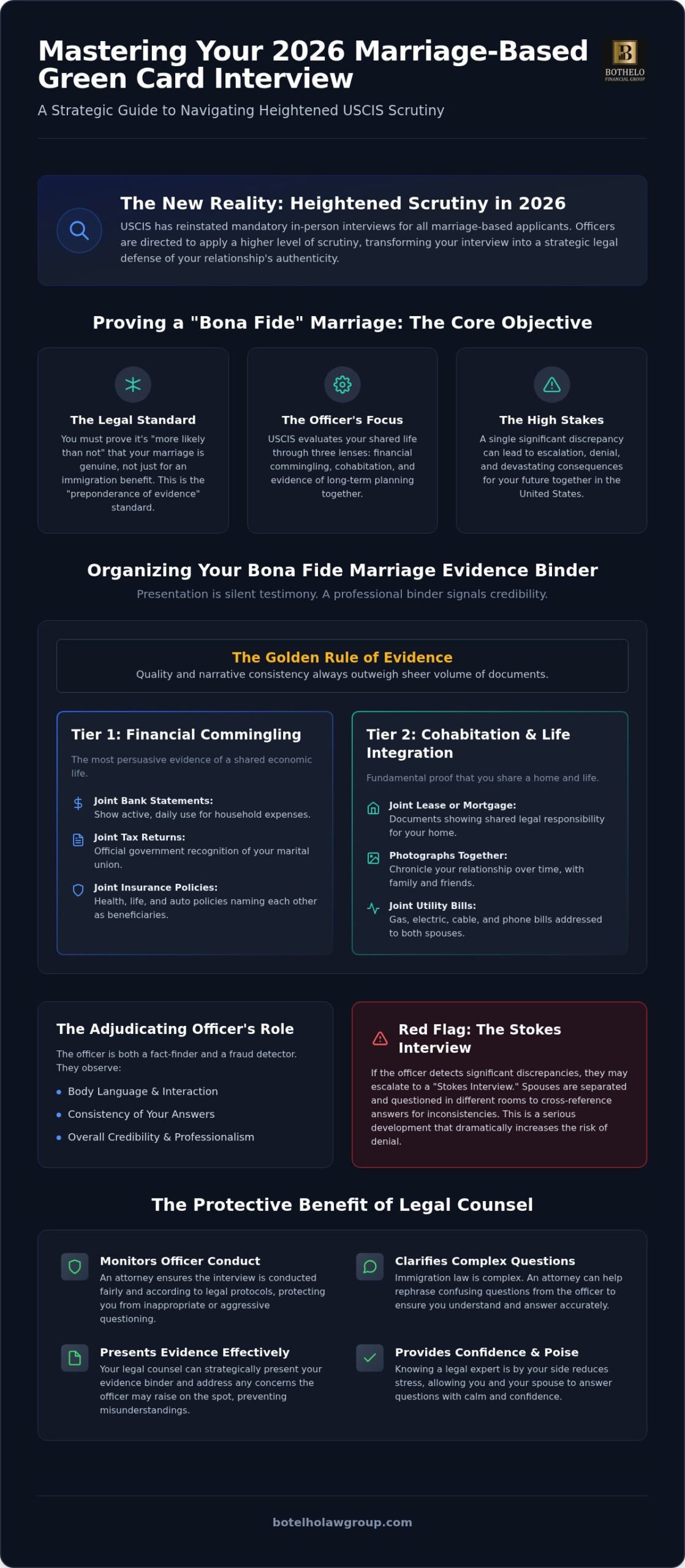
To succeed, you must meet the “preponderance of evidence” standard, which requires you to prove that it’s more likely than not that your marriage is legally valid and based on a shared future. USCIS officers are trained to look beyond your marriage certificate. They evaluate your shared life through three primary lenses: financial commingling, cohabitation, and long-term planning. They want to see that you don’t just exist on paper, but that you operate as a single economic and emotional unit.
The Role of the USCIS Adjudicating Officer
The adjudicating officer serves as both a gatekeeper and a fact-finder. While their official role is to verify your eligibility for a green card, they’re also tasked with fraud detection. These officers utilize the Adjudicator’s Field Manual to structure their questioning, ensuring that every interview follows a specific legal framework. They observe your body language, the consistency of your answers, and how you interact as a couple. Making a professional first impression is vital; it sets a tone of credibility before the first question is even asked. If an officer identifies significant discrepancies, they may escalate the meeting to a Stokes interview, where spouses are questioned in separate rooms to compare their answers for consistency.
When and Where the Interview Happens
In 2026, the timeline from filing your initial petition to receiving an interview notice has stabilized, with most concurrently filed cases reaching the interview stage within eight to nine months. You will receive a Form I-797C, Notice of Action, detailing the specific date, time, and location of your appointment. For couples in the Northeast, these interviews typically take place at local Massachusetts field offices in Boston or Lawrence, or the Providence field office in Rhode Island. Given the high stakes of these local office dynamics, many couples choose to work with a family based green card attorney to ensure their preparation is thorough and their rights are protected during the encounter.
Organizing Your Bona Fide Marriage Evidence Binder
Presentation serves as a silent form of testimony. A meticulously organized physical binder is vastly superior to a loose folder of papers because it communicates a high degree of professional preparedness. When an officer requests a specific document, fumbling through a disorganized stack creates an impression of hesitation or lack of transparency. By contrast, a tabbed binder allows for instant retrieval, which reinforces your credibility and keeps the interview moving efficiently. Your green card interview preparation for spouse must prioritize this level of organization to signal that your life together is well-documented and legitimate.
The “Golden Rule” of evidence is that quality and consistency always outweigh sheer volume. You do not need a five-inch stack of miscellaneous receipts; you need documents that clearly demonstrate a shared economic and social life over a sustained period. According to the USCIS Interview Guidelines, the burden of proof remains on the applicant to establish eligibility through clear and convincing documentation. To facilitate this, you must bring original documents for every copy you intend to provide, as the officer will likely need to verify the authenticity of vital records such as birth certificates and marriage licenses during the session.
Tier 1: Financial Commingling Evidence
Financial records are the most persuasive indicators of a genuine marriage. Focus on providing joint bank statements that show active, daily use for household expenses rather than a single lump-sum deposit. Include joint tax returns, utility bills addressed to both spouses, and insurance policies. Health, life, and auto insurance documents that name each other as beneficiaries provide strong evidence of a shared economic future and mutual protection.
Tier 2: Co-habitation and Life Integration
Proof of a shared residence is a fundamental requirement. Provide lease agreements or mortgage documents that feature both names. If you have children born to the marriage, their birth certificates represent the strongest possible evidence of a bona fide relationship. For couples without children, affidavits from third parties, such as friends, family members, or employers, can attest to the validity of the marriage and your shared history as a couple.
Tier 3: Social and Personal Proof
Social evidence rounds out your narrative. Select a photo album that demonstrates the passage of time, featuring different seasons, various locations, and integration with each other’s families. Supplement these with travel itineraries and hotel bookings from joint vacations. In the digital age, a consistent social media presence or a shared digital footprint can also serve as supporting evidence of a public and shared life. If you find the documentation requirements overwhelming, securing professional legal representation can help you curate a binder that meets the highest evidentiary standards.
Master the Marriage Interview Questions
The oral portion of the USCIS encounter is designed to probe the “common knowledge” that naturally exists between two people who share a life. While your evidence binder provides the documentary foundation, your testimony provides the narrative context. Effective green card interview preparation for spouse involves understanding that officers aren’t just looking for correct answers; they’re evaluating the consistency and spontaneity of your responses. They want to see that you know each other’s habits, histories, and preferences without needing a script. This oral examination serves as the final test of your marriage’s legitimacy.
Sensitive topics, such as past relationships or specific financial difficulties, often cause the most anxiety for applicants. If an officer asks about a previous marriage or a period of unemployment, provide a direct and factual response. Avoid over-explaining or appearing defensive. If you genuinely don’t know or can’t remember a specific detail, such as the exact brand of your spouse’s favorite coffee or the date of a minor social event, it’s safer to admit a lapse in memory than to provide a conflicting answer. Never guess or invent details to please the officer, as even a small fabrication can be interpreted as a material misrepresentation of your marriage.
Courtship and Wedding History
The officer will likely begin by exploring the origins of your relationship. You should be prepared to discuss the narrative of your first encounter, including where you met and who introduced you. Be ready to describe the details of the proposal, the engagement period, and the wedding itself. Officers often ask about the venue, the number of guests in attendance, and specific celebrations that occurred after the ceremony. Consistency in these core memories is vital for establishing a credible history of your union.
Daily Life and Household Routines
Questions regarding your daily life are intended to verify cohabitation and shared responsibility. You may be asked about your morning routines, such as who wakes up first or what you typically eat for breakfast. Household chores are another common topic; be prepared to explain who handles the laundry, grocery shopping, or cooking. Even your technology and entertainment habits are fair game, including which shows you watch together or how you manage your shared streaming accounts.
Family and Social Circle
A genuine marriage is rarely lived in isolation, and the government expects you to be familiar with your spouse’s relatives. You must know the names and general locations of each other’s parents and siblings. Officers frequently inquire about recent family gatherings, holiday celebrations, or the last time you saw a specific relative. If your family dynamics are complex, discussing these details with an immigration lawyer Fall River MA can help you present the facts clearly and prevent misunderstandings during the interview. Demonstrating that you are integrated into each other’s social circles remains one of the most effective ways to prove a bona fide union.
Day-of Logistics and Avoiding Red Flags
Logistics are often overlooked in green card interview preparation for spouse, yet they dictate the first impression you make on the adjudicating officer. Your appearance should reflect the gravity of the legal proceedings; business casual or professional attire is the standard. While you don’t need formal evening wear, dressing with respect for the court like environment signals that you take the process seriously. Beyond clothing, your non-verbal communication is under constant observation. Officers look for natural, comfortable interactions between spouses. Forced physical affection or, conversely, a total lack of eye contact can be perceived as signs of a fraudulent arrangement.
At Massachusetts field offices, such as the JFK Federal Building in Boston or the Lawrence office, security procedures are rigorous. You should plan to arrive at least 30 minutes before your scheduled appointment to clear metal detectors and check-in at the kiosk. Be aware that most federal buildings prohibit liquids and sharp objects, and while cell phones are generally permitted, they must be completely powered off before you enter the interview room. If an officer perceives a pattern of deception or significant evidentiary gaps, they may trigger a Stokes Interview; this is a high-stakes fraud interrogation where spouses are separated and questioned individually to compare their answers for discrepancies.
Common Red Flags to Address Early
Certain biographical facts automatically trigger a higher level of scrutiny from USCIS. Large age gaps, typically exceeding 15 years, or the lack of a common spoken language between spouses are frequent red flags. Officers also examine the timeline of your relationship closely; a very short duration between the marriage date and the filing of the I-485 petition often suggests a marriage of convenience. Additionally, if you and your spouse do not currently live together due to work or school obligations, you must provide a detailed and documented explanation for this arrangement to overcome the presumption of fraud. For couples where one spouse is still abroad and weighing their entry options, consulting a K-3 spouse visa attorney can help clarify whether a nonimmigrant visa or direct consular processing offers the fastest path to reunification before the interview stage.
Handling Discrepancies and Inconsistencies
Human memory is fallible, and it’s common for one spouse to forget a detail that the other remembers clearly. If you realize you’ve made a mistake mid-interview, correct it immediately by saying, “I’m sorry, I misspoke, the correct date was actually…” This transparency is far better than allowing a falsehood to stand. Even if an officer becomes skeptical or adopts a hostile tone, you must remain calm and respectful. Hostility is often a tactical tool used to see if a couple will provide conflicting information under pressure. If you are concerned that your case contains red flags that could lead to a denial, you should consult with the Botelho Law Group to develop a protective strategy before your interview date.
Why You Should Have an Immigration Attorney Present
The presence of an attorney during your USCIS appointment serves as a vital safeguard against procedural errors and officer overreach. While you must provide the testimony, your advocate acts as a formal witness to the entire proceeding, ensuring that the officer adheres to the standards set forth in the Adjudicator’s Field Manual. This level of green card interview preparation for spouse transforms a vulnerable encounter into a controlled legal process where your rights are the priority. Legal representation ensures that the government meets its own procedural obligations while you focus on the facts of your shared life.
Attorneys are permitted to intervene if a question is ambiguous, misleading, or legally inappropriate. They can ask the officer to rephrase a query that might otherwise lead to an accidental misstatement or a perceived discrepancy. If the interview results in a Request for Evidence (RFE) or a notice of intent to deny, your lawyer is already prepared with the context needed to draft a robust legal response. Professional representation provides a critical layer of security that allows couples to focus on their testimony rather than legal technicalities.
Botelho Law Group: Your Focused Advocates in Fall River
At Botelho Law Group, we serve as focused advocates for couples navigating the complexities of family-based petitions. Our preparation process includes intensive mock interviews and comprehensive document reviews designed to identify potential weaknesses before you ever step into a federal building. We possess deep experience with the specific adjudicators at the Boston and Lawrence field offices; this allows us to anticipate the unique questioning styles prevalent in the Massachusetts region. From the initial filing of your I-130 petition and I-485 to the final decision, we remain dedicated to protecting your interests and securing your legal standing.
Preparing for Your Future in the U.S.
Once your application is approved, the focus shifts to maintaining your lawful status and receiving your physical Green Card. You will typically receive the card via mail within a few weeks of the decision. If your marriage is less than two years old at the time of approval, you will receive a conditional card, which requires a joint petition to remove conditions before the two-year anniversary. For students transitioning their status, working with an F-1 to green card lawyer ensures that every step toward naturalization is handled with legal precision. This approval is the foundation of your shared life and your eventual path toward United States citizenship.
Secure Your Shared Future in the United States
Navigating the complexities of a marriage-based petition requires more than just a valid marriage certificate; it demands a strategic legal approach. By organizing a professional evidence binder and mastering the nuances of household inquiries, you establish the credibility necessary to satisfy heightened USCIS scrutiny. Your green card interview preparation for spouse should be methodical, focusing on the narrative consistency of your shared life and the proactive management of potential red flags. These steps are vital for transforming a high-pressure encounter into a successful path toward residency.
Botelho Law Group provides protective advocacy for clients in all 50 states, offering deep expertise in marriage-based petitions and local field office dynamics. We act as a dedicated shield for your rights, ensuring that your interview is conducted fairly and your future remains secure. To ensure your application is handled with the precision it deserves, Schedule a Consultation with a Fall River Immigration Attorney today. You have built a shared life together; now take the necessary steps to protect it with confidence.
Frequently Asked Questions
What should I do if I forget the answer to a question during the interview?
If you forget a specific detail, you must state that you don’t recall rather than attempting to guess. Guessing often results in conflicting testimony, which officers may interpret as a material misrepresentation. It’s natural to experience memory lapses under the pressure of a federal examination. Providing an honest admission of a memory lapse preserves your credibility far better than providing a fabricated answer that contradicts your spouse’s testimony.
Can we be interviewed separately if the officer suspects fraud?
Yes, USCIS has the authority to conduct separate interviews, commonly referred to as a Stokes interview, if fraud is suspected. During this process, the officer asks each spouse the same set of highly detailed questions in isolation to identify inconsistencies. This is a high-stakes scenario that often requires an attorney to monitor the proceedings and ensure the officer’s questioning remains within legal boundaries and procedural standards.
What happens if our green card interview is denied?
If your application is denied, you’ll receive a formal notice detailing the specific legal grounds for the decision. You may be eligible to file an appeal or a motion to reopen and reconsider the case within a strict timeframe. Because a denial can lead to the initiation of removal proceedings, you must seek immediate legal counsel to evaluate your options for challenging the government’s findings and protecting your status.
Is it okay if our wedding was very small or just at a courthouse?
A courthouse or small wedding is legally sufficient, provided it’s valid in the jurisdiction where it occurred. USCIS focuses on the bona fides of the marriage rather than the size of the celebration. While a large wedding provides social evidence, you can overcome a lack of ceremony by presenting robust documentation of a shared life, such as joint financial records, shared residency agreements, and insurance policies.
How long does the marriage green card interview typically last?
A standard marriage-based interview typically lasts between 20 and 45 minutes. The length of the session is dictated by the clarity of your documentation and the officer’s assessment of your credibility. If the adjudicator identifies significant discrepancies or complex legal issues, the interview may be extended or rescheduled for a more intensive fraud review. Thorough green card interview preparation for spouse often helps keep the session concise and focused.
Do we need to bring our children to the interview?
You aren’t generally required to bring your children to the interview unless they’re also applying for adjustment of status. While their presence isn’t mandatory, their birth certificates serve as the most powerful evidence of a genuine relationship. If you choose to bring young children, ensure you have childcare arrangements, as the interview environment is formal and requires your full, undivided attention during the questioning process.
What if we don’t speak English fluently; can we bring an interpreter?
If you aren’t fluent in English, you’re required to bring a qualified interpreter to the appointment. The interpreter must be able to translate accurately and can’t be a party to the case, such as your spouse or your legal representative. Clear communication is a fundamental component of green card interview preparation for spouse, as misunderstandings can lead to recorded inconsistencies that jeopardize your final approval.
Can my spouse and I have different bank accounts and still pass?
You may maintain separate bank accounts, but you must provide alternative evidence of financial integration to satisfy the adjudicator. USCIS looks for a shared economic life, which can be proven through joint leases, utility bills, or being named as beneficiaries on each other’s life and health insurance policies. If your finances are entirely separate, be prepared to explain the specific reasons for this arrangement during the interview. For families navigating the petition process from outside the United States, working with a dedicated I-130 petition lawyer for consular processing can help ensure your documentation meets the required evidentiary standards at every stage.