
A commercial truck accident is not a standard insurance claim; it is a high-stakes investigation where the trucking company often begins building its defense before you even leave the scene. When you’re facing catastrophic injuries and mounting debt, the pressure from aggressive insurance adjusters can feel overwhelming. Partnering with an experienced Massachusetts truck accident lawyer is the most effective way to level the playing field and protect your interests against well-funded corporate legal teams.
We understand that you’re likely struggling with the confusion of federal motor carrier regulations and the immediate financial burden of medical care. This guide simplifies the recovery process by providing a clear checklist of actions you must take to secure your future. You’ll learn how to navigate the Commonwealth’s $2,000 tort threshold for pain and suffering, understand the 51% modified comparative negligence rule, and ensure that vital electronic logging data is preserved before it’s lost forever.
Key Takeaways
- Establish a firm legal foundation by prioritizing official police reports and documenting commercial-specific details like DOT numbers immediately after a collision.
- Navigate the complexities of vicarious liability to hold trucking companies and third-party maintenance providers accountable for your damages.
- Act quickly to preserve “Black Box” data and Electronic Logging Device records that prove violations of federal Hours of Service regulations.
- Secure your right to compensation by understanding how the three-year statute of limitations and modified comparative negligence rules apply to your case with a Massachusetts truck accident lawyer.
- Learn how a focused advocate provides the protective litigation strategy necessary to combat aggressive corporate defense teams and maximize your financial recovery.
Immediate Steps to Take After a Trucking Collision in Massachusetts
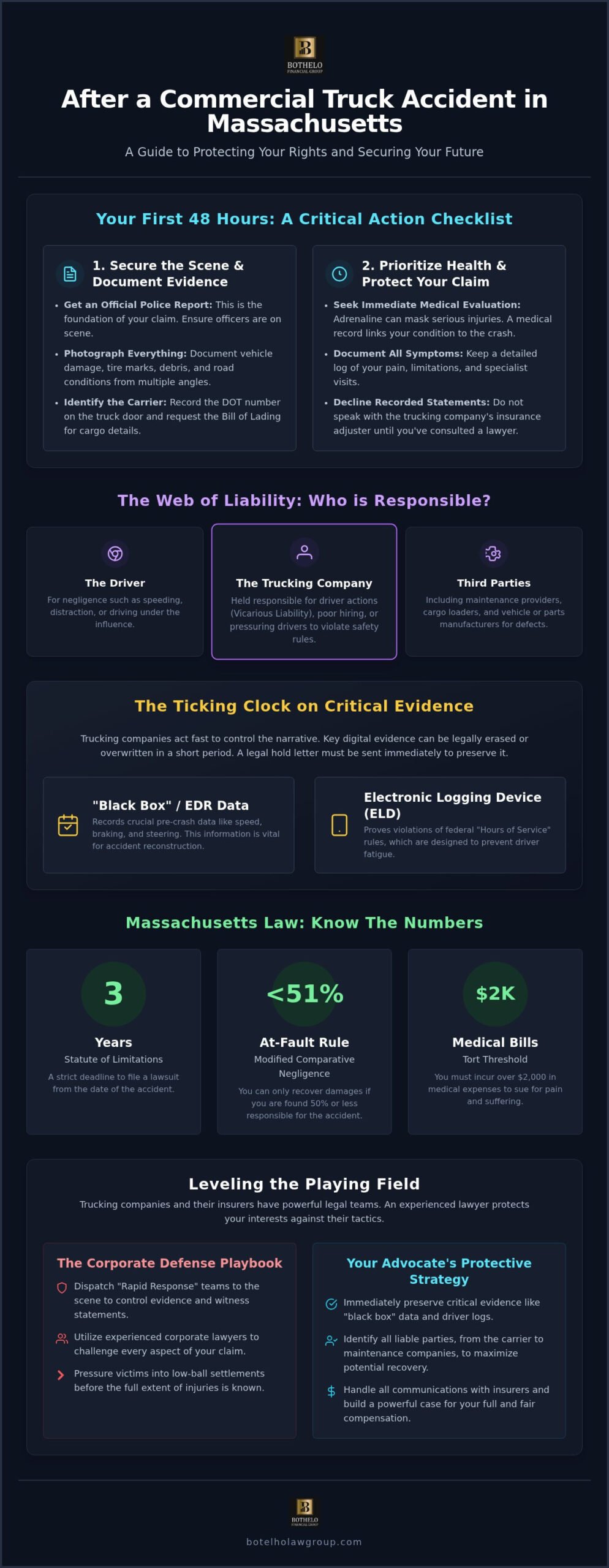
The moments following a collision with a commercial vehicle are high-stakes. While your primary focus must be physical safety, you’re also entering a legal environment where evidence disappears quickly. Trucking companies often dispatch “rapid response” investigators to the scene within hours. Their goal is to mitigate liability, not to assist you. To protect your rights, you must act with precision and establish a definitive legal foundation before the trucking company can control the narrative.
Securing the Scene and Official Documentation
A Massachusetts State Police or local law enforcement report serves as the bedrock of your claim. This document provides an objective account of the incident and often includes preliminary findings regarding fault. You must ensure the officer records the specific details of the commercial carrier. In many cases, the tractor and the trailer are owned by separate entities. Look for the Department of Transportation (DOT) number on the door and request the “Bill of Lading,” which identifies the cargo’s owner and destination. These details are vital for a Massachusetts truck accident lawyer to identify all potentially liable parties.
Capturing the scene involves more than just photographing vehicle damage. You need to document tire marks, fluid spills, and debris patterns. These physical markers provide essential data for accident reconstruction experts to determine speed and braking points. This level of detail is critical for upholding road traffic safety standards and proving negligence in a court of law. If you’re physically unable to do this, try to have a witness or family member take these photos before the site is cleared.
Seeking Specialized Medical Evaluation
Adrenaline is a powerful masking agent. Many victims feel fine initially, only to discover internal injuries or spinal damage days later. Seeking immediate emergency care creates a definitive medical record trail that links your injuries directly to the high-impact forces of an 80,000-lb vehicle. A collision of this magnitude often causes “hidden” injuries like traumatic brain injuries or soft tissue damage that require diagnostic imaging to identify.
Insurance adjusters will likely call you within 24 to 48 hours. Do not provide recorded statements or discuss your injuries until you’ve received a full medical evaluation. Anything you say during these early stages can be used to minimize the severity of your claim later. Ensuring your expenses are properly tracked is a job for a compensation for medical bills lawyer, who can help you document every specialist visit and hospital charge to protect the full value of your settlement.
Determining Liability: Who is Responsible for a Truck Accident?
Liability in commercial transportation is a complex web of contractual and legal obligations. While a driver’s immediate actions may trigger a crash, the underlying cause often rests with the corporate entities managing the operation. Data from the Federal Motor Carrier Safety Administration (FMCSA) highlights that mechanical failures and systemic safety violations contribute significantly to large truck collisions. Identifying every negligent party is necessary to access the multi-layered insurance policies that typically cover these high-stakes claims. In Massachusetts, commercial carriers must maintain a minimum liability limit of $750,000, but reaching these funds requires proving exactly who failed in their duty of care.
The Doctrine of Respondeat Superior
Under the legal principle of respondeat superior, an employer is held legally responsible for the wrongful acts of an employee committed within the scope of their employment. In the context of Massachusetts tort law, vicarious liability ensures that a commercial carrier is financially responsible for the negligence of its driver when the accident occurs during the performance of work-related duties. This means you don’t just sue the driver; you hold the company that profited from their labor accountable. However, trucking companies frequently attempt to evade this responsibility by classifying drivers as independent contractors. A skilled Massachusetts truck accident lawyer must scrutinize these employment agreements to prove the actual level of control the carrier exerted over the driver’s schedule and equipment.
Third-Party and Manufacturing Liability
Responsibility often extends beyond the driver and the carrier to include third-party entities that the public rarely sees. If a collision was caused by a mechanical failure, such as a tire blowout or a brake malfunction, the manufacturer of the defective part may be held strictly liable. Similarly, third-party maintenance providers are responsible if they failed to identify or repair known safety issues during routine inspections. These contractors have a legal obligation to ensure every vehicle they clear for the road is safe for public interaction.
Cargo loading companies also play a critical role in roadway safety. Improperly secured freight can cause a trailer to “jackknife” or lead to a rollover during a standard turn. When freight shifts, the driver often loses all steering control, making the loader the primary negligent party. Furthermore, systemic corporate negligence is often revealed through logbook analysis. If a carrier pressures a driver to exceed federal hours-of-service limits to meet a deadline, the company’s internal policies become the central focus of the litigation. Navigating these layers of responsibility requires a sophisticated legal strategy. If you are struggling to identify the responsible parties in your case, discussing your situation with a personal injury litigation specialist can provide the clarity needed to proceed.
The Critical Window: Preserving Commercial Trucking Evidence
In the aftermath of a catastrophic collision, the most valuable evidence is often digital and highly perishable. Unlike a standard passenger vehicle accident, commercial trucking claims rely heavily on data stored within the vehicle’s internal systems. A Massachusetts truck accident lawyer must act within days to ensure this information is not lost, as trucking companies are often legally permitted to purge certain records after a specific period. Taking immediate action is the only way to prevent the permanent loss of proof that could determine the outcome of your litigation.
The cornerstone of evidence preservation is the spoliation of evidence letter. This formal legal notice requires the trucking carrier to preserve specific items, including the vehicle itself, electronic data, and personnel files. Without this letter, companies may overwrite Electronic Logging Device (ELD) data or repair the vehicle, effectively destroying the scene of the accident. According to research from the Insurance Institute for Highway Safety (IIHS), large truck crashes often involve complex mechanical factors that can only be verified through the analysis of these preserved components.
Digital Evidence and Telematics
Modern trucks are equipped with an Event Data Recorder (EDR), commonly known as a “black box.” This device captures critical metrics in the seconds leading up to a collision, providing an objective account of the driver’s actions. We analyze this telematics data to identify specific failures, such as:
- Pre-crash Speed: Determining if the truck was exceeding the speed limit or driving too fast for weather conditions.
- Brake Activation: Verifying if the driver attempted to stop or if a mechanical failure prevented deceleration.
- Engine RPM and Steering: Assessing the driver’s control over the vehicle in the moments before impact.
When combined with GPS data, these records can reveal route deviations or instances where a driver was speeding to meet an unrealistic deadline. Dashcam footage from the truck’s cab or outward-facing lenses provides a visual narrative that often contradicts the driver’s initial statement to police.
Federal Compliance and Driver Qualification Files
We also scrutinize the Driver Qualification File (DQF), which contains the driver’s Commercial Driver’s License (CDL) history, medical certifications, and previous drug test results. Identifying “red flags” in these records, such as a history of safety violations or expired medical cards, points toward corporate negligence in the hiring or retention process. While strategic organizations like Sullivan Group HR prioritize human capital management to ensure safety and compliance, many carriers neglect these standards. By reviewing the company’s safety rating via the FMCSA, your legal team can establish a pattern of non-compliance that suggests the accident was a result of systemic failure rather than a one-time error. A properly served spoliation letter prevents the legal destruction of logbooks and personnel files, ensuring that the truth remains accessible throughout the discovery process.
Understanding Massachusetts Laws and Filing Deadlines
The legal framework governing commercial vehicle claims in the Commonwealth is rigorous and time-sensitive. Success in these cases requires more than just proving the other driver was at fault; it requires a deep understanding of the specific statutes that dictate how and when you can seek compensation. In 2026, the regulatory environment remains complex, particularly regarding the interaction between “no-fault” insurance benefits and the right to sue for pain and suffering. A Massachusetts truck accident lawyer must navigate these hurdles to ensure your claim isn’t dismissed on a technicality before it even reaches a courtroom.
One of the most powerful tools in a plaintiff’s arsenal is Massachusetts General Laws Chapter 93A. While often viewed as a consumer protection statute, it serves as a critical check against insurance companies that engage in unfair or deceptive settlement practices. If an insurer fails to make a reasonable settlement offer once liability has become reasonably clear, they may be liable for double or triple damages plus attorney fees. This statute provides the necessary leverage to force aggressive corporate adjusters to negotiate in good faith rather than attempting to starve out a victim through endless delays.
Modified Comparative Negligence in MA
Massachusetts follows a “51% Bar Rule” for negligence. This means you can recover damages as long as your percentage of fault does not exceed 50%. If a jury determines you were 51% responsible for the collision, you receive nothing. Insurance adjusters frequently exploit this rule by shifting blame onto the passenger vehicle driver to devalue the claim. They may argue that your speed or lane positioning contributed to the impact, even when the truck driver committed a clear violation. Overcoming this bias is a central component of our strategy, much like the approach discussed by a Fall River motorcycle accident lawyer when defending riders against similar unfair assumptions of fault.
Statutes of Limitations and Legal Deadlines
The standard statute of limitations for personal injury claims in Massachusetts is three years from the date of the accident. While this may seem like a generous window, waiting until the final year is a tactical error that often results in the loss of critical evidence. Furthermore, specific scenarios require much faster action. For instance, if the truck involved was owned by a government entity, you must file a formal “Notice of Claim” within a significantly shorter timeframe, often as little as two years, depending on the jurisdiction. Missing these deadlines is an absolute bar to recovery, regardless of the severity of your injuries. To ensure your filing meets every strict procedural requirement, it’s vital to contact our personal injury litigation team as soon as possible after the collision.
It’s also important to remember the “tort threshold” required to sue for non-economic damages like pain and suffering. In Massachusetts, you must have at least $2,000 in reasonable and necessary medical expenses or have suffered a permanent injury, such as a fracture or significant loss of sight or hearing. Your Personal Injury Protection (PIP) insurance covers the first $8,000 of medical bills and lost wages, but moving beyond these limited benefits requires proving that your case meets these specific legal criteria. Beyond medical costs, the financial impact of being unable to work can be devastating; working with a lost wages personal injury attorney ensures that every dollar of income you’ve lost due to your injuries is fully accounted for in your claim.
Choosing the Right Advocate: Why Specialized Representation Matters
A commercial trucking collision is a high-stakes legal battle against multi-million dollar corporations. You aren’t just filing a claim; you’re entering a system designed to protect corporate assets and minimize payouts. A general car accident lawyer might handle the basics of a fender-bender, but a seasoned Massachusetts truck accident lawyer understands the specific federal regulations and corporate structures that define these cases. Specialized representation is the difference between a settlement that barely covers your current bills and a recovery that secures your long-term future.
The Advantage of a Full-Service Litigation Firm
Botelho Law Group operates as a relentless fighter for those injured by corporate negligence. Our deep experience in personal injury litigation and asset protection provides a unique advantage when confronting national trucking carriers. We understand the sophisticated tactics defense teams use to shield their clients from liability. Our firm provides the localized, attentive care of a Fall River partner combined with the federal-level expertise required to navigate the complex litigation landscape of 2026. We act as your protective advocate, ensuring that aggressive investigators and adjusters cannot take advantage of your situation during this vulnerable time.
Contingency Fees: Justice Without Financial Risk
The cost of litigating a commercial truck case is significant. It requires accident reconstruction experts, medical specialists, and exhaustive discovery processes to uncover the truth. We remove these financial barriers by operating on a contingency fee basis. This “no win, no fee” structure ensures that your access to high-level legal strategy isn’t dependent on your current bank balance. By partnering with a no upfront fee personal injury lawyer, you can go toe-to-toe with powerful corporations without any immediate financial risk. Our interests are perfectly aligned with yours; we only succeed when we secure a recovery for you.
Your recovery depends on the actions you take today. The evidence is perishable, and the trucking company’s legal team is already at work to build their defense. Scheduling a strategic consultation allows us to evaluate the specifics of your collision and begin the process of preserving your rights. Don’t let a corporate defense team dictate the terms of your future. Contact us to discuss your case and take the first step toward the justice you deserve.
Securing Your Future After a Commercial Collision
Navigating the aftermath of a trucking accident requires a disciplined approach to evidence preservation and a deep understanding of vicarious liability. The critical window for securing black box data and electronic logs is brief; failing to act quickly can result in the loss of the proof needed to overcome the 51% modified comparative negligence bar. By identifying all responsible parties, from the carrier to third-party maintenance providers, you ensure that every available insurance policy is accessible for your recovery.
A dedicated Massachusetts truck accident lawyer provides the protective advocacy required to shield you from aggressive corporate defense tactics. Botelho Law Group offers specialized expertise in complex personal injury litigation with a focus on catastrophic injury claims. We operate on a contingency-based fee structure, meaning you pay nothing unless we recover compensation for you. This model allows you to pursue justice against powerful trucking corporations without added financial strain.
Contact Botelho Law Group today for a free, no-obligation consultation regarding your truck accident claim. You don’t have to face this complex system alone; our team is ready to fight for the full settlement you deserve.
Frequently Asked Questions
How long do I have to file a truck accident lawsuit in Massachusetts?
You generally have three years from the date of the collision to file a personal injury lawsuit in the Commonwealth. This deadline is strictly enforced under Massachusetts General Laws Chapter 260 Section 2A. If you fail to initiate litigation within this window, you lose the right to seek compensation. Cases involving government vehicles or minors have different notice requirements, so it’s vital to consult with a Massachusetts truck accident lawyer early to protect your rights.
Can I still recover compensation if the truck driver claims I cut them off?
You can still recover damages as long as you are not found to be more than 50% at fault for the accident. Massachusetts follows the 51% bar rule, which allows for recovery even if you shared some responsibility. The total compensation is reduced by your percentage of fault. We utilize accident reconstruction experts to challenge driver claims and prove the carrier’s negligence outweighed any minor errors you may have made during the event.
What is the average settlement for a truck accident in Massachusetts?
Settlement amounts vary significantly based on the severity of injuries, total medical debt, and lost earning capacity. There is no standard “average” because every claim involves unique variables like insurance policy limits and the degree of corporate negligence. We focus on calculating the full lifetime cost of your injuries to ensure any offer reflects the actual damages sustained rather than a generic industry figure that fails to account for your specific needs.
Who pays my medical bills after a collision with a commercial semi-truck?
Your Personal Injury Protection (PIP) insurance typically covers the first $8,000 in medical expenses regardless of who caused the accident. Once this threshold is exceeded, your private health insurance or the at-fault party’s liability policy becomes responsible. Because commercial trucks carry high-limit policies, a successful claim ensures that the trucking company or their insurer pays for the remaining medical debt and future care requirements. This prevents catastrophic injuries from resulting in permanent financial ruin.
What is an “Event Data Recorder” and why is it important for my case?
An Event Data Recorder (EDR) is the truck’s internal “black box” that captures technical data in the seconds before an impact. This device records pre-crash speed, braking patterns, and engine RPM. This data provides objective proof of driver behavior that often contradicts the driver’s testimony. We act quickly to download this information before the trucking company can legally overwrite the data during their next trip, ensuring the evidence remains available for your claim.
Do I need a different lawyer for a truck accident than a car accident?
Commercial litigation involves federal regulations and corporate law that standard car accident claims do not. A Massachusetts truck accident lawyer understands how to navigate the Federal Motor Carrier Safety Regulations and investigate multi-layered corporate structures. Specialized representation is necessary because trucking companies employ aggressive defense teams that general practitioners are often unequipped to handle in high-stakes litigation. Our firm provides the sophisticated strategy required to combat these well-funded corporate entities.
What if the trucking company is based in another state?
You can still pursue a claim in Massachusetts if the accident occurred on a roadway within the Commonwealth. Our courts have jurisdiction over out-of-state carriers that operate vehicles on our highways. We handle the complexities of interstate commerce laws and serve legal notice to companies regardless of where their headquarters are located. This ensures they are held accountable under Massachusetts tort law and that victims can seek justice in the jurisdiction where the injury occurred.
How much does it cost to hire a Massachusetts truck accident lawyer?
Our firm operates on a contingency fee basis, which means there are no upfront costs or hourly rates for our services. You pay nothing unless we successfully recover a settlement or jury award on your behalf. This structure ensures that every victim has access to sophisticated legal representation, regardless of their current financial situation. We cover all litigation expenses and are only reimbursed when you receive your compensation, allowing you to focus entirely on your physical recovery.