
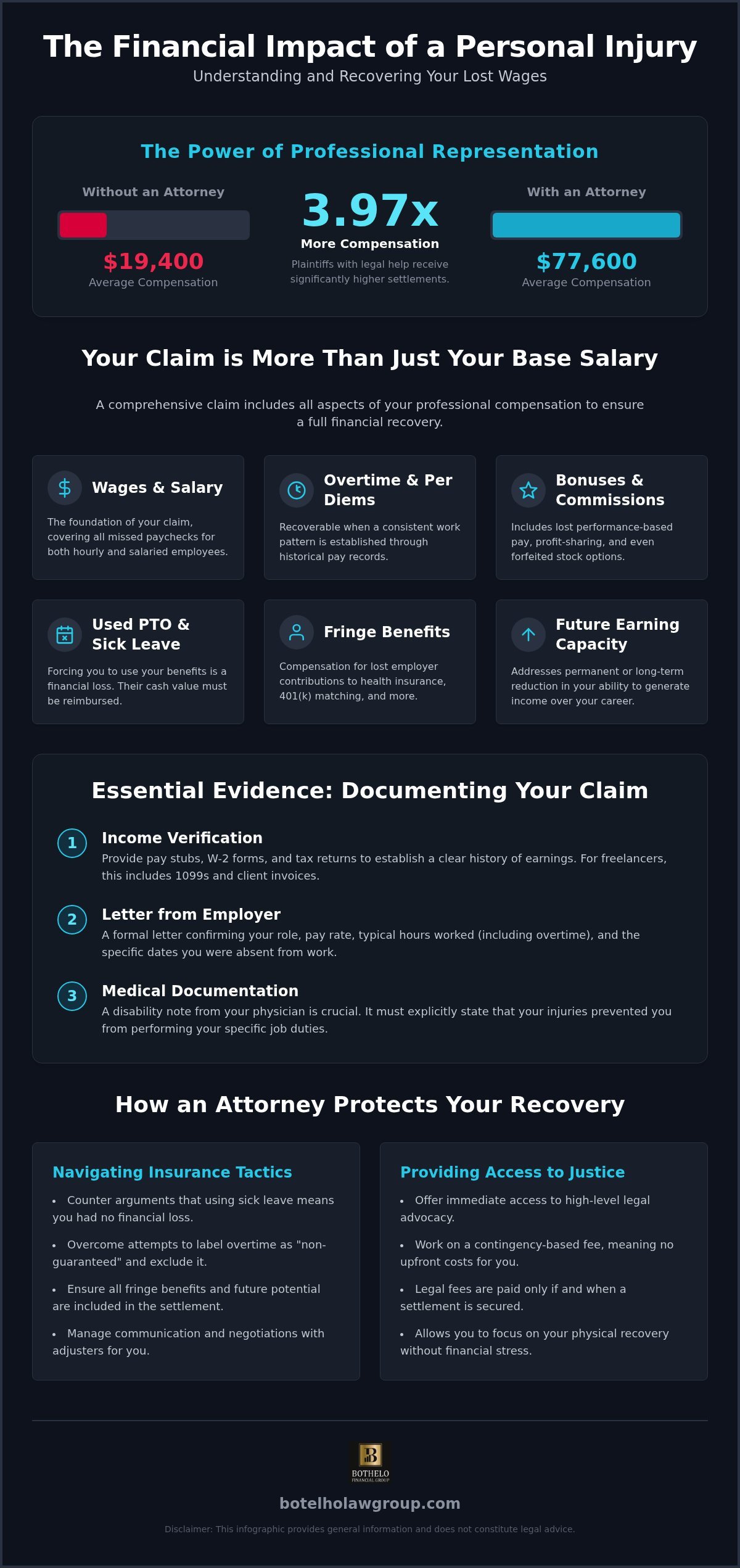
Did you know that plaintiffs who secure professional legal representation receive an average of $77,600 in compensation, which is nearly four times more than those who attempt to navigate the system alone? Your lost income isn’t just a missed paycheck; it’s the systematic erosion of your professional assets and future financial security. When you’re sidelined by an accident, the financial impact ripples through your life, turning a temporary injury into a long-term crisis. Partnering with a dedicated lost wages personal injury attorney ensures that you aren’t just filing a claim, but aggressively protecting your right to a full recovery of every dollar you’ve earned.
It’s exhausting to watch household bills mount while you’re physically unable to work, especially when you’re forced to burn through hard-earned PTO or sick leave just to stay afloat. You might worry that using these benefits disqualifies you from a claim, or feel confused about how to prove income from a non-traditional or freelance role. This article provides the clarity you need. You’ll learn how to accurately calculate your total losses, recover compensation for used benefits, and safeguard your future earning potential. We’ll examine the specific documentation required in 2026 to overcome increased insurer scrutiny and secure the reimbursement you deserve.
Key Takeaways
- Discover why a comprehensive claim must include overtime, bonuses, and employer-sponsored benefits rather than just your standard hourly rate.
- Learn the precise formulas used to calculate total income loss for both hourly workers and salaried professionals to prevent underpayment.
- Secure your claim by following a strict documentation checklist that links medical necessity directly to your missed shifts and professional obligations.
- Engaging a lost wages personal injury attorney allows you to navigate complex insurance tactics while ensuring that fringe benefits and future potential are included in your settlement.
- Understand how a contingency-based fee structure provides immediate access to high-level legal advocacy without the stress of upfront costs during your recovery.
What Are Lost Wages in a Personal Injury Claim?
In the context of a personal injury claim, lost wages represent the specific, quantifiable income you were prevented from earning due to your injuries. Massachusetts law classifies these as economic damages, which are designed to compensate you for actual monetary losses. This isn’t a speculative benefit; it’s a reimbursement for the erosion of your financial stability. Under Massachusetts tort law, the recovery of lost wages is a fundamental legal right intended to restore an injured party to their pre-accident financial position. A seasoned lost wages personal injury attorney focuses on two distinct categories: past lost wages and the future loss of earning capacity. While past wages cover the period from the accident to the present, the loss of earning capacity addresses the permanent reduction in your ability to generate income in the years to come.
The PTO and Sick Leave Misconception
Many insurance adjusters attempt to minimize settlements by claiming that if you used sick leave or vacation time, you didn’t suffer a loss. This is a significant misconception. Using accrued benefits is a direct financial loss because those assets are no longer available for their intended purpose. You’ve essentially spent your professional safety net to cover a defendant’s negligence. Your claim should reflect the fact that these hours have a specific cash value. A comprehensive demand includes:
- The total cash value of every hour of PTO, sick leave, or vacation time exhausted.
- Compensation for the lost opportunity of future leave you can no longer take.
- Reimbursement for any “use-it-or-lose-it” benefits that expired while you were incapacitated.
Temporary vs. Permanent Disability Impacts
Your recovery depends on the period of disability established by your healthcare providers. Medical evidence is the only currency that adjusters recognize. If a physician doesn’t explicitly state that you’re unable to perform your specific job duties, the insurance company will likely deny that portion of your claim. This is where a lost wages personal injury attorney becomes essential. They coordinate with medical experts to distinguish between temporary total disability, where you cannot work at all, and partial disability, where your earning power is restricted. Every shift missed and every hour of overtime lost during this period must be validated through rigorous documentation to ensure your professional assets are fully protected. Whether your disability lasts for three weeks or leads to a permanent career change, the legal focus remains on securing the total value of your lost time.
Recoverable Income: More Than Just Your Base Salary
A common error in personal injury litigation is the failure to account for the full spectrum of professional compensation. Your base salary is merely the starting point. A sophisticated lost wages personal injury attorney looks beyond the gross pay line on your pay stub to identify the total erosion of your benefits package. This includes employer-sponsored health insurance contributions and 401(k) matching funds that ceased while you were unable to work. These are tangible economic assets with a specific dollar value that must be replaced to make you whole.
Commissions and performance-based bonuses represent a significant portion of income for many professionals in Massachusetts. When recovering lost income, we must also factor in seasonal pay fluctuations and scheduled cost-of-living adjustments. If a raise was slated to take effect during your recovery period, your claim should reflect that higher rate for the duration of your absence. We also examine the loss of stock options or profit-sharing distributions that were forfeited due to your inability to meet service-length or performance requirements during your disability.
Overtime and Per Diem Losses
Insurance adjusters frequently attempt to exclude overtime by labeling it as non-guaranteed. We overcome this by establishing a clear pattern of work through an exhaustive review of your historical pay records. A qualified lost wages personal injury attorney will demonstrate that if you consistently worked 50 hours a week for the months prior to your accident, those extra ten hours are a predictable part of your livelihood. For those in field-based or industrial roles, lost per diems and travel stipends also represent a recoverable loss. These payments aren’t just reimbursements. They are part of the financial benefit of your employment that vanished the moment you were injured.
Lost Bonuses and Promotion Opportunities
The most complex area of recovery involves bonuses and promotions that were interrupted by your injury. Adjusters will reflexively argue these are too speculative to calculate. We counter this by utilizing your internal performance reviews and written company policies as legal evidence. If you were meeting the objective metrics required for a year-end bonus or a scheduled step-increase, that income was reasonably certain. Protecting your future earning potential means ensuring these missed milestones are quantified and included in your final settlement. Partnering with a no upfront fee personal injury lawyer ensures that even the most complex mathematical audits of your compensation package are handled with professional precision.
How to Calculate Lost Wages for Different Employment Types
Accurate financial recovery begins with a precise calculation of every missed opportunity. For hourly employees, the standard formula involves multiplying the total hours missed by your designated hourly rate. Salaried professionals require a more nuanced approach where we divide your annual compensation by the number of standard working days to establish an exact daily value. While these calculations seem straightforward, calculating personal injury settlements becomes significantly more complex when your income fluctuates based on performance or seasonal demand.
Commission-only sales professionals and those with heavy incentive structures shouldn’t settle for “average” figures that don’t reflect their true potential. We analyze your historical earnings over the preceding 24 months to establish a reliable baseline of what you would’ve earned. In high-stakes or high-income cases, a lost wages personal injury attorney often engages forensic accountants to audit these figures and provide expert testimony. This systematic approach transforms your claim from a speculative estimate into an indisputable financial fact that withstands the scrutiny of aggressive insurance adjusters.
Calculating Losses for the Self-Employed and Gig Workers
Independent contractors and 1099 gig workers often face the most resistance from insurance companies. Adjusters frequently focus on gross receipts, which don’t accurately reflect your actual take-home loss. We focus on net profit and utilize the “draw” method for small business owners to prove the personal income you would’ve extracted from the business. It’s also vital to document specific lost contracts, missed project deadlines, or the inability to bid on new work during your recovery. This detailed evidence ensures that the unique nature of your employment doesn’t become a loophole for the insurance company to avoid payment. Just as we advocate for workers here, a personal injury attorney Portland at Herron Law provides similar specialized support for those in the Pacific Northwest facing complex wage claims.
Loss of Earning Capacity for Future Income
The most devastating financial impact of an injury is often the permanent reduction in your ability to generate income. Diminished earning capacity occurs when you return to the workforce but are unable to perform at your pre-accident level or pursue the same career trajectory. We calculate the lifetime gap between your projected earnings before the injury and your new, restricted path. By integrating vocational experts, your lost wages personal injury attorney can project these losses over the remainder of your working life. This protective advocacy ensures that your settlement covers not just the paychecks you’ve missed today, but the professional growth you’ve lost for tomorrow. For individuals dealing with severe occupational illnesses, Weitz & Luxenberg offers specialized expertise in documenting and recovering these massive future income losses.
The integrity of your claim depends entirely on the quality of your evidence. Evidence is your only leverage. Insurance adjusters follow a strict ‘Golden Rule’: if a medical professional didn’t document your inability to work, the loss simply doesn’t exist in the eyes of the law. A dedicated lost wages personal injury attorney will ensure that your medical records explicitly state the physical or cognitive restrictions that prevent you from performing your specific job duties. In 2026, insurance companies are increasingly utilizing sophisticated billing audits to find discrepancies between medical treatment dates and claimed missed shifts. Any gap in this timeline can be used to deny your recovery.
To secure a full reimbursement, you must provide a comprehensive financial portfolio. This systematic documentation proves your income was not just possible, but certain. A standard checklist for a 2026 claim includes:
- Wage Verification Forms signed and dated by your HR department.
- Pay stubs covering at least six months prior to the accident to establish a baseline.
- W-2 forms or 1099 statements from the previous two tax years.
- For self-employed individuals, a complete Schedule C from your federal tax return to verify net profit.
The Medical-Financial Link
Your missed days must correlate directly with a specific medical restriction. If your doctor clears you for ‘light duty’ and your employer offers a compatible role, refusing that position may jeopardize your ability to claim lost wages for that period. We work closely with your compensation for medical bills lawyer to ensure your treatment plan and work restrictions are perfectly aligned. This unified approach prevents the insurance company from arguing that your time away from work was a personal choice rather than a medical necessity. Every medical note must be clear, concise, and restrictive enough to justify your absence.
Employer Cooperation and Third-Party Verification
Obtaining a formal Wage Verification Form from your employer is a critical step. We help you draft professional requests that secure the necessary data without creating friction in your workplace or jeopardizing your job security. If your employer is uncooperative or the business has closed, we pivot to third-party verification. This involves a rigorous analysis of bank statements, deposit records, and historical tax filings to reconstruct your income pattern. A lost wages personal injury attorney provides the sophisticated strategy needed to overcome these evidentiary hurdles and prove your loss through alternative means. If you’re struggling to gather the documentation needed to prove your income loss, contact the Botelho Law Group for a focused review of your case.
How a Lost Wages Personal Injury Attorney Protects Your Recovery
Securing your financial future requires more than just submitting paperwork. It demands a strategic shield against the aggressive tactics of insurance adjusters who are trained to minimize your loss. In Massachusetts, adjusters often use delay tactics to increase your financial desperation, hoping you’ll accept a low-ball settlement just to cover immediate bills. A skilled lost wages personal injury attorney disrupts this cycle by taking over all communication and establishing an authoritative presence. We don’t just ask for what’s on your pay stub; we calculate the hidden erosion of your professional assets, including the loss of retirement contributions and the long-term impact on your career trajectory.
For many residents, the primary barrier to legal action is the fear of additional costs while they aren’t working. This is why the Botelho Law Group operates on a contingency basis. Partnering with a no upfront fee personal injury lawyer means you can access high-level litigation resources without any out-of-pocket expense. We invest in the forensic accountants and vocational experts needed to build an indisputable case. If a settlement offer fails to reflect the true depth of your economic damages, we’re fully prepared to take your case to trial to protect your right to a full recovery.
Local Advocacy in Fall River and Massachusetts
Local knowledge is a critical component of a successful litigation strategy. We understand the specific jury tendencies in Bristol County courts and maintain relationships with local medical experts whose testimony carries weight in our community. This localized expertise allows us to anticipate how a case will be perceived by a judge or jury in Fall River. For those facing permanent disability, the insights of a wrongful death lawyer Fall River can be vital. While your case may not involve a fatality, the legal methodologies used to project lifetime financial losses in those high-stakes matters are equally applicable to permanent income erosion claims.
Your Next Steps Toward Financial Stability
The actions you take in the days following an accident often determine the outcome of your claim. An initial consultation is the most effective way to preserve evidence and establish a timeline that adjusters cannot contest. We handle the complex dialogue with your employer’s insurance carrier, ensuring you don’t inadvertently say something that compromises your recovery. Our team acts as your dedicated guide, moving logically from the initial audit of your losses to the final resolution of your case. Don’t let a temporary injury lead to permanent financial instability. Contact Botelho Law Group for a free consultation today.
Protecting Your Professional Assets and Financial Future
Recovering from an accident is a physical challenge, but it shouldn’t result in a long-term financial catastrophe. You’ve learned that every missed shift, exhausted PTO hour, and forfeited performance bonus represents a specific economic loss that you have a legal right to recover. Successfully reclaiming these funds requires a meticulous audit of your professional life and a direct evidentiary link between your medical restrictions and your missed income. Without professional guidance, the “PTO trap” and speculative bonus arguments can easily erode the value of your claim.
Partnering with a lost wages personal injury attorney ensures that complex calculations and aggressive insurance adjusters don’t stand between you and your financial stability. At Botelho Law Group, we provide dedicated advocacy for complex wage and benefit claims, utilizing our deep expertise in Fall River and Massachusetts personal injury law. Our contingency fee guarantee means you pay nothing unless we win, allowing you to focus entirely on your physical recovery without the stress of upfront costs. Secure Your Financial Recovery – Schedule a Free Consultation. Your professional future is worth defending, and we’re ready to act as your focused advocate.
Frequently Asked Questions
Can I still claim lost wages if I used my sick time or vacation days?
You are entitled to recover the value of sick time or vacation days used during your recovery. These benefits are part of your compensation package, and exhausting them to cover an injury caused by another’s negligence constitutes a tangible financial loss. A lost wages personal injury attorney calculates the monetary equivalent of these hours to ensure they are included in your settlement demand. You shouldn’t have to sacrifice your future rest or safety net for a defendant’s error.
How do I prove lost wages if I am self-employed or a 1099 contractor?
Proving income for 1099 contractors requires a rigorous analysis of tax returns, specifically your Schedule C, and recent bank deposits. We establish a baseline of your net profit rather than just gross receipts to demonstrate actual loss. Providing evidence of cancelled contracts or missed project deadlines further validates your claim. This systematic approach ensures that the unique nature of your employment doesn’t prevent you from receiving full compensation for your professional downtime.
What if the accident happened while I was unemployed but looking for work?
You may still have a claim for loss of earning capacity even if you were not actively employed at the moment of the accident. This requires proving you were capable of working and had a reasonable expectation of income. We utilize your prior work history, certifications, and documentation of active job searches or pending offers to establish your potential value. This protects your right to recover the income you would’ve likely secured if the injury hadn’t occurred.
Will the insurance company pay for my lost bonuses and overtime?
Insurance companies are legally required to compensate you for lost bonuses and overtime if you can prove they were reasonably certain. We establish this by reviewing your historical pay records to show a consistent pattern of overtime shifts or by using company policy to document bonus eligibility. A lost wages personal injury attorney counters the common “too speculative” objection by providing concrete data from your past performance reviews and employer-verified compensation structures.
How long does it take to get a settlement for lost wages in Massachusetts?
The timeline for a settlement depends largely on the duration of your medical treatment and when you reach maximum medical improvement. Most personal injury cases in Massachusetts, approximately 95 percent, are resolved through pre-trial settlements rather than lengthy court battles. Once your medical and financial documentation is complete, negotiations typically proceed more efficiently. We maintain a methodical rhythm to ensure your case moves toward a resolution without sacrificing the thoroughness required for a maximum recovery.
Can I recover lost wages if I am partially at fault for the accident?
Massachusetts follows a modified comparative negligence rule, allowing you to recover damages as long as you are not more than 50 percent at fault. Your total compensation, including lost wages, will be reduced by your percentage of responsibility. For example, if you are found 20 percent liable, you can still recover 80 percent of your total losses. We act as your protective advocate to ensure the insurance company doesn’t unfairly inflate your share of the liability.
Do I have to pay taxes on my lost wages settlement?
Most personal injury settlements are not taxable under federal law because they are intended to compensate for physical injuries. However, the IRS may view the portion of a settlement specifically designated for lost wages as taxable income since it replaces pay that would’ve been taxed. It’s vital to structure your settlement carefully to minimize potential tax liabilities. We recommend consulting with a tax professional to understand the specific implications for your unique financial situation in 2026.
What is the difference between lost wages and loss of earning capacity?
Lost wages refer to the specific income you’ve already missed between the date of the accident and the present. Loss of earning capacity is a forward-looking calculation that addresses your diminished ability to earn money in the future. This applies if your injuries prevent you from returning to your previous role or pursuing a higher career trajectory. We integrate vocational experts to project these lifetime losses, ensuring your settlement covers both your immediate needs and your long-term financial security.