
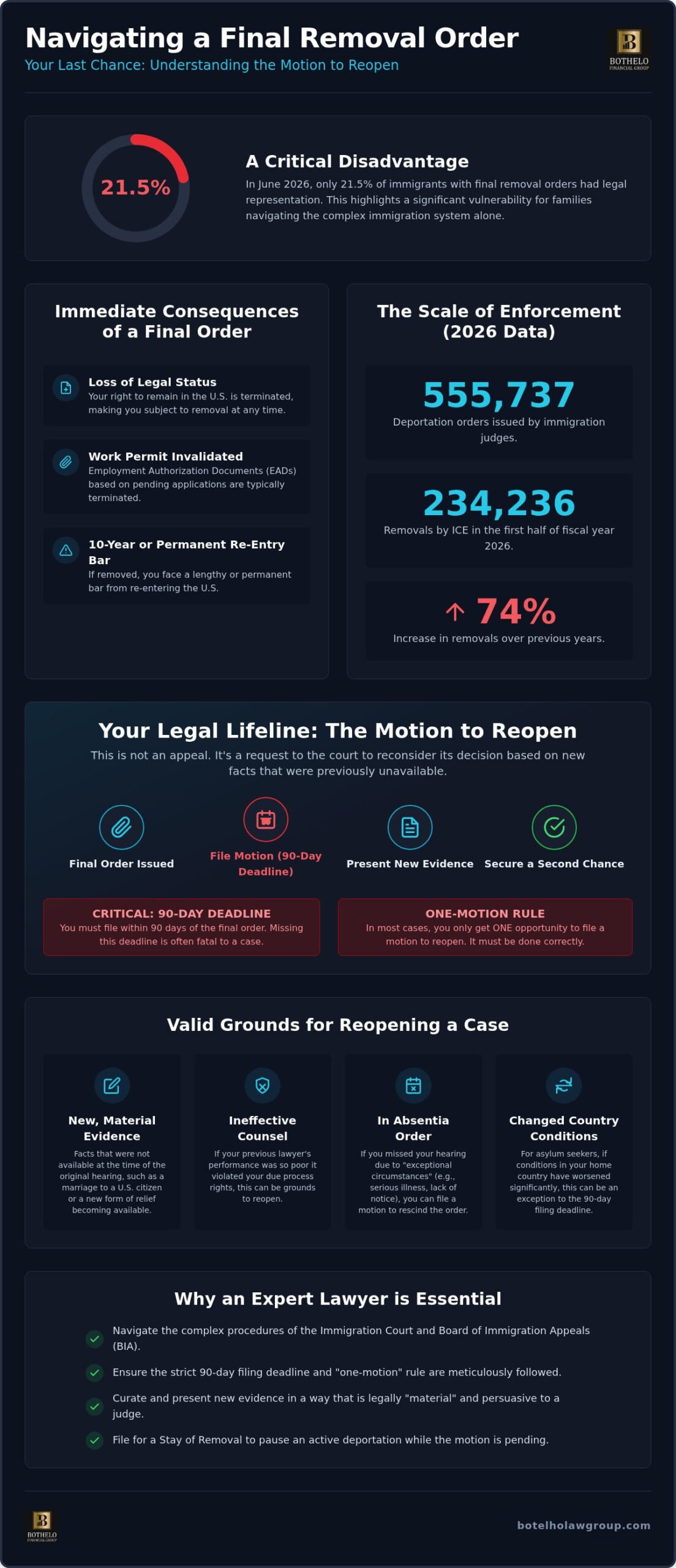
In June 2026, only 21.5% of immigrants facing removal orders had legal representation, a statistic that highlights the vulnerability of families managing a system that feels designed to push them out. Receiving a final order of removal feels like a definitive end. The fear of being separated from your children or arrested during a routine check-in is a heavy burden. You likely feel the clock is ticking and the law is no longer on your side. However, a final order isn’t always the end of the road. Working with a dedicated motion to reopen deportation case lawyer can provide the strategic leverage needed to challenge the court’s decision and protect your future.
This article shows how a Motion to Reopen serves as a vital legal tool to stop an imminent deportation and secure a Stay of Removal. You’ll learn how to present new, previously unavailable evidence that could change the outcome of your case, even after a judge has ruled. We break down the strict 90-day filing deadlines, explore exceptions for changed country conditions, and explain the precise steps required to dismantle a prior order. By understanding these high-stakes legal procedures, you can move from a place of anxiety to a position of informed, strategic action.
Key Takeaways
- Understand the immediate legal consequences of a final removal order, including the potential termination of your Employment Authorization Document.
- Discover how a motion to reopen deportation case lawyer can help you meet the strict 90-day filing deadline to pause an active deportation.
- Identify the specific legal grounds required to reopen a case, such as documenting changed country conditions or addressing ineffective assistance of counsel.
- Navigate the unique procedural requirements of the Boston Immigration Court and the Board of Immigration Appeals with expert precision.
- Learn how to curate and present new, material evidence that was previously unavailable to secure a second chance at your immigration hearing.
What Happens if You Get a Deportation Order? The Finality of Removal
When an Immigration Judge issues a final order of removal, your legal status shifts instantly. You move from being “in proceedings” to being “ordered removed.” This isn’t a mere administrative change. It’s a high-stakes transition that terminates your right to remain in the United States and often invalidates your Employment Authorization Document (EAD). If your work permit was based on a pending application for relief, that permit typically expires once the underlying case is denied. With over 555,737 deportation orders issued by immigration judges through June 2026, the scale of this enforcement is clear. Engaging a deportation defense lawyer immediately is essential to prevent permanent consequences. You must act before ICE takes you into custody, as a physical removal makes legal recourse significantly more difficult.
A final order also triggers a 10-year or even permanent bar to re-entry if ICE executes the removal. The government views this order as the conclusion of your case, meaning ICE can execute the removal at any time without further warning. ICE has conducted 234,236 removals in the first half of fiscal year 2026, representing a 74% increase over previous years. This creates a state of constant risk for you and your family, requiring a sophisticated legal response to pause the process.
The Risk of In Absentia Orders
Many individuals discover they have a removal order only after missing a court date. This is known as an “in absentia” order. These orders often occur because a notice was sent to the wrong address or never delivered. To challenge this, you must meet the “exceptional circumstances” standard. This requires proving that your failure to appear was due to factors beyond your control, such as a serious illness or the death of an immediate family member. Because these cases involve a fundamental lack of due process, they are among the most common reasons a motion to reopen deportation case lawyer is hired to intervene and restore a client’s rights.
Deportation vs. Voluntary Departure
A judge might grant voluntary departure instead of a forced removal. While this allows you to leave the country on your own terms and avoid certain re-entry bars, the deadlines are strict. If you overstay a voluntary departure period, the order automatically converts into a final deportation order. This brings heavy civil penalties and a 10-year bar on seeking most forms of relief. A strategic motion to reopen deportation case lawyer can sometimes be used to convert an existing deportation order into voluntary departure or to seek a stay that prevents the order from being executed while new evidence is reviewed. Understanding the difference between these outcomes is vital for your long-term immigration goals.
What is a Motion to Reopen and How Does It Work?
A Motion to Reopen is a procedural tool used to ask an Immigration Judge or the Board of Immigration Appeals (BIA) to take a second look at your case. It’s distinct from an appeal. While an appeal argues the judge made a mistake with existing facts, a Motion to Reopen presents “new and material” facts that didn’t exist or weren’t available during your initial trial. This is a high-stakes request. Under current regulations, you generally have a 90-day window from the date of the final order to file. Missing this deadline often results in a summary denial.
The law also enforces a “one-motion” rule. You typically only get one opportunity to reopen your case. Because you can’t keep filing until you get the result you want, your first attempt must be legally perfect. With the immigration court backlog reaching 3,195,137 active cases in August 2026, the system is increasingly rigid. A skilled motion to reopen deportation case lawyer ensures your filing stands out in a crowded docket by meeting every technical requirement. If you are concerned about meeting these strict standards, the team at Botelho Law Group can provide the strategic guidance necessary to protect your rights.
Step 1: Identifying New and Material Evidence
Evidence must be both “new” and “material” to qualify. “New” means the information was not available and could not have been discovered at the time of your hearing. “Material” means the evidence is significant enough that it would likely change the judge’s original decision. For example, if you’ve recently married a U.S. citizen or if a family member has developed a severe medical condition requiring your presence, these represent new equities. Changed country conditions, such as a sudden outbreak of civil war or a new regime targeting people in your social group, also serve as powerful grounds for reopening a case.
Step 2: Filing the Motion and the Stay of Removal
Filing your motion is only half the battle. A common and dangerous misconception is that filing a Motion to Reopen automatically stops your deportation. It doesn’t. Unless you are reopening an in absentia order, ICE can still remove you from the country while your motion is pending. To prevent this, your motion to reopen deportation case lawyer must file a “Stay of Removal” alongside your motion. If you are already in custody, an immigration bond hearing lawyer may be necessary to secure your release or an emergency stay. This dual-track strategy is the only way to ensure you remain in the U.S. while the court reviews your new evidence.
Legal Grounds for Reopening Your Case in 2026
Success in reopening a case hinges on the specific legal ground used to challenge the prior order. While the standard 90-day window is rigid, several exceptions allow for a second chance at relief. One common path involves a new eligibility for status, such as qualifying for a family based green card through a spouse or adult child. In other instances, the government’s own counsel may agree to a joint motion to reopen, effectively waiving time and numerical limitations if they believe the interests of justice are served. Identifying which ground applies to your specific situation is the first step in building a successful defense.
Ineffective Assistance of Counsel Claims
If your previous representative failed to provide competent service, you may have grounds for a claim based on ineffective assistance of counsel. This requires meeting the strict “Lozada” standards, which involve filing an affidavit detailing the agreement you had with your former lawyer and documenting their failures. You must also notify the previous attorney and, in most cases, file a formal complaint with the state bar association. These procedural steps are mandatory and must be followed with precision to avoid a summary denial by the court.
A motion to reopen deportation case lawyer uses these claims to argue for “equitable tolling.” This legal principle pauses the 90-day clock, allowing you to file for relief even years after the original order if the attorney’s negligence was only recently discovered. This is a powerful tool for those who were misled by “notarios” or lawyers who failed to file essential paperwork. By proving that the prior representation was fundamentally flawed, you can restart your case and present the evidence that should have been heard the first time.
Changed Circumstances in the Home Country
The law provides a critical exception for asylum seekers: there is no time limit for motions based on changed country conditions. To succeed, you must provide 2026 human rights reports or news documentation showing a material shift in the political or social landscape of your home country. This change must be personal. It isn’t enough to show that a country has become generally more dangerous; you must prove that the new conditions specifically increase the threat to your life or freedom. Your motion to reopen deportation case lawyer must demonstrate that this evidence was unavailable during your original hearing.
Because the immigration system currently manages over 2.3 million pending asylum cases, these motions require meticulous documentation to prove that the new evidence is significant enough to warrant a full rehearing. The court looks for specific, documented events that have occurred since your last appearance. If a new regime has taken power or if targeted violence against your specific social group has escalated, these facts can dismantle a prior deportation order. This allows you to present a fresh asylum claim based on the reality of the current global landscape. Working with a knowledgeable asylum lawyer in Massachusetts can be critical to building the evidentiary record needed to support these changed country conditions claims.
The Procedural Reality of Deportation Defense in Massachusetts
The Boston Immigration Court, located at the JFK Federal Building, operates under the specific legal framework of the U.S. Court of Appeals for the First Circuit. This means local precedents often differ from those in other regions, especially regarding what constitutes “exceptional circumstances” or “material evidence.” Navigating this environment requires more than general legal knowledge; it demands an understanding of the specific tendencies of the DHS Office of the Principal Legal Advisor (OPLA) in Boston. OPLA attorneys represent the government’s interest, and their willingness to join a motion can drastically change a case’s trajectory. A local immigration lawyer in Fall River MA provides a strategic advantage by maintaining proximity to these local offices and courts, ensuring that filings are physically delivered and processed without the delays inherent in remote representation.
Interacting with ICE Enforcement in Fall River
If you have an active order of removal, routine check-ins with ICE enforcement can become high-risk events. In Fall River and the surrounding South Coast area, having a signed Form G-28 (Notice of Entry of Appearance as Attorney) on file with the court and ICE is your first line of defense. This document legally establishes that you are represented, preventing ICE from questioning you without your counsel present. Our firm acts as a protective shield during these interactions, ensuring that your rights are respected and that any attempt at detention is met with an immediate legal challenge. We coordinate directly with local enforcement officers to manage your case transparently, which can often prevent the sudden, traumatic arrests that occur when an individual attempts to navigate the system alone.
Emergency Stays of Removal
When deportation is scheduled within a 24 to 48-hour window, the situation shifts from a standard legal proceeding to a crisis-level emergency. In these moments, a motion to reopen deportation case lawyer must act with absolute precision. There are two primary types of stays used to halt removal:
- Administrative Stays: These are requested directly from ICE, typically through Form I-246. They are discretionary and are usually granted for compelling humanitarian reasons or significant pending litigation.
- Judicial Stays: These are issued by an Immigration Judge, the BIA, or a federal court. Unlike administrative stays, a judicial stay legally prohibits ICE from removing you while your motion is being considered.
Managing these deadlines requires a high-stakes litigation firm capable of filing emergency petitions in multiple venues simultaneously. If your family is facing an immediate threat of separation, you need a strategist who understands how to stop the clock. To protect your family and secure your future, contact Botelho Law Group to begin your defense today.
Why a Motion to Reopen Deportation Case Lawyer is Essential
A final order of removal isn’t just a piece of paper; it’s a life-altering legal event that demands a sophisticated response. Many individuals attempt to write a simple letter to the court explaining their situation, but this approach almost always leads to a swift denial. The Board of Immigration Appeals (BIA) and Immigration Judges require a formal, technical legal brief that argues how the new evidence meets the “materiality” standard under federal law. A motion to reopen deportation case lawyer manages these strict evidentiary requirements, ensuring every affidavit and document is formatted and submitted according to the EOIR Practice Manual. Without this level of precision, even the most compelling new evidence can be discarded on a procedural technicality.
Protection extends beyond the courtroom. For families facing removal, the threat of sudden separation often endangers their financial stability and property. Our firm provides a systematic defense by coordinating your immigration strategy with professional estate planning services. This ensures that if a stay is denied, your assets, children, and business interests remain protected through legally binding powers of attorney. We don’t just fight for your status; we fight for the entire life you’ve built in the United States.
The Sophisticated Legal Strategy of Botelho Law Group
We employ a top-down approach to every case, beginning with a rigorous audit of your prior proceedings to identify judicial or clerical errors that others might overlook. From our headquarters in Fall River, we represent clients in all 50 states, providing a high-stakes litigation presence that smaller, localized practices often cannot match. Our goal is to move you from a state of panic to a structured legal plan. We handle the complex federal filings and the communication with government counsel, allowing you to focus on your family while we manage the litigation.
Taking the Next Step to Protect Your Future
Securing a second chance in court requires an immediate, honest evaluation of your legal options. During a crisis consultation, we analyze the specific grounds of your removal order and determine the likelihood of a successful reopening. As a full-service firm, we offer the unique advantage of protecting both your immigration status and your financial autonomy. It’s not enough to hope for a better outcome; you need a motion to reopen deportation case lawyer who can execute a results-oriented strategy in a system that offers no room for error. Contact our office today to begin building your defense.
Securing Your Future Through Strategic Litigation
A final order of removal is a significant challenge, but it does not have to be the end of your story in the United States. By identifying new, material evidence or uncovering procedural errors from prior hearings, you can dismantle a deportation order and reclaim your right to a fair hearing. The success of this high-stakes process depends on strict adherence to filing deadlines and a deep understanding of the Board of Immigration Appeals standards. You don’t have to face this complex system alone.
Working with an experienced motion to reopen deportation case lawyer ensures that your petition is built on a foundation of legal precision and protective advocacy. From our headquarters in Fall River, we serve as dedicated advocates for Massachusetts families while representing clients in all 50 states. Our expertise in complex BIA litigation allows us to act as a sophisticated shield against enforcement actions. Don’t let a deportation order be the final word; contact Botelho Law Group for a high-stakes defense today. You have worked hard to build a life here, and we are here to help you protect it.
Frequently Asked Questions
Can I be deported while my Motion to Reopen is pending?
Filing a motion doesn’t automatically stop your removal unless you’re challenging an in absentia order. In most other cases, ICE can legally deport you while the court reviews your petition. To prevent this, your motion to reopen deportation case lawyer must file a separate application for a Stay of Removal. This request asks the judge or the BIA to pause enforcement. Without an approved stay, you remain at risk of immediate physical removal from the country.
What is the 90-day deadline for a Motion to Reopen?
You must generally file your motion within 90 days of the final administrative order of removal. This deadline is strictly enforced by the immigration courts and the BIA. However, exceptions exist for individuals who didn’t receive proper notice of their hearing or for those filing based on changed country conditions. If you’ve been a victim of ineffective assistance of counsel, you might also qualify for equitable tolling to bypass this standard three month window.
Is there a limit on how many Motions to Reopen I can file?
Federal regulations typically limit individuals to filing only one Motion to Reopen. This one motion rule means you can’t submit multiple requests to see which one the judge likes best. Because you usually only get a single chance to present new facts, your legal brief must be comprehensive and technically perfect. Certain exceptions apply for motions based on asylum or changed country conditions, but these require meeting an extremely high evidentiary threshold to be considered.
How much does it cost to file a Motion to Reopen in 2026?
As of August 2026, the filing fee for a motion before an Immigration Judge is $1,065.00. If your motion is being filed before the Board of Immigration Appeals, the fee is $1,030.00. It’s important to note that since February 23, 2026, all EOIR fees must be paid electronically through the official payment portal. The court no longer accepts checks or money orders. Failure to provide proof of electronic payment will result in an immediate rejection of your filing.
Can I file a Motion to Reopen if I missed my court date (In Absentia)?
You can file to reopen an in absentia order if you missed your hearing due to exceptional circumstances or a lack of notice. If you had a valid reason, such as a medical emergency, you have 180 days from the order date to file. If you never received the hearing notice at all, there’s no time limit to challenge the order. Filing this specific type of motion provides an automatic stay of removal while the judge reviews your case.
What qualifies as “new evidence” for an immigration case?
New evidence must be information that was not available and couldn’t have been discovered during your original trial. Examples include a recent marriage to a U.S. citizen, the birth of a child with a serious medical condition, or new documentation of political upheaval in your home country. To be successful, a motion to reopen deportation case lawyer must prove this evidence is material, meaning it’s significant enough that it likely would’ve changed the judge’s initial decision.
How long does the Board of Immigration Appeals take to decide a motion?
The BIA doesn’t have a fixed timeline for deciding motions, and wait times vary based on the complexity of the case. With the immigration court backlog reaching 3,195,137 active cases in 2026, the process can take several months or even longer. While your motion is pending, it’s critical to have a Stay of Removal in place. This ensures you aren’t removed from the country while the board members review your new evidence and legal arguments.
Can a lawyer stop my deportation if ICE is already at my door?
A lawyer can stop an imminent deportation by filing an emergency Stay of Removal with the court or the BIA. If ICE has already taken you into custody, your representative must act immediately to petition for a judicial stay. This process requires a high stakes litigation strategy and the ability to file complex documents within hours. While no outcome is guaranteed, having a dedicated advocate can provide the legal intervention necessary to pause the removal and keep your family together.