
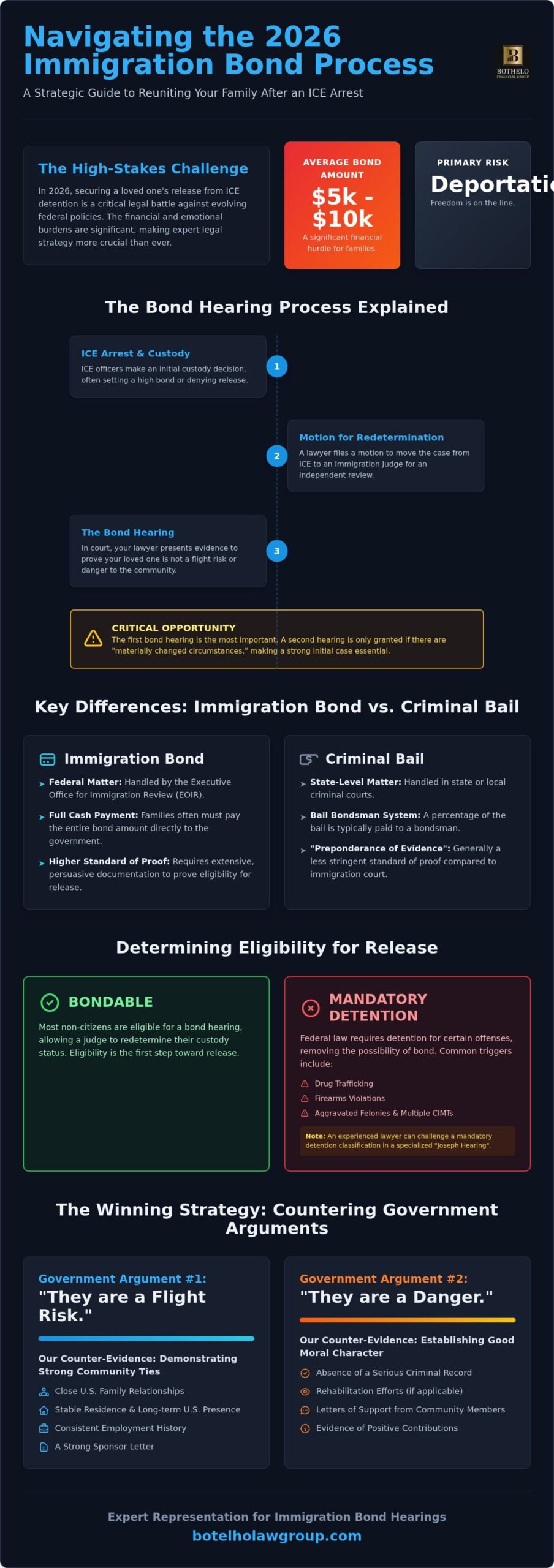
In 2026, the path to reuniting your family after an ICE arrest is no longer a matter of simple paperwork; it’s a high-stakes legal battle where your eligibility for release is under direct threat by federal policy shifts. Securing the freedom of a loved one requires the precise intervention of an experienced immigration bond hearing lawyer who understands the evolving circuit court splits and the impact of the Laken Riley Act. You’re likely feeling the crushing weight of uncertainty as you face the fear of immediate deportation and the financial strain of rising bond amounts, which now average between $5,000 and $10,000.
It’s a heavy burden to carry alone. We’ll show you how a systematic legal strategy can dismantle government assumptions of danger or flight risk to secure the lowest possible bond. This article provides a clear breakdown of the 2026 detention landscape, the critical evidence needed for a successful hearing, and the procedural shifts that dictate how and when your family can be reunited.
Key Takeaways
- Understand how a bond hearing functions as a formal redetermination of ICE custody and the specific 2026 timelines for filing a request.
- Identify the critical legal distinctions between mandatory detention and bondable offenses to determine if your family member is eligible for release.
- Learn how a skilled immigration bond hearing lawyer systematically dismantles government arguments regarding community danger and flight risk.
- Discover the essential documentation and sponsor letter requirements necessary to build a persuasive case for the lowest possible bond amount.
- Explore how professional advocacy provides a structured path to family reunification while navigating the complexities of federal immigration litigation.
Understanding the Immigration Bond Hearing Process
An immigration bond hearing serves as a formal “redetermination” of the custody conditions previously established by Immigration and Customs Enforcement (ICE). When a non-citizen is taken into custody, ICE officers make the initial decision regarding release; they might set a prohibitively high bond or declare the individual ineligible for release. This is where a dedicated immigration bond hearing lawyer intervenes. By filing a motion for a bond redetermination, the lawyer moves the case from the hands of enforcement officers to an Immigration Judge (IJ). The IJ operates under the Department of Justice and has the power to override ICE’s initial custody decision.
The timeline for this process is swift. You can request a hearing as soon as the detainee is processed and served with a Notice to Appear. However, speed shouldn’t compromise preparation. Within the complex structure of U.S. Immigration Law, the first bond hearing is usually the only opportunity to secure release. If the judge denies bond or sets an amount the family can’t afford, requesting a second hearing requires showing “materially changed circumstances.” This means if you don’t present your strongest evidence the first time, your loved one may remain in detention for the duration of their case, which can last months or even years.
The Purpose of an Immigration Bond
The fundamental purpose of an immigration bond is to ensure the respondent attends every scheduled court date. It acts as a financial guarantee to the government that the individual will not disappear into the interior of the country. Beyond appearance, the court uses the bond process to protect the community. The judge must be satisfied that the individual isn’t a “danger to property or persons.” For the family, the bond’s most significant benefit is the ability to prepare a robust removal defense from home. It’s much harder to gather evidence and meet with counsel while behind bars.
Differences Between Criminal Bail and Immigration Bond
Immigration bonds are federal matters handled by the Executive Office for Immigration Review (EOIR), making them distinct from state-level criminal bail. One of the most striking differences is the payment method. The traditional “bail bondsman” system common in criminal courts doesn’t exist here in the same way; families often must pay the full cash amount directly to the government to secure release. The standards of proof also diverge. While criminal bail focuses on “preponderance of evidence,” the immigration court requires a higher level of persuasive documentation. An immigration bond hearing lawyer knows how to navigate these federal evidentiary rules to prove that their client is neither a flight risk nor a threat to public safety.
Determining Eligibility: Mandatory Detention vs. Bondable Offenses
Not every non-citizen in custody is granted an automatic right to a bond hearing. Eligibility depends entirely on the specific grounds of removability cited by the government in the Notice to Appear. While many individuals qualify for a redetermination, others fall under “mandatory detention” statutes that prohibit release. An experienced immigration bond hearing lawyer must first analyze the charging documents to determine if the government has correctly classified the detainee’s legal status. If a mistake exists in the government’s classification, it must be challenged immediately to open the door for a release request.
The distinction between being “bondable” and “non-bondable” often hinges on the individual’s criminal history or the manner in which they entered the country. Under federal law, certain convictions strip an individual of their right to a bond hearing, effectively keeping them in custody for the duration of their removal proceedings. However, these labels are not always final. Through a “Joseph Hearing,” a lawyer can argue that the government’s evidence is insufficient to trigger mandatory detention. This specialized proceeding allows us to challenge the legal definition of a prior conviction, potentially restoring the client’s eligibility for a bond redetermination.
Crimes That Trigger Mandatory Detention
Federal statutes under INA § 236(c) require ICE to detain non-citizens who have committed specific offenses. This includes drug trafficking, firearms violations, and crimes involving national security. Additionally, individuals with multiple convictions for “crimes involving moral turpitude” (CIMTs) or a single “aggravated felony” are often barred from bond. The legal definitions of these terms are complex and frequently litigated. A conviction that appears to be an aggravated felony at first glance might not meet the strict federal criteria upon closer inspection by a skilled advocate.
The “Arriving Alien” Challenge
Individuals detained at a port of entry, such as an airport or a border crossing, face a distinct set of hurdles. The government classifies these individuals as “arriving aliens,” a status that historically limits their access to an Immigration Judge for bond. Instead of a standard hearing, these individuals must often seek “humanitarian parole” directly from ICE. This is a discretionary process with no judicial oversight, making it notoriously difficult to navigate. Recent Bond Hearing Legal Challenges continue to test these boundaries in federal court. Success in these cases requires sophisticated immigration court representation to ensure the detainee isn’t overlooked by a rigid system. If you’re facing this uncertainty, consulting an immigration bond hearing lawyer can help you identify the most viable path toward freedom.
The Legal Strategy: Overcoming Flight Risk and Danger Arguments
Success in a bond redetermination hearing requires a proactive dismantling of the government’s two primary objections: that the detainee is a danger to the community or a flight risk. An immigration bond hearing lawyer uses the legal framework established in Matter of Guerra to build this defense. This precedent requires the judge to consider a specific set of factors, including the individual’s fixed address in the U.S., their length of residence, and their record of appearing for previous court dates. It’s not enough to simply deny the government’s claims; we must provide a structured rebuttal that proves the respondent’s reliability.
Proving Stability and Community Ties
Judges prioritize individuals who have deep roots in the United States, as these ties suggest they’re unlikely to flee and abandon their lives. We present comprehensive evidence to establish this stability through multiple lenses. They don’t just look at the length of time spent in the country, but the quality of that time. We focus on several key pillars of stability:
- Family Unity: Documentation of immediate family members who are U.S. citizens or Lawful Permanent Residents.
- Economic Contribution: Multi-year tax filings, consistent employment records, and proof of financial responsibility.
- Civic Engagement: Evidence of active participation in religious organizations, local charities, or community groups.
Addressing Criminal History
When the government alleges a danger to the community based on a criminal record, the defense must pivot to contextualization and rehabilitation. It is essential to distinguish between minor, non-violent infractions and serious threats. An immigration bond hearing lawyer prepares a defense that highlights the passage of time since an offense and presents tangible proof of a changed life. This process involves a meticulous review of the Record of Proceedings to ensure the judge sees the full picture of the individual’s character.
A persuasive strategy often includes the following elements:
- Certificates of completion for counseling, vocational training, or educational programs.
- Documentation of community service, restitution, or other rehabilitative efforts.
- Formal “letters of support” from employers, neighbors, and community leaders who can attest to the individual’s character and reliability.
The judge weighs the severity of the alleged immigration violation alongside these mitigating factors. By demonstrating that the client has a stable home and a supportive network, we dismantle the government’s narrative and advocate for the lowest possible bond amount to ensure the family is reunited during the removal defense. If a bond hearing does not result in release and a final order of removal is issued, working with a motion to reopen deportation case lawyer may provide the critical legal tool needed to challenge that outcome and stop an imminent deportation.
Critical Evidence: How to Prepare for Your Bond Redetermination
Preparation is the single most important factor in a successful bond redetermination. An immigration bond hearing lawyer does not simply appear in court to argue; they curate a comprehensive documentary record that speaks for the respondent when they cannot speak for themselves. The judge’s decision relies heavily on the physical evidence presented in the “bond packet.” If this packet is incomplete or disorganized, the judge may default to ICE’s initial custody decision. To build a persuasive case, families should follow a structured five-step collection process.
- Step 1: Identity and Status Documents. Collect birth certificates, passports, and marriage licenses for the detainee and their immediate family members. Proof of a family member’s U.S. citizenship or Lawful Permanent Residency is vital.
- Step 2: The Sponsor Letter. Secure a formal commitment from a sponsor detailing exactly where the detainee will reside upon release. This letter serves as the anchor of the residence plan.
- Step 3: Financial Records. Gather pay stubs, bank statements, and property deeds. These documents prove the family’s ability to pay the bond and demonstrate a high level of economic stability.
- Step 4: Character References. Obtain letters from employers, teachers, or clergy. These provide a window into the detainee’s life and character outside of the immigration charges.
- Step 5: The Legal Motion. Your immigration bond hearing lawyer will draft a formal “Motion for Bond Redetermination,” which includes a legal brief tying all the evidence to the relevant federal statutes.
The Role of the Sponsor
The sponsor is the individual who guarantees the court that the respondent will attend all future hearings. Ideally, a sponsor should be a U.S. Citizen or a Lawful Permanent Resident. The judge views these sponsors as more reliable because they have a personal stake in following federal law. The sponsor must provide a detailed affidavit that includes their address, contact information, and a clear statement of their relationship to the detainee. If the sponsor has a stable employment history or owns property, this further reassures the court that the respondent has a secure environment to return to.
Drafting Persuasive Support Letters
Generic, templated letters often fail to move the court. Judges look for personalized stories that illustrate the “extreme hardship” a family faces while their loved one is in custody. These letters should describe specific instances of the detainee’s contributions to their family and community, such as caring for an ill relative or volunteering at a local church. These letters must be signed under penalty of perjury to ensure they carry maximum legal weight with the Immigration Judge. If you need assistance organizing these documents or identifying the right sponsor, contact an experienced legal advocate to begin building your defense packet today.
Securing Expert Representation with Botelho Law Group
Botelho Law Group provides comprehensive representation for individuals in ICE custody across all 50 states. While our reach is national, we maintain a deep commitment to the Fall River, MA, and South Coast community. This dual identity allows us to act as a powerful federal advocate while remaining an accessible partner for local families. Our team specializes in high-stakes deportation defense, ensuring that a bond hearing is treated as the first critical step in a larger removal defense strategy. We integrate bond requests with broader relief applications, including our work as a cancellation of removal lawyer, to provide a unified front against deportation.
Communication is the foundation of effective advocacy. We offer direct, bilingual support in Portuguese and English, ensuring that language barriers never compromise the quality of your legal representation. This capability is particularly vital when gathering sensitive testimony from family members or coordinating with sponsors who may not be fluent in English. By maintaining clear lines of communication, we ensure that every client feels fully informed and empowered throughout the litigation process. This results-oriented approach is what distinguishes our firm as a sophisticated problem-solver in the federal court system.
Why a Dedicated Immigration Attorney Matters
Success in the courtroom often depends on understanding the specific procedural preferences of local immigration judges. A seasoned immigration bond hearing lawyer anticipates these nuances, ensuring that every piece of evidence is formatted to the court’s exacting standards. We handle the complex task of translating foreign documents and certificates, a requirement that often delays cases when handled by less experienced firms. Beyond routine filings, we possess the capability to file emergency motions for bond redetermination when circumstances shift rapidly. This level of technical precision prevents administrative errors from standing between your family and a successful release.
Contact Botelho Law Group Today
Time is the most critical factor in detention cases. Every day spent in custody is a day of lost wages, family separation, and increased psychological strain. Our protective advocacy style is designed to instill trust in our clients while projecting a serious, results-oriented presence to the court. We don’t just fill out forms; we build a strategic shield around our clients’ interests. If your loved one is currently detained, the window to request a redetermination is narrow. You shouldn’t wait for the system to move on its own. Schedule a consultation with our Fall River immigration team to begin the process of securing their release and defending their right to remain in the country.
Take Decisive Action to Secure Your Family’s Freedom
The 2026 immigration landscape demands a level of precision that only a dedicated legal advocate can provide. A successful outcome requires more than just a request for release; it involves a strategic dismantling of government assumptions regarding eligibility and risk. By identifying bondable offenses early and preparing a meticulous evidence packet, you can effectively counter claims of flight risk or danger to the community. Every document, from sponsor affidavits to character references, serves as a vital pillar in your defense strategy.
Delaying action in detention cases often leads to prolonged separation and missed legal opportunities. Our firm brings focused expertise in removal defense and a bilingual Portuguese and English legal team to every case we handle. We represent clients in all 50 states, providing a powerful federal presence combined with localized, protective advocacy. You don’t have to navigate this complex system alone. Protect your family and secure their release; contact Botelho Law Group for a bond hearing consultation. With a skilled immigration bond hearing lawyer by your side, you can move forward with the professional guidance needed to achieve family reunification.
Frequently Asked Questions
How much does an immigration bond usually cost in 2026?
The statutory minimum for a delivery bond is $1,500, while a voluntary departure bond starts at $500. However, in 2026, most immigration judges set bonds significantly higher than these minimums. The current average typically ranges between $5,000 and $10,000. These amounts reflect the judge’s assessment of flight risk and the specific circumstances of the case, making thorough documentation essential for a lower amount.
Can I get a bond if I have a criminal record?
Eligibility depends on the nature of the offenses. While certain crimes trigger mandatory detention and bar release, many individuals with minor infractions still qualify for a hearing. An immigration bond hearing lawyer can review charging documents to determine if a Joseph Hearing is necessary to challenge the government’s classification of your record. We focus on proving that past mistakes don’t define your current character or risk level.
What happens if the immigration judge denies the bond request?
If a judge denies the request, you have the right to appeal the decision to the Board of Immigration Appeals. There is no filing fee for a bond appeal in 2026. Alternatively, you can request a new hearing later if you can prove “materially changed circumstances” that weren’t present during the initial proceeding. This requires presenting new, significant evidence that directly addresses the judge’s previous concerns. If the case ultimately results in a final order of removal, consulting a motion to reopen deportation case lawyer can help you explore whether new evidence or changed circumstances justify challenging that final order.
How long does it take to get a bond hearing after being detained?
Scheduling usually takes between a few days and three weeks after the request is filed. Once the hearing concludes, a judge typically issues a decision within one week. After the bond is paid, release from custody generally occurs within 7 to 14 days. These timelines are standard in 2026, though local court backlogs can occasionally influence the speed of the process.
Can a person be deported while waiting for a bond hearing?
Generally, an individual cannot be deported while their bond request is pending in immigration court. However, those subject to expedited removal orders face different rules. It’s vital to have an immigration bond hearing lawyer ensure that all necessary stays of removal are in place while the custody redetermination proceeds. Protecting the respondent’s right to a hearing is the first priority in any detention case. For individuals who may also have a viable claim for protection, working with an asylum lawyer in Massachusetts alongside bond counsel can provide a comprehensive defense strategy that addresses both immediate custody and long-term relief options.
What is the difference between a delivery bond and a voluntary departure bond?
A delivery bond allows a detainee to be released and remain in the U.S. while their removal case continues. In contrast, a voluntary departure bond is granted only to individuals who agree to leave the country by a specific date. The latter ensures the person departs as promised rather than staying to fight their case. Choosing the wrong bond type can permanently impact your ability to return.
Who is allowed to pay the immigration bond once it is granted?
Only a person with lawful status, such as a U.S. Citizen or Lawful Permanent Resident, can pay the bond. As of February 23, 2026, the Executive Office for Immigration Review no longer accepts checks or money orders for these fees. All payments must be made electronically through the EOIR Payment Portal. The person paying the bond becomes the “obligor” and is responsible for the respondent’s court appearances.
Do I need an immigration lawyer for a bond hearing, or can I do it myself?
While you’re legally permitted to represent yourself, the 2026 legal landscape is exceptionally complex. New mandates like the Laken Riley Act and shifting DHS policies regarding arriving aliens make release harder to secure than in previous years. Professional advocacy ensures that evidence is presented according to strict federal standards, which significantly increases the likelihood of a successful redetermination and family reunification.