
What if the most dangerous moment in your immigration journey isn’t the filing of the initial petition, but the silent handoff between government agencies that you cannot see? For many families, the approval of a Form I-130 is a moment of celebration that quickly turns into a season of intense anxiety. You understand that the stakes are absolute; a single clerical error or a misunderstood question at a consular interview can lead to years of additional separation. It’s natural to feel overwhelmed by the transition from USCIS to the National Visa Center, especially when the doctrine of consular non-reviewability means there are few second chances. Engaging a dedicated I-130 petition lawyer is the most effective way to protect your family’s future against these systemic risks.
This comprehensive guide will help you master the complexities of the consular processing journey in 2026. We provide expert insights on multi-agency coordination, specific document requirements, and the high-stakes interview strategies used by successful applicants. You’ll learn how to navigate the current 10 to 15 month processing windows for immediate relatives and ensure every submission meets the Department of State’s exacting standards. By the end of this article, you’ll have a clear timeline for reunification and the confidence to face your consular appointment with precision.
Key Takeaways
- Navigate the multi-agency relay between USCIS and the National Visa Center with precision to avoid unnecessary months of family separation.
- Learn how to address Section 221(g) administrative processing risks and 2026 public charge rules before they result in a visa denial.
- Prepare a comprehensive interview packet and coordinate your mandatory medical examination according to specific Department of State protocols.
- Retaining a specialized I-130 petition lawyer allows you to identify legal red flags and achieve documentarily qualified status on your first attempt.
- Master the strategies needed to navigate the final embassy interview with the confidence of a well-prepared and professional applicant.
What is Consular Processing? Defining the Path to U.S. Residency
Consular processing represents the final, critical bridge between a foreign national and their permanent residency in the United States. It’s the procedure where individuals residing outside the U.S. apply for an immigrant visa at a U.S. Embassy or Consulate in their home country. This pathway is governed by a complex framework of U.S. visa policy, requiring precise coordination between the Petitioner, who is the U.S. citizen or permanent resident sponsor, and the Beneficiary, the foreign national seeking the visa. Eligibility generally extends to immediate relatives like spouses, children, and parents, as well as those in family preference or employment-based categories.
Consular Processing vs. Adjustment of Status: Key Differences
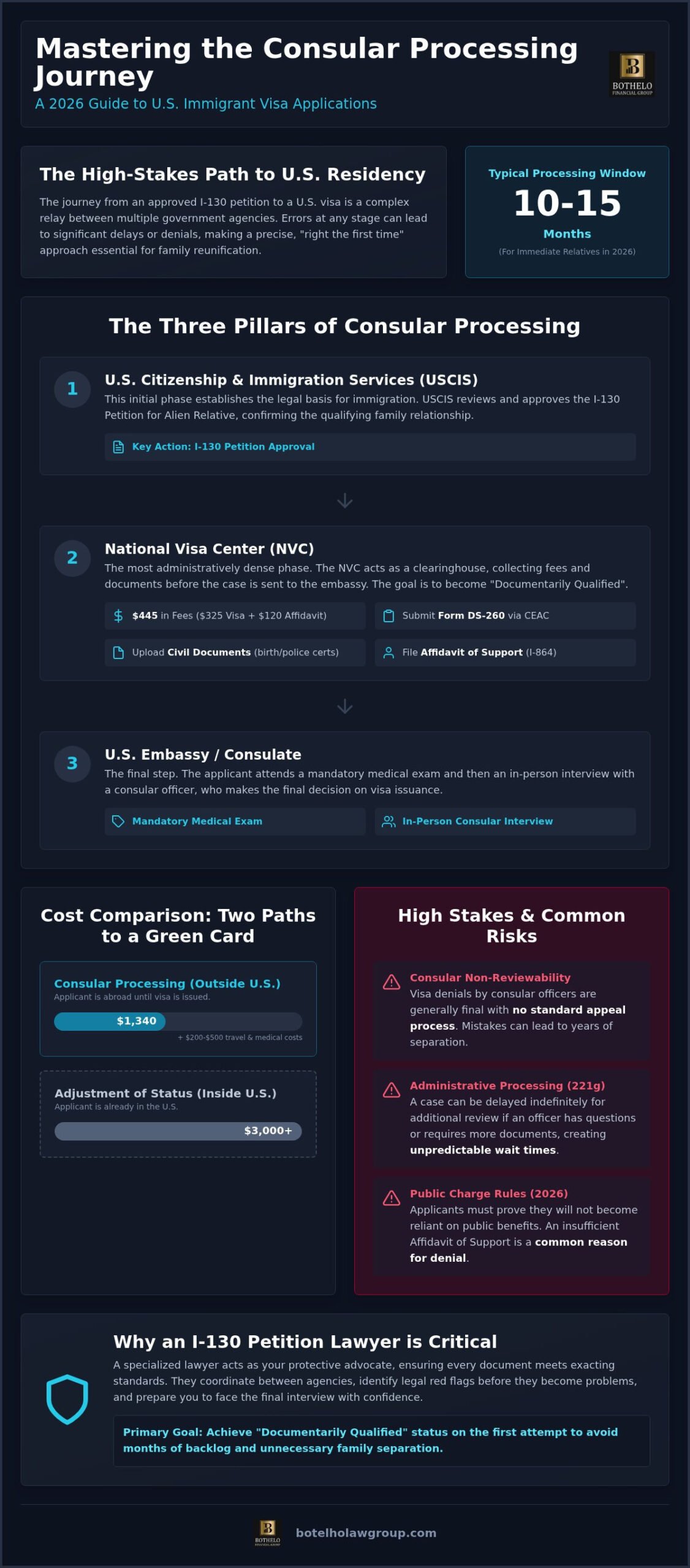
The primary distinction between these pathways is the applicant’s physical location. While Adjustment of Status (AOS) allows individuals already inside the U.S. to change their status without leaving, consular processing requires the applicant to remain abroad until the visa is issued. Financial considerations also differ significantly. In 2026, government fees for a marriage-based green card through consular processing total approximately $1,340, whereas the AOS package can exceed $3,000. However, consular applicants must account for international travel and medical exams that cost between $200 and $500. A seasoned I-130 petition lawyer can analyze your specific circumstances to determine which path offers the most reliable timeline for your family’s reunification. For married couples specifically, it’s also worth understanding how the CR-1 immigrant visa compares to alternatives like the K-3 spouse visa, as current processing data in 2026 reveals a paradoxical shift that surprises many families.
The High Stakes of the Consular Pathway
Errors in the consular process carry severe, often irreversible consequences. Unlike domestic USCIS applications, consular decisions are largely protected by the doctrine of “Consular Non-reviewability.” This means there’s no standard appeal process if an officer denies your visa. If a mistake occurs, the beneficiary remains outside the U.S., often facing years of separation while attempting to rectify the record. Success requires a “right the first time” approach. An I-130 petition lawyer acts as a protective advocate, ensuring every document meets Department of State standards before it ever reaches an officer’s desk. This level of precision is vital when dealing with systems that offer no margin for error.
The Three Pillars of the Consular Process: USCIS, NVC, and the Embassy
The consular journey is a systematic relay race involving three distinct federal entities. It begins with U.S. Citizenship and Immigration Services (USCIS), moves to the National Visa Center (NVC), and concludes at a U.S. Embassy or Consulate. Success requires understanding the specific Consular Processing steps required to move a file from the Department of Homeland Security to the Department of State. An experienced I-130 petition lawyer acts as the central coordinator during this transition, preventing the “file limbo” that occurs when these agencies fail to communicate effectively.
Phase 1 establishes the legal basis for immigration through the initial petition. Once USCIS approves this, they transfer the case to the NVC for the second phase. This is the most administratively dense portion of the process, involving fee payments and document collection. Finally, Phase 3 occurs at the embassy, where a consular officer conducts an in-person interview to make a final decision on visa issuance. Each pillar has its own set of standards; a failure to satisfy one will halt the entire progression.
Navigating the National Visa Center (NVC) and CEAC
The NVC serves as the clearinghouse for all immigrant visa applications. Applicants must use the Consular Electronic Application Center (CEAC) to pay the $325 Immigrant Visa Fee and the $120 Affidavit of Support Review Fee. The most critical component of this stage is the DS-260, a comprehensive biographical form that requires exhaustive detail regarding your history and intent. You must also upload scanned “Civil Documents,” including certified birth certificates and police clearances from every country where the beneficiary has resided for more than six months. Achieving “documentarily qualified” status on the first attempt is essential to avoid the multi-month backlogs currently affecting NVC processing in 2026.
The Affidavit of Support (I-864) Requirement
The petitioner must prove they can financially support the beneficiary by meeting the 2026 HHS Poverty Guidelines. If the petitioner’s income is insufficient, a joint sponsor may be required to bridge the gap and assume legal liability. NVC officers are notoriously strict regarding tax transcripts. Submitting incomplete returns or failing to include all necessary W-2s often triggers an immediate rejection. Precision in these financial disclosures is non-negotiable for a successful outcome. If you are concerned about meeting these strict evidentiary standards, consulting a family-based green card attorney can ensure your financial package is bulletproof before submission.
Common Obstacles and the Risk of Administrative Processing
The transition from a documentarily qualified status at the NVC to a final interview at the embassy is often where the most significant delays occur. Many applicants mistakenly believe that NVC clearance guarantees visa issuance. However, the consular officer has the final authority to refuse a visa under Section 221(g) of the Immigration and Nationality Act. This is technically a visa refusal, though it’s commonly referred to as “administrative processing.” It occurs when an officer determines that essential information is missing or that a case requires further security vetting. A single missing police certificate from a country where the beneficiary resided for only six months can add three to six months to the timeline. Retaining a skilled I-130 petition lawyer ensures that your packet is audited for these minute details before you ever step into the consulate.
In 2026, the Department of State continues to apply rigorous standards regarding the “Public Charge” rule. Officers evaluate the beneficiary’s age, health, family status, and financial assets to determine if they’re likely to become dependent on government assistance. Even if your petitioner meets the income requirements, a consular officer can still issue a 221(g) notice if they feel the financial evidence is insufficient. Identifying these vulnerabilities early allows for the inclusion of a joint sponsor or additional assets, shielding your family from the “black hole” of indefinite processing delays. Spouses navigating these delays should also consult a K-3 spouse visa attorney to evaluate whether an alternative visa strategy could accelerate reunification or whether the underlying petition will finish first.
Security Clearances and Background Checks
Certain cases are flagged for extra scrutiny through the Security Advisory Opinion (SAO) process. This often happens based on the applicant’s nationality, professional background in sensitive technologies, or travel history to specific regions. When a case enters this phase, it moves beyond the embassy’s local control and into the hands of federal agencies in Washington, D.C. While these checks are mandatory, an attorney can monitor the progress and file formal inquiries if the case remains stalled beyond standard processing windows. We act as your protective advocate, ensuring the government doesn’t simply let your file sit on a desk without progress.
Overcoming Prior Denials or Misrepresentations
Transparency is the only viable strategy during a consular interview. Attempting to hide a prior visa refusal or a period of unlawful presence in the U.S. is a high-risk gamble that often leads to a permanent bar for misrepresentation. If an inadmissibility issue exists, such as a criminal record or a prior overstay, you may require an I-601 waiver. This legal remedy asks the government to overlook the ground of inadmissibility due to extreme hardship to a U.S. citizen relative. This is where an I-130 petition lawyer is most critical. We prepare “waiver-ready” cases from the start, gathering the necessary evidence of hardship so that you’re prepared to respond immediately if the officer issues a finding of inadmissibility.
Preparing for the Consular Interview: Evidence and Conduct
The consular interview is the final, high-stakes hurdle in your immigration journey. Before this meeting, you must complete a mandatory medical examination with a Department of State-approved panel physician. These exams typically cost between $200 and $500 depending on the country and required vaccinations. You’ll receive your results in a sealed envelope or through a digital transfer directly to the embassy. If you receive a physical envelope, you must not open it. Breaking the seal invalidates the results and necessitates a costly re-examination. Your I-130 petition lawyer will ensure you coordinate this appointment within the required timeframe to prevent the results from expiring before your interview date.
Success inside the consulate depends heavily on the organization of your interview packet. While you previously uploaded digital copies to the NVC, you must bring the original versions of every civil document to the interview window. This includes certified birth certificates, marriage licenses, and police clearances. To prove a bona fide relationship, you must provide evidence that goes beyond family photographs. Officers prioritize concrete proof of financial commingling, shared insurance policies, and detailed travel logs that document physical time spent together. A meticulously organized packet reflects a prepared applicant and significantly reduces the likelihood of an officer issuing a request for additional evidence.
The Psychology of the Consular Interview
Consular officers operate in a high-pressure environment and often conduct interviews through a reinforced glass window. They’re trained to identify even minor inconsistencies between your verbal testimony and the data provided in your DS-260 and initial filings. Whether you’re a spouse, child, or parent, your answers must be concise and truthful. Speculation is dangerous; if you don’t know an answer, it’s safer to admit it than to guess. An I-130 petition lawyer can conduct mock interviews to help you remain calm and consistent, ensuring your testimony aligns perfectly with your documented legal history.
Post-Interview Outcomes: Issued, Refused, or Pending
At the conclusion of the interview, the officer will typically announce their decision. If your visa is issued, you’ll receive instructions on passport delivery and must pay the $235 USCIS Immigrant Fee before traveling to the United States. If you receive a “Blue Sheet,” your case is refused under Section 221(g) pending further evidence. This is a critical moment that requires an immediate, precise response to avoid the administrative processing delays discussed earlier. Your final step is the Port of Entry inspection, where a Customs and Border Protection officer will admit you as a Lawful Permanent Resident. To ensure you’re fully prepared for this high-stakes encounter, schedule a consultation for expert interview preparation.
Why Professional Representation is Critical for Consular Cases
Government agencies frequently suggest that legal representation is optional during the immigration process. However, this perspective ignores a fundamental reality: neither USCIS nor the National Visa Center will assist you in identifying or correcting errors in your own application. A single mistake in a biographical form or an incomplete tax transcript can result in months of additional separation. Engaging a dedicated I-130 petition lawyer provides a layer of strategic protection that self-represented applicants simply don’t have. We specialize in strategic case mapping, identifying potential red flags such as prior visa refusals or complex financial profiles before they ever reach a consular officer’s desk.
Efficiency at the NVC stage is paramount in 2026. With current backlogs, achieving “Documentarily Qualified” status on your first attempt is the only way to ensure a predictable timeline for your family’s reunification. Professional project management involves auditing every civil document for compliance with Department of State standards. When delays do occur, attorneys have access to specialized communication channels, including formal NVC inquiry systems and Congressional liaisons, to ensure your case receives the attention it deserves. This proactive advocacy provides peace of mind for families separated by thousands of miles, knowing that a seasoned strategist is managing the high-stakes details of their future.
The Botelho Law Group Advantage
Our firm offers experienced representation for families across all 50 states and for beneficiaries residing worldwide. We understand that behind every file is a family waiting to be whole again. Our results-oriented approach prioritizes precision and protective advocacy, ensuring that your case is handled with the gravity it deserves. As a dedicated Family Based Green Card Attorney: Securing Your Future in Fall River, MA, we combine localized, attentive service with the power of a nationwide authority to overcome the most complex consular challenges.
Securing Your American Dream in 2026
The landscape of U.S. immigration is shifting toward a digital-first model that demands technical and legal accuracy. In this evolving environment, the risks associated with “DIY” immigration have never been higher. A misunderstood question on the DS-260 or a poorly prepared interview packet can lead to a permanent bar for misrepresentation. Protecting your family’s interests requires a sophisticated legal partner who understands the nuances of the current system. Don’t leave your reunification to chance. An I-130 petition lawyer from our firm will act as your relentless fighter through every stage of the process. Contact us today to schedule a consultation and review your consular strategy.
Securing Your Family’s Future Through Expert Consular Strategy
Navigating the multi-agency relay of consular processing requires more than just filling out forms; it demands a sophisticated understanding of how the Department of State evaluates evidence in 2026. You’ve learned that achieving “documentarily qualified” status at the NVC is only half the battle. Success at the final embassy interview depends on your ability to present a consistent narrative that withstands rigorous officer scrutiny. With decades of collective experience in federal immigration law, our firm acts as your dedicated advocate, identifying legal red flags before they result in years of unnecessary separation.
Partnering with a specialized I-130 petition lawyer ensures your application meets the strictest standards, shielding you from the administrative processing delays that stall so many cases. We provide nationwide representation with a local, client-focused feel, specializing in the most complex family-based green card petitions. Protect your family’s future—consult with a consular processing attorney at Botelho Law Group today. Your journey toward U.S. residency is a significant undertaking, and with the right legal strategist by your side, you can face the consulate with absolute confidence.
Frequently Asked Questions
How long does the consular processing stage usually take in 2026?
Total processing time for spouses of U.S. citizens averages 14.5 months in 2026. This includes the initial 10 to 15 month window for I-130 adjudication followed by the NVC and embassy stages. Spouses of Lawful Permanent Residents face longer wait times, currently averaging 35 months. These timelines vary based on specific embassy backlogs and the accuracy of your initial document submissions.
Can I stay in the U.S. while my consular processing is pending?
You generally cannot reside in the U.S. while awaiting consular processing because the pathway is designed for individuals living abroad. Attempting to enter on a tourist visa while an immigrant petition is pending often results in denial at the border due to “immigrant intent.” Staying in the U.S. without valid status can lead to permanent bars that complicate your final visa issuance.
What happens if my immigrant visa is denied at the embassy?
A denial at the embassy is often final under the doctrine of consular non-reviewability. If the refusal is based on Section 221(g), you’re in administrative processing and must provide the specific evidence requested. If the denial is based on a ground of inadmissibility like a prior overstay, you might require an I-601 waiver. An I-130 petition lawyer can evaluate if a legal remedy exists to overcome the refusal.
What is the National Visa Center (NVC) and why do I have to deal with them?
The National Visa Center acts as the administrative intermediary between USCIS and the U.S. embassy. They’re responsible for collecting the $325 immigrant visa fee and the $120 affidavit of support fee. You must deal with them because they perform the initial review of your civil and financial documents. They only schedule your interview once they designate your case as “documentarily qualified.”
Do I need a new medical exam if my interview is delayed?
You will need a new medical exam if your results expire before your interview or your entry into the United States. Most medical results are valid for six months. If administrative processing or embassy backlogs push your appointment past this window, you must visit a panel physician again. This second exam will require another payment of the standard $200 to $500 fee.
Can an I-130 petition lawyer help me if I live outside of Massachusetts?
An I-130 petition lawyer from our firm can represent you regardless of your physical location. Immigration law is federal, allowing us to manage cases for clients in all 50 states and beneficiaries residing in any country worldwide. We handle the entire process digitally and through federal portals, providing authoritative guidance from our Fall River office to families across the globe.
What is the difference between an immigrant visa and a green card?
An immigrant visa is the document placed in your passport that allows you to travel to a U.S. port of entry. A green card is the physical proof of your Lawful Permanent Resident status which is issued after you enter the country. You must pay a $235 USCIS Immigrant Fee after your visa is issued to trigger the production and mailing of your actual green card.
What documents are required for the “Documentarily Qualified” stage at NVC?
You must submit several key documents to reach the “documentarily qualified” stage. These include the DS-260 biographical form, the I-864 Affidavit of Support with tax transcripts, and certified civil documents like birth and marriage certificates. You also need police clearances from every country where you lived for six months or more since age 16. Missing any of these items will trigger a rejection.