
The transition from a student visa to permanent residency is not merely a paperwork exercise; it is a high-stakes legal maneuver where a single timing error can jeopardize your future in the United States. While your F-1 status provides a temporary foundation, the path to a Green Card requires a sophisticated strategy to manage dual intent and strict USCIS deadlines. Engaging an experienced F-1 to green card lawyer ensures that your transition is handled with the precision necessary to avoid the pitfalls of the 90-day rule or OPT expiration.
We understand the anxiety that comes with watching your work authorization clock wind down while you weigh the merits of marriage-based versus employment-based petitions. You’ve worked too hard on your education to let a technicality force you to leave the country. This 2026 guide outlines the exact legal pathways available to you, providing a structured timeline for filing your I-485 Adjustment of Status. You’ll learn how to identify the fastest route to residency, whether through EB-2, EB-3, or family sponsorship, and how dedicated legal representation secures your standing against the complexities of the immigration system.
Key Takeaways
- Understand the legal friction between non-immigrant F-1 status and immigrant intent to ensure your transition remains compliant.
- Evaluate the fastest residency pathways, including marriage-based petitions and EB-2 or EB-3 employment categories.
- Learn the “Bridge” strategy to maintain your underlying student status throughout the I-485 Adjustment of Status process.
- Secure your timeline by consulting an F-1 to green card lawyer at least 12 months before your current OPT authorization expires.
- Discover how protective legal advocacy can prevent status jeopardization during complex USCIS reviews.
Understanding the F-1 to Green Card Transition
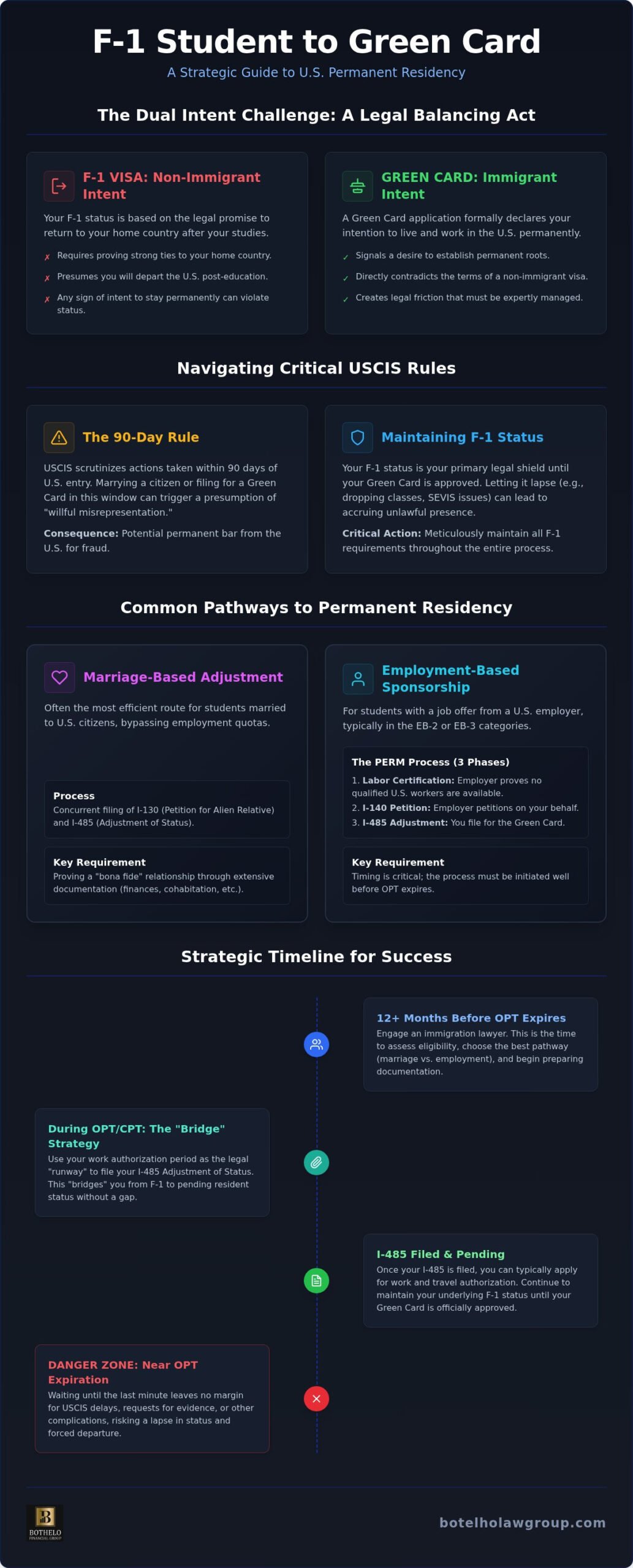
The F-1 visa is strictly classified as a non-immigrant status. When you applied for your visa at a U.S. consulate, you explicitly demonstrated “non-immigrant intent,” meaning you provided evidence of strong ties to your home country and a clear plan to return after your studies. Transitioning to a Green Card fundamentally shifts this dynamic because a residency application signals “immigrant intent.” This shift creates significant legal friction. If you express a desire to stay permanently while holding a visa that requires you to leave, you risk violating the terms of your stay. Managing this transition requires the precision of an F-1 to green card lawyer who understands how to reconcile these opposing legal standards.
Strategic timing is the most critical factor in a successful transition. The window of opportunity is often narrowest during Optional Practical Training (OPT) or Curricular Practical Training (CPT). These periods of work authorization provide the legal runway needed to file for residency without a gap in your ability to live and work in the U.S. Waiting until your status is near expiration leaves no room for administrative delays or requests for evidence. A seasoned I-485 adjustment of status lawyer acts as a protective advocate, ensuring your petition is filed while your underlying F-1 status remains robust and defensible.
The Non-Immigrant Intent Hurdle
Section 214(b) of the Immigration and Nationality Act serves as the baseline for most non-immigrant visas. It creates a legal presumption that every foreign national is an intending immigrant until they prove otherwise. If you have a pending Green Card petition, traveling outside the U.S. becomes a high-stakes risk. Customs and Border Protection (CBP) officers can see your pending filings in their system. If they determine you no longer intend to be a temporary student, they may deny you entry. It’s also vital to maintain your SEVIS records meticulously. Even if you’ve filed for residency, your F-1 status remains your primary legal shield until the Green Card is approved. An F-1 to green card lawyer will emphasize that letting your student status lapse before your adjustment of status is fully processed can lead to immediate accrual of unlawful presence.
The 90-Day Rule Explained
USCIS maintains a strict watch over the timing of status changes to prevent fraud. If a student enters the U.S. and files for a Green Card or marries a citizen shortly after arrival, the government may trigger a presumption of “willful misrepresentation.” They may argue that you lied about your intentions when you crossed the border. The 90-day rule is a USCIS policy used to scrutinize the timing of status changes. Filing within this 90-day window can lead to a permanent bar from the U.S. based on fraud. To protect your future, you must demonstrate that your intent to seek residency developed after your entry, a task that requires documented evidence and a clear narrative of your circumstances.
Common Pathways: How F-1 Students Obtain Residency
Transitioning from a student visa to permanent residency doesn’t always require a detour through the H-1B lottery. Many students are eligible for direct pathways that offer a more stable transition. Identifying the correct category early is where an F-1 to green card lawyer provides the most value; each path carries distinct evidentiary requirements and processing times. Whether your eligibility is based on a personal relationship or your professional credentials, the goal remains the same: securing residency without a gap in your legal status. To understand how specialized legal support can facilitate these transitions, learn more about Law Offices of Peg Yang, P.C. and their approach to U.S. immigration law.
For students whose professional credentials or business interests involve cross-border operations between the U.S. and Italy, Tosolini, Toniutti & Partners offers the specialized legal support necessary to manage these complex international requirements.
Marriage-Based Adjustment of Status
For students married to U.S. citizens, this is often the most efficient route. Concurrent filing of the I-130 petition and I-485 allows you to remain in the country while your application is pending. The burden of proof lies in demonstrating a “bona fide” relationship through shared financial assets, cohabitation, and personal history. Experienced family based green card attorneys prepare clients for the intensive USCIS interview, ensuring all documentation meets federal standards to avoid denials based on suspicion of fraud. With USCIS reinstating mandatory in-person interviews for every marriage-based applicant in 2026, thorough green card interview preparation for spouse has become an essential component of any successful marriage-based petition. This path bypasses the lengthy wait times associated with employment quotas, making it a primary choice for eligible students.
Employment-Based Sponsorship (PERM)
The PERM process is the standard for employer sponsorship in the EB-2 and EB-3 categories. It involves three phases: Labor Certification, the I-140 petition, and the final I-485 adjustment. Timing is critical. If your OPT is set to expire, you must initiate this process early to avoid being forced out of the country. It’s a common misconception that you must obtain an H-1B before a Green Card. You can move directly to residency if your priority date is current and your employer is willing to sponsor the full process from the start. If you’re currently working on OPT, securing a legal advocate to review your employer’s sponsorship capacity is a vital first step.
High-achieving students with advanced degrees or exceptional ability may qualify for the National Interest Waiver (NIW) under the EB-2 category. This allows you to bypass the PERM labor certification process entirely. It’s an underutilized tool that rewards those whose work significantly benefits the U.S. economy, healthcare, or education. An F-1 to green card lawyer can help you determine if your research or professional background meets the “national interest” threshold. Finally, students from countries with low immigration rates may also enter the Diversity Visa Lottery. While this is a low-cost alternative, it should only serve as a secondary strategy due to its unpredictable nature and high-luck requirement.
The I-485 Process: Strategic Adjustment of Status
Filing the Form I-485 is the definitive step in converting your status from a student to a permanent resident. It’s a high-stakes moment. For F-1 students, this stage is fraught with the “dual intent” trap. Unlike H-1B or L-1 visas, the F-1 does not explicitly allow for immigrant intent. Filing the I-485 must be timed with surgical precision to avoid accusations of visa fraud at the point of entry. An F-1 to green card lawyer ensures that your adjustment of status application is supported by a clear record of compliance and a timeline that satisfies USCIS scrutiny.
The “Bridge” strategy is a vital defensive maneuver during this transition. It requires you to maintain your full-time enrollment and SEVIS record even after filing your residency papers. It’s a safety net. If your Green Card application faces a technical denial or an administrative delay, an active F-1 status prevents you from being immediately deportable. This provides a critical layer of security during the months of USCIS processing. Without this bridge, a denial could lead to an immediate accrual of unlawful presence.
While your application is pending, you’ll likely receive an Employment Authorization Document (EAD) and Advance Parole (AP). These offer significant freedom. You can work for any U.S. employer and travel abroad. However, there’s a legal catch. Using these documents often terminates your underlying F-1 status. You must weigh the immediate benefits of employment flexibility against the loss of your non-immigrant backup. A legal strategist can help you decide when it’s safe to transition away from your student status.
Maintaining Lawful Status Throughout
Class attendance is not optional during the wait. Don’t let your SEVIS record lapse just because you have a pending I-485. If you stop attending school and your residency application fails, you lose your legal footing entirely. You’ll have no basis to stay in the country. An F-1 to green card lawyer will generally advise staying in school until you hold the physical card in your hand. This disciplined approach eliminates the risk of “falling out of status,” which remains one of the most frequent causes of I-485 denials in student-to-resident cases.
Medical Exams and Background Checks
The I-693 medical exam is a mandatory requirement for all adjustment of status applicants. In 2026, USCIS maintains specific validity periods for these reports, and they must be signed by a government-designated civil surgeon. You’ll also be scheduled for a biometric appointment for fingerprints and federal background checks. A full service law firm in Fall River MA manages these complex logistics. They ensure your medical records are current and that you’re prepared for the scrutiny of a federal background investigation, protecting your path to residency from administrative errors.
Avoiding Mistakes: A Timeline for Success
Success in federal immigration matters is rarely the result of luck. It’s the product of meticulous scheduling and proactive legal management. Reacting to an expiring OPT card is a recipe for failure; instead, you must treat your residency transition as a multi-year project. Engaging an F-1 to green card lawyer early allows you to map out every deadline and evidentiary requirement well before they become emergencies. A disciplined approach ensures that your transition from student to resident remains seamless and legally sound.
- Step 1: Consult with legal counsel at least 12 months before your OPT or STEM OPT expires to allow time for PERM processing or marriage documentation.
- Step 2: Determine the most viable pathway based on your professional credentials, advanced degrees, or family relationships.
- Step 3: Systematically collect evidence of your status maintenance, including every I-20 issued, all academic transcripts, and copies of previous EAD cards.
- Step 4: File the appropriate petitions while strictly managing travel to avoid violating dual intent restrictions.
- Step 5: Prepare for the rigorous USCIS interview with a legal strategist who can anticipate and address potential points of scrutiny.
The Danger of Unauthorized Employment
USCIS has increased its scrutiny of digital footprints, making “side hustles” a significant liability for F-1 students. Engaging in unauthorized work, even through platforms like Etsy, Uber, or freelance consulting, can permanently disqualify you from adjusting your status. These violations often surface during the I-485 review when bank statements or tax records are analyzed. Even 24 hours of unauthorized work can lead to an I-485 denial. To protect your future, you must ensure every hour of labor is strictly covered by CPT, OPT, or a valid EAD. If you suspect a past violation, you should secure professional representation to discuss disclosure strategies before filing your petition.
Travel Restrictions While Pending
Filing for residency fundamentally changes your ability to move across borders. You should never leave the U.S. without a physical Advance Parole document in your possession. If you depart while your I-485 is pending without this authorization, USCIS will consider your application abandoned. This remains true even if your F-1 visa stamp is still valid. For students with family emergencies abroad, the risks are even higher. If your visa stamp expires while your Green Card is pending, you cannot renew it at a consulate because you have now demonstrated immigrant intent. For families navigating this situation from outside the United States, working with a dedicated I-130 petition lawyer experienced in consular processing can help manage the complex multi-agency coordination involved. Strategic planning with an F-1 to green card lawyer ensures you have the necessary travel documents to handle life’s unpredictability without sacrificing your residency goals.
Why Botelho Law Group is the Right Choice for F-1 Students
Selecting an F-1 to green card lawyer is a decision that directly impacts your professional trajectory and your legal right to remain in the United States. Botelho Law Group offers a sophisticated combination of expertise in both family-based petitions and employment-based visas. This dual-track proficiency is rare and provides our clients with a significant advantage. If one pathway becomes less viable due to shifting federal policies or changes in your employment status, we possess the depth of knowledge to pivot your strategy without compromising your residency goals.
Our firm prioritizes status protection above all else. Every filing we submit is treated as a high-stakes legal maneuver that requires precision and foresight. We don’t simply process paperwork; we act as dedicated legal strategists who anticipate USCIS scrutiny. Our results-oriented approach ensures that your transition from a student visa is handled with the gravity it deserves. You’ll work directly with seasoned attorneys who maintain a focused, disciplined delivery of information, ensuring you feel fully informed at every stage of the process.
Our physical presence in Fall River, MA, places us in the center of the university corridors connecting major student hubs like Boston and Providence. While we are a localized and accessible partner for students in Massachusetts and Rhode Island, we provide nationwide representation for clients in all 50 states. This allows us to handle complex I-485 adjustments regardless of where your university or employer is located. We maintain a high formality register and avoid the casual approach of larger, volume-based firms, ensuring your case receives individual, expert attention.
Protective Advocacy in Immigration Court
What sets our firm apart is our extensive experience in removal defense and litigation. This background provides an extra layer of security for our student clients. If your status is ever challenged or if you face complex removal proceedings, you’re represented by a firm that knows how to fight in immigration court. We understand the high stakes for international students and their families. This persona of a “focused advocate” means we don’t just hope for the best; we prepare for the most challenging legal scenarios to ensure your American Dream remains intact.
Schedule Your Consultation Today
Proactive planning is the only way to secure your future in the U.S. Waiting until your work authorization is near expiration limits your options and increases the risk of status violations. Take the first step by securing a professional evaluation of your current standing and potential residency pathways. Our Fall River office is ready to conduct a strategic review of your F-1 status and provide a clear, methodical roadmap for your Green Card application. Protect your future in the U.S. with Botelho Law Group and gain the sophisticated legal representation your case requires.
Securing Your Future in the United States
Transitioning from student status to permanent residency is a high-stakes legal maneuver that demands strategic foresight. You must navigate the friction between non-immigrant intent and the desire for residency while strictly adhering to USCIS timelines. By implementing a bridge strategy and avoiding the pitfalls of unauthorized work, you protect both your legal standing and your professional future. A successful transition isn’t just about filling out forms; it’s about managing a complex legal process with precision.
Partnering with a dedicated F-1 to green card lawyer ensures that your I-485 filing is managed with the expertise required to withstand federal scrutiny. Botelho Law Group provides nationwide immigration representation for clients in all 50 states, leveraging deep knowledge in complex adjustment of status petitions. Based in Fall River, MA, we are strategically positioned to serve students and professionals throughout the Boston and Providence university corridors. Secure Your Permanent Residency: Consult with Botelho Law Group to receive a professional evaluation of your case. You’ve worked hard to build your life here; let us provide the protective advocacy needed to make it permanent.
Frequently Asked Questions
Can I apply for a Green Card while on an F-1 visa?
Yes, you can apply for a Green Card while holding F-1 status, but you must navigate the legal conflict between your current non-immigrant status and your new immigrant intent. Filing for residency signals a permanent desire to stay in the U.S., which can complicate your ability to renew your student visa or re-enter the country after travel. Most students use a strategic adjustment of status process to bridge the gap between these two legal categories without leaving the country.
How long does the F-1 to Green Card process take in 2026?
Processing times in 2026 depend heavily on the specific pathway you choose and current USCIS backlogs. Marriage-based petitions for immediate relatives of U.S. citizens generally move faster than employment-based categories. Employment paths are often subject to the PERM labor certification process and priority dates listed in the Department of State Visa Bulletin. You should prepare for a process that typically spans several months to over a year depending on your eligibility category.
Do I need an employer to sponsor my Green Card if I am a student?
Employer sponsorship is not the only option for international students seeking residency. While many transition through EB-2 or EB-3 employment categories, others secure residency through marriage to a U.S. citizen or permanent resident. Additionally, high-achieving students in STEM or other critical fields may qualify for a National Interest Waiver (NIW), which allows them to sponsor themselves without a specific job offer or labor certification. Consulting an F-1 to green card lawyer can help you identify which path fits your credentials.
What happens to my F-1 status if my Green Card application is denied?
If your residency application is denied, your legal standing depends on whether you meticulously maintained your F-1 status throughout the pending period. If you continued attending classes and followed all SEVIS requirements, you generally fall back on your original student status. However, if you stopped attending school or your F-1 status expired while the application was pending, a denial could lead to immediate accrual of unlawful presence and potential removal proceedings.
Can I travel outside the U.S. while my Adjustment of Status is pending?
You must not travel outside the United States without an approved Advance Parole document in your physical possession. If you depart the country while your I-485 application is pending without this authorization, USCIS will consider your application abandoned. Even with Advance Parole, re-entry is at the discretion of Customs and Border Protection officers. It is often safer to remain in the U.S. until your residency is fully approved to avoid any risk of being barred from re-entry.
Is it faster to get a Green Card through marriage or employment for a student?
Marriage to a U.S. citizen is almost always the fastest route because visas for immediate relatives are not subject to annual numerical caps. Employment-based pathways involve more administrative hurdles, such as the PERM process, and are subject to priority dates that can cause years of waiting for certain nationalities. However, the best path for you depends on your personal circumstances and long-term career goals. A legal advocate can provide a comparative timeline based on your specific situation.
What is the “90-day rule” for F-1 students?
The 90-day rule is a USCIS policy used to evaluate whether a non-immigrant misrepresented their intent when entering the country. If a student files for a Green Card within 90 days of their last entry, the government may presume they lied about their temporary intent at the border. This presumption can lead to a permanent bar from the U.S. for fraud. You must demonstrate that your intent to seek residency developed after you were already in the country for a significant period.
How much does an immigration lawyer cost for an F-1 to Green Card transition?
Legal fees for residency applications vary based on the complexity of your case and whether you are pursuing a family-based or employment-based petition. Each pathway requires different levels of documentation, labor certification, or evidence of a bona fide relationship. You should consult with an F-1 to green card lawyer to obtain a specific breakdown of legal costs and USCIS filing fees. Investing in professional representation ensures that your high-stakes transition is handled with the precision necessary to avoid costly errors.