
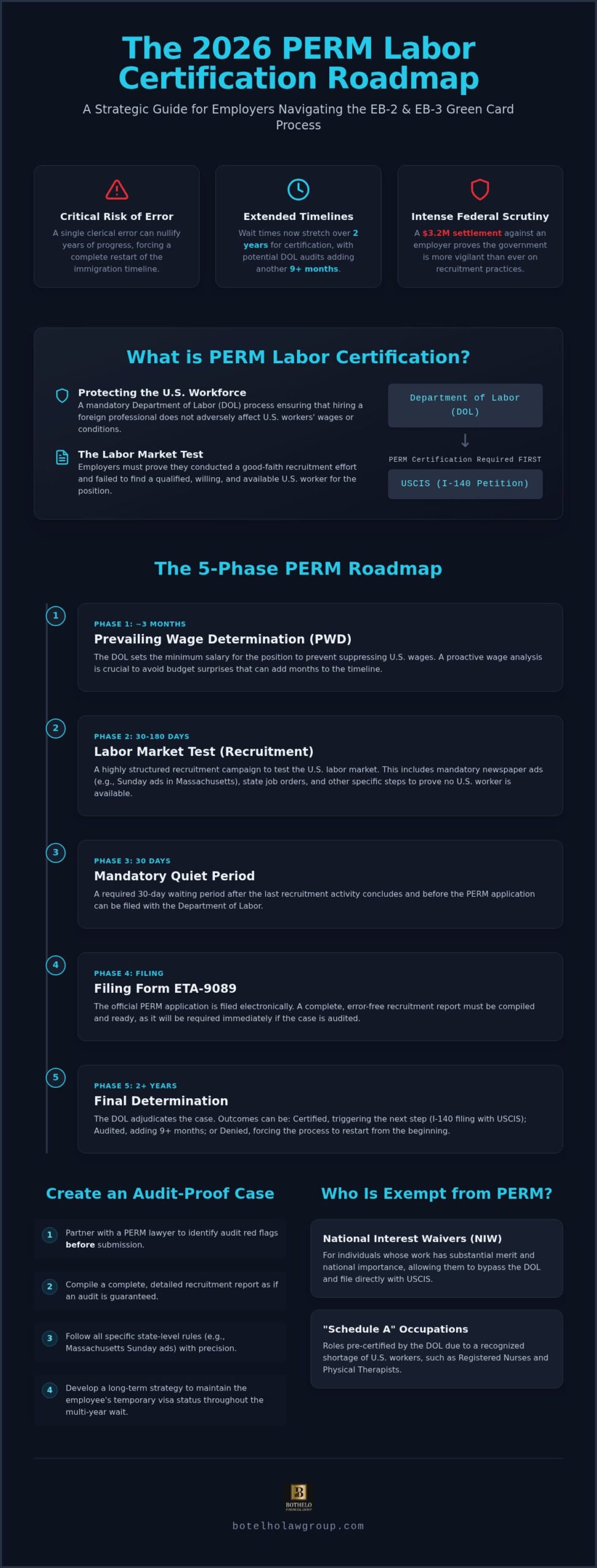
Wait times for a PERM certification now stretch beyond two years, yet a single clerical error in your recruitment report can nullify that entire window of progress. In August 2026, the Department of Justice secured a $3.2 million settlement against an employer for flawed recruitment practices, proving that the federal government is more vigilant than ever. If you’re an employer or a foreign professional, the stakes are too high to treat this as a standard administrative filing. Partnering with a dedicated PERM labor certification lawyer is no longer just a luxury; it’s a strategic necessity to protect your business interests and your employees’ futures.
You likely feel the pressure of these mounting timelines and the constant threat of a Department of Labor audit that could add another nine months to your wait. We understand that the complexity of modern recruitment, especially with the rise of AI-generated job applications, makes it difficult to conduct a good-faith test of the U.S. labor market. This guide provides a comprehensive roadmap to master the 2026 PERM landscape. You’ll learn how to structure an audit-proof recruitment strategy, manage the 2.5-year timeline alongside current visa maintenance, and successfully transition from a temporary visa to a permanent Green Card.
Key Takeaways
- Understand the Department of Labor’s protective role in the labor market test required for EB-2 and EB-3 visa categories.
- Follow a structured five-phase roadmap that begins with a precise Prevailing Wage Determination to ensure regulatory compliance.
- Learn the specific recruitment rules for Massachusetts, including mandatory Sunday advertisements and state-level job orders.
- Partner with a PERM labor certification lawyer to identify audit red flags and compile a complete recruitment report before submission.
- Establish a long-term strategy to navigate the multi-year processing timeline while maintaining valid temporary work authorization.
What is PERM Labor Certification and Why is it Required for EB-2 and EB-3 Visas?
The PERM Labor Certification, or Program Electronic Management Review, is a rigorous Department of Labor (DOL) process designed to safeguard the domestic workforce. Its primary purpose is to ensure that hiring a foreign professional won’t adversely affect the wages or working conditions of similarly employed U.S. workers. For most employers sponsoring individuals for EB-2 and EB-3 immigrant visas, this certification is the mandatory first step. It functions as a formal “test of the labor market,” requiring the employer to prove they conducted a good-faith recruitment effort but failed to find a U.S. applicant who is able, willing, qualified, and available for the role.
The stakes of this process are exceptionally high. Because current processing times for labor certifications can exceed two years, a single administrative error can reset an employee’s entire immigration timeline. This often leads to significant anxiety for both the company and the foreign national, especially if their temporary work authorization is nearing its six-year limit. Engaging an experienced PERM labor certification lawyer is essential to ensure every regulatory requirement is met with precision, protecting the continuity of your business operations and the legal status of your key talent.
The Role of the Department of Labor (DOL) vs. USCIS
Navigating the path to a Green Card involves multiple federal agencies with distinct jurisdictions. The DOL handles the PERM stage, while U.S. Citizenship and Immigration Services (USCIS) adjudicates the subsequent I-140 Immigrant Petition. This sequence is absolute; a certification from the DOL must be granted before an employer is permitted to file with USCIS. A Labor Certification is essentially a verified government claim that no qualified U.S. workers were found for the specific position, serving as the legal foundation for the entire permanent residency application.
Who is Exempt from PERM?
While the majority of employment-based petitions require a labor market test, certain categories offer a direct path to USCIS. National Interest Waivers (NIW) allow individuals to bypass the DOL if their work has substantial merit and national importance. Similarly, “Schedule A” occupations, such as registered nurses and physical therapists, are pre-certified because the DOL has already determined a shortage of U.S. workers in those fields. However, most professional roles don’t meet these narrow criteria. For those who don’t qualify for an exemption, consulting an employment based visa attorney can help identify the most viable strategy for securing long-term work authorization.
The 5-Phase PERM Roadmap: A Step-by-Step Guide for Employers
Success in the Department of Labor (DOL) PERM process is built on a foundation of methodical preparation. It isn’t a single event but a multi-stage progression that requires strict adherence to federal timelines. Engaging a PERM labor certification lawyer ensures that these phases are executed with surgical precision, protecting the employer from the catastrophic delays of a government audit. The journey follows a logical five-phase structure: defining the role and wage, testing the labor market, observing a mandatory quiet period, filing the formal application, and receiving the final determination.
Phase 1: Securing the Prevailing Wage
Before recruitment begins, the DOL must set the minimum salary for the position. This Prevailing Wage Determination (PWD) prevents the hiring of foreign workers from suppressing the wages of U.S. employees. As of June 30, 2026, the National Prevailing Wage Center is processing requests filed in April 2026, indicating a processing window of approximately three months. If a determination returns a wage higher than the employer’s budget, you have limited options. You may appeal the determination with a private wage survey or adjust the job requirements; however, changing the job duties often requires a new PWD request, which adds months to the timeline. A proactive PERM labor certification lawyer can help analyze wage data before filing to avoid these budgetary surprises.
Following the wage determination, Phase 2 involves the mandatory recruitment period. This is the “labor market test” where the employer places specific advertisements, including two Sunday newspaper ads and a 30-day job order with the State Workforce Agency. Phase 3 is the “Quiet Period,” a 30-day window after all recruitment ends. This period allows late applicants to submit resumes and gives the employer time to interview and evaluate every candidate based on lawful, job-related criteria.
Phase 4 & 5: Filing and Waiting for Certification
Once the quiet period concludes and the recruitment report is finalized, the employer files ETA Form 9089 through the DOL portal. This electronic filing must be perfect. Any inconsistency between the recruitment ads and the form can lead to an immediate denial. As of August 7, 2026, the DOL is processing applications filed in September 2025, with an average processing time of approximately 372 days for clean cases. When the “Certified” stamp finally arrives, the employer enters Phase 5, which is the transition to the I-140 Immigrant Petition with USCIS. You must file this petition within 180 days of the PERM certification date or the certification will expire. To ensure your timeline remains on track, consider a consultation with the Botelho Law Group to review your specific filing requirements.
Executing the Labor Market Test: Recruitment Rules in Massachusetts
Every employer must understand that while federal law governs the legal definition of PERM, the actual execution of recruitment happens at the local level. In Massachusetts, the Department of Labor (DOL) mandates a strict “test of the labor market” to ensure no qualified U.S. workers are displaced. This phase is the most frequent point of failure in the entire process. The oversight of a PERM labor certification lawyer is vital to ensure that every advertisement and job posting aligns perfectly with the original job description, preventing costly discrepancies that trigger audits.
Recruitment in the Fall River and Boston Metro Areas
For positions based in Massachusetts, employers must place two advertisements in the Sunday edition of a newspaper of general circulation. In the Fall River area, this typically requires placement in The Herald News, while Boston-based roles often necessitate the Boston Globe. These ads must appear at least 30 days but no more than 180 days before filing your application. Simultaneously, you must file a 30-day job order with the Massachusetts State Workforce Agency (SWA). Precise documentation is critical; you must retain proof of the exact start and end dates of the SWA posting to satisfy DOL scrutiny.
Beyond newspaper ads and the SWA order, an Internal Notice of Filing (NOF) must be posted at the physical worksite for ten consecutive business days. For professional positions, the DOL requires three additional recruitment steps from a list of ten options. Common choices include:
Evaluating U.S. Worker Resumes
When resumes arrive, the employer must evaluate every applicant based on “lawful, job-related reasons” for rejection. You cannot dismiss a candidate for subjective traits like “poor cultural fit” or “lack of enthusiasm” if they possess the minimum education and experience requirements listed in your filing. It’s a strict regulatory requirement that the employer, not the attorney, conducts the actual interviews and evaluations. The role of your PERM labor certification lawyer is to provide the legal framework and ensure the recruitment report is prepared correctly, but the hiring decision must remain a business function. Rejecting a U.S. applicant who is able, willing, and qualified will lead to an immediate denial of the certification and could expose the firm to Department of Justice scrutiny regarding discriminatory hiring practices.
How to Bulletproof Your PERM Case Against DOL Audits
An audit from the Department of Labor (DOL) is not a random inquiry; it’s a high-stakes investigation that can derail an immigration strategy for years. As of August 2026, the DOL is reviewing audit responses for cases filed in December 2025, which means an audit adds at least nine months to an already exhausting process. Success depends on identifying red flags before they appear on the government’s radar. Common triggers include family relationships between the employer and beneficiary, foreign language requirements that aren’t strictly necessary for the role, or job duties that exceed standard industry benchmarks. If your case involves these elements, you must have an ironclad justification prepared before you click the submit button.
The oversight of a seasoned PERM labor certification lawyer is your best defense against these scrutiny-heavy reviews. When a Request for Information (RFI) arrives, your response must be prompt, precise, and backed by documentary evidence. A failure to provide a comprehensive response doesn’t just lead to a denial; it can trigger Supervised Recruitment. This is a severe administrative penalty where the DOL oversees every step of an employer’s future recruitment efforts, effectively stripping the company of its hiring autonomy and adding massive overhead to every filing.
Common Pitfalls: Requirements vs. Preferences
Job descriptions must be drafted according to the “Business Necessity” standard. If you require a skill that isn’t typical for the occupation, the DOL will assume you’re tailoring the role to exclude qualified U.S. workers. This “tailoring” is a primary cause for audits. Your minimum requirements must represent the bare essentials needed to perform the job, not a wish list designed to match the foreign national’s specific resume. If your requirements appear to exclude U.S. workers artificially, the DOL will likely issue a challenge that is difficult to overcome without sophisticated legal strategy.
Maintaining the Audit File for Five Years
The most critical shield in your possession is the Audit File. This dossier must be finalized before the ETA Form 9089 is submitted. It’s a dangerous regulatory trap to wait for an audit notice before gathering your evidence. Federal law requires you to retain these records for five years from the date of filing. A complete file must include:
- Original newspaper tear sheets and SWA job order confirmations.
- Every resume received during the recruitment period.
- Detailed recruitment reports and rejection letters citing lawful, job-related reasons.
- Signed copies of the prevailing wage determination and the Internal Notice of Filing (NOF).
A sophisticated PERM labor certification lawyer manages these records with obsessive detail, ensuring your firm is always prepared for a surprise inspection. If you’re concerned that your current recruitment records won’t stand up to a federal audit, contact our firm today to secure your filing and protect your employees’ future.
Strategic Representation: Why Employers Choose Botelho Law Group
Botelho Law Group serves as a sophisticated partner for companies managing the high-stakes requirements of employment-based immigration. While we maintain deep roots in Fall River, Massachusetts, our team represents employers across all 50 states. This dual perspective allows us to apply localized recruitment standards while navigating the federal complexities of the Department of Labor. Choosing the right PERM labor certification lawyer is a decision that impacts your company’s ability to retain top international talent in a competitive market. We act as a “focused advocate,” combining legal precision with a relentless commitment to protecting our clients from the severe consequences of DOL scrutiny. Our firm handles the entire lifecycle of the case, from the initial prevailing wage request to the final audit-ready recruitment report.
Our firm doesn’t view the PERM process in isolation. We understand that a labor certification filing is just one component of a broader corporate immigration strategy. We meticulously coordinate every filing with your employee’s current non-immigrant status to ensure there are no gaps in work authorization. This proactive approach is essential in 2026, where the total timeline from recruitment to Green Card can exceed 30 months. We provide clear, declarative guidance that helps HR departments and business owners feel informed and composed, even when facing the gravity of federal investigations or historically long wait times.
Coordinating PERM with Non-Immigrant Visas
Timing is the most critical factor when transitioning from a temporary visa to permanent residency. For employees on an H-1B visa, we generally recommend starting the PERM process by the beginning of their fourth year. This provides enough buffer to navigate the 2.5-year processing window and secure a Priority Date, which is necessary for extending H-1B status beyond the six-year limit. We apply this same level of temporal discipline to our L-1 clients, who face strict five or seven-year caps. Additionally, we specialize in managing the complex transition from E-2 Investor Visas to immigrant status. This transition requires careful planning to ensure your business investment remains secure while you seek permanent residency. Our goal is to provide a seamless bridge between your current work authorization and your future as a permanent resident.
Next Steps: Starting Your PERM Journey in 2026
The path to a successful certification begins with a detailed evaluation of your job descriptions and minimum requirements. During an initial strategy session, we’ll analyze your specific roles to identify potential audit triggers before any government filings occur. This top-down approach ensures that your recruitment efforts are systematic and defensible from day one. Our firm offers transparent fee structures, including flat-fee and hourly options tailored to the needs of corporate clients. We believe in providing clear, high-stakes communication that positions your firm for success. Don’t let administrative delays or regulatory changes jeopardize your workforce. Schedule a consultation with Botelho Law Group today to partner with a PERM labor certification lawyer who prioritizes your results and your peace of mind.
Securing Your Workforce Through Strategic Compliance
Navigating the PERM labor certification process in 2026 demands more than administrative accuracy; it requires a long-term legal strategy that accounts for historic wait times and increased federal scrutiny. Success depends on mastering the five-phase roadmap and strictly adhering to localized recruitment standards. Audit-proofing your case from day one is the only reliable method to protect your business and your employees from the nine-month delays associated with Department of Labor investigations. Don’t leave your talent’s future to chance when the stakes involve years of legal status and professional continuity.
Choosing an experienced PERM labor certification lawyer ensures your recruitment efforts are defensible and your filing is precise. Botelho Law Group provides nationwide immigration representation from our sophisticated legal hub in Fall River, MA, offering focused advocacy for employment-based Green Cards. We’re ready to guide you through every complexity with professional confidence and legal precision. Secure your company’s future—contact Botelho Law Group for expert PERM representation today. With the right legal partner, you can turn a complex multi-year journey into a systematic path toward growth and stability.
Frequently Asked Questions
How much does a PERM labor certification cost in 2026?
The Department of Labor doesn’t charge a filing fee for the PERM application itself. However, the employer’s responsible for all costs associated with mandatory recruitment, such as newspaper advertisements and state workforce agency postings. While a bipartisan bill’s proposed a $1,200 premium processing fee, it hasn’t become law as of August 2026. Employers should also account for professional fees when hiring a PERM labor certification lawyer to manage the filing and ensure full compliance.
Can an employee pay for the PERM labor certification process?
No, the employer must pay all costs associated with the PERM process, including legal fees and recruitment expenses. Federal regulations strictly prohibit the foreign national from paying for any part of the labor certification. This rule ensures that the recruitment process remains a legitimate test of the U.S. labor market. Any violation of this requirement can lead to the denial of the application and potential legal penalties for the sponsoring company. It protects the integrity of the system.
How long is a PERM labor certification valid after it is approved?
A certified PERM’s valid for exactly 180 days from the date of issuance. During this six-month window, the employer must file the Form I-140, Immigrant Petition for Alien Worker, with USCIS. If the employer fails to file the petition within this timeframe, the labor certification expires and becomes invalid. This necessitates restarting the entire process, including the prevailing wage determination and recruitment phases, which can add years to the immigration timeline. Prompt action is mandatory.
What happens if my PERM labor certification is denied?
If the DOL denies the application, the employer’s entitled to file a request for reconsideration or an appeal. As of August 2026, the DOL’s processing reconsideration requests from March 2026. Alternatively, the employer can choose to restart the process by filing a new application. A PERM labor certification lawyer can evaluate the denial notice to determine if a legal error occurred or if refiling’s the more efficient path to secure the employee’s status.
Can I change employers while my PERM application is pending?
Changing employers while a PERM application’s pending generally requires the new employer to start a completely new labor certification process. The PERM application’s specific to the employer, the job location, and the specific duties offered. If you leave your current sponsor before the I-140’s approved and the I-485’s been pending for 180 days, you lose the progress made on that specific application. This’s why timing your career moves’s critical for your long-term immigration status.
Does a PERM audit mean my case will be denied?
An audit’s a request for additional evidence, not an automatic denial. It means the DOL wants to verify that your recruitment was conducted according to regulatory standards. While an audit adds approximately nine months to the processing time, many cases are successfully certified after a thorough response. Your audit file must contain every resume and rejection letter to prove that no qualified U.S. workers were available. Meticulous preparation prevents these inquiries from becoming permanent denials.
What is the “Priority Date” and why does the PERM filing date matter?
Your Priority Date’s the date the DOL receives your PERM application. This date marks your “place in line” for an immigrant visa number. Because of the multi-year backlogs in many visa categories, securing an early Priority Date’s vital for your eventual Green Card eligibility. If the PERM’s certified and the I-140’s approved, this date remains yours even if you later change employers or visa categories under certain portability rules. It’s the foundation of your residency.