
With average USCIS processing times reaching 18.6 months in 2026, receiving a Request for Evidence (RFE) can feel like a devastating blow to your future in the United States. It’s natural to feel a sense of urgency and anxiety when faced with complex legal jargon or demands for hard-to-source documents from your home country. You’ve worked too hard on your adjustment of status application to let a single notice jeopardize your residency. Engaging a focused I-485 request for evidence lawyer ensures that you meet federal scrutiny with a composed, systematic defense designed to protect your status.
By securing professional advocacy, you can transform this procedural hurdle into a strategic opportunity to perfect your record and secure your permanent residency. Our firm provides the sophisticated problem-solving necessary to handle these high-stakes communications with precision. This guide explores how expert legal advocacy helps you navigate the 87-day response window, address common triggers like the I-693 medical exam, and satisfy the strict 2026 Public Charge requirements to avoid a Notice of Intent to Deny. You will learn the methodical steps required to move from a state of uncertainty to a successful case resolution and long-term peace of mind.
Key Takeaways
- Distinguish between Initial and Additional Evidence requests to precisely address the specific deficiencies USCIS has identified in your 2026 green card filing.
- Identify the updated 2026 Public Charge standards and financial documentation triggers that frequently lead to increased federal scrutiny for adjustment of status applicants.
- Assess the severity of your USCIS notification by understanding the critical differences between a standard RFE and an adversarial Notice of Intent to Deny (NOID).
- Learn why partnering with an I-485 request for evidence lawyer is essential for curating authenticated evidence and addressing the underlying legal concerns of immigration officers.
- Gain a strategic advantage by utilizing local Fall River advocacy to navigate the unique procedural requirements and officer preferences of the Boston and Providence field offices.
What is an I-485 Request for Evidence (RFE) and Why Did You Get One?
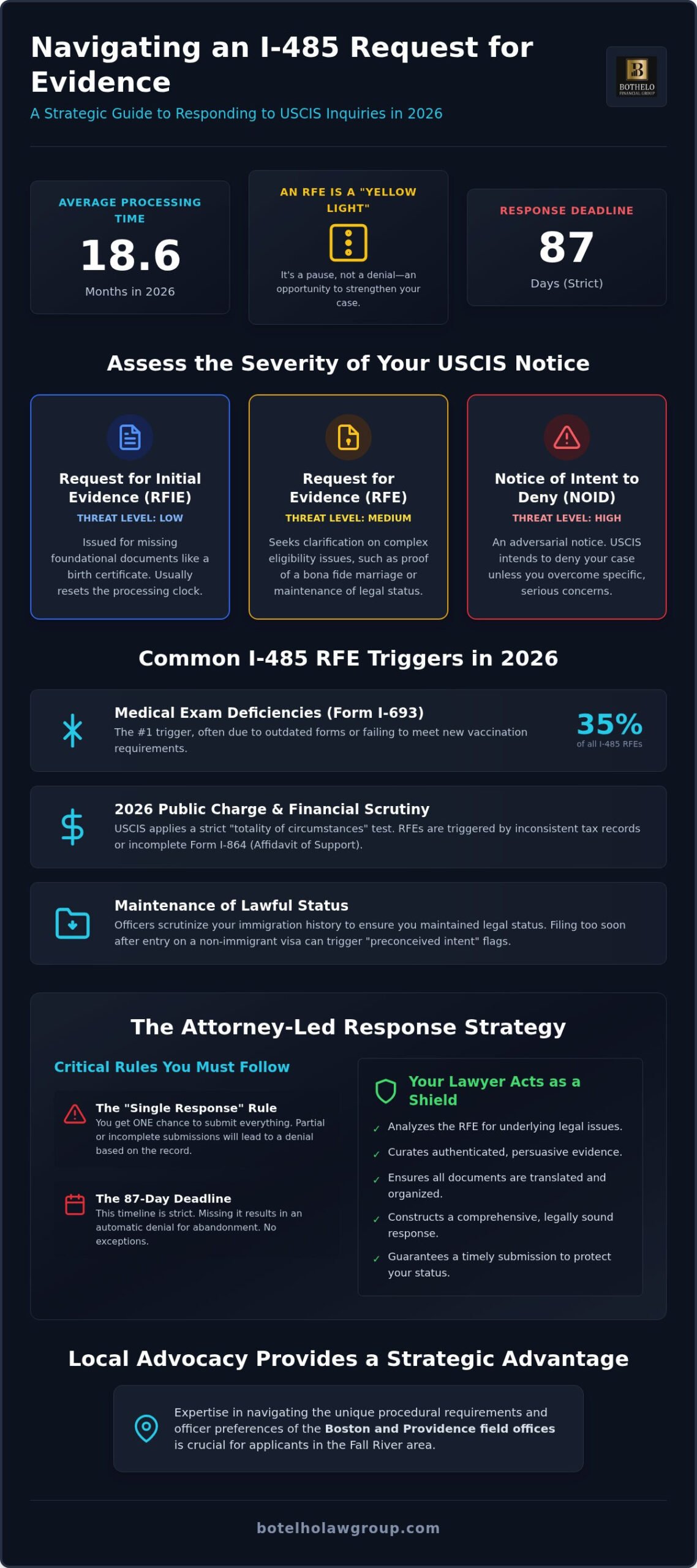
A Request for Evidence (RFE) is a formal notification from U.S. Citizenship and Immigration Services (USCIS) stating that the adjudicating officer requires additional documentation to complete your case. It is not an immediate denial; rather, it functions as a “yellow light” in the process for becoming a permanent resident. This notice pauses the progression of your application to provide a structured path toward approval. However, the 2026 landscape is unforgiving. With average processing times for all USCIS forms rising to 18.6 months, any procedural delay requires a calculated response to prevent your application from languishing in a massive backlog.
RFE vs. RFIE: Understanding the Distinction
The type of notice you receive dictates how your case will proceed. A Request for Initial Evidence (RFIE) is typically issued when foundational documents are missing from the initial filing. This might include a birth certificate or the initial Form I-864 financial proof. Receiving an RFIE is significant because it often resets the processing “clock” for your employment authorization. In contrast, a standard RFE usually seeks clarification on more complex eligibility issues, such as proving a bona fide marriage or demonstrating that you maintained legal status throughout your stay. An I-485 request for evidence lawyer can analyze the specific language of your notice to determine if the officer is questioning a simple clerical error or a substantive legal requirement.
The Legal Significance of the “Single Response” Rule
One of the most dangerous traps for applicants is the “single response” rule. You cannot supplement your evidence after you’ve submitted your packet. USCIS requires you to provide all requested information in one comprehensive mailing. If you send a partial response with the intention of sending the rest later, the officer may adjudicate your case based on the incomplete record, leading to an immediate denial. This is where the oversight of an immigration lawyer in Fall River, MA becomes vital. We ensure every document is translated, authenticated, and organized to satisfy every demand in the notice simultaneously.
In 2026, the standard deadline to respond to an RFE is 87 days from the date the notice was issued. This timeline is strict. Failure to provide a complete response by the deadline results in an automatic denial based on abandonment. When your future in the United States is at stake, you don’t have room for error. A professional I-485 request for evidence lawyer acts as your shield, ensuring your response is both timely and legally sound.
Common Triggers for I-485 RFEs in 2026
Understanding why USCIS flagged your Form I-485 is the first step in mounting a protective defense. In 2026, medical exam deficiencies remain the primary trigger, accounting for approximately 35% of all adjustment of status RFEs. Often, these notices arise from outdated Form I-693 versions or failure to meet the latest 2026 vaccination requirements. Beyond medical issues, USCIS has increased its focus on financial stability and the legality of your initial entry. An experienced I-485 request for evidence lawyer identifies these underlying concerns to ensure your response is comprehensive and authoritative.
The 2026 Public Charge and Financial Scrutiny
USCIS now applies a rigorous “totality of circumstances” test to evaluate whether an applicant might become a public charge. This scrutiny intensified after the revised Public Charge rule took effect on September 18, 2026. Officers don’t just look at current income; they analyze assets, education, and skills to predict future self-sufficiency. Self-employed applicants or those relying on joint sponsors often face RFEs when tax transcripts are inconsistent or Form I-864 is incomplete. If your financial documentation doesn’t meet the high bar set in 2026, you’ll likely face a request for additional tax records or detailed bank statements to prove your financial standing.
Maintenance of Lawful Status and the 90-Day Rule
Officers frequently scrutinize the timing of your filing to check for “preconceived intent.” If you entered on a non-immigrant visa, such as a B-2 or F-1, and filed for adjustment shortly after, USCIS may suspect you planned the filing before your entry. Proving you didn’t violate your status requires meticulous record-keeping and a clear timeline. Our family based green card attorneys specialize in documenting legal stay and curing minor status violations through specific legal exceptions. Whether you overstayed a visa or worked without authorization, your response must address these violations with legal precision to avoid a denial.
For spousal petitions, the “bona fide” marriage RFE remains a significant hurdle. USCIS may demand deep evidence of shared lives, from joint financial accounts to lease agreements and shared insurance policies. Handling these complex requests alone increases the risk of a denial. If you’re unsure how to satisfy these 2026 standards, consulting with a dedicated advocate can provide the clarity you need. A seasoned I-485 request for evidence lawyer will ensure that every piece of evidence is authenticated and presented to withstand federal scrutiny.
RFE vs. NOID: Assessing the Threat Level to Your Case
Receiving a notice from USCIS is always serious, but the specific heading on that document dictates your legal strategy. A Request for Evidence (RFE) is generally a neutral inquiry where an officer requires clarification or missing items as outlined in the USCIS I-485 Instructions. In contrast, a Notice of Intent to Deny (NOID) is an adversarial communication. It indicates that the officer has already uncovered a reason to deny your application and is giving you one final chance to argue why they’re wrong. If you’ve reached this stage, particularly after a difficult “Stokes” interview where an officer suspected marriage fraud, you must engage an I-485 request for evidence lawyer immediately.
When an RFE Becomes a NOID
A poorly managed RFE response often serves as the bridge to a NOID. If your initial response is “weak” or fails to address the specific legal concerns raised by the officer, USCIS uses that failure to build a formal record for denial. In 2026, officers are exercising broader discretion in evaluating an applicant’s likelihood of becoming a public charge. If your RFE response regarding financial self-sufficiency is incomplete, it provides the legal foundation for a NOID. Protecting your rights during this phase requires more than just submitting a few extra pay stubs; it requires a structured rebuttal that addresses the officer’s findings point by point.
The Role of Protective Advocacy
At Botelho Law Group, we treat every RFE with the same level of intensity and precision that a cancellation of removal lawyer uses to defend a client in immigration court. Many applicants believe that “just telling the truth” is sufficient to clear up a misunderstanding. However, in the 2026 administrative environment, the truth must be backed by structured legal evidence and a persuasive narrative. An I-485 request for evidence lawyer ensures that your response creates a strong administrative record. This record is vital not only for securing an immediate approval but also for protecting your ability to appeal or file a motion to reopen if the case is unfairly adjudicated. Our approach moves beyond simple document collection to provide sophisticated legal advocacy that anticipates and neutralizes the officer’s objections.
The Attorney-Led Response Strategy: How to Overcome an I-485 RFE
Responding to a USCIS notice isn’t merely a clerical task; it’s a high-stakes legal submission that requires a methodical approach. When you receive a request, the government is essentially pausing your case until you can prove your eligibility under strict 2026 standards. A passive or disorganized response often leads to a Notice of Intent to Deny. Our firm employs a structured, five-step strategy to ensure your filing is beyond reproach. By engaging an I-485 request for evidence lawyer, you ensure that your response isn’t just a collection of papers, but a persuasive legal defense of your right to remain in the United States.
- Step 1: Thorough Analysis: We identify the “unspoken” concerns of the officer, looking past boilerplate text to see why the evidence was deemed insufficient.
- Step 2: Document Curation: Every piece of evidence is verified, authenticated, and paired with certified English translations.
- Step 3: Drafting the Legal Argument: We frame the evidence within a formal cover letter that addresses statutory requirements point-by-point.
- Step 4: Quality Control: We conduct a final audit of signatures, barcodes, and filing addresses to prevent technical rejections.
- Step 5: Post-Submission Monitoring: Our team tracks the delivery and monitors your case status for immediate follow-up actions or interview notices.
Drafting a Persuasive Legal Argument
A simple list of documents rarely satisfies a skeptical immigration officer. To overcome complex challenges, such as those involving the 2026 Public Charge rule, we draft a structured legal brief. This document cites relevant 2026 immigration case law to support your eligibility and explains why the provided evidence meets the “preponderance of the evidence” standard. If primary documents like birth certificates aren’t available from your home country, we curate secondary evidence and detailed affidavits to fill the gaps. This professional framing transforms raw data into a compelling narrative of compliance.
Avoiding Common Pro Se (Self-Filing) Mistakes
Self-represented applicants often fall into the trap of “over-explaining” their situation. This frequently leads to the accidental disclosure of information that creates new inadmissibility issues. Additionally, many applicants mistakenly send original documents, which USCIS may never return, or they fail to place the critical “RFE Gold Sheet” as the top page of their packet. Missing this single page can cause your response to be lost in a mailroom backlog. If you’re facing a complex request, securing expert legal management is the most effective way to avoid these technical pitfalls. An I-485 request for evidence lawyer acts as a final filter, ensuring every page of your submission serves a strategic purpose.
Why Local Fall River Representation Matters for Your Green Card
While many immigration matters are managed through digital portals, the final adjudication of your permanent residency often depends on the specific preferences of local field offices. If your case is assigned to the Boston or Providence field offices, having a local Fall River presence provides a distinct advantage. Officers in these locations have specific evidentiary standards and procedural nuances that a generic nationwide firm might overlook. An I-485 request for evidence lawyer who understands the local landscape can tailor your response to meet these localized expectations. Our Fall River hub serves as a dedicated space for in-person document review and rigorous interview preparation, ensuring you’re ready for federal scrutiny.
Securing your permanent residency is just the first step in building your legacy in the United States. Once your status is protected, it’s vital to integrate your success with comprehensive estate planning in Fall River. Protecting your new status and your assets ensures that your family’s future remains secure against unforeseen legal or financial challenges. While we provide nationwide advocacy for clients in all 50 states, we apply this high-level, localized strategy to every case we manage.
The Botelho Law Group Difference
Our firm maintains a serious, results-oriented approach that treats every RFE as a top priority. We specialize in high-stakes cases that require sophisticated legal strategy rather than simple form-filling. This deep expertise extends across the entire immigration spectrum, including our role as an n-400 denial appeal lawyer for those facing citizenship rejections. You’ll communicate directly with seasoned attorneys who understand the gravity of your situation. We don’t delegate your future to paralegals; we provide the protective advocacy your case deserves.
Next Steps: Securing Your Future
Time is your most critical asset when responding to a USCIS notice. You shouldn’t wait more than 48 hours after receiving an RFE to contact an I-485 request for evidence lawyer. This window allows for a comprehensive analysis of the 87-day deadline and the immediate curation of necessary evidence. When you arrive for your initial strategy consultation, bring the original RFE notice, your entire initial filing packet, and any new documentation related to the officer’s concerns. We will map out a path forward that moves your application from a state of uncertainty to a successful approval and long-term security.
Securing Your Permanent Residency in 2026
Navigating a USCIS Request for Evidence requires more than just gathering documents; it demands a sophisticated legal strategy that addresses federal scrutiny with precision. Whether you’re facing questions about the 2026 Public Charge rule or complex medical exam requirements, your response will determine the future of your adjustment of status. Engaging a focused I-485 request for evidence lawyer ensures that your application remains on a clear path toward approval while avoiding the adversarial complications of a Notice of Intent to Deny.
Botelho Law Group brings a proven track record in complex Adjustment of Status litigation and specialized local expertise in the Boston and Providence Field Offices. We provide comprehensive legal support that extends from securing your immigration status to protective asset management. Our firm acts as a relentless fighter for your interests, treating every case with individual seriousness. Do not risk your Green Card, contact Botelho Law Group for an expert RFE strategy session today. You’ve come too far to let a procedural notice stand in the way of your American dream.
Frequently Asked Questions
How long do I have to respond to an I-485 RFE in 2026?
You have exactly 87 days from the date the notice was issued to submit your complete response to USCIS. This deadline is strictly enforced throughout 2026. Missing this window usually results in an automatic denial due to abandonment. It’s critical to calculate this date precisely and ensure your packet is delivered via tracked mail. Professional legal management ensures your delivery is confirmed before the clock runs out.
Can my I-485 be denied without an RFE being sent first?
USCIS has the discretionary authority to deny an application without first issuing an RFE or a Notice of Intent to Deny if there’s clear evidence of ineligibility. This policy emphasizes that adjustment of status is a discretionary form of relief. If your initial packet lacks foundational evidence or contains significant legal errors, the officer may choose to deny the case immediately rather than requesting clarification, making the quality of your initial filing paramount.
What happens if I cannot find the specific document USCIS is requesting?
You must provide secondary evidence or a certificate of non-availability from the relevant government authority if a primary document is unavailable. For instance, if a birth certificate cannot be found, you might submit school records, religious documents, or multiple affidavits from relatives. An I-485 request for evidence lawyer will help you authenticate these secondary sources to ensure they meet the rigorous 2026 evidentiary standards and satisfy the officer’s request.
Will receiving an RFE delay my work permit (EAD) or travel document?
Receiving a Request for Initial Evidence (RFIE) typically stops the processing clock for your Employment Authorization Document (EAD) and Advance Parole. The clock only resumes once USCIS receives your response. While a standard RFE for additional evidence might not officially stop the clock, it often creates administrative delays. Your entire file is typically set aside until the new evidence is integrated and reviewed, which slows your overall 2026 processing timeline.
Do I need to hire a lawyer if the RFE is just for a missing birth certificate?
Even seemingly simple requests can hide complex legal traps regarding document authentication or “bona fide” status. A missing document often signals that the officer is looking for reasons to doubt the validity of your claim. Having professional oversight ensures that your response is comprehensive and follows the “single response” rule. This prevents you from accidentally providing information that could trigger further federal scrutiny or an immediate denial of your permanent residency.
What is the most common reason for an I-485 RFE in 2026?
Deficiencies in the Form I-693 medical exam remain the most frequent trigger, representing approximately 35% of all adjustment of status RFEs in 2026. These notices often arise from expired exam results or failure to comply with the latest 2026 vaccination requirements. Other major triggers include financial insufficiency under the revised Public Charge rules and inconsistencies in proving that you maintained a lawful status throughout your entire stay in the United States.
Can I travel outside the U.S. after receiving an RFE?
You shouldn’t travel abroad if you have an outstanding RFE, even if you possess a valid Advance Parole document. Leaving the country while a deadline is pending is risky because you may miss additional notices or face issues at the border upon re-entry. It’s safer to remain in the U.S. until your I-485 request for evidence lawyer confirms your response has been successfully filed and acknowledged by the relevant USCIS service center.
Is an RFE a sign that my Green Card interview will be difficult?
An RFE indicates that an officer has identified a specific weakness or gap in your file, which often translates to more intense questioning during your interview. If the request involves your marriage or financial stability, you should prepare for a high-stakes “Stokes” style interview. Our Fall River office provides rigorous preparation sessions to help New England clients navigate these difficult local officer preferences in the Boston and Providence field offices.