
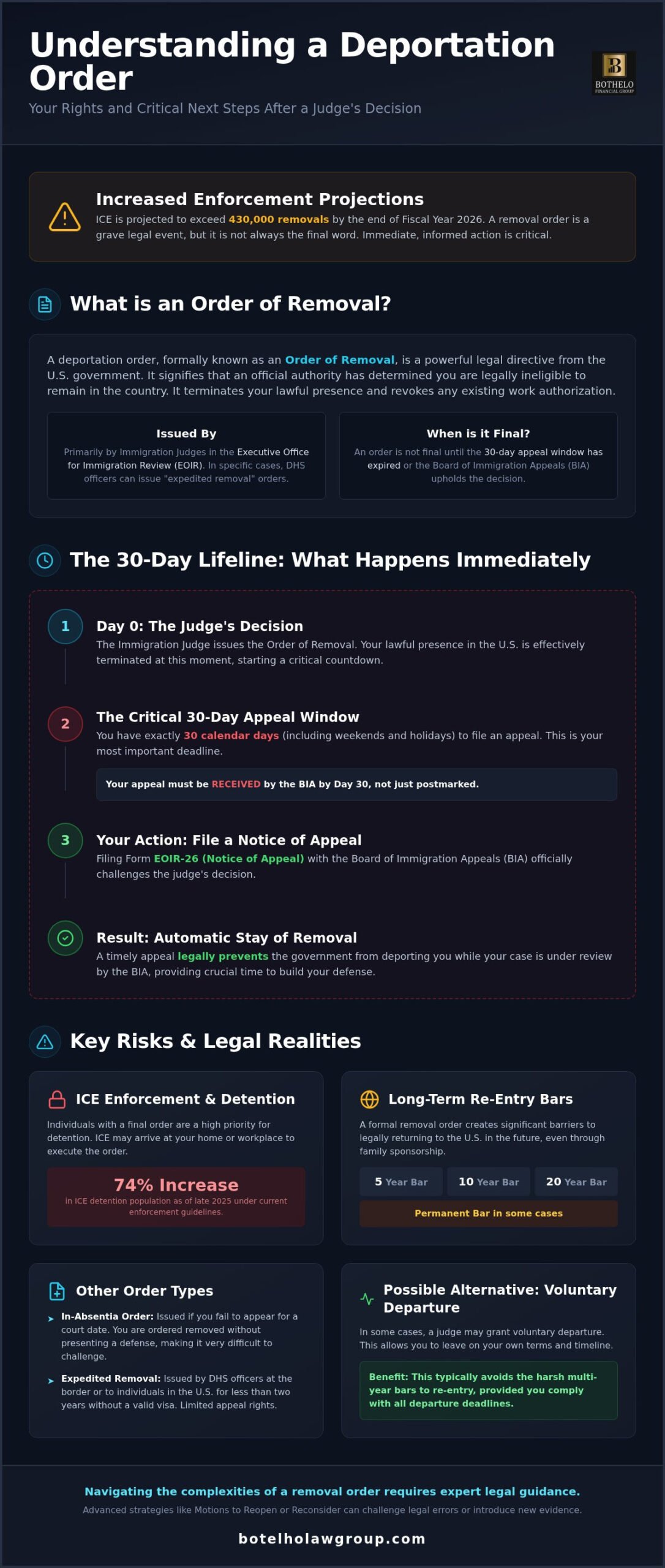
With ICE projected to exceed 430,000 removals by the end of Fiscal Year 2026, receiving a final decision from an immigration judge can feel like an immediate sentence of exile. It’s natural to feel overwhelmed by the fear of family separation and the crushing weight of legal uncertainty. You’re likely wondering exactly what happens if you get a deportation order and if there’s any way to stop the process before it’s too late. While the situation is grave, a removal order isn’t always the definitive end of your life in the United States.
We understand that the 30-day appeal window creates an intense pressure to act with precision. This guide provides the clarity you need to navigate these high-stakes legal waters during a period of increased enforcement and rising filing fees. You’ll discover the immediate consequences of a removal order and the critical legal steps you can take to challenge it. We’ll outline the process for securing a ‘stay of removal’, explain the complexities of Board of Immigration Appeals (BIA) filings, and detail the specific 2026 timelines you must follow to protect your future and remain with your family.
Key Takeaways
- Understand that a removal order is a formal legal determination of ineligibility to remain in the U.S., but it also triggers specific rights to challenge the decision.
- Learn exactly what happens if you get a deportation order, including the immediate risks of ICE detention and the mandatory 30-day deadline to file a BIA appeal.
- Discover how filing a Notice of Appeal (Form EOIR-26) can secure an automatic stay of removal, legally preventing the government from deporting you while your case is reviewed.
- Explore advanced litigation strategies like Motions to Reopen or Reconsider that allow you to introduce new evidence or challenge legal errors made during your initial hearing.
- Gain insight into how professional deportation defense helps you navigate 2026’s complex filing fee structures and the new USCIS rules regarding asylum case transfers.
What is a Deportation Order? Defining the Order of Removal
A deportation order, formally known as an Order of Removal, is a powerful legal directive issued by the U.S. government. It signifies that an official authority has reviewed your case and determined you are legally ineligible to remain in the country. To understand What is Deportation in a legal sense, one must view it as the final step in a process where the government asserts its right to exclude a non-citizen. This document isn’t a mere suggestion; it’s a mandate that carries immediate and long-term consequences for your life and your family.
It’s vital to distinguish between a preliminary order and one that’s legally final. An order issued by an immigration judge is not considered final until the 30-day window for an appeal has expired or the Board of Immigration Appeals (BIA) has affirmed the decision. Understanding what happens if you get a deportation order often depends on where you stand within this timeline. Additionally, some individuals may be granted “voluntary departure,” which allows them to leave on their own terms. Unlike a formal removal order, voluntary departure doesn’t typically trigger the same harsh multi-year bars to reentry, provided the individual complies with all departure deadlines.
Who Issues the Order?
Most removal orders originate within the Executive Office for Immigration Review (EOIR), where immigration judges preside over adversarial hearings. However, the Department of Homeland Security (DHS) also holds significant power. Under expanded 2026 protocols, DHS officers can issue “expedited removal” orders at the border or for individuals who’ve been in the country for less than two years without a valid visa. If you fail to appear for a scheduled court date, the judge can issue an “in-absentia” order. This means you’ve been ordered deported without the chance to present a defense, making the subsequent legal challenge significantly more difficult.
The Legal Status of an Individual with an Order
Once an order becomes active, your legal standing in the United States evaporates. Any existing work authorization is typically revoked, and you lose the right to receive most federal benefits. The government eventually issues a “bag and baggage” letter, which is a formal notification from ICE providing a specific date and location for your removal. Beyond the immediate physical departure, a formal order often results in a 5, 10, or 20-year bar on reentering the country. In some cases, a permanent bar applies, making it nearly impossible to secure future visas or green cards without high-level waivers.
Immediate Consequences: What Happens Once the Order is Issued?
Receiving a removal order triggers a cascade of legal and logistical shifts that demand immediate attention. Understanding what happens if you get a deportation order is the first step in mounting a defense. Once the judge signs the order, your lawful presence is effectively terminated, and the government begins the administrative deportation process. This isn’t a time for hesitation; it’s a time for strategic action to protect your future.
The 30-Day Appeal Deadline
The 30-day window following the judge’s decision is the most critical period for your future in the United States. If you don’t file an appeal within this timeframe, the order becomes “final,” and your options for staying legally diminish almost entirely. These are 30 calendar days, not business days. This count includes weekends and holidays. Your Notice of Appeal (Form EOIR-26) must be physically received by the Board of Immigration Appeals (BIA) by the 30th day, not merely postmarked. Missing this deadline by even a few hours can result in the permanent loss of your right to challenge the removal.
ICE Enforcement and Detention
Current 2026 enforcement guidelines have led to a 74% increase in the ICE detention population as of late 2025. If you’re under a final order of removal, you’re a high-priority target for detention. ICE officers may arrive at your home or workplace to execute the order. If you’re not immediately removable-perhaps because your home country is slow to issue travel documents-you might be placed on an “Order of Supervision.” This requires you to check in regularly with ICE and comply with specific conditions while you remain in the country. However, this status is precarious and can be revoked at any time. Preparing a family plan for dependents is essential to ensure they’re protected if you’re taken into custody.
Your ability to work legally also ends with a removal order. Most work permits are tied to a pending application for relief. When that relief is denied, the permit is typically revoked immediately. This sudden loss of income adds financial strain to an already stressful legal battle. Because the stakes involve your livelihood and your family’s stability, seeking specialized deportation defense is a necessary step to explore every possible avenue for a stay of removal.
The Appeals Process: How to Challenge a Removal Order
A removal order is a critical legal junction, not an immediate end. Understanding what happens if you get a deportation order involves recognizing that the law provides a structured pathway to challenge the judge’s decision. The first and most vital step is filing a Notice of Appeal (Form EOIR-26) with the Board of Immigration Appeals (BIA). This filing must be precise; it’s the foundation of your defense and determines whether you’ll have the opportunity to present your case to a higher authority.
One of the most significant benefits of a timely appeal is the “automatic stay” of removal. This legal mechanism prevents ICE from physically deporting you while your appeal is pending before the BIA. It acts as a shield, ensuring you can remain in the country to pursue all available relief from removal. Without this stay, the government could move forward with enforcement even if you have valid legal arguments to stay. You must ensure the appeal is filed within the strict 30-day window to trigger this protection.
Board of Immigration Appeals (BIA) Basics
The BIA, located in Falls Church, Virginia, holds national jurisdiction over immigration court appeals. In 2026, the board focuses heavily on identifying legal errors, factual mistakes, or due process violations that occurred during the initial hearing. Once the BIA receives your appeal and the court transcript is prepared, they’ll issue a briefing schedule. This is your opportunity to submit a written argument detailing why the immigration judge’s decision was incorrect. Given the increased complexity of the 2026 legal landscape, these briefs must be meticulously researched and legally sound. Most BIA decisions in 2026 are reached through a paper review, making the quality of the written brief the single most important factor in your case.
Petitions for Review in Federal Court
If the BIA denies your appeal, the fight can move to the U.S. Court of Appeals through a Petition for Review. This shifts the case from the executive branch to the federal judicial system. For individuals in Massachusetts, this typically means the First Circuit Court of Appeals. Judicial review is distinct from administrative appeals; it requires a sophisticated understanding of federal law and appellate procedure. This level of litigation is highly specialized and demands a representative who acts as a relentless fighter for your interests. Unlike BIA appeals, a Petition for Review doesn’t always grant an automatic stay, which makes the timing of your filing and the skill of your advocate even more critical.
Possible Forms of Relief: Can You Still Stay in the U.S.?
A removal order is a critical legal junction, but it doesn’t necessarily signal the end of your ability to live in the United States. Understanding what happens if you get a deportation order requires exploring the specific forms of relief that remain available even after a judge’s ruling. While the government may have issued a mandate for your departure, the legal system provides mechanisms to pause or even reverse that decision based on new evidence or fundamental changes in your circumstances.
One primary defense for long-term residents is seeking help from a Cancellation of Removal Lawyer. In 2026, the filing fee for non-permanent residents (Form EOIR-42B) is $1,640, reflecting recent inflation-indexed adjustments. This form of relief is available to those who’ve maintained a continuous physical presence for ten years and can prove that their removal would cause “exceptional and extremely unusual hardship” to a qualifying U.S. citizen or permanent resident relative. Additionally, individuals fearing persecution can file for Asylum (Form I-589) with a $100 initial fee and a $102 annual maintenance fee, or seek Withholding of Removal if they face a clear probability of threats to their life or freedom.
The Motion to Reopen Strategy
A Motion to Reopen is a procedural tool used to bring new, material facts before the court that weren’t available during the original hearing. Generally, you’re limited to one motion filed within 90 days of the final order. Critical exceptions exist for cases involving changed conditions in your home country or instances where a previous attorney provided ineffective assistance. The court also possesses the ‘sua sponte’ authority to reopen a case on its own motion to address exceptional situations or clear legal errors. Because of the strict time and number limitations, these motions require a sophisticated legal strategy to ensure every piece of new evidence is presented with maximum impact.
Administrative and Humanitarian Stays
For those who’ve exhausted their court options, filing Form I-246 with ICE can secure a discretionary stay of removal. This is an administrative request rather than a court order. ICE officers consider humanitarian factors such as severe medical issues, extreme family hardships, or the status of a pending U-visa for victims of crime. In 2026, the role of prosecutorial discretion remains a vital factor; the government may choose to deprioritize your removal if you don’t pose a threat to public safety and have deep ties to the community. Navigating these requests requires a deportation defense attorney who can present a compelling narrative to enforcement officials.
Why You Need a Removal Defense Attorney from Botelho Law Group
The consequences of a removal order are too severe to navigate without sophisticated legal representation. When considering what happens if you get a deportation order, the reality is that you’re facing a government with vast resources and specialized prosecutors. Attempting to manage your own defense is not a viable option in an adversarial system. Botelho Law Group acts as a focused advocate, providing a relentless defense for clients facing the most complex immigration challenges. While our physical headquarters is in Fall River, MA, we provide deportation defense and immigration representation across all 50 states, ensuring every client has access to high-level litigation expertise regardless of their location.
Our approach extends beyond the courtroom to ensure the total protection of your family and future. We integrate our immigration strategy with Estate Planning and asset protection. This multi-disciplinary focus ensures that your property and dependents are legally secured even while we fight your removal case. We don’t just handle the paperwork; we build a comprehensive shield around your life in the United States. Our firm positions itself as a sophisticated problem-solver, addressing the immediate threat of removal while securing your long-term interests.
Sophisticated Problem-Solving for Complex Cases
Our firm specializes in identifying obscure legal errors that others might overlook. In 2026, with the introduction of new USCIS rules on asylum case transfers and indexed filing fees, the margin for error in court is narrower than ever. We are prepared to handle emergency stays of removal and late-night filings when the 30-day window is closing. Our team understands how to challenge the government’s evidence and leverage the court’s reopening powers to secure your right to remain. This level of precision is what separates a failed appeal from a successful stay of removal.
Contacting an Immigration Lawyer in Fall River, MA
Time is your most precious resource once an order is issued. We offer immediate consultation availability to address time-sensitive deportation matters and BIA appeals. Our commitment to clear, high-stakes communication ensures that you’re never left in the dark regarding your legal status. If you’re facing removal, contact an Immigration Lawyer in Fall River, MA today. We act as your dedicated guide through a complex system, fighting to protect your American dream with the seriousness and expertise your case deserves.
Take Decisive Action to Protect Your Future in the United States
Receiving a removal order is a high-stakes legal event, but it doesn’t have to be the final word on your life in this country. You now understand that the 30-day appeal window is the most critical period for your legal future and that filing a timely notice can trigger an automatic stay of removal. Whether you’re exploring a Motion to Reopen or seeking Cancellation of Removal, success depends on a meticulous legal strategy and swift execution. Understanding what happens if you get a deportation order is the first step toward mounting a successful defense that keeps your family together.
Botelho Law Group provides nationwide immigration representation from our headquarters in Fall River, MA. We act as a focused advocate for those facing complex removal proceedings, bringing a sophisticated approach to every case. Don’t let a deadline pass without a fight. Secure Your Future-Schedule a Deportation Defense Consultation with Botelho Law Group Today. Our team is ready to provide the relentless representation you need to navigate these complex systems and find a path to remain legally in the U.S. There are still legal avenues available to you; let’s explore them together.
Frequently Asked Questions
How long do I have to leave the U.S. after a deportation order?
If an immigration judge in a Massachusetts court issues an order, you typically have 30 days to either depart or file an appeal. Once that window expires without action, the order becomes final. ICE then sends a “bag and baggage” letter, which specifies a date and location for your physical removal. Compliance is mandatory; however, our Fall River firm often helps clients seek extensions or stays based on humanitarian grounds before that departure date arrives.
Can I be deported immediately if I have a pending appeal?
You cannot be physically removed while a timely appeal is pending before the Board of Immigration Appeals. This “automatic stay” protects you from ICE enforcement until a decision is reached. It is the most effective way to prevent the immediate consequences of what happens if you get a deportation order. You must ensure your appeal is received at the Falls Church, VA office within the strict 30-day calendar window to maintain this protection.
What is a ‘Stay of Removal’ and how do I get one?
A ‘Stay of Removal’ is a formal pause on your deportation. There are two primary types: automatic and discretionary. You secure an automatic stay by filing a BIA appeal on time. Discretionary stays require filing Form I-246 directly with ICE. In 2026, ICE considers factors like medical emergencies or pending U-visas. Our attorneys specialize in these high-stakes filings to provide immediate protection for families in Bristol County and across the country.
Can I get a work permit if I have a deportation order?
Generally, a final removal order terminates your eligibility for a work permit. Most Employment Authorization Documents (EADs) are tied to a pending application for relief, such as asylum. When the judge denies that relief, the permit is typically revoked. However, if you are released on an Order of Supervision because your home country won’t accept you, you may be eligible to apply for work authorization under specific 2026 federal categories during your stay.
What happens if I miss my immigration court hearing?
Missing a hearing usually results in an “in-absentia” deportation order. The judge can order you removed simply because you weren’t there to present a defense. This makes your legal situation significantly more difficult, as you must then file a Motion to Reopen to prove “exceptional circumstances” for your absence. We represent clients nationwide who have missed hearings due to medical emergencies or lack of notice, fighting to vacate these restrictive and life-altering orders.
Can my spouse or child’s status protect me from a deportation order?
Having a U.S. citizen spouse or child does not provide automatic protection, but it is a critical factor in your defense. Their status allows you to apply for Cancellation of Removal if you can prove their “exceptional and extremely unusual hardship” upon your departure. This is a complex litigation process where we demonstrate your deep family ties and contributions to your Massachusetts community to convince the judge to grant you permanent residency instead of removal.
How much does it cost to appeal a deportation order in 2026?
As of February 23, 2026, all EOIR fees must be paid through the official online payment portal; checks and money orders are no longer accepted. While the specific appeal fee is separate, related relief forms have seen significant increases. For example, filing for Cancellation of Removal for non-permanent residents now costs $1,640. These costs are indexed to inflation, making it essential to verify the exact total for your specific case before filing your documents.
Will ICE come to my house to arrest me after the judge’s decision?
It is a distinct possibility, especially given that ICE detention increased by 74% in late 2025. Enforcement priorities in 2026 focus heavily on individuals with final removal orders. ICE officers may conduct residential or workplace arrests to execute the judge’s mandate. This is why having a legal plan and a “focused advocate” is vital. We help families in the Fall River area prepare for these high-stakes interactions while aggressively pursuing stays to prevent arrest.