
Your consular interview isn’t a casual conversation; it’s a high-stakes credibility test where a single misunderstood phrase can lead to a permanent visa denial. Most applicants walk into the embassy feeling prepared, only to be blindsided by aggressive questioning or minor document discrepancies that the officer views as red flags. If you’re feeling anxious about consular processing interview questions, it’s because you understand that your entire future depends on a few minutes of interaction. It’s natural to fear that a nervous slip-up might be mistaken for intentional misrepresentation.
We’re here to replace that uncertainty with a disciplined, expert-backed strategy. This 2026 guide provides a comprehensive list of categorized questions and the high-stakes tactics used by seasoned legal advocates to secure immigrant visa approvals. You’ll learn how to identify exactly what an officer is looking for when they probe your history or finances. By the end of this article, you’ll have a systematic understanding of the interview process and the confidence to navigate even the most rigorous scrutiny with precision and poise.
Key Takeaways
- Treat the interview as a final credibility test rather than a simple administrative task to ensure your immigrant visa is approved.
- Categorize and prepare for the most frequent consular processing interview questions to maintain total consistency with your DS-260 form.
- Recognize and neutralize red flags like language barriers or rapid marriages that often lead to increased officer scrutiny.
- Develop a systematic review process for your interview packet to prevent minor document discrepancies from causing major delays.
- Leverage professional legal briefings to align the petitioner and applicant, creating a unified and defensible case for the consular officer.
The Purpose of the Consular Processing Interview: The Credibility Test
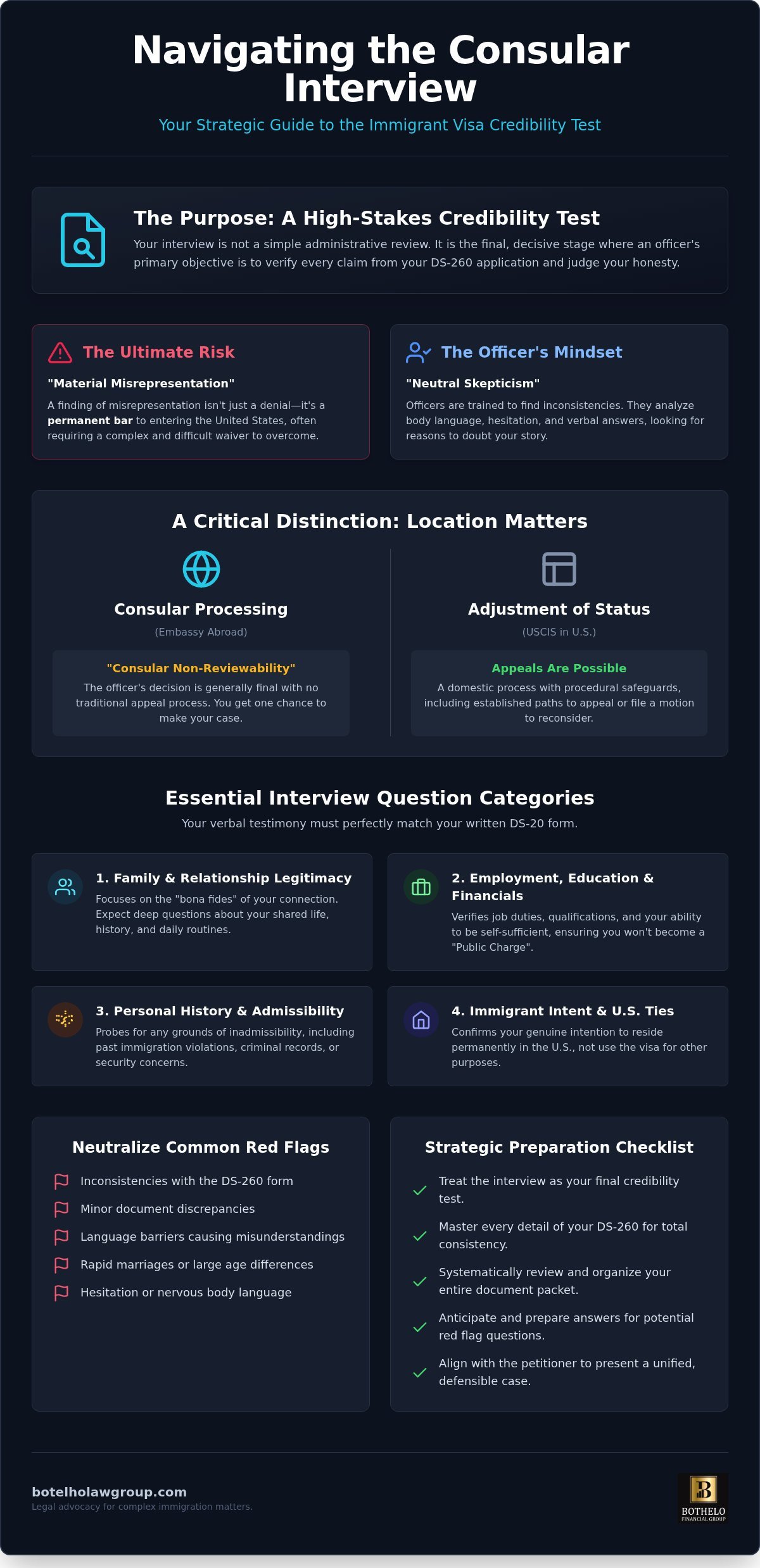
Consular processing represents the final, decisive stage of the immigrant visa journey for those residing outside the United States. While you’ve likely spent months or years submitting petitions and waiting for NVC approvals, the embassy interview is where the Department of State (DOS) determines your eligibility. This isn’t a mere formality or a review of your paperwork. It’s a high-stakes credibility test designed to verify every claim made on your DS-260 application. The officer’s primary objective is to ensure that your intent is lawful and your relationships are genuine. You’re being judged on your honesty as much as your eligibility.
The stakes are incredibly high. If an officer determines that you provided false information, they may find you guilty of “material misrepresentation.” This isn’t a simple rejection. It’s a permanent bar to entering the United States that often requires a complex waiver to overcome. Understanding the logic behind consular processing interview questions is the first step in avoiding these life-altering consequences. Officers aren’t just checking boxes; they’re looking for reasons to doubt your story.
Why the Consular Officer is Skeptical
Every consular officer operates under a mandate to prevent immigration fraud. They don’t start from a position of trust; they start from a position of neutral skepticism. In 2026, this skepticism is bolstered by new training protocols that focus heavily on vetting financial stability and public charge grounds. In family or marriage cases, they apply the “Bona Fide” standard. They aren’t just looking for a marriage certificate; they’re looking for evidence of a shared life. Officers are trained to observe body language, hesitation, and verbal consistency. If your spoken answer deviates even slightly from the written record, it triggers a red flag. They use specific consular processing interview questions to probe for these inconsistencies, testing whether your story holds up under pressure.
Consular Processing vs. Adjustment of Status
The environment of an overseas embassy is fundamentally different from a domestic USCIS field office. You aren’t in a local office with the same procedural safeguards; you’re in a secure federal facility on foreign soil. One of the most critical differences is the doctrine of consular non-reviewability. Unlike domestic cases, there’s no traditional appeal process for a consular denial. If the officer says no, that decision is generally final. This lack of oversight makes legal preparation essential before you step into the embassy. You must be ready to defend your case perfectly the first time. You won’t get a second chance to clarify a misunderstanding once the decision is recorded.
Essential Categories of Consular Processing Interview Questions
The DS-260 serves as the primary source for all questions asked during the consular interview. Officers review this electronic application in detail before you even enter the room; they use it as a baseline to detect any deviations or hesitations that might suggest a lack of credibility. Success requires that your verbal testimony matches the written record with absolute precision. Preparation is most effective when you organize your responses into four distinct “buckets” of consular processing interview questions. If you’re concerned about how your specific background might trigger an officer’s suspicion, seeking a professional case evaluation can help you identify and address these vulnerabilities before the interview.
Family and Relationship Legitimacy Questions
For those pursuing family-based green cards, the focus is on the “bona fides” of the relationship. Officers move beyond simple dates and names to probe the depth of your connection. You may be asked, “How did you meet?” or “When was the last time you saw the petitioner in person?” Spousal cases involve more intrusive inquiries about daily routines, such as your partner’s favorite hobbies or the names of their close relatives. For children or parents in family-preference categories, the officer often focuses on the history of financial support and the continuity of the relationship during your time apart.
Employment, Education, and Financial Questions
Employment-based applicants face a different set of inquiries. The officer will verify your specific job duties, educational credentials, and the legitimacy of the U.S. employer. They want to ensure you possess the exact qualifications listed in the petition. With new Public Charge guidance effective September 18, 2026, financial sponsorship is under extreme scrutiny. You must be prepared to discuss the income levels listed on the I-864 Affidavit of Support. For example, a sponsor for a household of three in the contiguous 48 states must demonstrate an annual income of at least $34,150 to meet the current 125% poverty guideline.
Security, Background, and Intent Questions
This is the highest-risk category. Standard questions about criminal records or extremist affiliations require absolute precision. If you have a history of unauthorized stay or a previous visa overstay, your strategy for navigating difficult consular interview questions must be grounded in transparency and legal accuracy. Officers also probe “immigrant intent” to confirm you’ll reside permanently in the U.S. and aren’t misusing the visa category. They may ask about your remaining ties to your home country. Any perceived attempt to hide past conduct is treated as material misrepresentation, which carries a permanent bar to entry that’s difficult to overcome.
Navigating ‘Red Flag’ Scenarios and Difficult Questions
Consular officers are trained to identify patterns that deviate from standard immigrant profiles. These deviations, known as “red flags,” trigger a deeper level of scrutiny that can turn a routine appointment into a grueling interrogation. Understanding how to handle high-stakes consular processing interview questions is vital when your case involves non-traditional elements. Consistency is more important than perfection in answers.
When faced with a question about a specific date or a minor detail from several years ago, your impulse might be to provide a concrete answer to appear prepared. However, guessing is a dangerous strategy. If you genuinely cannot recall a detail, it’s safer to state “I don’t remember” rather than providing an inaccurate response that conflicts with your DS-260 or your partner’s testimony. Officers view conflicting “facts” as evidence of a manufactured story, even if the discrepancy was caused by simple nervousness.
Common Red Flags in Marriage-Based Cases
Marriage-based petitions are subject to the highest level of skepticism because they are frequent targets for fraud. Officers look for indicators such as large age gaps, a lack of a shared language between spouses, or a marriage that occurred very shortly after the couple met. They may also probe deeply into previous marriages or children from other partners to ensure no ulterior motives exist. If you and your spouse give conflicting answers to a question about your daily life, don’t panic. Address the discrepancy calmly by explaining the context, such as a misunderstanding of the question or the stress of the environment.
Handling Aggressive or Repetitive Questioning
Maintaining your composure is critical when an officer adopts a confrontational tone. Some officers use aggressive or repetitive questioning to see if your story changes under pressure. They might ask the same question three different ways to catch a slip-up in your narrative. Strategies for remaining professional include taking a brief breath before answering and maintaining steady eye contact. If you don’t understand the officer’s accent or phrasing, ask for clarification immediately. You have a right to understand the question before you provide an answer. Our role as a protective advocate is to prepare you for these adversarial environments through mock interviews that simulate this exact pressure, ensuring you remain focused on the facts of your case.
A Strategic Preparation Checklist for Your Embassy Appointment
Success at the embassy is not a matter of luck; it’s the result of disciplined, methodical preparation. Many applicants fail because they assume their previous paperwork was enough. In reality, the officer is evaluating your current eligibility and your ability to answer consular processing interview questions with immediate accuracy. To ensure you are ready for this high-stakes encounter, follow this strategic checklist:
- Step 1: Comprehensive DS-260 Review. Re-read every line of your filed application and all supporting evidence. Your verbal testimony must align perfectly with these documents to avoid fraud suspicions.
- Step 2: Organize the Interview Packet. Group your documents into logical sections. You must bring original civil documents and high-quality photocopies for the officer to keep.
- Step 3: Conduct Mock Interviews. Practice verbalizing your answers. Thinking of an answer is easy, but speaking it clearly under the pressure of an officer’s gaze requires repetition.
- Step 4: Update Financial Evidence. Ensure your I-864 Affidavit of Support is current. If the tax year has shifted since your initial NVC filing, you must provide the most recent tax returns and ensure you meet the 2026 poverty guidelines effective as of March 1, 2026.
- Step 5: Finalize Logistics. Confirm your medical examination is complete. These exams typically cost between $150 and $500 depending on the civil surgeon. Register with the required courier service and review the specific security rules for your embassy location.
The Essential Document Portfolio
The embassy requires a specific mix of original documents and translations. Generally, the officer will inspect your original birth certificates, marriage licenses, and police clearances but will only keep the photocopies. Every document not in English or the official language of the country where the interview takes place must have a certified translation that meets Department of State standards. Working with a Family Based Green Card Attorney ensures that your portfolio is audit-ready and that no technicality leads to a preventable delay.
Psychological Readiness and Body Language
Your non-verbal communication is just as important as your spoken words. Maintain steady eye contact and an upright posture to project confidence and honesty. Avoid the trap of “over-explaining.” When you provide long, rambling answers to simple consular processing interview questions, you often provide unnecessary details that trigger follow-up inquiries or create confusion. Answer the question directly and then stop. Dress in professional business attire to signal your respect for the process and the gravity of the legal matter at hand. If you want to ensure your strategy is airtight, you should schedule a pre-interview strategy session with our legal team.
How Legal Advocacy Minimizes Risks During Consular Processing
Botelho Law Group serves as a dedicated guide through the complexities of the Department of State’s vetting systems. We don’t simply manage paperwork; we act as protective advocates who identify and neutralize legal vulnerabilities before they ever reach a consular officer’s desk. Our approach is rooted in the understanding that preparation for consular processing interview questions requires more than just a list of facts. It requires a unified narrative between the petitioner in the U.S. and the applicant abroad. When you’re dealing with life-altering legal consequences, a passive approach is a liability.
A critical component of our representation is the pre-interview briefing. This session aligns both parties to ensure that responses remain consistent under the stress of an interrogation. If a case is unexpectedly delayed or put into “Administrative Processing” under Section 221(g), we provide the systematic follow-up required to resolve the issue. We act as a global advocate for families separated by international borders, ensuring that the gravity of your legal matter is treated with the individual seriousness it deserves. Our firm remains calm and composed while fighting relentlessly for your interests.
Identifying Inadmissibility Issues Early
Early detection is the most effective way to prevent a permanent visa denial. Our firm conducts rigorous screenings for potential medical, criminal, or prior immigration violations that might trigger a finding of inadmissibility. If we identify a “red flag” scenario, we don’t wait for the denial to act. Instead, we prepare comprehensive waiver applications, such as the I-601, in anticipation of the officer’s concerns. By securing the services of an Immigration Lawyer in Fall River MA, you gain a strategist who understands how to navigate these high-stakes litigation hurdles with precision.
The Botelho Law Group Advantage: Results-Oriented Representation
Our firm possesses deep experience with U.S. Embassies and Consulates across the globe. This international perspective allows us to anticipate the specific cultural and procedural nuances of different consular posts. We provide the peace of mind that comes from knowing every detail of your case is being managed by a sophisticated problem-solver. You don’t have to face the uncertainty of the embassy alone. We’re here to provide the disciplined advocacy you need to navigate the system successfully. To secure your future and protect your family’s interests, Schedule a consultation with Botelho Law Group today.
Securing Your Family’s Path to Permanent Residency
Navigating the final stage of your immigration journey requires more than just gathering documents; it demands a precise, defensive strategy. You’ve learned that the embassy appointment is a rigorous credibility test where consistency with your written record is the only path to success. By mastering the most common consular processing interview questions and identifying red flags early, you significantly reduce the risk of a life-altering denial. Preparation is the difference between a visa approval and a permanent bar to entry.
Botelho Law Group stands as Fall River’s trusted legal authority, providing specialized immigration defense for families across all 50 states. We act as a focused advocate for complex family-based petitions, ensuring that every legal vulnerability is addressed before you ever face an officer. Don’t leave your future to chance or a nervous misunderstanding. Secure your future with expert consular processing representation from Botelho Law Group. We’re here to guide you home with confidence and professional precision.
Frequently Asked Questions
What happens if I forget the answer to a question during the interview?
If you forget a specific detail during the interview, it is better to state that you don’t recall than to guess. Providing an inaccurate date or name creates a discrepancy with your filed DS-260 application. Consular officers view these inconsistencies as potential red flags for fraud. While you should prepare thoroughly, honesty about a memory lapse is safer than a guess that contradicts your previous legal submissions.
Can my U.S. citizen spouse come into the interview with me at the embassy?
Most U.S. Embassies and Consulates don’t allow the U.S. citizen petitioner to attend the interview. Security protocols generally restrict access to only the visa applicants. However, some locations make exceptions for certain categories or if an interview is conducted in a stokes style format. You should check the specific security regulations for your assigned embassy. Our firm helps Massachusetts residents prepare their overseas relatives for this solitary encounter.
How long does the consular processing interview usually last?
The actual interaction with the consular officer typically lasts between 10 and 20 minutes. Most of your time at the embassy will be spent in security lines, document intake, and the waiting room. While the conversation is brief, the officer uses every second to evaluate your eligibility. This short window is why mastering consular processing interview questions is vital for a successful outcome at the window.
What should I do if the consular officer says my case needs ‘Administrative Processing’?
If your case is placed in Administrative Processing under Section 221(g), it means the officer requires more information or time for a background check. You will receive a letter outlining the specific documents or steps needed. Don’t panic; this is a common procedural delay rather than a final denial. You must submit the requested evidence promptly. Our team assists clients in Fall River by managing these complex follow-up requests to avoid prolonged delays.
Is it possible to fail the interview even if my I-130 was already approved?
Yes, a visa denial is possible even with an approved I-130 petition. The I-130 only confirms the legal relationship between the petitioner and applicant. The consular officer’s role is to determine if you are personally admissible to the United States. Issues such as medical grounds, criminal history, or public charge concerns can lead to a denial. Preparation for consular processing interview questions ensures you can defend your admissibility beyond just the relationship.
Do I need to bring new photos or evidence to the interview?
You should bring two identical color photographs taken within the last six months to your appointment. It is also essential to bring updated evidence of your relationship, such as recent photos or chat logs, and current financial documents. If the tax year has changed since your initial NVC submission, bring the most recent tax returns. Providing current evidence shows the officer that your relationship and financial support remain stable and ongoing.
What are the most common reasons for an immigrant visa denial at the embassy?
The most common reasons for immigrant visa denials include public charge concerns, material misrepresentation, and criminal history. Under new guidance effective September 18, 2026, officers are scrutinizing financial stability more rigorously. If you can’t meet the 125% poverty guideline, which is $34,150 for a household of three, you risk a denial. Any attempt to hide a past arrest or visa overstay is also treated as a permanent bar to entry.
Can I reschedule my consular interview if I have an emergency?
You can reschedule your consular interview in the event of a genuine emergency, but doing so will cause significant delays. Most embassies have a significant backlog, meaning a new appointment might not be available for several months. For example, some consulates currently have wait times exceeding 14 months for certain categories. If you must reschedule, use the official online appointment system immediately. Our firm advises clients to prioritize their original date whenever possible.