
An O-1 visa is not a reward for past fame; it’s a precise legal argument built on strategic evidence. While you’ve spent years reaching the pinnacle of your profession, the prospect of proving “extraordinary ability” to a USCIS officer often feels like an exercise in frustration. You likely feel the pressure of subjective standards and the rigid 8-point criteria. In an era where a single evidentiary gap can lead to an immediate denial without a Request for Evidence, partnering with a seasoned O-1 visa attorney is no longer optional. It’s a necessity for protecting your career trajectory in the United States.
We understand the gravity of your move and the high stakes of your petition. You need more than a form-filler; you require a sophisticated strategist who can translate your professional milestones into the specific language of federal regulations. This article provides a clear roadmap to approval by breaking down the 2026 evidentiary standards and the nuances of petitioner requirements. You’ll learn how to frame your unique expertise as “extraordinary” while navigating the latest policy shifts with total confidence.
Key Takeaways
- Understand the high evidentiary threshold for “Sustained National or International Acclaim” and how to meet it through systematic documentation of your career.
- Identify the specific USCIS criteria that best align with your professional history to build a persuasive legal argument for extraordinary ability.
- Learn why partnering with a dedicated O-1 visa attorney is essential for navigating 2026 policy updates and avoiding immediate petition denials.
- Discover the strategic role of peer advisory letters and expert testimonials in validating your standing within your industry.
- Secure a clear timeline for your U.S. work authorization by leveraging premium processing options and precise Form I-129 filing procedures.
Understanding the O-1 Visa: A Pathway for Extraordinary Individuals
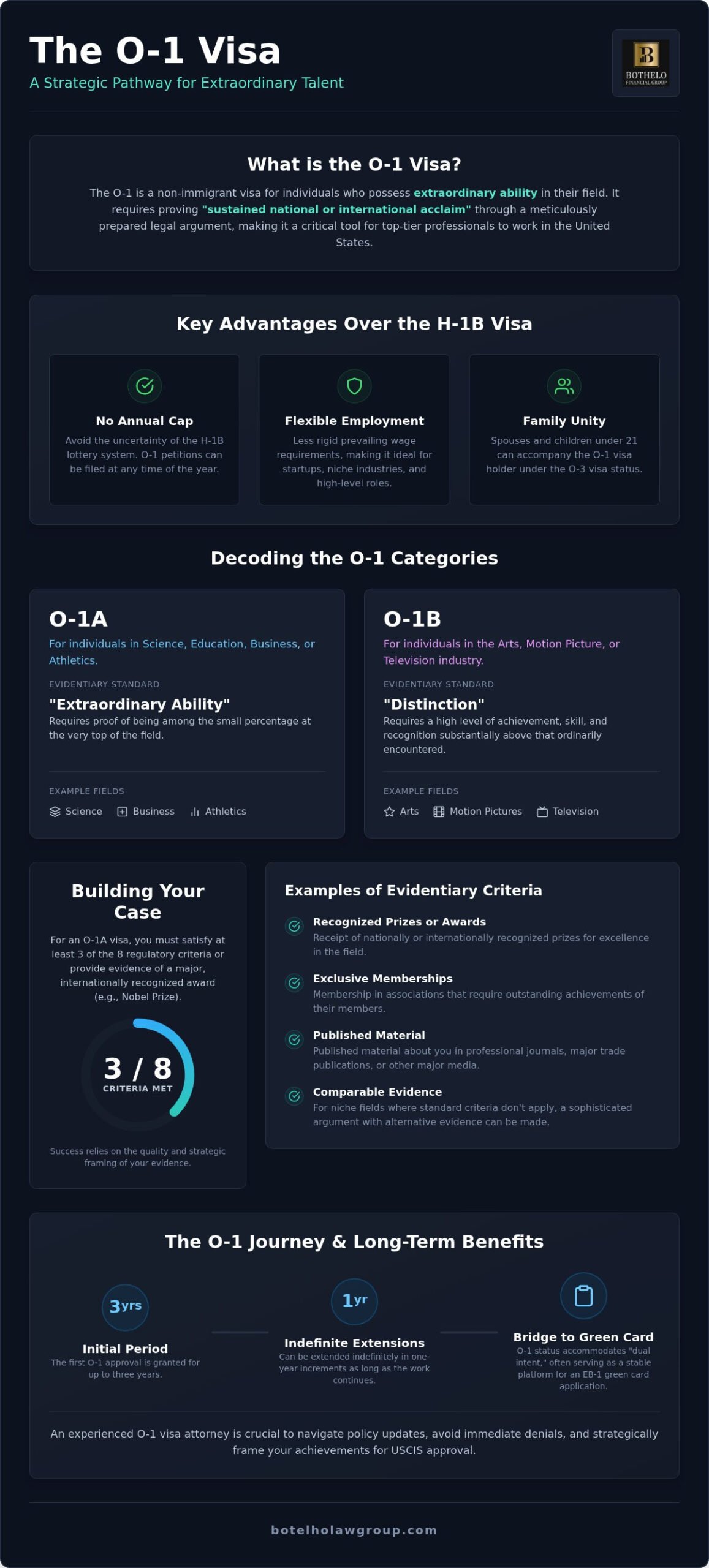
The O-1 visa serves as a premier non-immigrant status for individuals who have demonstrated extraordinary ability in their respective fields. Securing this status requires the precision of a dedicated O-1 visa attorney to prove “sustained national or international acclaim.” This legal standard implies you’ve reached a level of expertise shared by only a small percentage of people at the top of your profession. A comprehensive O-1 visa overview reveals the specific evidentiary requirements that differentiate this status from more common work permits.
Many professionals initially consider the H-1B visa, but the O-1 offers distinct legal advantages. There’s no annual cap, which means you aren’t subject to the random lottery system that leaves many qualified applicants in limbo. The O-1 also doesn’t carry the rigid prevailing wage requirements that often complicate H-1B petitions for startups or niche industries. Spouses and children under 21 can accompany the primary beneficiary under the O-3 visa status. This ensures family unity while you pursue high-level professional objectives in the United States.
O-1A vs. O-1B: Which Category Fits Your Achievement?
Selecting the correct subcategory is a critical strategic decision. The O-1A classification applies to science, education, business, and athletics. It carries a higher evidentiary burden, requiring you to prove you are among the very best in your field. In contrast, the O-1B classification covers the arts, motion pictures, and television. This category utilizes the “distinction” standard, which focuses on a high level of achievement evidenced by a degree of skill and recognition substantially above that ordinarily encountered. Misidentifying your category can lead to an automatic Request for Evidence (RFE) or an outright denial. The guidance of a focused O-1 visa attorney is vital to avoid these procedural pitfalls.
The Key Advantages of the O-1 Visa in 2026
The O-1 visa remains a powerful long-term strategy because it allows for indefinite extensions in one-year increments after the initial three-year period. This flexibility is unmatched by other non-immigrant categories. In 2026, the absence of an annual cap continues to make it the most reliable path for global talent. While the O-1 is technically a non-immigrant visa, it accommodates “dual intent” nuances more effectively than many other categories. This allows a strategist to position your current status as a stable bridge toward an EB-1 green card, provided your professional trajectory remains consistent and well-documented.
Meeting the Extraordinary Ability Standard: USCIS Criteria Explained
The success of your petition hinges on a precise interpretation of the USCIS O-1 visa criteria. For O-1A applicants in STEM, business, or athletics, the law requires meeting at least three of eight specific benchmarks. These include receiving nationally recognized prizes, membership in associations requiring outstanding achievements, or published material in professional journals. Simply checking three boxes isn’t enough to secure an approval. An O-1 visa attorney must ensure the evidence survives the “Final Merits Determination,” a process where an officer evaluates the totality of the record to decide if the applicant is truly extraordinary.
In the arts and entertainment sectors, the O-1B standard is defined as “distinction.” This threshold is technically lower than O-1A but still requires demonstrating a high level of achievement substantially above what’s ordinarily encountered. You must show you’re recognized as prominent, leading, or well-known in your field. Many applicants fall into the trap of overwhelming the officer with redundant paperwork. In 2026, USCIS officers increasingly prioritize the quality and relevance of evidence over sheer volume. Strategic curation of your professional highlights is the most effective way to satisfy these high-stakes requirements.
Proving Sustained National or International Acclaim
Extraordinary ability is legally defined as being in the small percentage at the top of the field. While a major one-time achievement like a Nobel Prize or an Academy Award satisfies the requirement immediately, most professionals rely on the three-criteria alternative. If your specific industry doesn’t align with the standard USCIS categories, you can submit “comparable evidence” to establish your standing. This requires a sophisticated legal argument to prove why the standard criteria are inapplicable and how your alternative proof demonstrates equivalent acclaim. If you’re unsure if your achievements meet these rigorous standards, consulting with an experienced legal representative can help clarify your eligibility.
The Most Common Criteria Used in Successful Petitions
- Original contributions of major significance: This requires more than just performing your duties; you must prove your work has influenced the industry as a whole.
- Authorship of scholarly articles or high-impact media: USCIS looks for articles in professional or major trade publications that have garnered significant attention or citations.
- Critical or essential capacity: This involves proving you’ve held a leadership or pivotal role for organizations that have a distinguished reputation.
Each of these points requires objective documentation, such as circulation data for publications or detailed testimonials from industry leaders. Your O-1 visa attorney focuses on connecting these dots to build a narrative of consistent, high-level success that leaves no room for subjective doubt.
Building a Winning Evidentiary Profile: Strategy Beyond the Paperwork
Success in an O-1 petition requires more than a checklist; it demands a cohesive narrative. An O-1 visa attorney acts as a curator, selecting only the evidence that reinforces your standing as a leader in your field. This process involves documenting your prospective work in the United States to prove that your presence serves a clear professional purpose. You must provide contracts, deal memos, or letters of intent that outline the specific projects you’ll undertake. Without a logical thread connecting your past achievements to your future engagements, even the most impressive resume can fail to meet the scrutiny of a USCIS officer.
The Role of Peer Advisory Letters and Expert Testimony
USCIS mandates a written advisory opinion from a peer group or labor organization. A “favorable” letter explicitly supports your expertise, while a “non-objection” letter simply states the organization has no grounds to oppose the petition. Both are acceptable, but the context of your industry often dictates which is more persuasive. Expert recommendation letters must avoid generic, boilerplate language that officers frequently disregard as “attorney-prepared.” Instead, they should incorporate objective data such as citation counts, box office figures, or documented sales growth. This grounding in fact transforms a subjective opinion into an irrefutable legal asset. When selecting experts, focus on individuals who can attest to your reputation from an objective distance rather than just close personal collaborators.
Navigating the Agent as Petitioner Model
For freelancers, artists, and independent contractors, the “Agent as Petitioner” model is a vital tool for maintaining professional flexibility. This structure allows a U.S. agent to file on your behalf even if you’ll work for multiple employers during your stay. You must provide a detailed itinerary proving a set schedule of events, performances, or engagements for the duration of the requested period. The legal safeguards in the contract between the agent and the talent must be clearly defined to satisfy USCIS O-1 Visa Information requirements regarding the nature of the employment relationship. A skilled O-1 visa attorney ensures that these contracts explicitly state the agent’s role and the terms of compensation, preventing delays caused by ambiguous employment status.
The O-1 Application Process: Timelines and Requirements for 2026
Filing the Form I-129 is the foundational step of the O-1 process. In 2026, USCIS requires the February 27, 2026 edition of this form for all petitions. Your O-1 visa attorney ensures the petition is routed to the correct service center based on the petitioner’s location and the nature of the work. This procedural accuracy is vital because a clerical error on the jurisdiction or form edition can lead to an immediate rejection. Managing a Request for Evidence (RFE) effectively is also a key part of the process. Since the August 5, 2026 policy change allows officers to deny petitions without an initial RFE if the evidence is insufficient, your initial filing must be comprehensive and legally sound from day one.
Premium Processing and Expedited Adjudication
For many high-level professionals, timing is as critical as the approval itself. Premium processing offers a decision within 15 business days. As of March 1, 2026, the fee for this expedited service is $2,965. This investment is often worth it for projects with fixed start dates or for those transitioning from an expiring status. You should also account for the 2026 USCIS fee schedule updates, which include the Asylum Program Fee and the Visa Integrity Fee. O-1 petitions can be filed up to one year before the start date. This long lead time allows for thorough preparation and the development of a robust evidentiary strategy.
Consular Processing vs. Change of Status
If you are currently outside the United States, you’ll undergo consular processing. This involves submitting the DS-160 form and attending an interview at a U.S. embassy or consulate. For those already in the U.S. on a different visa, a change of status petition allows you to transition without leaving the country. It’s essential to maintain your current legal status while the petition is pending to avoid “gap” issues. Working with an Employment Based Visa Attorney ensures that your transition is legally sound and that you remain compliant with all federal regulations throughout the process.
The 2026 landscape features increased scrutiny on renewals and a preference for digital evidence, such as online publications and contributions to open-source repositories. A seasoned O-1 visa attorney will guide you through these procedural shifts, ensuring your filing reflects the most current USCIS standards. If you are ready to secure your U.S. work authorization, consult with a legal strategist to begin building your case.
Why Choose a Focused O-1 Visa Attorney at Botelho Law Group?
Botelho Law Group operates on the principle that your professional future should not be left to the whims of a high-volume “visa mill.” We adopt a “Focused Advocate” approach, which means we don’t just file forms; we build comprehensive legal cases designed to withstand the highest levels of USCIS scrutiny. Our extensive experience in high-stakes litigation and deportation defense informs every O-1 strategy we develop. This background allows a dedicated O-1 visa attorney to identify potential weaknesses in a petition and address them proactively before they can be exploited by an adjudicator. We offer nationwide representation, facilitating the arrival of global talent in all 50 states while ensuring you have direct access to your attorney rather than being redirected to automated portals or paralegal-only communication.
Personalized Legal Strategy for High-Stakes Petitions
A boutique approach is essential when navigating the subjective “extraordinary ability” standard. Unlike larger firms that may treat your career as a set of generic data points, we treat it as a narrative of unique achievement. This focus becomes particularly critical when handling complex RFE responses. We don’t settle for passive submissions. Instead, we deploy aggressive legal arguments to challenge overreaching requests from adjudicators. Whether you are an artist in New York or a researcher seeking an Immigration Lawyer in Fall River, MA, our firm provides the sophisticated problem-solving required for success in 2026. We prioritize legal precision to ensure your petition is robust enough to survive the “deny without RFE” policy currently in place.
Bridging the Gap Between O-1 and Permanent Residency
Securing an O-1 visa is often the first step in a broader immigration journey. We specialize in strategic planning for the transition from non-immigrant status to EB-1A or EB-1B green cards. This long-term vision ensures that the evidence we gather now serves as the foundation for your permanent residency application later. For international talent based in Massachusetts, we also offer integrated services for asset protection to safeguard your professional earnings. If your goals eventually involve bringing family members to join you in the United States, our expertise as a Family Based Green Card Attorney ensures a seamless legal transition for your entire household. We act as your dedicated guide through every phase of the U.S. immigration system, providing a stable and reliable legal presence.
Securing Your Professional Future in the United States
Achieving the O-1 visa requires more than industry success; it demands a meticulously curated legal narrative that aligns with 2026 USCIS standards. You’ve reached the top of your field through dedication, and your immigration strategy should reflect that same level of excellence. By focusing on quality evidence over quantity and navigating the procedural nuances of the “Agent as Petitioner” model, you position yourself for a successful transition to U.S. work authorization. Partnering with a dedicated O-1 visa attorney ensures that your petition is built on a foundation of protective advocacy and legal precision.
At Botelho Law Group, we provide Nationwide Immigration Representation and Focused Legal Advocacy within a Full-Service Law Firm Support structure. We don’t just file forms; we build cases that protect your career trajectory and bridge the gap toward permanent residency. Consult with an O-1 Visa Attorney at Botelho Law Group today to begin your journey. Your extraordinary achievements deserve a representative who is as relentless and focused as you are.
Frequently Asked Questions
How long does it take to get an O-1 visa in 2026?
Standard processing times for O-1 petitions in 2026 typically range from 11 to 14 months depending on service center workloads. However, you can secure a decision within 15 business days by utilizing premium processing. Our firm manages these timelines for clients in Massachusetts and worldwide, ensuring every document is prepared to avoid unnecessary delays. Filing early is essential, as USCIS allows submissions up to one year before your intended start date in the United States.
Can I apply for an O-1 visa without a job offer?
You cannot self-petition for an O-1 visa. Every application requires a U.S. employer or a U.S. agent to act as the petitioner. If you are a freelancer or have multiple projects, an agent can coordinate your itinerary across different states. This requirement ensures that your work in the U.S. is documented and legitimate. An O-1 visa attorney helps structure these petitioner relationships to satisfy federal regulations while maintaining your professional flexibility.
What is the difference between O-1 and EB-1 extraordinary ability?
The primary difference is that the O-1 is a temporary, non-immigrant visa, while the EB-1 is a permanent immigrant visa leading to a green card. While both require proving extraordinary ability, the EB-1 carries a higher evidentiary standard and allows for self-petitioning in certain categories. Many of our clients in Fall River and beyond use the O-1 as a strategic bridge to demonstrate sustained acclaim before pursuing a permanent EB-1 application.
Do I need to be famous to qualify for an O-1 visa?
Fame is not a legal requirement for the O-1 visa. You must instead demonstrate that you are among the small percentage at the top of your field by meeting specific USCIS criteria. This can involve original contributions, authorship in professional journals, or a history of high-salary compensation. Our O-1 visa attorney focuses on translating your technical achievements into a narrative of national or international acclaim that satisfies federal adjudicators regardless of your public celebrity status.
Can my spouse work in the U.S. on an O-3 visa?
Spouses and children under 21 who hold O-3 status are not authorized to work in the United States. They may, however, engage in full-time or part-time study without a separate student visa. This limitation makes long-term strategic planning essential for families moving to Massachusetts. We often assist families in exploring alternative employment-based visas or permanent residency options if the spouse also intends to pursue a professional career during their stay in the country.
What happens if my O-1 visa petition is denied?
If your petition is denied, you may have the option to appeal the decision, file a motion to reopen, or refile a new petition with more robust evidence. Given the 2026 policy allowing denials without an initial Request for Evidence, the stakes are exceptionally high. Our firm leverages experience in deportation defense and high-stakes litigation to analyze denial notices and build an aggressive strategy for your next steps, protecting your ability to remain in the U.S.
How many times can I extend my O-1 visa status?
There is no statutory limit on the number of times you can extend your O-1 status. USCIS typically grants an initial stay of up to three years, followed by indefinite extensions in one-year increments as long as the work continues. Each extension requires proving that you maintain your extraordinary ability and have ongoing projects. We help clients throughout Massachusetts document their continued acclaim to ensure their professional presence in the U.S. remains uninterrupted and legally secure.
Is there an age limit for the O-1 extraordinary ability visa?
Federal immigration law does not impose an age limit on O-1 visa applicants. Whether you are a young prodigy in athletics or a seasoned executive with decades of business experience, the focus remains entirely on your “extraordinary ability” and sustained acclaim. Adjudicators look for objective proof of your standing in the field rather than your age. We represent global talent at all career stages, ensuring their unique professional milestones are framed effectively for USCIS approval.