
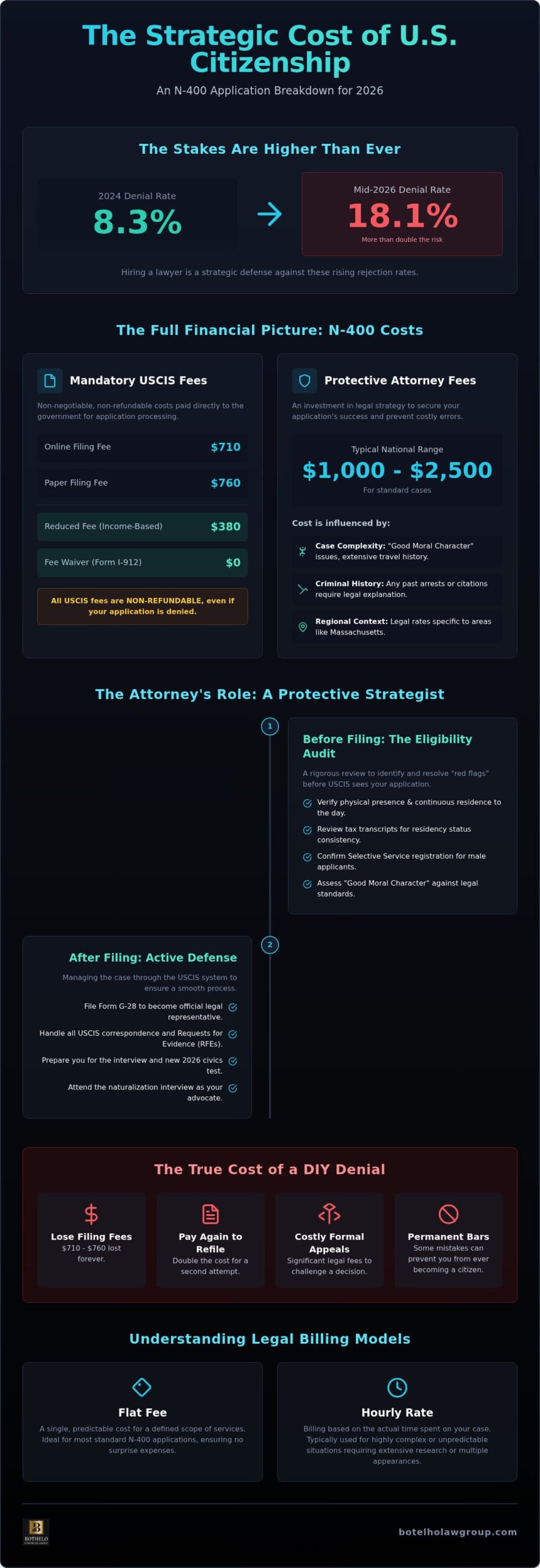
Did you know the national denial rate for N-400 applications surged from 8.3% in 2024 to over 18% by mid-2026? When you consider the cost of hiring a lawyer for N-400, it’s vital to view the expense as a strategic safeguard against these rising rejection rates. You’ve worked hard to build a life in the United States, and it’s natural to feel anxious about the shifting 2026 USCIS fee schedule or the risk of losing your non-refundable filing fees due to a minor administrative error.
We understand that you want a clear, predictable path to citizenship without the anxiety of hidden expenses. This guide provides a transparent breakdown of the full financial commitment, from the current $710 online filing fee to the proposed increases on the horizon. You’ll gain a comprehensive understanding of attorney fee structures and the specific ways a Fall River immigration expert justifies the investment by preventing permanent citizenship bars. We’ll outline the current fee landscape and explain how professional oversight ensures your application is handled with the precision and focus it deserves.
Key Takeaways
- Identify the exact 2026 USCIS filing fee requirements to prevent administrative rejections caused by common payment errors.
- Evaluate how the cost of hiring a lawyer for N-400 provides a strategic defense against rising denial rates and complex eligibility challenges.
- Distinguish between flat-fee and hourly billing models to ensure your legal representation remains predictable and focused on your specific goals.
- Assess the long-term financial risks of an N-400 denial, including the cumulative expense of refiling fees and formal naturalization appeals.
- Leverage professional legal oversight to navigate the more rigorous 2026 civics test and holistic moral character assessments with confidence.
Breaking Down the N-400 Cost: Filing Fees vs. Attorney Fees
Achieving U.S. citizenship is a milestone that requires a precise financial strategy. You must distinguish between the non-negotiable fees paid to the government and the professional fees paid to your legal representative. While government fees cover administrative processing, the cost of hiring a lawyer for N-400 secures the strategic defense of your permanent record. These two costs serve different purposes; one opens the door, while the other ensures you’re prepared to walk through it without triggering a denial. Understanding this distinction prevents unexpected financial strain during the naturalization process.
Mandatory USCIS Government Fees in 2026
As of September 2026, the standard filing fee for Form N-400 is $710 for online submissions and $760 for paper filings. These amounts now include the biometrics services fee, so you don’t need to calculate a separate appointment cost for fingerprints or photographs. Many applicants use Form G-1450 to authorize credit card payments, but you must exercise caution. If USCIS rejects a payment due to a daily limit or an expired card, they’ll typically reject the entire application package, causing significant delays and potential loss of priority.
It’s vital to remember that all government fees are non-refundable. If your application is denied because of an eligibility error or a failure to disclose required information, the government retains the funds. You’ll be forced to pay the full amount again to refile. For those facing financial hardship, a reduced fee of $380 is available for eligible lower-income applicants, and a full fee waiver ($0) remains an option for those who qualify through Form I-912. However, these assistance programs are currently only accessible through paper-based filings.
Variable Attorney Fee Ranges for Naturalization
The cost of hiring a lawyer for N-400 reflects the level of risk and technical complexity in your specific background. While national averages for standard cases often range between $1,000 and $2,500, several factors can influence the final quote. A standard legal package generally includes a comprehensive eligibility audit, meticulous form preparation, and professional representation during the USCIS interview.
- Case Complexity: Applications involving “Good Moral Character” concerns or extensive travel outside the U.S. require more intensive legal research.
- Criminal History: If you have any prior arrests or citations, your attorney must prepare a protective legal memorandum to explain these events to the adjudicating officer.
- Regional Context: Massachusetts legal rates may vary based on the specific requirements of the Boston field office and the depth of local expertise required.
By investing in professional oversight, you’re not just paying for form-filling; you’re paying for a sophisticated strategist who identifies red flags before they reach a government officer’s desk.
What Does a Naturalization Attorney Actually Do for the Fee?
Many applicants mistakenly assume the cost of hiring a lawyer for N-400 covers simple data entry. In reality, a qualified attorney acts as a protective strategist. They scrutinize your entire immigration history for “red flags” that frequently trigger denials, such as undisclosed arrests, tax discrepancies, or prolonged absences from the United States. By the time you pay the official N-400 filing fees, your attorney has already constructed a comprehensive legal defense around your eligibility. This proactive approach is designed to prevent the 18.1% denial rate seen in 2026 from affecting your specific case.
Pre-Filing: The Eligibility Audit
An attorney conducts a rigorous audit before a single form is submitted to the government. This process involves verifying physical presence and continuous residence requirements down to the specific day to ensure you meet the statutory thresholds. Your legal representative will review tax transcripts to confirm you haven’t claimed “non-resident” status and verify Selective Service registration for male applicants. Good Moral Character is a legal standard evaluating whether an applicant’s conduct during the statutory period measures up to the average standards of the community where they reside. This audit ensures you don’t risk non-refundable funds on an application that is legally destined for rejection.
Post-Filing: Managing USCIS Correspondence
The work shifts to active defense once the application is in the USCIS system. Your attorney files Form G-28, establishing them as your official representative of record. This legal standing ensures that USCIS must copy your lawyer on every notice, interview appointment, and Request for Evidence (RFE). If an RFE arrives, your legal team manages the high-stakes response, drafting technical legal arguments to satisfy the adjudicating officer’s concerns without causing unnecessary processing delays.
Beyond managing paperwork, your advocate prepares you for the modernized 2026 civics test, where you must now answer 12 out of 20 questions correctly from an expanded pool. They provide physical representation at the field office during your interview, acting as a professional witness to ensure the officer adheres to established policy and treats your testimony fairly. If you’re concerned about how your past might impact your future, a specialized naturalization attorney can provide the focused advocacy required to secure your citizenship with confidence.
Flat Fees vs. Hourly Rates: Which Billing Model is Best?
Selecting the appropriate billing structure is a critical component of your financial strategy when pursuing U.S. citizenship. When you evaluate the cost of hiring a lawyer for N-400, you’ll generally encounter two distinct models: flat-fee arrangements and hourly billing. Each serves a specific purpose based on the complexity of your immigration history and the level of risk involved in your application. For most standard naturalization cases, the goal is financial predictability and the elimination of “surprise” invoices for routine communication.
The Benefits of Flat-Fee Immigration Services
Flat-fee models are the preferred standard for the majority of naturalization applications because they offer total transparency. This structure consolidates the eligibility audit, form preparation, and interview attendance into a single, predetermined investment. It allows you to budget for your entire citizenship journey without the anxiety of being billed for every phone call, email, or administrative task. Most experienced firms in Fall River utilize this model for N-400 cases to provide clients with a clear, results-oriented roadmap.
While a flat fee covers the core application process, it’s essential to understand what might fall outside this scope. Typically, a flat-fee agreement for an N-400 does not include:
- Formal appeals of a prior citizenship denial (Form N-336).
- Representation in separate deportation or removal proceedings.
- Complex litigation in federal court to compel a decision on a stalled case.
When Complex Cases Require Hourly Representation
Hourly billing is often reserved for high-stakes cases where the scope of work is unpredictable and requires intensive legal research or litigation. If your background involves allegations of prior immigration fraud or a criminal record that challenges the “Good Moral Character” standard, your advocate may suggest an hourly rate. These scenarios often require the drafting of multiple legal memoranda and extensive coordination with various government agencies, making a fixed-fee model difficult to calculate accurately.
Hourly rates are also common when an applicant is already in removal proceedings but remains eligible to seek naturalization. In these instances, the total cost of ownership is generally higher because the attorney must defend you in immigration court while simultaneously managing the USCIS application. Whether your case is straightforward or complex, choosing a firm that prioritizes a structured, systematic approach ensures that every billable minute or flat-fee milestone is dedicated to securing your status as a U.S. citizen.
The True Cost of a DIY N-400 Denial or RFE
The initial cost of hiring a lawyer for N-400 is often weighed against the perceived savings of a “do-it-yourself” approach, but this calculation rarely accounts for the financial burden of failure. When an application is denied, the non-refundable USCIS filing fees are permanently lost. You don’t just lose capital; you lose months or even years of progress in a system where median processing times currently range between 8 and 17.5 months. A single administrative error or a misunderstood eligibility question can turn a straightforward naturalization journey into a multi-year legal battle.
Financial Consequences of a Citizenship Rejection
A rejection triggers a “refiling penalty” that immediately doubles your government expenses. Because USCIS does not issue refunds for denied cases, you must pay the $710 online or $760 paper filing fee a second time to start over. If the denial was based on a substantive legal issue, the expense of an N-400 denial appeal lawyer to handle an N-336 hearing is significantly higher than the investment in a correct initial filing. Corrective legal work is inherently more labor-intensive because the attorney must first deconstruct and fix the previous record before moving forward. These costs often include:
- Lost initial filing fees of $710 or $760.
- The price of new biometrics appointments if the previous data expires.
- Escalated legal fees for “fix-it” representation and formal appeals.
Legal Risks Beyond Financial Loss
The N-400 process is a comprehensive re-examination of your entire immigration history. USCIS officers use this application to scrutinize how you obtained your original Green Card and whether you’ve maintained eligibility ever since. Minor inconsistencies on forms can be interpreted as “false testimony,” which can lead to permanent bars to citizenship. In high-stakes scenarios, a poorly filed application can even trigger removal proceedings. This shifts your situation from a citizenship quest to a defensive battle against deportation. Simple mistakes are frequently viewed as intentional fraud by officers, especially regarding “Good Moral Character” disclosures.
The “opportunity costs” of a denial are equally severe. Every month spent waiting for a refiled application is a month you cannot access federal employment, secure a U.S. passport, or sponsor family members for their own petitions. If you’re facing a complex Request for Evidence or a prior rejection, consult a naturalization specialist to secure your status and prevent further losses.
Securing Your Citizenship with Botelho Law Group in Fall River
Botelho Law Group provides comprehensive naturalization representation for clients in Fall River and across all 50 states. We prioritize a results-oriented approach that balances technical legal precision with dedicated client advocacy. When you evaluate the cost of hiring a lawyer for N-400, the primary value lies in the security of a professional record review. Our firm specializes in navigating the high-stakes “Good Moral Character” assessments that have become increasingly rigorous under the 2026 USCIS policy guidelines. We act as your dedicated strategist, ensuring that every aspect of your immigration history is prepared to withstand intense government scrutiny.
Why Choose a Local Fall River Immigration Expert?
While virtual-only firms promote convenience, they frequently overlook the nuanced dynamics of local field office adjudication. An Immigration Lawyer in Fall River, MA offers a distinct advantage by providing physical representation during your citizenship interview. We understand the specific expectations and procedural trends within the Boston field office and across the New England region. This local insight allows us to prepare you for the unique questioning styles of regional officers, ensuring you approach your appointment with confidence and clarity.
Our commitment to a flat-fee pricing model ensures that this localized expertise remains accessible and predictable. You’ll receive a structured breakdown of services that covers every phase of the process, from the initial eligibility audit to the final administrative review. This transparency eliminates the risk of unexpected legal costs, allowing you to focus on the significance of your naturalization journey rather than administrative surprises. We provide the stability and reliability of a physical office where you can meet your advocate face-to-face.
Next Steps: Your Path to U.S. Citizenship
The journey to becoming a U.S. citizen requires meticulous preparation and a disciplined approach to documentation. We invite you to schedule a consultation where we will conduct a preliminary review of your case and provide a tailored fee quote. To maximize the value of this initial meeting, we recommend preparing the following items for our review:
- Tax transcripts for the last five years, or three years if you’re filing based on marriage to a U.S. citizen.
- Detailed records of all international travel since obtaining your Lawful Permanent Resident status.
- Certified court dispositions for any legal citations, arrests, or charges, regardless of the eventual outcome.
The Botelho Law Group process is designed to be methodical and protective. We manage the technical complexities of your filing, monitor all USCIS correspondence, and provide the focused advocacy required to navigate the updated 2026 civics test requirements. Contact our Fall River office today to secure a results-oriented review of your N-400 case and take the final step toward U.S. citizenship with an expert by your side.
Finalizing Your Path to American Citizenship
Navigating the 2026 naturalization landscape requires a disciplined approach to both legal strategy and financial planning. You’ve seen that the cost of hiring a lawyer for N-400 is more than an administrative expense; it’s a strategic safeguard against a rising denial rate and the permanent loss of non-refundable government fees. By choosing a structured flat-fee model, you eliminate the risk of surprise invoices while ensuring every eligibility “red flag” is professionally addressed before your interview at the field office. This investment provides the certainty that a “do-it-yourself” approach simply cannot guarantee.
Botelho Law Group stands as a dedicated advocate for those facing complex naturalization hurdles, including Good Moral Character assessments and prior immigration challenges. From our headquarters in Fall River, Massachusetts, we provide specialized representation across all 50 states to ensure your application meets the highest standards of precision. Don’t leave your future to chance or risk the significant delays of a refiled application. Schedule a Consultation with Botelho Law Group today to secure your status with the support of a seasoned strategist. We’re ready to help you complete your American dream with confidence.
Frequently Asked Questions
How much does USCIS charge for the N-400 application in 2026?
USCIS currently charges $710 for online filings and $760 for paper-based submissions as of September 2026. These mandatory fees include biometrics services, so you don’t need to pay a separate appointment fee for fingerprints or photographs. Note that a proposed rule from June 2026 seeks to increase these costs significantly, potentially reaching $1,280 for online filings. Always verify the most current rate on the official USCIS website before submitting your payment.
Can I get a fee waiver for my citizenship application?
You may qualify for a full fee waiver by filing Form I-912 if your household income is at or below 150% of the Federal Poverty Guidelines. This option is also available if you receive a means-tested benefit or face extreme financial hardship. Additionally, a reduced fee of $380 is available for those with incomes under 400% of the poverty guidelines. These assistance programs currently require paper filing to be processed by USCIS.
Is it worth hiring a lawyer for a ‘simple’ citizenship case?
Even cases that appear straightforward carry significant risks due to the 18.1% national denial rate recorded in 2026. The cost of hiring a lawyer for N-400 ensures that a professional identifies potential “red flags” like travel history or tax compliance issues before they reach an officer. Professional oversight prevents the loss of non-refundable filing fees and avoids the lengthy delays associated with a Request for Evidence or a formal denial.
What is the average attorney fee for a naturalization application?
National averages for standard naturalization representation generally range from $1,000 to $2,500 depending on the case complexity. At Botelho Law Group, we provide tailored fee quotes based on a thorough review of your specific immigration history and eligibility. Factors such as criminal records or previous immigration issues will influence the final quote. We prioritize transparent billing structures so you can budget for your citizenship journey without unexpected administrative expenses.
Do I have to pay the lawyer’s fee all at once?
Fee structures vary by firm, but many immigration specialists offer structured payment arrangements to make professional representation more accessible. Botelho Law Group utilizes flat-fee models for naturalization applications to provide clients with financial predictability. During your initial consultation in Fall River, we’ll discuss the specific terms of our representation agreement. This ensures you understand the total investment required to secure your status before the legal process begins.
What happens to my fees if my N-400 is denied?
USCIS filing fees are non-refundable regardless of the outcome of your application. If your N-400 is denied due to an eligibility error or administrative mistake, the government retains your payment, and you must pay the full amount again to refile. This financial risk is a primary reason why many applicants in Massachusetts choose professional legal review. A correct initial filing is the most cost-effective way to achieve U.S. citizenship.
Does the legal fee include representation at the citizenship interview?
Standard naturalization legal packages typically include physical representation by an attorney at your USCIS interview. Having an advocate present ensures the adjudicating officer follows established policy and treats your testimony fairly. At Botelho Law Group, we prepare you for the 2026 civics test and accompany you to the field office to provide focused advocacy. This physical presence is a critical component of our results-oriented service for clients in Fall River.
Are there extra costs if I have a criminal record?
Cases involving criminal records or “Good Moral Character” issues often require additional legal work, which may impact the total cost of hiring a lawyer for N-400. Your attorney must conduct extensive research and draft a legal memorandum to explain how your history meets statutory requirements. These complex scenarios require a more intensive defense strategy to prevent a permanent bar to citizenship. We’ll provide a customized quote after reviewing your specific court dispositions.