
The same marriage can lead to two different green card processes. If you’re researching how to get a green card for spouse, the right path depends on whether the petitioner is a U.S. citizen or lawful permanent resident, where the spouse lives, and the spouse’s immigration history.
It’s understandable to feel uncertain about which forms to file, what evidence to gather, and whether an error could delay a decision. A spouse in the United States may be eligible to apply for adjustment of status, while a spouse abroad generally follows consular processing. The petitioner’s immigration status can also affect visa availability and the steps involved.
This guide covers the main spouse-based green card paths, typical filing stages, and evidence couples may need to prepare. It also explains what may happen after filing, including possible interviews, and when circumstances such as prior immigration issues or inconsistent records may call for case-specific legal guidance. Reviewing the process before submitting can help you identify which requirements apply to your situation.
Key Takeaways
- To understand how to get a green card for spouse, first consider the petitioner’s status and whether the spouse is in the United States or abroad.
- Location can point to the likely process, but entry history and other immigration factors may affect adjustment eligibility.
- Check the required forms, current filing instructions, and evidence of a genuine marriage before submitting an application.
- Prepare for possible notices, biometrics, requests for evidence, and interviews. The sequence and timing can vary by case.
- Prior immigration issues, past denials, or inconsistent records may warrant case-specific legal review before filing.
How to Get a Green Card for Your Spouse: Start With Eligibility
A marriage-based green card is a family-based route to lawful permanent residence in the United States. The U.S. citizen or lawful permanent resident spouse files a petition, but the foreign national spouse must also meet the immigration requirements that apply to the case. A valid marriage is essential, but it does not guarantee approval.
Before deciding how to get a green card for spouse, identify the petitioner’s immigration status and review the applicant’s history. Prior immigration violations, removals, criminal history, or possible misrepresentation can affect eligibility or require closer legal analysis. These circumstances do not all have the same consequences, so don’t assume that a past event automatically disqualifies someone or is irrelevant.
Does the petitioner’s immigration status change the process?
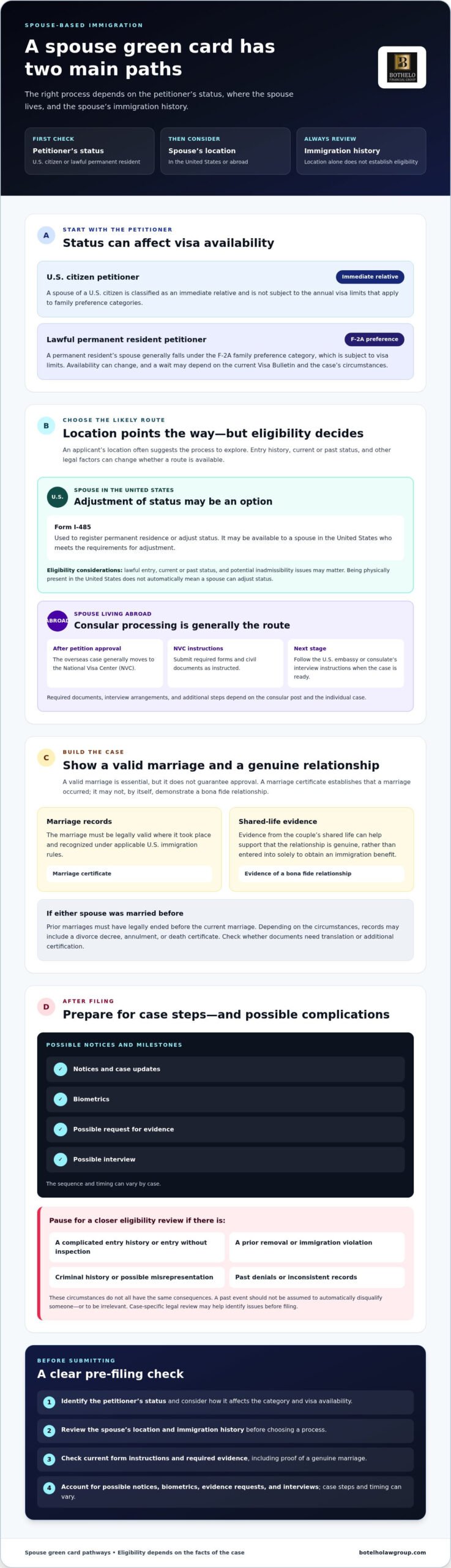
Yes. U.S. citizens and lawful permanent residents may petition for a spouse, but the categories and visa availability rules differ. USCIS classifies the spouse of a U.S. citizen as an “immediate relative.” Immediate relatives are not subject to the annual visa limits that apply to family preference categories.
A permanent resident’s spouse generally falls under the F-2A family preference category, which is subject to visa limits. Availability can change, and a wait may depend on the current Visa Bulletin and the case’s circumstances. The petitioner’s status can therefore affect both the available route and when the spouse may proceed. For background on the meaning of Lawful Permanent Resident, see this overview, then consult current official guidance for case-specific requirements.
Does the marriage qualify for immigration purposes?
Generally, the marriage must be legally valid where it took place and recognized under applicable U.S. immigration rules. The couple must also show that the relationship is genuine, rather than entered into solely to obtain an immigration benefit. A marriage certificate establishes that a marriage occurred, but may not, by itself, demonstrate a bona fide relationship. Evidence from the couple’s shared life can help support that requirement.
Any prior marriages must have legally ended before the current marriage. Depending on the circumstances, records may include a divorce decree, annulment, or death certificate. Confirm which records are required for each prior marriage and whether documents need translation or additional certification before filing.
Eligibility depends on the facts. If the applicant has a complicated entry history, a prior removal, criminal history, or concerns about information submitted in an earlier immigration matter, an individualized review can help identify issues before they affect the filing strategy.
Choose Between Adjustment of Status and Consular Processing
The spouse’s location often points to the likely route, but location alone does not determine eligibility. Eligible applicants in the United States may seek adjustment of status. A spouse abroad generally completes consular processing. Entry history, immigration status, and other legal factors may affect whether a route is available, so don’t choose based on location alone.
When may adjustment of status be an option?
Form I-485 is the application used to register permanent residence or adjust status. It may be available to a spouse in the United States who meets the requirements for adjustment. Lawful entry, current or past status, and potential inadmissibility issues may all matter. These factors are not a complete eligibility checklist. USCIS explains eligibility for a green card for immediate relatives of U.S. citizens. Other petitioner categories may follow different rules.
For example, being physically present in the United States doesn’t automatically mean a spouse can adjust status. A past entry without inspection or an earlier immigration violation may change the analysis. Review the circumstances before filing Form I-485 or making decisions about travel while an application is pending. The firm’s family-based green card guidance may help couples understand the petition process.
What should a spouse abroad expect from consular processing?
After the family petition is approved, an overseas case generally moves to the National Visa Center (NVC). The NVC provides instructions for submitting required forms and civil documents. When the case is ready for the next stage, the spouse follows the U.S. embassy or consulate’s interview instructions. Required documents, interview arrangements, and any additional steps depend on the consular post and the individual case.
Neither route is universally available, and the processes are not interchangeable. A spouse abroad generally cannot use adjustment of status simply because the couple would prefer to complete the case in the United States. Likewise, a spouse already in the country should not assume that filing Form I-130 alone establishes whether adjustment is permitted.
To determine how to get a green card for spouse, assess the petitioner’s status alongside the applicant’s location and full immigration history. Immigration counsel can help evaluate those facts and organize a filing strategy. Botelho Law Group handles family-based green card petitions nationwide and assists clients abroad with consular processing. Couples seeking help with spouse-based immigration matters can consider a case-specific review before selecting a route.
Which Forms and Evidence Support a Spouse Green Card Case?
Preparation involves more than completing forms. Couples need to select filings that match the spouse’s route and provide accurate, consistent evidence. If you’re researching how to get a green card for spouse, treat the documents as a record of the relationship and eligibility, not as a fixed checklist that guarantees approval.
What does the I-130 petition establish?
Form I-130 asks U.S. Citizenship and Immigration Services (USCIS) to recognize a qualifying family relationship between the petitioner and spouse. Form I-130A provides additional information about the spouse beneficiary when required by current USCIS instructions. Check the official Green Card eligibility for spouses guidance and form pages for current editions, filing instructions, signature requirements, and submission methods.
Use genuine records that show the couple’s shared life over time. The most relevant evidence depends on what exists and the circumstances of the relationship. For example, couples may provide records of shared housing or finances, insurance coverage, correspondence, photographs from different occasions, or documents relating to children, if applicable.
Evidence should be consistent with the information on the forms. Don’t create documents, alter records, or rehearse answers. If the couple has separate residences, limited joint finances, or another unusual circumstance, explain it accurately and provide context where appropriate.
| Evidence category | Examples to consider |
|---|---|
| Identity | Passports, birth records, and other requested identity documents |
| Marriage | Marriage certificate and proof that prior marriages legally ended |
| Relationship | Shared residence or financial records, insurance, correspondence, photographs, and children’s records when applicable |
| Financial sponsorship | Form I-864 and supporting income or tax documents, when required |
| Route-specific | Form I-485 and related filings for eligible applicants in the United States, or forms and civil documents requested for consular processing |
This is a starting point, not a universal document list. Confirm current requirements before filing, and address missing or unusual records honestly instead of trying to force the evidence into a standard pattern.
What Happens After Filing, and What Could Complicate the Case?
Filing begins a review, not an automatic approval. A marriage does not itself grant permanent residence or work authorization. An eligible applicant with a pending adjustment application may request work authorization separately, but the spouse must qualify and receive authorization before working. The steps that follow depend on whether the case proceeds through adjustment of status or consular processing, as well as the couple’s circumstances.
What are the main stages after the petition is filed?
The sequence varies, but cases commonly move through these stages:
- Receipt and petition review: USCIS issues a receipt notice after accepting the filing, then reviews the petition and supporting evidence. The I-130 petition stage is separate from the spouse’s later application for residence.
- Route-specific processing: An eligible spouse in the United States may submit Form I-485 for adjustment of status. In an overseas case, an approved petition generally proceeds to National Visa Center processing and then consular review.
- Additional review: USCIS may schedule biometrics when required, issue a request for evidence, or arrange an interview. A spouse abroad follows the relevant consular post’s interview instructions.
- Decision: The agency or consular officer reviews the application and evidence before deciding the case. Approval is not guaranteed, and approval of a petition alone does not grant permanent residence.
Follow the instructions in each official notice, respond by the stated deadline, and keep contact information current. General processing estimates can’t predict the outcome or timing of an individual case.
What case issues deserve prompt legal review?
Prior overstays, unauthorized employment, entry without inspection, removal history, and criminal records can affect the analysis. Their consequences depend on the details, so disclose them accurately and seek individualized review before filing or acting on assumptions.
Inconsistent answers across forms, unsupported claims, or missed notices can create avoidable complications. Review every filing for accuracy, retain copies, and address unusual circumstances truthfully. If the marriage is less than two years old when permanent residence is approved, the spouse generally receives conditional residence. To remove the conditions, the couple must file Form I-751 during the 90-day period before the conditional card expires.
If a past immigration event or inconsistency raises questions about how to get a green card for spouse, a case-specific review may help clarify the filing strategy. Discuss your spouse green card case with an immigration attorney before submitting a response or application.
Plan Your Spouse Green Card Application With Clear Next Steps
Before starting a filing, organize the facts that determine the route and the documents you may need. A clear record makes it easier to spot missing information, explain inconsistencies, and prepare focused questions. If you’re deciding how to get a green card for spouse, start with the couple’s actual immigration and relationship history rather than relying on a generic checklist.
What information should couples gather before seeking advice?
Collect copies of key records and prepare a truthful timeline. Include:
- Identity and marriage documents: Passports or other identity records, the current marriage certificate, and records showing how any prior marriages ended.
- Immigration history: Travel and entry details, prior visa or immigration filings, notices from immigration agencies, and records of any proceedings or decisions.
- Relationship history: A concise chronology of how the relationship developed, important dates, shared addresses, and relevant changes in living arrangements.
- Current contact details: Each spouse’s current address and reliable contact information, including any recent changes that may affect notices or case correspondence.
Be candid about gaps or uncertainty. Don’t guess at dates or leave out an event because it seems minor. Avoid sending original documents or sensitive personal information through unsecured channels. Ask how records should be shared safely.
When should a spouse green card case receive legal review?
Consider an individualized assessment before filing if either spouse has prior immigration violations, a criminal history, a removal case, a prior denial, a complicated entry, or inconsistent information in earlier records. These circumstances don’t all have the same effect. An immigration attorney can review the facts, assess which process may apply, identify issues that need attention, and help organize the filing strategy without guaranteeing an outcome.
Botelho Law Group handles family-based green card matters for clients throughout the United States and assists individuals abroad with consular processing. The firm is based in Fall River, Massachusetts, and represents clients nationally. Each case depends on its own facts and applicable requirements.
Once you’ve gathered the records and timeline, consider discussing questions or concerns before submitting an application. Contact Botelho Law Group about your spouse green card circumstances to explore whether case-specific guidance may help you plan the next steps.
Take the Next Step With a Clear Filing Strategy
Understanding how to get a green card for spouse starts with identifying the process that fits the petitioner’s status, the spouse’s location, and the applicant’s immigration history. Adjustment of status and consular processing involve different steps, and location alone does not determine the right route. Careful, consistent forms and evidence can help you prepare a more complete application, but approval depends on meeting the applicable requirements.
Before filing, organize marriage and identity records, review prior immigration history, and check current government instructions. If there has been a prior denial, removal, complicated entry, or inconsistent record, case-specific legal review may help clarify the issues and next steps.
Botelho Law Group handles family-based green card petitions for clients nationwide and assists individuals abroad with consular processing. Discuss your spouse-based immigration case with Botelho Law Group to consider a filing strategy based on your circumstances. With careful preparation and appropriate guidance, you can move forward with greater clarity.
Frequently Asked Questions
Can my spouse get a green card if I am a permanent resident?
Yes. A lawful permanent resident may petition for a spouse, but the case follows a family preference category rather than the immediate-relative category available to spouses of U.S. citizens. Visa availability can change, and the waiting period depends on the category and current government processing. Check the current Visa Bulletin and official USCIS instructions before planning next steps. A Massachusetts immigration attorney can help assess which requirements apply to your case.
Can my spouse apply for a green card while in the United States?
Possibly, but being physically present in the United States does not automatically make a spouse eligible to adjust status. Form I-485 is generally used when adjustment is permitted, and eligibility may depend on the spouse’s entry, immigration history, petitioner’s status, and other legal factors. If there has been an overstay or another immigration issue, review the facts before filing. Couples in Massachusetts should confirm the correct route using current official guidance.
How long does it take to get a green card for a spouse?
There is no single timeline that applies to every case. How long it takes to get a green card for spouse can depend on the petitioner’s status, visa availability, whether the spouse applies in the United States or abroad, agency workload, and any requests for evidence or interview scheduling. Avoid relying on an old estimate or general online average. Check current USCIS processing information or Department of State guidance for the relevant case stage.
What forms are needed for a spouse green card?
Form I-130 is commonly used to petition for a qualifying family relationship, and Form I-130A may be required in spouse cases under current USCIS instructions. An eligible applicant adjusting status may also need Form I-485 and related filings. A spouse abroad generally follows consular processing requirements instead. The correct forms depend on the case, so check current form editions, instructions, and submission requirements before filing a package.
Does getting married automatically give my spouse a green card?
No. Marriage alone does not grant lawful permanent residence, work authorization, or permission to remain in the United States. The couple must complete the applicable immigration process, establish eligibility, submit truthful and consistent documentation, and receive approval. The spouse’s immigration history or other legal issues may affect the available route. If you live in Massachusetts and have questions about a past immigration event, consider obtaining case-specific guidance before filing.
What happens if our marriage is less than two years old when the green card is approved?
If the marriage is less than two years old when permanent residence is approved, the spouse generally receives conditional permanent residence. The couple must file Form I-751 to request removal of the conditions during the 90-day period before the conditional card expires. Check current USCIS instructions for filing requirements. If the marriage ends or circumstances change, the rules may require closer review, so seek guidance based on the specific facts.
Do we need an immigration lawyer to apply for a spouse green card?
Not every couple needs a lawyer, and legal representation cannot guarantee approval. Individual review may be especially helpful when a case involves prior immigration violations, a criminal record, a past denial, removal history, or uncertainty about adjustment versus consular processing. Couples with straightforward cases should still follow current official forms and instructions carefully. Botelho Law Group, based in Fall River, Massachusetts, handles family-based green card petitions nationwide and assists individuals abroad with consular processing.