
A distribution that seems straightforward can create a dispute if it conflicts with the trust’s terms or Massachusetts law. Trustees need to make careful decisions, keep reliable records, and communicate with beneficiaries while protecting trust assets. If you’re looking for a trust administration lawyer Massachusetts trustees can consult, focused legal guidance can help clarify your responsibilities before an unresolved question becomes a larger problem.
It’s common to have questions about required notices, recordkeeping, or when assets may be distributed. The trust document and state law both matter, and the right course depends on the trust’s terms and circumstances. This guide covers the main stages of Massachusetts trust administration, key trustee responsibilities, and situations where legal guidance may be useful.
You’ll also learn what to gather before discussing the trust, its assets, and decisions ahead. Botelho Law Group, based in Fall River, provides estate planning and asset protection counsel to Massachusetts residents. Understanding the process can help you approach your role with greater confidence and care.
Key Takeaways
- Understand how a grantor, trustee, successor trustee, and beneficiary have distinct roles and responsibilities under a trust.
- Follow a practical administration sequence, starting with document review and moving to asset management, reporting, and distributions as circumstances allow.
- Assess whether routine recordkeeping is manageable or whether interpretation questions, disputes, court issues, or complex assets call for legal guidance.
- Prepare the trust document, asset information, relevant correspondence, and a list of urgent decisions or unanswered questions for a focused legal discussion.
- Learn when a trust administration lawyer Massachusetts trustees can consult may help clarify responsibilities and next steps.
What a Trust Administration Lawyer in Massachusetts Helps a Trustee Manage
Trust administration counsel advises a trustee on carrying out the trust’s instructions, meeting applicable legal duties, and addressing questions as assets are managed and beneficiaries’ interests are considered. A trust administration lawyer Massachusetts trustees consult can help interpret unclear provisions, organize documentation, and assess proposed actions that could lead to disagreement or legal exposure.
A trust separates roles and responsibilities. The grantor, also called the settlor, creates and funds the trust. The trustee holds and manages trust property under the trust’s terms and applicable law. A successor trustee takes over when the named trustee can no longer serve or a specified condition occurs. Beneficiaries have interests or rights defined by the trust and governing law, but they don’t automatically have the same authority as the trustee. For a high-level explanation of these roles, see Trust (law).
A trustee’s fiduciary role means managing trust property in good faith for the purposes of the trust and the interests the law protects. Massachusetts trust administration is generally governed by the Massachusetts Uniform Trust Code. The trust document and the circumstances help determine how particular duties apply. The instrument may address who receives information, how assets are handled, and when distributions may be made. If a provision is ambiguous or a decision could affect beneficiaries differently, consider both the document and applicable law before acting.
Who is responsible for administering a trust?
The person named in the trust generally assumes the role by accepting trusteeship. If that person cannot or stops serving, the trust’s successor-trustee provisions guide who may take responsibility next. The trustee remains the decision-maker, subject to the trust’s terms and legal duties. A lawyer advises and represents the client who retains them. Hiring counsel does not, by itself, appoint the lawyer as trustee or transfer the trustee’s responsibilities.
What does a trust administration lawyer help address?
Counsel can review relevant trust provisions, explain how they may apply to an administration question, and help the trustee approach records, notices, and beneficiary communications carefully. Advice may be useful before a proposed action affects a beneficiary or when beneficiaries disagree about the trust’s meaning or administration. A lawyer can clarify options and risks, but can’t promise a particular financial, tax, or dispute outcome.
Trust administration is distinct from creating a trust, which involves preparing an arrangement for future management of property. It also differs from probate administration, the court process that may handle a person’s estate, and from ongoing investment management, which concerns investment decisions. These activities can intersect, but each raises separate responsibilities. Legal guidance can help a trustee distinguish questions about the trust instrument from those involving Massachusetts law or matters outside the trustee’s role.
How Trust Administration Typically Proceeds from Document Review to Distribution
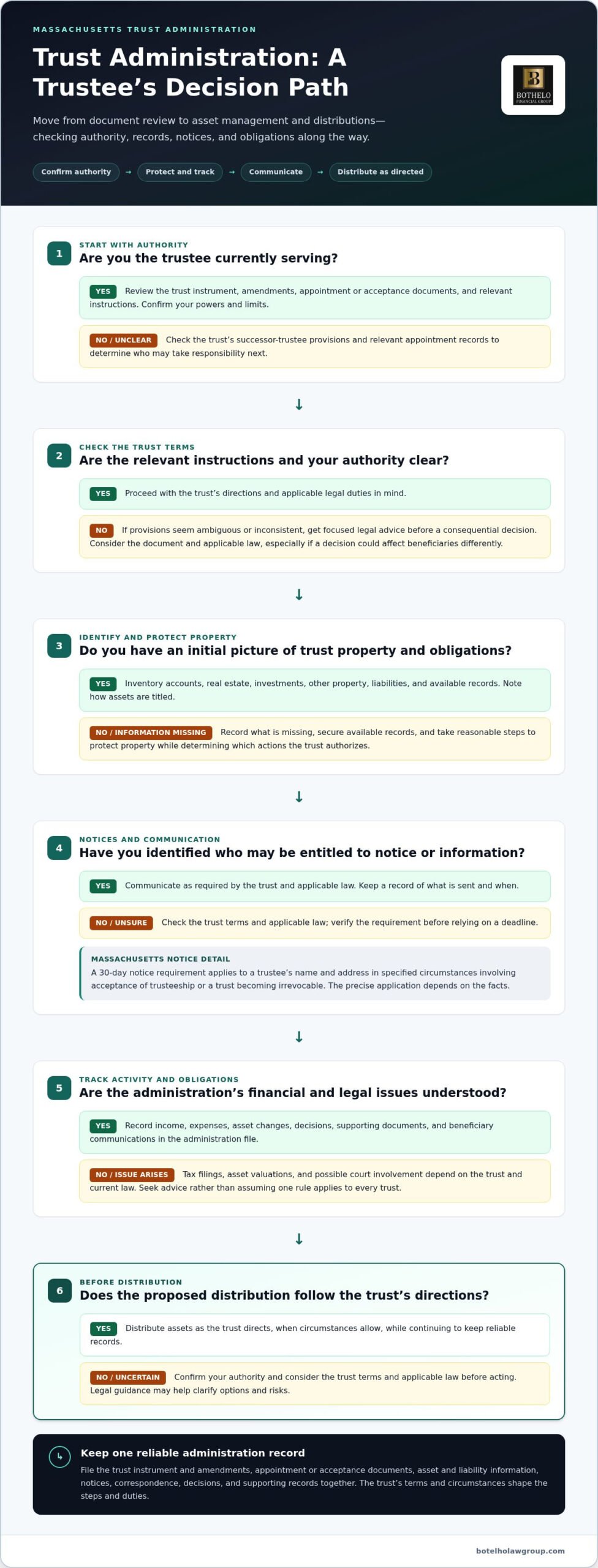
Trust administration involves a series of decisions, not a single task. The trust instrument and circumstances can change the order or scope of each step, so confirm your authority before acting. The state provides an overview of Massachusetts law about trusts. Applying the law to a particular trust may require focused legal advice.
In general, trustees review their authority, identify and protect trust property, keep beneficiaries appropriately informed, address financial and legal obligations, and distribute assets as the trust directs.
- 1. Review the documents and authority. Gather the trust instrument, amendments, appointment or acceptance documents, and relevant instructions. Confirm who is serving as trustee and what powers and limits the document establishes. If provisions seem unclear or inconsistent, a trust administration lawyer Massachusetts trustees consult can help analyze them before a consequential decision.
- 2. Identify trust property and obligations. Prepare an initial inventory of accounts, real estate, investments, other property, liabilities, and available records. Note how assets are titled and what information is missing. Secure records and take reasonable steps to protect property while determining which actions the trust authorizes.
- 3. Address notices and communications. Identify who may be entitled to notice or information under the trust and applicable law. Keep a record of what is sent and when. Massachusetts law includes a 30-day notice requirement for a trustee’s name and address in specified circumstances involving acceptance of trusteeship or a trust becoming irrevocable. The precise application depends on the facts, so verify the requirement before relying on a deadline.
- 4. Track activity and evaluate obligations. Record income, expenses, asset changes, decisions, and supporting documents. Keep beneficiary communications with the administration file. Tax filings, asset valuations, and possible court involvement depend on the trust and current law. Seek advice when those issues arise rather than assuming one rule applies to every trust.
- 5. Make distributions under the governing terms. Before transferring property, review the distribution provisions, relevant circumstances, and duties to beneficiaries. Preserve records showing the basis for decisions and the assets distributed. The timing and form of a distribution can vary with the trust and any unresolved obligations.
Good records matter throughout administration, not just at the end. A clear file helps explain what the trustee knew, which instructions were considered, and why actions were taken. If you’re uncertain about the document, a deadline, or a proposed distribution, discuss the question with Massachusetts estate planning counsel before proceeding.
Need a Lawyer for Trust Administration in Massachusetts?
Not every trustee needs the same level of legal support. Organizing statements and logging straightforward transactions may be manageable without ongoing counsel. Interpreting an unclear clause or responding to a beneficiary dispute raises different concerns. The trust, relationships, assets, and decision at hand all matter. Cornell Law School’s overview of Trust administration describes responsibilities that can make even a seemingly simple task more involved.
Use this comparison as a starting point, not a substitute for reviewing the trust terms and circumstances.
| Situation | Possible approach |
|---|---|
| Organizing statements, receipts, and correspondence | A trustee may be able to maintain records directly, provided the process is consistent and complete. |
| Tracking routine income and expenses | Record transactions and keep supporting documents; confirm the trust’s instructions for handling trust property. |
| Unclear or conflicting trust provisions | Seek legal guidance before choosing an interpretation that could affect beneficiaries. |
| Beneficiary disagreement or a proposed action outside ordinary administration | Discuss the issue with counsel before acting, particularly if the decision could change someone’s interests. |
| Unusual or substantial assets, tax decisions, or possible court proceedings | Get advice tailored to the assets, trust language, and current law. Court involvement and procedure depend on the issue. |
When may a trustee handle routine administration tasks?
A trustee may be able to organize records, preserve statements, and track clear deposits or expenses without extensive legal assistance. These tasks still must follow the trust instrument and the trustee’s duties. Even a seemingly routine transaction, such as paying an expense or transferring an account, may raise a legal question if the trust’s authority or the effect on beneficiaries is uncertain. A task’s appearance alone doesn’t establish that it is simple.
When should a trustee seek legal guidance?
Consider speaking with a trust administration lawyer Massachusetts trustees can consult when the document is ambiguous, beneficiaries disagree, assets are unusual or difficult to value, or a proposed action may depart from the trust’s terms. Legal review may also be appropriate before pursuing a court petition, considering a trust modification, or making a tax-related decision that depends on the trust’s structure.
Massachusetts court involvement is issue-specific. A petition or dispute may require action in the Probate and Family Court, but the proper procedure depends on the relief sought and the circumstances. Counsel can assess the question, explain potential options, and help the trustee understand relevant risks. Hiring a lawyer doesn’t eliminate all risk or guarantee a particular result, but it can help a trustee make a more informed decision before taking a consequential step.
What to Prepare Before Speaking With a Massachusetts Trust Lawyer
A focused legal discussion starts with the documents, facts, and decisions that need attention. You don’t need to resolve every question first. Organizing the information you have can help a trust administration lawyer Massachusetts trustees consult identify which trust provisions and legal requirements may apply, as well as what information is missing.
Documents and information to organize
Gather available materials before the discussion. If a record isn’t available, note that rather than delaying to locate every detail.
- The trust instrument, amendments, and any appointment, acceptance, or successor-trustee records.
- Available information about trust property, including account statements, real estate records, income, expenses, liabilities, and other assets.
- Relevant correspondence and notices, including communications with beneficiaries and professionals involved in managing trust property.
- A short list of pending distributions, decisions already made, and actions that still need approval or interpretation.
Separate urgent items from background information. Write down any upcoming deadline, planned transaction, requested distribution, or time-sensitive notice. Note unanswered questions, such as uncertainty about who may receive a distribution or what conditions apply. Massachusetts law, including the Massachusetts Uniform Trust Code, may affect how a provision operates, so consider the trust instrument alongside current law rather than in isolation.
Questions to clarify before administration decisions
Bring specific questions. For each pending decision, identify the relevant trust language, the facts that may affect the outcome, and who may be affected. Flag any reporting, notice, tax, court, or timing issue for legal review. If family members have raised concerns, record what was said and when, without assuming that a disagreement has become a formal dispute.
Keep trustee authority distinct from authority under a power of attorney. An agent’s powers come from the power of attorney, while a trustee’s authority comes from the trust and applicable law. The roles may involve the same person, but one role doesn’t automatically confer the other’s authority. The firm’s Power of Attorney Lawyer Fall River article addresses the separate agent role. Don’t share account numbers, tax identifiers, or other sensitive records in a public message; organize them for a private legal discussion instead.
For a focused review of your trust administration questions, contact Botelho Law Group. Bring the documents you have and identify the decision that needs attention first.
Trust Administration Counsel in Massachusetts: A Clear Path to Next Steps
Trustees don’t have to resolve every administration question alone. Botelho Law Group is based in Fall River and provides estate planning and asset protection counsel to Massachusetts residents, including in Boston and Worcester. For trustees and beneficiaries facing uncertainty about a trust, focused legal guidance can help clarify the document, identify questions that need attention, and outline practical next steps.
How focused legal guidance supports a trustee
A trust administration lawyer Massachusetts trustees consult can review the trust language alongside the relevant facts and applicable duties. For example, a proposed distribution may need careful review if the terms are unclear, circumstances have changed, or beneficiaries may be affected differently. Counsel can explain the legal considerations and available options so the trustee can make an informed decision.
Early attention to records and communication can bring structure to administration. A clear account of assets, transactions, notices, and unresolved questions makes it easier to assess what has happened and what remains to be done. Legal guidance can inform the process, but the trustee remains responsible for exercising the authority granted by the trust and fulfilling the trustee’s duties. Counsel does not automatically take over that role or guarantee a particular result.
Take the next step with Botelho Law Group
Before discussing your concerns, gather the trust instrument and amendments, trustee appointment information, relevant correspondence, and a basic summary of the assets and decisions at issue. Identify the most urgent question first. It may involve interpreting a provision, responding to a beneficiary request, evaluating a proposed distribution, or understanding whether a notice or other action is time-sensitive.
Bring the facts as you understand them, including any disagreement or uncertainty. You don’t need to have a complete answer before seeking guidance. Botelho Law Group can review your trust administration concerns, identify issues that merit legal analysis, and advise on possible next steps in light of the trust and applicable law.
If you’re serving as a trustee or have a beneficiary’s interest in an administration matter, discuss your trust administration questions with Botelho Law Group.
Move Forward With a Clear Administration Plan
Trust administration calls for careful attention to the trust’s terms, Massachusetts law, and the trustee’s fiduciary responsibilities. Organized records and thoughtful communication can help trustees evaluate decisions. Focused legal guidance can clarify questions about authority, notices, beneficiary concerns, or distributions.
A trust administration lawyer Massachusetts trustees consult can help assess the trust and the facts behind an unresolved decision. Botelho Law Group is a Fall River-based Massachusetts law firm whose practice includes estate planning and asset protection counsel. Preparing the trust documents and a concise list of outstanding questions can make a legal discussion more focused.
Discuss your trust administration questions with Botelho Law Group. A clearer understanding of your responsibilities and next steps can help you approach trust administration with greater confidence and care.
Frequently Asked Questions
What does a trust administration lawyer do in Massachusetts?
A trust administration lawyer advises a trustee about carrying out the trust’s terms and complying with applicable law. Counsel may review unclear provisions, explain duties, help assess notices and records, or advise on a proposed distribution or beneficiary disagreement. A trust administration lawyer Massachusetts trustees consult can help identify relevant questions and options, but the trustee generally retains responsibility for decisions and actions taken under the trust.
Is a lawyer required to administer a trust in Massachusetts?
No, Massachusetts doesn’t require every trustee to hire a lawyer for every administrative task. A trustee may be able to organize records and track straightforward transactions independently. Legal advice can be valuable when the trust is ambiguous, beneficiaries disagree, assets are complex, or a decision could affect beneficiary interests. Whether counsel is appropriate depends on the trust’s terms, the circumstances, and the issues the trustee must address.
What are a trustee’s main duties in Massachusetts?
A trustee’s responsibilities include acting loyally, administering the trust prudently, and treating beneficiaries impartially as required by the trust and applicable law. The trustee must follow the instrument’s directions, manage trust property within the authority granted, and maintain appropriate records. Specific duties and decisions depend on the trust language and circumstances. If a provision or proposed action is unclear, seek advice before proceeding.
What happens when a trust creator dies?
After the trust creator, often called the grantor or settlor, dies, the trust may become irrevocable if it was revocable during the creator’s lifetime. The acting trustee or successor trustee must then follow the trust’s terms and applicable law. That may involve identifying trust assets, addressing notices and obligations, keeping records, and making distributions when authorized. Property not held in the trust may be handled separately, including through probate when applicable.
How long does trust administration take in Massachusetts?
There’s no single Massachusetts deadline for completing trust administration or making every distribution. The time depends on the trust’s terms, the assets involved, outstanding obligations, tax matters, and whether questions or disputes arise. Some Massachusetts trusts are settled within 12 to 18 months, but that is not a guaranteed timeline. A trustee should avoid rushing a distribution before reviewing the trust, unresolved responsibilities, and applicable legal requirements.
Can a beneficiary challenge how a trust is administered?
Yes. A beneficiary may raise concerns or bring a proceeding if they believe a trustee has breached a duty or failed to follow the trust. Massachusetts law sets time limits that may depend on what the beneficiary knew or should have known, and a shorter period may apply to contesting a final account that fully discloses the matter. Because deadlines and facts matter, a beneficiary or trustee should seek legal advice promptly.
When does trust administration involve the Massachusetts Probate and Family Court?
Trust administration is generally private and doesn’t require routine court supervision. The Massachusetts Probate and Family Court may become involved when a party seeks court action, such as resolving a dispute or requesting relief concerning the trust. The appropriate procedure depends on the issue and circumstances. A trustee or beneficiary considering a petition should get legal guidance about the court process and any applicable deadlines before filing or responding.