
What if you could remain in your Massachusetts home for life while arranging for it to pass to your children without probate? If you’re asking what is a life estate, it divides property rights: you keep the right to live in and use the home, while a named remainderman receives a future ownership interest. That arrangement has limits. Selling or refinancing may require the remainderman’s consent, and transferring an interest in your home can affect MassHealth eligibility and estate recovery.
If you’re concerned about nursing-home costs, probate, or what “remainderman” means for your family, it’s important to understand the legal details. This guide explains how life estates work in Massachusetts, the rights and responsibilities of each party, and how MassHealth’s five-year look-back period may apply. It also covers potential benefits and risks, including why a life estate does not guarantee MassHealth eligibility, to help you assess whether this deed fits your home-protection and legacy goals.
Key Takeaways
- Learn what is a life estate and how it separates your lifetime right to use a home from a remainderman’s future ownership.
- Understand the life tenant’s responsibilities for maintaining the property and the limits on selling or refinancing it.
- Weigh potential benefits, including avoiding probate and a possible step-up in basis, against restrictions that can affect your future choices.
- See how transferring a remainder interest may interact with MassHealth’s five-year look-back period and estate recovery. Eligibility is not guaranteed.
- Identify key decisions when drafting and recording a life estate deed to reduce uncertainty and help prevent family disputes.
Understanding the Basics: What Is a Life Estate?
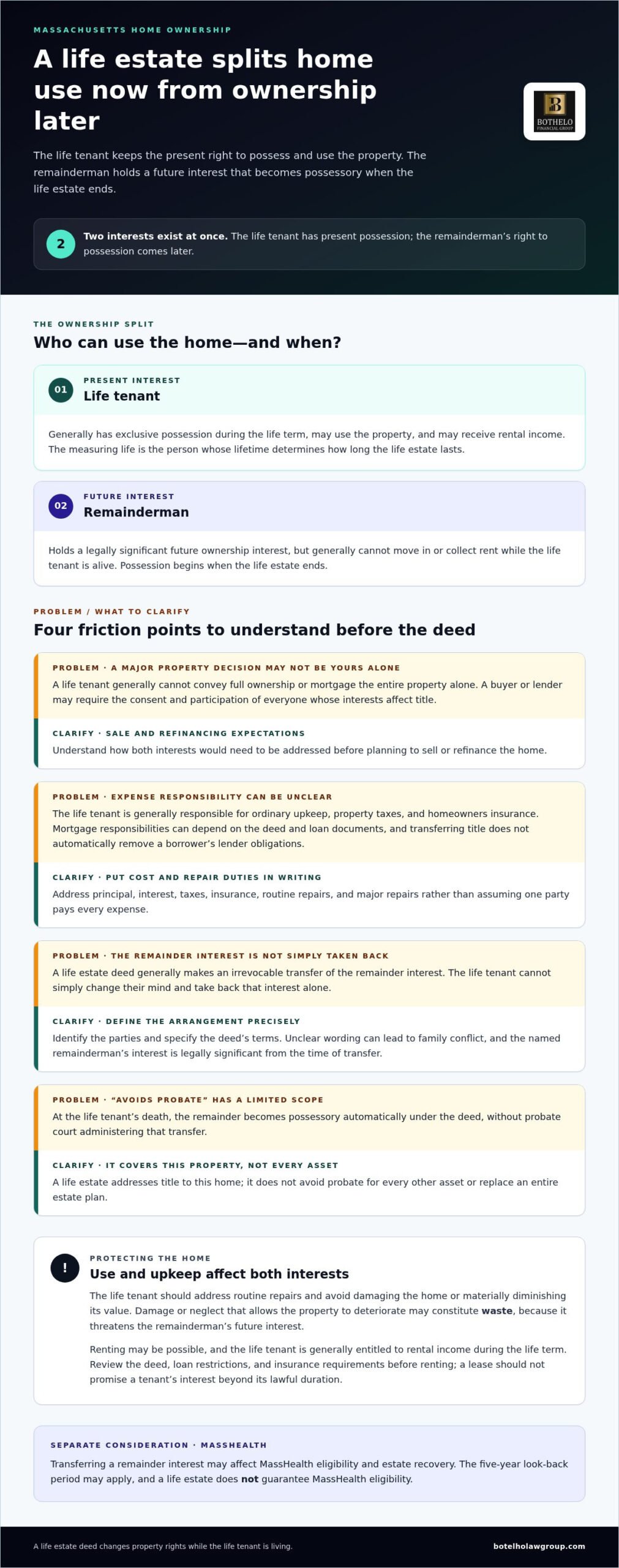
To understand what is a life estate, picture one property divided into two ownership interests with different timelines. The life tenant has the present right to possess and use the home for the duration of a specified person’s life. The remainderman holds a future interest that becomes possessory when that life ends. Both interests exist at the same time, but the life tenant has the right to occupy the property during the life term.
In Massachusetts, a life estate deed creates this arrangement by transferring the remainder interest to the person or people named in the deed while reserving a life estate for the current owner. For example, a parent might reserve the right to live in a home for life and name an adult child as remainderman. The child does not gain the right to move in or collect rent just by being named, but the child’s future interest is legally significant from the time of the transfer.
The Legal Split of Ownership
The life tenant’s interest is called a present interest because it gives the right to use and possess the property now. The remainderman’s future interest is established now but generally does not include present possession. This distinction is central to Understanding Life Estates and sets a life estate apart from a simple promise in a will to leave a home to someone.
A life estate deed generally makes an irrevocable transfer of the remainder interest. The life tenant cannot simply change their mind and take back the remainderman’s interest alone. This can limit future choices, including selling or mortgaging the property, because the interests may need to be addressed together. The deed should identify the parties and define the arrangement precisely. Unclear terms can lead to family conflict.
Key Terminology for Homeowners
The measuring life is the person whose lifetime determines how long the life estate lasts. In a standard arrangement, that person is the life tenant. The deed’s wording matters. If the interest is measured by someone else’s life, its duration may not match the life tenant’s own lifetime.
A life estate also differs from joint tenancy with right of survivorship. Joint tenants hold present ownership interests, with the surviving joint tenant generally receiving the deceased tenant’s interest. In a life estate, the life tenant has the present right to use the property, while the remainderman’s right to possession comes later.
At the life tenant’s death, the remainder interest becomes possessory automatically under the deed. The property can pass to the remainderman without probate court administering that transfer, but this does not avoid probate for every other asset the life tenant owns. A life estate addresses title to this property, not the entire estate plan, which typically requires broader wills and inheritance guidance such as the legal counsel outlined at rgs-law.com.
Rights and Responsibilities of the Life Tenant and Remainderman
A life estate gives each owner a different set of rights, which can affect everyday decisions about the home. The life tenant generally has exclusive possession during the life term and may use the property or receive rental income from it. The remainderman holds a future ownership interest, not a present right to move in or collect rent. Cornell Law School’s Legal Definition of Life Estate describes this division between present use and future possession.
Understanding what is a life estate means looking beyond who lives in the home. The deed, existing mortgage documents, and applicable law can affect how responsibilities are allocated. Clear written terms can reduce conflict if the parties later disagree about repairs, expenses, or a proposed sale.
The Life Tenant’s Obligations
The life tenant is generally responsible for ordinary upkeep, property taxes, and homeowners insurance. The tenant should address routine repairs and avoid actions that damage the home or materially diminish its value. In property law, conduct that harms the property or neglect that allows it to deteriorate may constitute waste, because it threatens the remainderman’s future interest.
Renting the property may be possible, and the life tenant is generally entitled to rental income during the life term. A lease should not promise the tenant’s interest beyond its lawful duration. Before renting, review the deed, any loan restrictions, and insurance requirements.
Mortgage expenses require particular care. The deed and loan documents may affect who must make payments, and transferring title does not automatically remove a borrower’s obligations to the lender. Clarify responsibility for principal, interest, taxes, insurance, and repairs in writing rather than assuming that one party pays every expense.
The Remainderman’s Role During the Life Term
The remainderman generally cannot occupy the home or demand its rental income while the life tenant is alive. The interest is nevertheless real and may be transferable or subject to a creditor’s claim, depending on the circumstances. A sale or pledge of that future interest does not give the recipient the right to possess the home before the life estate ends.
Debt, divorce, or bankruptcy involving a remainderman can create uncertainty for the family. The remainderman’s interest may become part of a dispute or financial proceeding, though the outcome depends on the facts and applicable law. A life tenant also generally cannot convey full ownership or obtain a mortgage on the entire property alone. A buyer or lender may require the consent and participation of everyone whose interests affect the title.
Before signing, clarify who pays each recurring expense, how major repairs will be handled, and what happens if the parties consider selling. Thoughtful Massachusetts estate planning can address these responsibilities in the deed and help reduce the risk of later disputes.
The Pros and Cons of a Life Estate for Asset Protection
A life estate can help a Massachusetts homeowner arrange for a home to pass outside probate while retaining the right to live there. But that benefit comes with a lasting change in ownership. Before deciding, weigh the simpler transfer and potential tax treatment against reduced control, family risks, and the possibility that a future sale becomes difficult.
Why Homeowners Choose Life Estates
Because the remainder interest is established by deed, the home can pass to the named remainderman automatically at the life tenant’s death, rather than waiting for a will to be administered through probate. This can clarify who is intended to receive the property. It does not avoid probate for the life tenant’s other assets or eliminate every possible title or estate issue.
A life estate may also affect the home’s tax basis. Under the general rule described in this guide, property included in an estate for tax purposes may receive a basis adjustment at the owner’s death. That adjustment can reduce a beneficiary’s taxable gain if the home is later sold, but the result depends on the facts and applicable tax rules. A life estate is not a substitute for individualized tax advice, and comprehensive wealth and tax advisors such as timothyrobertsllc.com can help you evaluate how property decisions align with your broader financial plan.
Homeowners may also want to preserve a Massachusetts homestead exemption while transferring a future interest. Do not assume the exemption continues automatically or applies in the same way after a deed is recorded. Eligibility and how the exemption interacts with a life estate depend on the property, deed, and current rules.
Potential Pitfalls and Risks
The transfer is generally difficult to reverse. If the life tenant later wants to sell, refinance, or change who receives the home, the remainderman’s interest may prevent the life tenant from acting alone. A deed that seems right today can become a source of conflict if family relationships or financial circumstances change.
A remainderman’s financial problems can also affect the future interest. Creditors, divorce proceedings, or bankruptcy may create claims or disputes involving that interest, potentially complicating a later sale or transfer. Careful planning should account for the proposed recipients and the consequences if one of them faces financial distress.
If the home is sold during the life tenant’s lifetime, the sale proceeds may need to be divided between the life tenant and remainderman based on actuarial factors. The remainderman may also face capital gains tax consequences. Do not assume the life tenant will receive all the proceeds or that the tax result will be the same as for a sale after death.
Incapacity can add another obstacle. A power of attorney may authorize an agent to act for the person who granted it, but it does not automatically give authority over another owner’s interest or guarantee that a sale can proceed. Consider how decision-making would work for each party before signing. A careful review can help determine whether a life estate supports your asset-protection goals without creating unacceptable restrictions.
Life Estates and Medicaid (MassHealth) in Massachusetts
A life estate can affect both MassHealth eligibility and what happens to a home after the life tenant dies. The outcome depends on the timing, the deed’s terms, the applicant’s circumstances, and applicable recovery rules. Treating the deed as a guaranteed way to qualify for benefits or shield the home can put care planning and family finances at risk.
For long-term-care coverage, MassHealth generally reviews financial transactions made during the 60-month (five-year) look-back period before an application. Giving a remainderman a future interest in a home may be treated as a transfer for less than fair market value. If the transfer falls within the look-back period, it may result in a penalty period during which the applicant is ineligible for coverage. The penalty’s length depends on MassHealth’s rules and the transfer. It is not fixed for every deed.
Navigating the 5-Year Lookback
The five-year period is not a waiting period that automatically guarantees eligibility once it passes. It is a review window for past transfers. Planning early may provide more options, while a deed created shortly before a care application can create a serious coverage gap. Before transferring an interest, consider the timing, the value transferred, the possibility of needing care, and how the household would pay for care during a penalty period.
Eligibility also depends on other financial and program requirements. In 2026, the MassHealth countable-asset limit for a single long-term-care applicant is $2,000, but a home’s treatment is subject to separate rules. For a primary residence to be exempt, the applicant’s equity interest cannot exceed $1,130,000 under the 2026 guidance described here. These figures do not determine whether a particular life estate qualifies for an exemption or whether a transfer triggers a penalty.
Estate Recovery and the Home
Estate recovery is the state’s effort to recover certain Medicaid costs from a recipient’s estate after death. A life estate deed may allow the remainder interest to pass automatically rather than through probate, which can affect whether the home is part of the probate estate. Avoiding probate does not, by itself, establish that the property is beyond MassHealth’s reach.
MassHealth may place a lien on a life estate interest in some circumstances, including when a person is in a nursing facility and is not expected to return home. The rules and outcome depend on the facts. Consider both the transfer and potential recovery exposure before relying on the deed as a protection strategy.
The practical question is not only what is a life estate, but whether its timing and consequences fit your care plan. A deed can change ownership rights immediately, while MassHealth consequences may arise later. Have the proposed transfer, other assets, and possible care needs reviewed together. Discuss a MassHealth-focused asset protection plan before making an irreversible transfer, and do not rely on a life estate to guarantee eligibility or prevent recovery.
How to Set Up a Life Estate and Why Professional Drafting Matters
Creating a life estate is not simply a matter of adding a child’s name to a deed. The deed must clearly reserve the life tenant’s rights and define who receives the future interest. Because the transfer can be difficult to reverse, address ownership, future flexibility, and family circumstances before signing.
The Drafting and Filing Process
For a Massachusetts life estate deed, begin by reviewing the current title and the property’s legal description. The deed generally needs to identify the current owner, the life tenant, and each remainderman, then state how the life estate is reserved and how the remainder is held. The language should also account for multiple remaindermen and what happens if one dies before the life tenant.
Check for title issues before preparing a new deed. An existing mortgage, lien, ownership claim, or error in the legal description can complicate a transfer or later sale. Reviewing the title can reveal issues that need attention before the deed is signed and recorded.
Once properly executed, the deed must be recorded with the Registry of Deeds for the district where the property is located. Recording places the transfer in the public land records and provides notice of the ownership interests. The Registry charges recording fees, and the applicable amount depends on the filing. A deed that is signed but not recorded may fail to accomplish the intended public transfer, so recording is an essential step.
Precise drafting matters. Vague descriptions of the life tenant’s rights or the remaindermen’s shares can invite disagreement, particularly if the family later wants to sell or refinance, or needs to respond to an owner’s incapacity.
Comparing Alternatives
A life estate and a trust can both be used in estate planning, but they work differently. A life estate transfers a remainder interest in a particular property while reserving lifetime use. A trust can hold and manage assets under written terms, creating a different structure and method of administration. A will generally directs how probate assets should pass, while assets held or transferred outside probate may follow separate rules. The right approach depends on the home, other assets, family needs, and goals for control.
Some states use an enhanced life estate deed, often called a “Lady Bird Deed,” which may preserve broader powers for the owner. Do not assume a deed form used elsewhere has the same effect in Massachusetts. Its availability and legal consequences are state-specific. Using an unfamiliar form without Massachusetts-focused review can undermine the plan.
If you’re weighing what is a life estate against a trust or another approach, assess your whole estate plan, not only the deed. A consultation with an estate planning lawyer in Fall River, MA can help evaluate title, family circumstances, and asset-protection goals before you transfer an ownership interest.
Make Your Home-Protection Plan Deliberate
The right estate plan should reflect more than a desire to pass property to family. It should account for how much control you want to retain, how your family may need to make decisions in the future, and what could change in your health or finances. A deed that looks straightforward today can shape important choices for years, so the decision deserves careful, individualized review.
If you’re still asking what is a life estate in the context of your own home, focus on whether its lasting effects fit your priorities, not just whether it offers a route around probate. A thoughtful plan considers the property alongside your broader estate and asset-protection goals. Botelho Law Group helps Massachusetts families evaluate those choices through estate planning and asset protection.
Contact Botelho Law Group to discuss your Massachusetts home and estate-planning goals. A clear plan can help you move forward with greater confidence and give your family a more considered path ahead.
Frequently Asked Questions
Can a life tenant sell the property in Massachusetts?
A life tenant generally cannot sell the entire property alone because the remainderman also holds an ownership interest. A sale of full title usually requires the parties to cooperate and sign the necessary documents. The life tenant may be able to transfer only their own interest, but that will not give a buyer unrestricted ownership or immediate possession. Before accepting an offer, review the deed, title, and any mortgage obligations.
Does a life estate protect my home from nursing home costs?
A life estate does not guarantee that a home will be protected from nursing-home costs or that the owner will qualify for MassHealth. A transfer of the remainder interest may trigger a penalty if it falls within MassHealth’s five-year look-back period, and other eligibility rules still apply. For example, transferring the interest after a health crisis begins can create a coverage gap. Review timing and care-funding options before changing title.
What happens if the remainderman dies before the life tenant?
The deed’s language and the remainderman’s ownership structure determine what happens. If the interest is vested and the deed does not provide for a substitute recipient or survivorship, it may pass through the remainderman’s estate to heirs or beneficiaries. That can introduce new parties whose participation may be needed for a later sale. Drafting should address this possibility, including whether the interest passes to the remainderman’s estate or to another named person.
Who is responsible for paying property taxes in a life estate?
The life tenant is generally responsible for property taxes during the life term, along with ordinary upkeep and insurance, unless the deed or another agreement allocates expenses differently. If taxes go unpaid, the property can face tax claims regardless of disagreements between the owners. Keep tax bills, receipts, and written expense agreements together. In Massachusetts, confirm that the town’s assessment and ownership records accurately reflect the recorded deed.
Can a life estate be overturned or changed without consent?
Usually, the life tenant cannot unilaterally cancel a completed transfer of the remainder interest. Changing ownership generally requires the participation and signatures of everyone whose interest is affected. A court challenge may be possible in limited circumstances, such as a dispute over the deed’s validity, but outcomes depend on the evidence and applicable law. Before signing, consider how future changes in family relationships, finances, or care needs could affect the arrangement.
Is a life estate better than an irrevocable trust for asset protection?
Neither option is automatically better for every Massachusetts family. A life estate changes title to a specific property and can limit the owner’s future control. An irrevocable trust uses a separate legal structure with terms governing the assets placed in it. Their effects on long-term-care planning, taxes, administration, and access to property differ. Compare them against your full financial picture and goals before transferring a home.
Are there capital gains tax implications when the life tenant dies?
There may be tax consequences, but the result depends on the property’s value, ownership, and applicable tax rules. A basis adjustment at death may reduce taxable gain if the remainderman later sells, but it is not safe to assume every life estate receives the same treatment. Keep records of the purchase price and documented improvements, and have the tax consequences reviewed before a sale or transfer.
Does a life estate affect my ability to get a reverse mortgage?
It can make a reverse mortgage more complicated because the life tenant does not hold the entire property interest alone. A lender may require review of the deed and participation from other owners, and the life tenant’s age, occupancy, equity, and loan terms can affect eligibility. Do not assume a remainderman can be excluded from the transaction. If borrowing against the home may be important, evaluate that need before creating a life estate.