
Can seeking immigration protection after a crime feel as risky as staying silent? If you’re uncertain whether your experience qualifies, worried about speaking with law enforcement, or unsure what sharing sensitive information could mean, those concerns deserve careful attention. A U visa attorney for crime victims can help assess the legal requirements and explain the application process.
Experiencing a qualifying crime alone doesn’t establish eligibility. U nonimmigrant status has specific requirements involving substantial abuse, information about the crime, helpfulness to law enforcement, and certification from an authorized agency. Certification is an important part of the process, but it doesn’t guarantee approval. Supporting records and a clear account of what happened may also matter.
This guide explains who may qualify, what evidence and certification may be required, and how the application and potentially lengthy wait can unfold. It also covers practical ways to organize your case and prepare for an individualized, confidential discussion about representation, without promising a particular outcome.
Key Takeaways
- U nonimmigrant status may offer immigration relief to qualifying crime victims who assist authorities, but it doesn’t address every safety or recovery concern.
- Assess the full eligibility picture: the crime, harm, information provided, helpfulness to law enforcement, and required certification all matter.
- U status, VAWA relief, and asylum have different legal bases and eligibility questions. Compare them before deciding which path may fit your circumstances.
- Preserve records you already have and organize key dates and agency contacts, but don’t delay urgent safety decisions to collect paperwork.
- A U visa attorney for crime victims can help organize eligibility facts, identify evidence needs, and clarify the petition process during an individualized case review.
U Visa Attorney for Crime Victims: What the Visa Can and Cannot Do
Crime victims may face immigration questions while weighing their safety, recovery, and whether to report what happened. A U visa may offer immigration relief to some people, but eligibility depends on specific facts and legal requirements. Understanding what this option does and doesn’t do can help you consider next steps without assuming that reporting a crime automatically provides immigration protection.
What is U nonimmigrant status?
U nonimmigrant status is a form of temporary humanitarian immigration relief for certain noncitizens who have experienced qualifying criminal activity and assist authorities in investigating or prosecuting it. The program supports law enforcement efforts while recognizing the harm victims may experience. The U visa is different from a general work visa or family-based petition: eligibility depends on qualifying criminal activity, the victim’s experience, and cooperation with authorities, not employment or a qualifying family relationship.
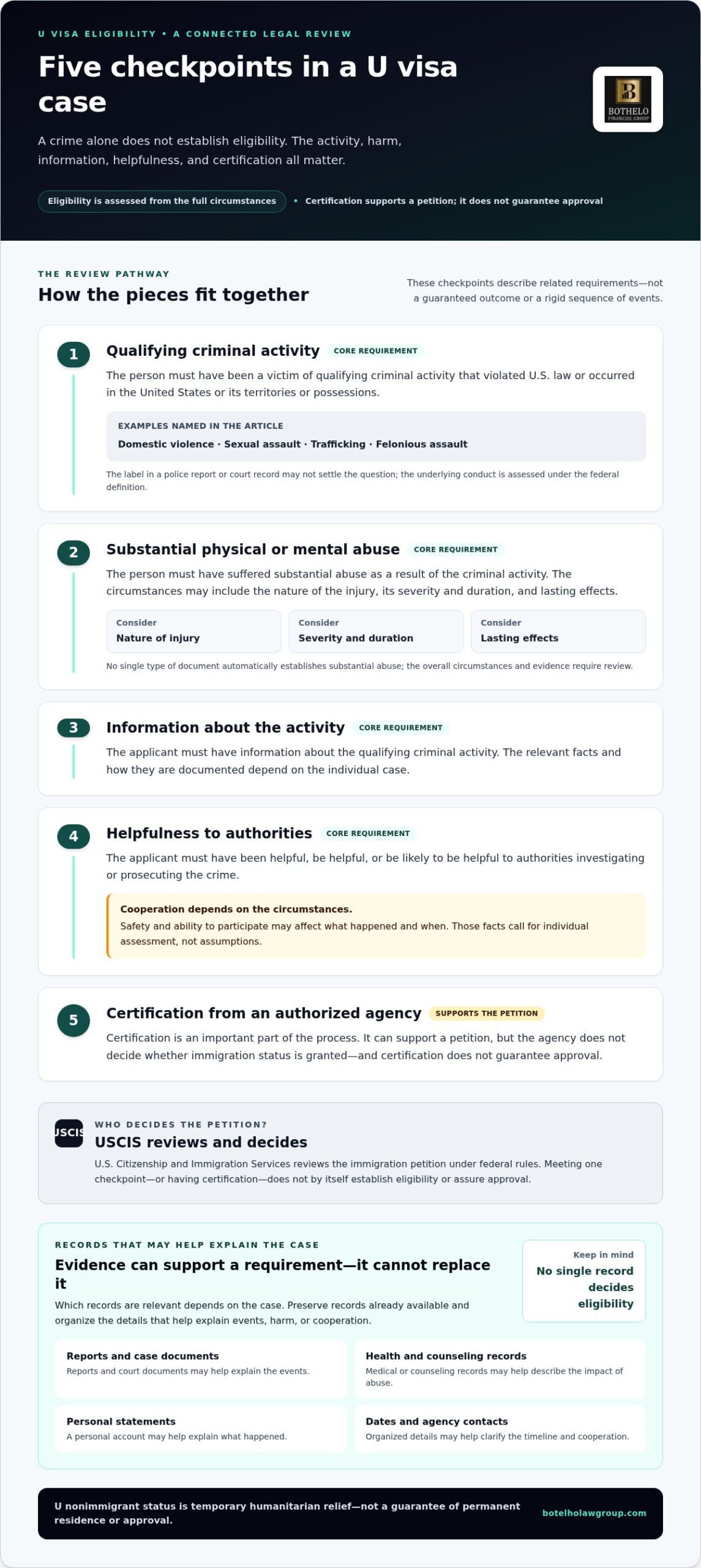
An agency’s certification can support a petition, but the agency doesn’t decide whether immigration status is granted. U.S. Citizenship and Immigration Services (USCIS) reviews the immigration petition and makes that decision under federal rules.
Who may qualify for a U visa?
Eligibility depends on several requirements, not simply on whether a crime occurred. In general, an applicant must have been a victim of qualifying criminal activity, suffered substantial physical or mental abuse as a result, and have information about the activity. The crime must have violated U.S. law or occurred in the United States or its territories or possessions.
The applicant must also have been helpful, be helpful, or be likely to be helpful to authorities investigating or prosecuting the crime. What cooperation involves depends on the circumstances. A person’s safety and ability to participate may affect what happened and when, so those facts need individual assessment rather than assumptions.
Qualifying criminal activity can include domestic violence, sexual assault, trafficking, and felonious assault, as well as certain related or similar crimes. The label used in a police report or court record may not, by itself, determine whether the activity meets the federal definition. The underlying conduct and how it relates to the legal criteria may also matter.
A U visa isn’t automatic protection from immigration consequences, a grant of permanent residence, or a guarantee of approval. Even when an incident appears to involve qualifying criminal activity, the other eligibility requirements and supporting evidence still need review. USCIS decides petitions under applicable federal rules. Some U status holders may later pursue permanent residence through a separate process, but that outcome isn’t automatic.
A U visa attorney for crime victims can help organize relevant facts, identify questions about eligibility and certification, and explain how the requirements apply to an individual situation. This review can be especially useful when records are incomplete, events are complex, or discussing sensitive details feels difficult. General information explains the framework, but it can’t replace an individual legal assessment.
U Visa Eligibility: How Certification, Harm, and Cooperation Fit Together
U visa eligibility is a connected legal test, not a single question about whether a crime occurred. A person may have experienced a serious offense and still need to establish the other requirements. Use the checklist below to separate the core eligibility elements from records that may help document them. Evidence can support a case, but it doesn’t replace a required element.
- Qualifying criminal activity: The person was a victim of qualifying activity that violated U.S. law or occurred in the United States or its territories or possessions.
- Substantial abuse: The person suffered substantial physical or mental abuse as a result of the criminal activity.
- Relevant information: The person has information about the activity.
- Helpfulness: The person has been helpful, is being helpful, or is likely to be helpful to authorities investigating or prosecuting it.
- Supporting records: Available reports, medical or counseling records, court documents, and personal statements may help explain the events, harm, or cooperation. Their relevance depends on the case.
Which crimes and forms of harm may qualify?
Examples of qualifying criminal activity include domestic violence, sexual assault, trafficking, and felonious assault. The legal analysis may also involve an attempt, conspiracy, or qualifying similar activity. An offense’s everyday name or the label in a report may not settle the issue. The underlying conduct must be assessed under the federal definition.
Substantial abuse can involve physical or mental harm. Relevant circumstances may include the nature of the injury, its severity and duration, and its lasting effects. No single type of document automatically establishes substantial abuse, and not every victim will meet this standard. Treatment records, for example, may help describe an impact, but the overall circumstances and evidence require careful review.
What does law-enforcement certification establish?
Form I-918 Supplement B is the certification form an authorized agency uses to confirm relevant information about a person’s helpfulness. It isn’t the U visa petition and doesn’t grant immigration status. The agency and USCIS have separate roles: the certifying agency addresses its knowledge of the case and the person’s cooperation, while USCIS decides the immigration petition.
Certification supports a petition, but it doesn’t decide its outcome. A signed certification therefore can’t establish every eligibility requirement or guarantee approval. The petition must also address the remaining legal criteria and include appropriate supporting evidence. Questions about the crime classification, the impact of harm, or how cooperation is documented can affect how clearly and completely the case is presented.
A focused review can help organize these elements and identify gaps before filing. A confidential immigration case review offers an opportunity to discuss the facts and certification questions in context. A U visa attorney for crime victims can explain how the requirements apply to an individual case without treating any one document as a guarantee.
U Visa or Another Immigration Option? Compare the Legal Questions First
Different immigration pathways address different circumstances. An experience involving abuse or violence may raise questions about more than one form of relief, but the options have distinct legal standards, evidence, and procedures. Comparing the questions each pathway asks can help frame an individualized review. It can’t determine eligibility on its own.
| Option | Legal basis | Central questions |
|---|---|---|
| U nonimmigrant status | Qualifying criminal activity and cooperation with authorities | Was the person a victim of qualifying activity, suffered substantial abuse, has relevant information, and has been, is being, or is likely to be helpful? |
| VAWA relief | Abuse connected to a qualifying relationship with a U.S. citizen or lawful permanent resident | Does the person meet the applicable relationship, abuse, and other statutory requirements for the specific VAWA process? |
| Asylum | Persecution or a well-founded fear of persecution tied to a protected ground | Does the person meet the legal requirements based on past harm or feared harm and the reason for it? |
U visa and VAWA relief: different eligibility pathways
U status focuses on qualifying crime victimization, substantial abuse, relevant information, and helpfulness to authorities. VAWA relief generally concerns abuse by a qualifying U.S. citizen or lawful permanent resident relative and requires a qualifying statutory relationship. The process and precise elements depend on the form of relief. Domestic violence alone doesn’t establish eligibility for either pathway. The relationship, facts, and applicable requirements all need review.
U visa and asylum: different legal questions
Asylum centers on persecution, or a well-founded fear of persecution, connected to a protected ground. It doesn’t use the U visa’s law-enforcement certification framework. A crime experienced in the United States and fear of harm upon return to another country are distinct issues, although a person’s history may raise both. Each claim requires its own fact-specific legal analysis.
For example, someone who experienced abuse may need to consider who caused it, the nature of the relationship, where the conduct occurred, and whether authorities were involved. If that person also fears persecution in their country of origin, the basis for that fear raises separate questions. These circumstances don’t automatically establish eligibility under any option. Nor should one pathway be presumed faster, safer, or more likely to succeed than another.
A careful comparison considers timelines, relationships, locations, reporting or cooperation, and the reasons for any fear of return. It also considers how existing immigration history may affect the analysis. Reviewing the full picture can help identify questions that need more evidence and prevent important facts from being overlooked. A U visa attorney for crime victims can assess these distinct legal frameworks and explain how the facts may relate to each, without treating them as interchangeable or predicting an outcome.
How to Prepare for a U Visa Case Review in Massachusetts
You don’t need to assemble a complete file before an immigration case review. A simple timeline and the records you already have can help counsel understand what happened, which agencies were involved, and what needs closer review. If collecting paperwork could affect your safety, prioritize immediate safety instead. Explain what’s missing and why.
Organize records and a clear timeline
Start with brief notes rather than trying to reconstruct every detail perfectly. Write down approximate dates, locations, agency contacts, case or report numbers, and any follow-up you remember. Separate what you know firsthand from what you’re unsure about. An honest account of gaps or uncertainty is more useful than guessing.
- Gather records you already have, such as police or court papers, medical records, and relevant correspondence.
- Preserve messages, emails, photographs, and other materials in their original form when possible. Don’t edit records or create documents to fill gaps.
- Note the names or roles of agencies and officials you contacted, along with any dates or reference numbers you have.
- List documents you believe exist but can’t access, including where you think they may be held.
Missing records don’t, by themselves, determine whether someone qualifies. They may affect how the facts are presented or what additional information should be considered. A U visa attorney for crime victims can help identify relevant evidence and distinguish essential facts from helpful supporting material. Don’t delay urgent safety decisions to locate paperwork.
Raise immigration and safety concerns directly
Include immigration details that may affect the review, even if they seem separate from the crime. Note your current status, prior applications or filings, travel outside the United States, contact with immigration authorities, and family members who may be affected. Accurate details help counsel identify questions for individualized legal review. Don’t leave out a difficult fact because you’re unsure whether it matters.
Also explain any concerns about contacting an agency, receiving mail, attending appointments, or discussing sensitive information. You can ask how information shared during an initial consultation is handled before providing details. Immigration counsel can assess potential immigration issues and explain available legal steps, but that role isn’t criminal defense. A case review also isn’t emergency assistance. If you’re in immediate danger, contact emergency services or an appropriate local support resource.
Keep your notes and available documents together, but don’t feel you must have every record or answer ready. Botelho Law Group is based in Fall River, Massachusetts, and represents immigration clients nationwide. You can request a confidential immigration consultation to discuss your circumstances and the questions you want addressed. An individualized review can help organize next steps without guaranteeing a particular result.
Working With an Immigration Attorney on a U Visa Petition
A U visa petition involves more than completing forms. The eligibility facts, agency certification, supporting records, and immigration history must be presented consistently. Immigration counsel can review these pieces together, identify questions that need further analysis, and help organize the application. That guidance can make the process clearer, but it can’t guarantee approval or a particular timeline.
What an attorney can help manage
Counsel can compare the available facts with the legal requirements, flag gaps or inconsistencies, and explain which records could help address them. The review may include organizing forms, personal declarations, supporting documents, and certification-related materials. The certifying agency and USCIS have different roles, so clear guidance can help you understand what each step involves and what remains for USCIS to decide.
Good preparation also means checking that dates, names, and descriptions align across records and statements. If documents are missing or details are uncertain, counsel can help identify how to address those issues accurately rather than fill gaps with assumptions.
What to expect after filing
USCIS reviews the petition and may request additional evidence. A response must follow the agency’s instructions and deadline. USCIS policy can also allow officers to deny an application without first requesting more evidence when required initial evidence is missing, so carefully reviewing filing materials matters. Procedures and processing information can change. Verify current guidance through official USCIS resources.
Some petitioners may be considered for a bona fide determination, which can lead to deferred action and temporary work authorization while they await a final decision. These benefits aren’t automatic. Eligibility and timing depend on USCIS review and the circumstances of the case. A qualifying petitioner may also be able to include certain eligible family members, but derivative eligibility has its own requirements and needs individual assessment.
Representation should include clear communication about who is handling each task, what information or records are still needed, and how significant case developments will be shared. Ask for explanations of agency correspondence, requests, and next steps so you understand what action may be required. An attorney can help manage the immigration petition, but doesn’t replace the certifying agency’s role or USCIS’s decision-making authority.
A U visa attorney for crime victims can help assess case facts, organize petition materials, and explain the process without promising an outcome. Botelho Law Group provides immigration representation to clients nationwide. Discuss your immigration matter with Botelho Law Group to request individualized guidance about your circumstances and potential next steps.
Take the Next Step With a Clearer Plan
You don’t need to resolve every question before seeking legal guidance. Start by identifying what feels uncertain, noting the facts you can confidently share, and deciding what you need to understand before moving forward. An individualized discussion can help turn those questions into a practical plan for evaluating your immigration options.
A U visa attorney for crime victims can review your circumstances, explain relevant legal considerations, and help you understand what further information may be needed. Be candid about safety concerns, immigration history, or contact with authorities so those issues can be considered in context. No initial discussion can guarantee an outcome, but a focused review can help you make more informed decisions.
Botelho Law Group represents clients in immigration matters and can discuss your situation based on its specific facts. If you’re ready to explore your next step, discuss your immigration matter with Botelho Law Group. Your questions deserve careful attention. Begin by requesting the guidance you need.
Frequently Asked Questions
Can I apply for a U visa if I did not report the crime right away?
Yes. A delayed report doesn’t automatically prevent you from pursuing U nonimmigrant status. The timing and circumstances may still matter when authorities assess your helpfulness and consider certification. Be prepared to explain why reporting was delayed and describe any later communication or cooperation. An individualized review can help identify which details and records may be relevant.
Do I need a police report to qualify for a U visa?
A police report can support an application, but not having one doesn’t automatically establish that you’re ineligible. U visa petitions require law-enforcement certification, and other available evidence may help document the incident, harm, or your cooperation. Court records, medical documentation, or communications with an agency may provide relevant context. The usefulness of each record depends on the facts, so keep what you have and identify what’s missing.
Does Form I-918 Supplement B guarantee U visa approval?
No. Form I-918 Supplement B is a certification from an authorized agency, not an approval of immigration status. It addresses the agency’s knowledge of the case and your helpfulness, while USCIS separately reviews the petition and eligibility requirements. A signed certification is an important part of the process, but it doesn’t resolve every issue USCIS considers. Review the full application carefully and respond to any USCIS notice by its stated deadline.
Can I apply for a U visa if I have no lawful immigration status?
Having no lawful immigration status doesn’t, by itself, prevent you from filing a U visa petition. USCIS considers whether you meet the U visa requirements, along with the full circumstances and your immigration history. Prior applications, immigration proceedings, or travel may raise separate questions that deserve careful review. Share those facts with counsel rather than assuming they automatically disqualify you. An individualized assessment can clarify potential issues without predicting the decision.
Can my spouse or children receive immigration status through my U visa?
Possibly. Certain qualifying family members may be eligible to seek derivative U status, but the rules depend on the principal applicant’s age and the family relationship. A spouse or child may qualify in some circumstances, while other relatives may be covered under specific conditions. Review each family member’s eligibility and documentation individually. Include family relationships and relevant ages in your case discussion so the available options can be assessed.
How long does it take to get a U visa?
There’s no fixed processing time, and a final decision may take years. Federal law caps principal U-1 approvals at 10,000 per fiscal year, and the number of pending petitions can exceed that limit. USCIS processing estimates and case status information change, so consult current official USCIS updates rather than relying on an older estimate. A bona fide determination may be considered during the wait, but it isn’t a final U visa decision.
Can a U visa applicant receive work authorization?
Some petitioners may receive temporary work authorization through USCIS’s bona fide determination process while awaiting a final decision, but it isn’t automatic. USCIS must assess the petition under its current criteria. Work authorization may also be available after U status is granted, subject to applicable requirements and filing procedures. Before working, confirm that you’ve received valid authorization and understand its terms. A U visa attorney for crime victims can help clarify what may apply to your case.