
After an accident in Fall River, medical appointments, missed work, and calls from insurance adjusters can compete for your attention. You may also be unsure who was responsible or what to say while a claim is being evaluated. A personal injury lawyer Fall River MA can help you understand your options, preserve useful information, and identify the issues that may affect your claim.
It’s reasonable to want clear answers without pressure or promises. Botelho Law Group is headquartered in Fall River and handles personal injury litigation in Massachusetts and Rhode Island. The firm represents personal injury clients on a contingency-fee basis, with no upfront legal fees unless it successfully recovers compensation.
This article covers practical steps to take after an injury, how Massachusetts rules on fault and deadlines may affect a claim, and what to consider when dealing with insurers. It also explains how legal representation can assess responsibility, organize evidence, and document losses such as medical expenses and lost income.
Key Takeaways
- An injury alone doesn’t establish legal responsibility. The circumstances, available evidence, and applicable law all matter.
- Massachusetts evaluates negligence and considers economic and non-economic damages, but compensation is never automatic.
- Vehicle collisions, injuries on another party’s property, and other potential negligence claims can raise different legal and evidence questions.
- Document what happened, preserve relevant records, and keep communications and expenses organized.
- A personal injury lawyer Fall River MA can assess the facts, identify legal issues, and help organize evidence and claim communications.
When an injury in Fall River may justify speaking with a lawyer
A personal injury claim is a civil claim seeking accountability for harm allegedly caused by another party’s negligence or wrongful conduct. Being hurt does not, on its own, prove that someone else is legally responsible. The circumstances, available evidence, and applicable law must be considered together. This general overview of personal injury law explains the broad concept, but it can’t determine how Massachusetts law applies to a particular incident.
Speaking with a personal injury lawyer Fall River MA can help you understand whether your situation warrants a closer legal evaluation. The purpose is to assess the facts and explain possible next steps, not to promise a settlement or a particular result.
What facts can make an injury claim worth evaluating?
An initial evaluation looks at how the injury happened, what harm followed, and what information may help establish the sequence of events. After a traffic collision, for example, the parties’ accounts, photographs, and incident records may help clarify what occurred. If someone is hurt on another person’s property, the location and surrounding circumstances may be relevant. The important details depend on the incident and the legal questions it raises.
The seriousness of an injury and the question of liability are related but distinct. A serious injury can significantly affect daily life, but that alone doesn’t show that another party caused it through legally actionable conduct. Likewise, an incident that initially appears minor doesn’t settle the question of responsibility. Both the evidence and applicable rules need careful consideration.
Seek appropriate medical attention for your needs, and keep records connected to the incident, such as medical paperwork, photographs already taken, and communications about what happened. Don’t risk your safety to collect evidence or return to an unsafe location. An organized account can help a lawyer understand what happened and identify questions for further review.
Which injury situations may call for legal guidance?
Potential claims can arise from motor vehicle collisions, injuries on someone else’s property, and other incidents involving alleged negligence. In Fall River, a collision on a local road or a fall inside a privately owned building may raise questions about how the injury occurred and whether another party’s conduct contributed to it.
Not every accident creates a valid claim, and the label attached to an incident doesn’t establish liability. A lawyer can assess the facts, identify relevant legal questions, and explain what information may matter. Botelho Law Group is headquartered in Fall River and handles personal injury litigation in Massachusetts and Rhode Island. Legal guidance can clarify your options, but no initial review can promise a settlement, verdict, or specific outcome.
How fault and compensation are evaluated under Massachusetts law
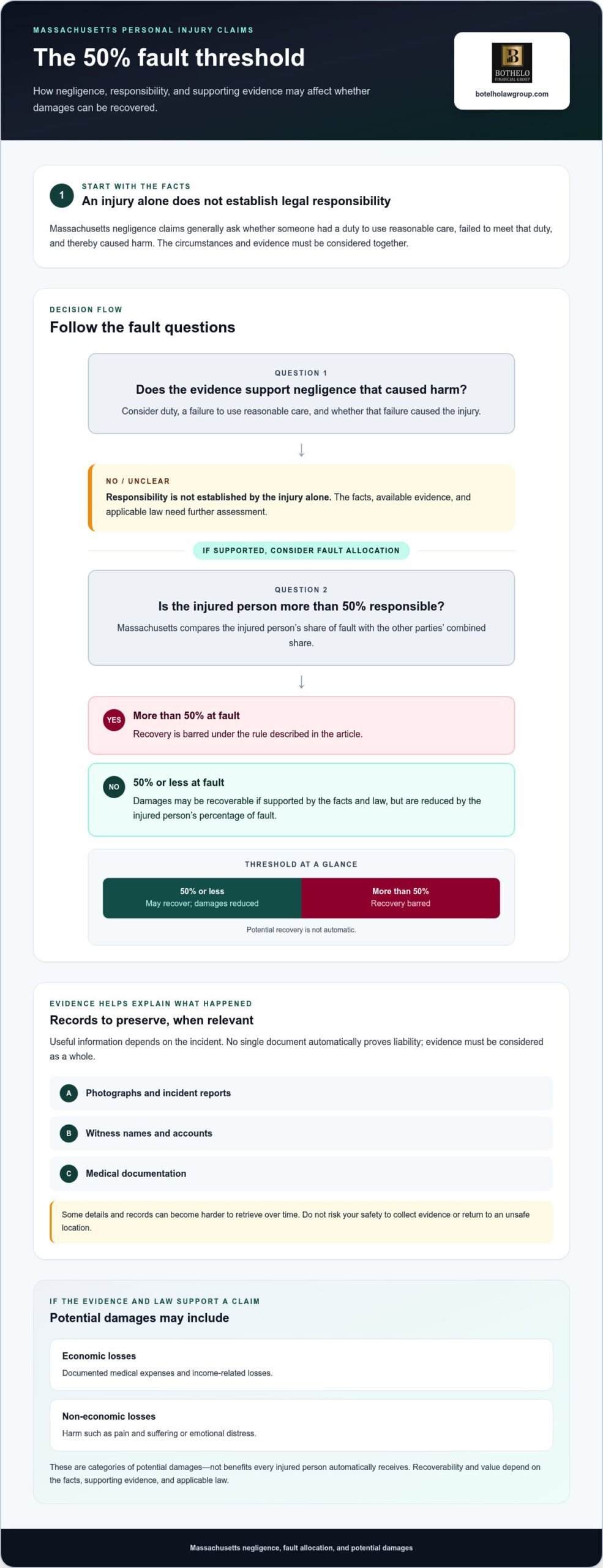
Massachusetts injury claims generally turn on negligence: whether someone had a legal duty to use reasonable care, failed to meet that duty, and thereby caused harm. How those elements apply depends on the circumstances and evidence. An unsafe condition or a collision, for example, doesn’t by itself establish who was legally responsible. The connection between a party’s conduct and the injury must also be evaluated.
Proof that you were injured is not the same as proof that another party is legally responsible for the injury. Medical records can help document harm, while other evidence may be needed to show what happened and why. A personal injury lawyer Fall River MA can assess how the evidence fits the facts and Massachusetts law without promising a particular result.
How evidence helps establish responsibility
Evidence helps reconstruct an event and assess whether a party’s conduct caused the harm. Depending on the incident, useful information may include photographs, incident reports, witness names and accounts, and medical documentation. In complex road incidents, technical assessments often examine how physical layouts and vehicle movements interact; transport planning consultancies such as ML Traffic Engineers Australia provide insight into how traffic engineering principles analyze road design and vehicle flow. A traffic collision and an injury on someone else’s property can call for different records and questions. No single document automatically proves liability; the evidence must be considered as a whole.
Some details and records can become harder to retrieve over time. Preserve the records you have and note who may have witnessed the event. What matters depends on the parties, location, and issues in dispute. Legal review can help identify relevant information and explain how it relates to the claim.
What compensation may account for
When the evidence and law support a claim, potential damages may include economic and non-economic losses. Economic damages can include documented medical expenses and income-related losses. Non-economic damages may address harm such as pain and suffering or emotional distress. These are categories of potential damages, not benefits every injured person automatically receives.
Whether a loss is legally recoverable, and how it may be valued, depends on the facts, supporting evidence, and applicable law. The nature of an injury matters, but it doesn’t determine the outcome on its own. Each claimed loss must be assessed in context rather than assumed to be covered or assigned a value in advance.
Fault allocation can also affect recovery. Massachusetts follows a modified comparative negligence rule: a person may recover damages if their share of fault is not greater than the other parties’ combined share. If the injured person is found more than 50% responsible, recovery is barred; otherwise, damages are reduced by that person’s percentage of fault. A dispute about how responsibility should be divided can therefore directly affect a claim.
Botelho Law Group handles personal injury litigation in Massachusetts and Rhode Island. If you’re weighing how fault or documented losses may affect your situation, speaking with a Fall River injury lawyer can help clarify the legal questions and potential next steps.
Which Fall River injury claim questions should you compare?
Different claims can involve different liability questions, evidence, and insurance rules. Comparing the circumstances helps identify what may need closer legal review. An insurer’s description of fault is its position on the claim, not a final legal determination.
| Scenario | Liability questions | Evidence to consider | Possible damages |
|---|---|---|---|
| Vehicle collision | How did the collision occur, and how might each party’s conduct affect fault? | Available collision reports, photographs, witness information, and medical records | Potentially supported medical expenses, income-related losses, and other legally recoverable harm |
| Injury on another party’s property | What condition or event contributed to the injury, and what facts bear on responsibility? | Incident records, photographs, witness accounts, and relevant medical documentation | Potentially supported economic and non-economic damages |
| Other alleged negligence | What duties and legal rules apply to the particular event and parties? | Records and other evidence specific to how the harm occurred | Losses allowed by applicable law and supported by the evidence |
How the issues differ by incident type
Vehicle incidents. Massachusetts uses a no-fault auto insurance system. Personal Injury Protection coverage generally pays first for medical expenses and lost wages, up to a combined $8,000. A claim for pain and suffering against an at-fault driver generally requires meeting the tort threshold, such as reasonable medical expenses exceeding $2,000 or a qualifying serious injury. Fault and the specific facts of the collision can affect the analysis.
Property-related injuries. Responsibility depends on the circumstances and evidence, not merely on where the injury happened. Other alleged negligence may involve different legal rules, so don’t assume the analysis for one incident applies to another. In every scenario, an insurer’s assessment is not the same as a court’s decision about fault.
How legal fees work for a personal injury case
Botelho Law Group represents personal injury clients on a contingency-fee basis, with no upfront legal fees unless the firm successfully recovers compensation. The written agreement explains the fee terms. Review it carefully and make sure you understand them before representation begins. This arrangement doesn’t guarantee a recovery.
If an injury resulted in a death, the legal questions may differ from those in an injury claim. Families can learn more from this wrongful death lawyer guide. For other claims, a personal injury lawyer Fall River MA can help assess which liability, evidence, and insurance questions matter to the specific facts.
Steps to Protect Your Massachusetts Injury Claim
After an injury, a few careful steps can help preserve information and keep important details from being lost. Focus first on your health, then organize what you can safely access. You don’t need to investigate the incident yourself or have every document in hand before seeking legal guidance.
- Address urgent medical needs. Seek appropriate care and follow the guidance of your medical providers. Keep paperwork related to visits, treatment, and work absences as it becomes available.
- Write down what you remember. Record the date, location, people involved, and your recollection of what happened. Details can fade, so make notes while they’re fresh. Don’t return to an unsafe location to gather information.
- Preserve relevant records. Save available photographs, incident reports, witness contact details, insurer correspondence, and receipts or work records related to the injury.
- Seek legal guidance promptly. A lawyer can review the circumstances, identify potential deadline issues, and explain what information may be relevant to your claim.
Prompt documentation can preserve useful evidence and create a clearer account of what happened, but no single record guarantees a particular result.
What records and details may be useful?
Keep records together in a secure digital or paper folder. Useful materials may include photographs already taken, incident reports, witness names and contact details, and letters or messages from insurers. Medical paperwork and work-related records can help document the injury’s effects. A simple log of related expenses and communications, with dates and the names of people who contacted you, can make the record easier to follow.
Not every record will be available, and gaps in documentation don’t automatically determine whether a claim can proceed. Don’t delay seeking guidance because you lack a report or witness details. A personal injury lawyer Fall River MA can assess what information exists, what may still be obtained, and how any gaps affect the claim in context.
Why timing matters in Fall River injury cases
Massachusetts generally sets a three-year limitation period for personal injury lawsuits, measured from the date of injury, but exceptions and other notice requirements may apply. Claims involving a government entity can require a written presentment of claim within two years. For injuries involving public sidewalks or snow and ice, written notice may be required within 30 days. These rules don’t apply identically to every situation; the facts and parties can affect which deadlines matter.
Because deadlines may depend on the type of claim, the defendant, and applicable exceptions, don’t assume the general limitation period is the only date to consider. Timely legal review can help identify relevant requirements. If you need help assessing timing and preserving your claim, discuss your injury claim with Botelho Law Group.
How a Fall River personal injury lawyer can guide your next steps
After an injury, it can be difficult to determine which details matter, who may be responsible, or how to respond to an insurer. A personal injury lawyer Fall River MA can review the circumstances, identify legal issues, and help organize information relevant to a potential claim. That guidance can bring structure to decisions while you focus on your recovery.
The firm can assess the available facts, consider what additional evidence may be relevant, and communicate with insurers or other parties about the claim. Representation can help protect your interests, but it cannot guarantee that a claim will be accepted or result in compensation.
The firm represents personal injury clients on a contingency-fee basis, with no upfront legal fees unless it successfully recovers compensation. The written agreement explains the fee terms and should be reviewed before representation begins. This arrangement does not promise a recovery or a particular result.
What to expect when discussing a potential claim
A concise timeline can make an initial discussion more focused. Note when and where the incident occurred, what you remember, and who was involved. Bring available incident records, insurer correspondence, and information about your injury and related treatment. You don’t need every document or answer before speaking with counsel. The discussion can identify relevant questions, highlight missing information, and clarify possible next steps based on the circumstances.
Choose informed next steps after an injury
Clear records and communication can help counsel assess a claim and address questions as they arise. Keep relevant documents together, preserve communications, and share accurate information about the incident and its effects. If you’re uncertain about a document or an insurer’s request, ask counsel how it may relate to your situation before responding. Each matter requires an individual assessment, and the appropriate course depends on its facts and applicable law.
An injury can bring financial pressure and uncertainty at the same time. You don’t have to resolve every legal question alone. Botelho Law Group can discuss your circumstances, explain issues that may affect your claim, and help you understand potential next steps without promising an outcome. Contact the firm to discuss your injury and available legal options.
Take the Next Step With a Clear Plan
Uncertainty after an injury can make every decision feel urgent, but you don’t need to resolve every question at once. Start by identifying what you need to understand, such as how a decision could affect your claim or what information may be important to preserve. A focused conversation can turn those concerns into practical next steps.
If you’re considering a personal injury lawyer Fall River MA, look for a conversation that gives you space to explain what happened and understand your options. Bring your questions, even if you’re still gathering records. Clear guidance can help you make informed choices without assuming in advance what the outcome will be.
Discuss your personal injury matter with Botelho Law Group to talk through your circumstances and possible next steps.
Frequently Asked Questions
When should I contact a personal injury lawyer after an accident in Fall River?
Consider seeking legal guidance promptly if you were injured, another party disputes responsibility, or an insurer has contacted you. Early review can help you understand what information may matter and how to handle claim communications. If an adjuster requests a recorded statement or asks you to sign a release, get advice about the document’s implications before deciding how to respond. Timing depends on the facts, so don’t assume that waiting is harmless.
How long do I have to file a personal injury claim in Massachusetts?
Many Massachusetts personal injury lawsuits generally must be filed within three years of the injury, but that period doesn’t apply to every claim in the same way. Claims involving government entities may have earlier presentment requirements, and certain incidents may involve additional notice rules. The relevant dates can depend on the claim, parties, and exceptions. Have the circumstances reviewed promptly rather than calculating a deadline from a general rule alone.
What compensation can I seek in a Massachusetts personal injury case?
You may seek damages for losses supported by the evidence and recognized by applicable law. A claim might include treatment expenses or income lost because an injury prevented you from working. Other harm may also be relevant, depending on the circumstances. Keep records that show how each claimed loss connects to the injury. The available damages and their value vary, and a short description cannot establish what a case may recover.
Do I have a personal injury claim if I was partly at fault?
Possibly. Under Massachusetts’ modified comparative negligence rule, a claimant generally may recover if their share of fault is not more than 50%; any damages are reduced according to their share of responsibility. The evidence and applicable law determine how fault is assessed, and exceptions or other rules may affect a particular matter. An insurer’s conclusion is not necessarily the final legal determination, so ask how its assessment relates to the available facts.
Do personal injury lawyers in Fall River charge upfront fees?
Botelho Law Group handles personal injury matters on a contingency-fee basis, with no upfront legal fees unless the firm successfully recovers compensation. The written agreement explains the terms of representation, so review it carefully and ask for clarification about anything you don’t understand before signing. This fee arrangement doesn’t guarantee a recovery.
What should I bring to a personal injury lawyer consultation?
Bring any records you already have, such as insurer correspondence, an incident report, photographs, or documents related to treatment and missed work. A short timeline can help organize events, including when the incident occurred and what communications followed. Keep originals safely stored and use copies when possible. You can still seek guidance if records are incomplete; a lawyer can identify what additional information may help assess the facts.
Can I still speak with a lawyer if an insurance company has contacted me?
Yes. An insurer’s contact doesn’t prevent you from seeking legal guidance. Save letters, emails, claim numbers, and notes about calls, including dates and the names of people you spoke with. Before accepting an offer or signing a release, make sure you understand what the document says and how it may affect your options. The significance of an insurer’s request depends on the circumstances, so don’t treat it as a final legal ruling.
Does Botelho Law Group handle personal injury cases near Fall River?
Yes. When discussing your situation with a personal injury lawyer Fall River MA, be ready to describe where the incident occurred, who was involved, what harm followed, and what records or insurance communications you have. That information can help frame an initial review.