
Could a living trust make things easier for your family, or add paperwork without addressing your real concerns? The answer depends on how the trust is structured, which assets it holds, and what you want your estate plan to accomplish. If you’re searching for a living trust lawyer Boston residents can work with, start by considering those factors. It’s also important to understand how a trust differs from a will and what is involved in keeping a trust properly funded.
This article explains what a revocable living trust can and cannot do, how it may work alongside a will and other estate-planning documents, and why transferring assets into the trust matters. It also covers considerations for Massachusetts residents, including Boston-area property and planning for incapacity. Botelho Law Group serves estate-planning clients in Boston and across Massachusetts, helping them consider their goals, assets, and family circumstances. You’ll come away better prepared to discuss whether a living trust belongs in your plan.
Key Takeaways
- Understand how a revocable living trust works and the distinct roles of the person who creates it, the trustee, successor trustee, and beneficiaries.
- Learn why a trust’s usefulness depends in part on funding it properly and reviewing how each asset is owned.
- Compare a living trust with a will, including how the documents may work together in an estate plan.
- See why Massachusetts rules, Boston-area real estate, and property in other states may affect trust planning.
- Prepare for a focused discussion with a living trust lawyer Boston by organizing your goals, assets, ownership details, and beneficiary information.
What a Living Trust Does for a Boston-Area Estate Plan
A revocable living trust is a legal arrangement created during a person’s lifetime to hold and manage assets according to written terms. The person who creates it is the grantor, also called the settlor or trustmaker. A living trust can specify who manages the property and who is intended to receive it. It is a planning tool, not a guarantee against every legal or financial issue. For a general overview, see What is a Living Trust?
The people named in the document have distinct roles. The trustee manages trust property according to its terms. If the trust is structured to allow it, the grantor may serve as the initial trustee and continue managing the assets. A successor trustee is designated to take over if the initial trustee can no longer serve, including after incapacity or death. The beneficiaries are the people or organizations the trust identifies to benefit from its assets.
How a revocable living trust is structured
“Revocable” generally means the grantor can amend or revoke the trust during their lifetime, subject to the document’s terms and applicable Massachusetts law. The details matter. The trust should identify who can make decisions, what happens if the grantor becomes unable to act, and how assets are managed or distributed. A living trust lawyer Boston residents consult can review those provisions in light of the grantor’s goals and circumstances.
Choose a successor trustee carefully. That person may need to manage property, keep records, and carry out the trust’s instructions during a demanding period. Naming someone is only part of the plan. The document should also explain when that person’s authority begins and what responsibilities apply.
What a living trust does not automatically accomplish
Signing a trust document does not, by itself, transfer ownership of assets into the trust. Assets generally must be retitled or otherwise coordinated with the trust, and the appropriate steps depend on the asset and its ownership. A home, a financial account, and an asset with a beneficiary designation may each require a different approach. If property intended for the trust remains outside it, that property may not receive the same probate treatment.
A properly funded trust may help avoid probate for assets held in the trust, but it does not eliminate every form of estate administration. Assets outside the trust may still require separate handling, and the trust itself must be administered under its terms. A revocable trust should not be assumed to provide creditor protection or tax savings. Those outcomes depend on the circumstances and applicable law.
Trust planning is also distinct from incapacity documents. A successor trustee’s authority concerns trust assets. A power of attorney addresses authority over certain matters outside the trust, while health-care planning documents address medical decisions. A coordinated estate plan considers how these documents work together instead of treating the trust as a substitute for all of them.
How to Fund and Manage a Living Trust Over Time
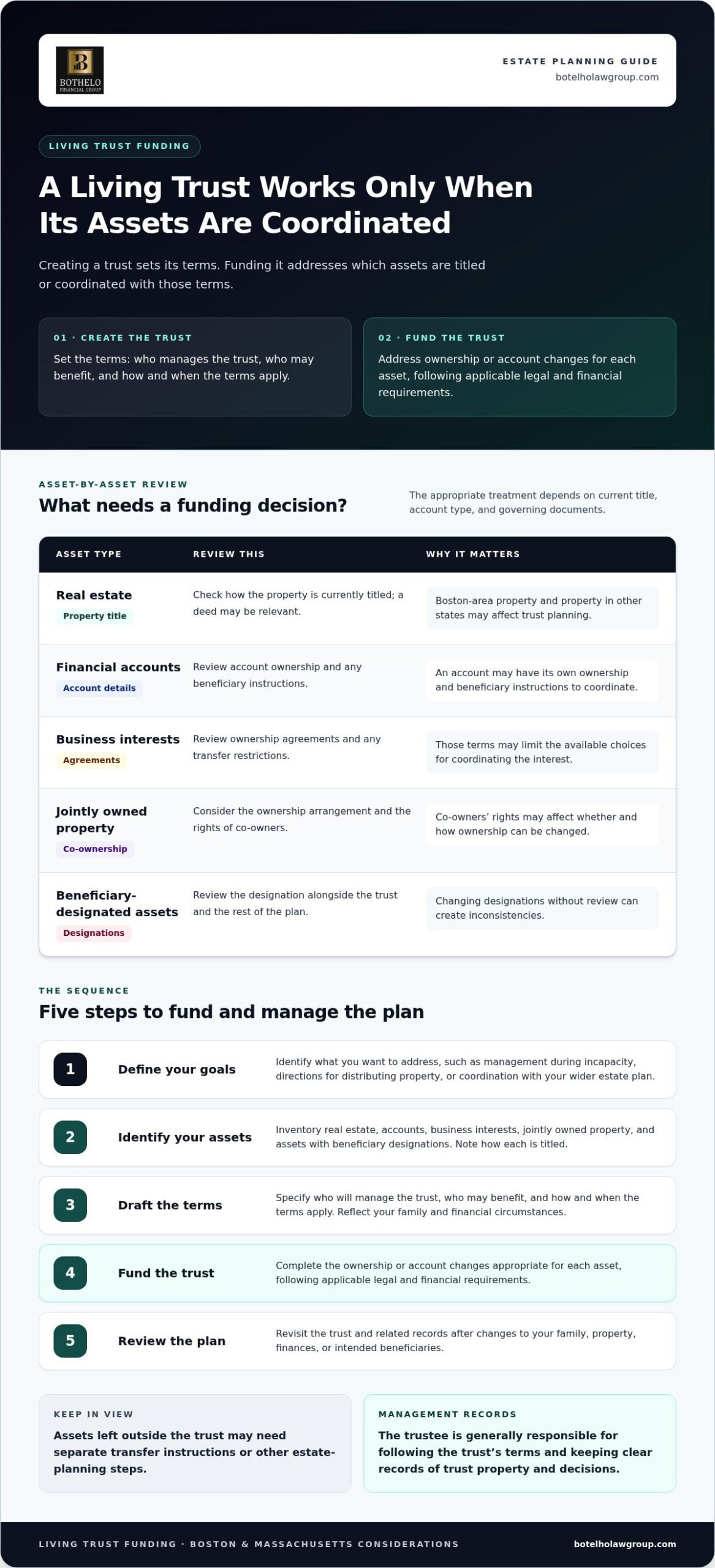
A trust plan takes more than signed paperwork. It requires decisions about which assets belong in the trust, how ownership should be recorded, and how to maintain the arrangement as circumstances change. The distinction is straightforward: creating a trust sets its terms; funding it addresses which assets are titled or coordinated with those terms.
Work through the process in sequence:
- Define your goals. Identify what you want the trust to address, such as management during incapacity, directions for distributing property, or coordination with your wider estate plan.
- Identify your assets. Make an inventory of real estate, accounts, business interests, jointly owned property, and assets with beneficiary designations. Note how each is currently titled.
- Draft the terms. Specify who will manage the trust, who may benefit, and how and when the terms apply. The provisions should reflect your family and financial circumstances.
- Fund the trust. Complete the ownership or account changes appropriate for each asset, following applicable legal and financial requirements.
- Review the plan. Revisit the trust and related records after changes to your family, property, finances, or intended beneficiaries.
Which assets may require a funding decision?
Real estate and financial accounts are common examples, but the right treatment depends on the asset’s current title, account type, and governing documents. A deed may be relevant to real property, while an account may have its own ownership and beneficiary instructions. Changing title or designations without reviewing how they interact with the trust and the rest of your plan can create inconsistencies.
Business interests and jointly owned property call for particular care. Ownership agreements, co-owners’ rights, or transfer restrictions may limit the available choices. Assets left outside the trust may need separate transfer instructions or other estate-planning steps. A living trust lawyer Boston residents consult can review these details alongside the trust terms, rather than treating every asset as interchangeable.
Who manages the trust and what records matter?
The trustee is generally responsible for following the trust’s terms and keeping clear records of trust property and decisions. Depending on the document and circumstances, a successor trustee may step in if the initial trustee can no longer serve or has died. The trust’s terms and applicable law govern that transition, so the named successor should know where the document and asset records are kept.
Keep the signed trust, amendments, deeds, account records, and related correspondence organized and consistent. Review them after a move, property purchase or sale, significant financial change, marriage, divorce, or change in family priorities. Massachusetts trust rules can inform that review. Massachusetts Laws on Trusts provides state-specific legal information. For individualized estate-planning guidance, discuss your trust and asset plan with counsel.
Living Trust vs. Will: How to Assess the Right Planning Fit
A will and a revocable living trust serve different functions, and an estate plan may use both. A will generally directs how property covered by it should be handled after death. A trust can hold and manage assets under its terms during the grantor’s lifetime and after death. The right fit depends on your assets, family circumstances, and preferences for management and administration, not on one document being universally better.
| Planning factor | Living trust | Will |
|---|---|---|
| Control | Sets terms for managing trust assets during life and after death. | States instructions that generally take effect after death. |
| Asset transfer | Applies to assets properly transferred to or coordinated with the trust. | Directs the handling of property covered by the will. |
| Privacy | Trust terms and administration are generally handled outside the probate process for trust-held assets, but privacy isn’t absolute. | A will submitted for probate may become part of the public court record. |
| Administration | Requires funding, recordkeeping, and administration under the trust terms. | May require probate administration for property passing under the will. |
| Intended use | May support ongoing management and directions for trust assets. | Can provide instructions for property at death and address other will-related needs. |
The table is a starting point, not a substitute for reviewing your circumstances and current Massachusetts law. A trust does not automatically cover assets that remain outside it, and a will does not provide the same lifetime management structure as a trust.
When a living trust may merit consideration
A trust may be worth discussing if you want a plan for managing certain assets if you become unable to manage them yourself, or if you want trust terms to guide how those assets are administered after your death. Real estate ownership, family needs, and your preferred distribution process can all affect the analysis. These are factors to weigh, not automatic reasons to create a trust.
Some trust-based plans include a pour-over will, which is intended to direct certain assets left outside the trust into it at death. That document does not necessarily keep those assets out of probate. A living trust lawyer Boston residents consult can assess how a will and trust should work together under current Massachusetts requirements.
When a will-centered plan may be more appropriate
A will-centered plan may fit someone whose goals can be addressed through a will and related documents without the additional work of establishing, funding, and maintaining a trust. The choice depends on the person’s assets, family needs, and priorities. A will may also address matters a trust does not replace, such as nominating a guardian for minor children.
Trust planning can involve added setup and ongoing administration. That effort may support a person’s goals, but it should be weighed against the responsibility of keeping ownership records and trust terms coordinated. Estate-planning counsel can evaluate the full plan rather than recommend either document in isolation.
Massachusetts and Boston Factors to Review Before Creating a Trust
A trust should reflect the law that applies to your assets and how you own them. For a Boston-area homeowner, planning questions may include how a property is titled, whether it is jointly owned, and whether you own real estate in another state. A trust document alone cannot resolve every issue created by ownership, tax rules, or other estate-planning documents. Review the full picture before choosing a structure.
Massachusetts probate and property questions
Massachusetts Probate and Family Court handles probate and related estate matters, but court involvement depends on the assets, their ownership, and the applicable legal process. Property titled in a trust may be handled differently from property held individually, while jointly owned property may raise separate questions. No single court process applies to every estate.
Boston-area real estate deserves asset-specific review. The deed, co-ownership arrangement, mortgage-related documents, and intended trust terms may affect how a transfer should be handled. If you also own property outside Massachusetts, the laws and procedures connected to that property may need to be considered alongside your Massachusetts plan. A living trust lawyer Boston residents consult can evaluate those details as part of an individualized estate-planning analysis.
Family, tax, and incapacity planning considerations
Consider who you want to benefit, who could manage trust property, and whether your choices still reflect your family relationships. A marriage, separation, new child, death in the family, or change in a beneficiary’s needs may prompt a review. Consider trust terms alongside any powers of attorney and health-care documents. Those documents address different responsibilities and are not replaced simply by creating a trust.
Tax and public-benefit planning require particular care. As of 2026, the Massachusetts estate tax exemption is $2 million per person, while the federal estate tax exemption is $15 million per person. These figures do not establish whether a particular estate will owe tax, and a revocable trust should not be assumed to create tax savings. Public-benefit eligibility and estate-recovery questions also depend on the individual’s circumstances and current rules. Have counsel review the applicable law before relying on a trust for tax or benefit planning.
Before a legal consultation, gather your current will and trust documents, deeds, account and beneficiary records, ownership details, a list of intended beneficiaries, and a summary of your planning concerns. These materials give counsel a practical starting point for identifying how Massachusetts law, your family situation, and property in or beyond Boston may affect the plan. Botelho Law Group serves estate-planning clients in Boston and across Massachusetts. Discuss your Massachusetts trust plan with counsel.
Work With a Living Trust Lawyer in Boston on Your Next Steps
Deciding whether to create a trust is only one part of estate planning. First, organize the facts that shape the decision. Then consider how a trust would work with your will, ownership records, beneficiary designations, and incapacity plan. A living trust lawyer Boston residents consult can assess those pieces together, based on current Massachusetts law and your circumstances.
What to prepare for an estate-planning discussion
A useful first meeting starts with a clear picture of what you own, how it is held, whom you want to benefit, and what you want your plan to address. Bring existing estate documents and current beneficiary information if available. You do not need to resolve every question in advance. The goal is to give counsel enough context to identify the issues that need focused review.
Before the discussion, consider whether your priorities include managing assets during incapacity, guiding administration after death, addressing family needs, or maintaining privacy. Your answers can help frame the legal analysis.
- Write down your goals. Identify what you want your estate plan to accomplish and any concerns you want counsel to address.
- Prepare an asset list. Include real estate, financial accounts, business interests, and significant property, along with each asset’s location.
- Record ownership details. Note whether property is held individually, jointly, or in another form, and gather available deeds or account statements.
- Review beneficiaries. List the people or organizations named in your documents and account designations, and note any updates you are considering.
- Gather existing documents. Bring your will, trust documents, powers of attorney, health-care documents, and relevant amendments.
How Botelho Law Group supports Massachusetts estate planning
Botelho Law Group provides estate planning and asset protection in Massachusetts, serving clients in Boston and other Massachusetts communities. Counsel can consider your goals, assets, family circumstances, and administration concerns when evaluating whether a trust fits and how it may coordinate with the rest of your plan. The recommendation should follow a review of your circumstances, not a one-size-fits-all assumption.
Incapacity planning is also part of the broader discussion. A trust and a power of attorney address different aspects of decision-making, so reviewing them together can clarify how your plan is intended to function. The firm’s power of attorney guidance offers related context for considering that document alongside trust planning.
Bring your questions and records to a focused conversation about your options. To discuss estate-planning guidance, connect with Botelho Law Group about planning for your Massachusetts assets and family.
Take the Next Step Toward a Clearer Estate Plan
Your estate plan should reflect the life you’re planning for, not simply the documents you happen to have. Before deciding whether a trust belongs in it, consider what you want your family and decision-makers to understand and which questions still need careful legal analysis. A focused conversation can help turn those priorities into a practical planning direction.
A living trust lawyer Boston residents consult can review your goals, assets, and family circumstances as part of a broader estate plan. Botelho Law Group handles estate planning and asset protection in Massachusetts, serving clients in Boston and other Massachusetts cities from its Fall River headquarters. The firm can help you assess your options without assuming one structure fits every family.
Discuss your Massachusetts estate-planning goals with Botelho Law Group and take a thoughtful next step toward a plan shaped around your needs. Informed guidance can help you approach these important decisions with greater clarity.
Frequently Asked Questions
Can I create a living trust without a lawyer in Massachusetts?
Yes, you can prepare a trust without hiring a lawyer, but a form may not address your assets or family circumstances accurately. For example, a trust intended to hold a home requires attention to the property’s ownership and transfer documents. A living trust lawyer Boston residents consult can review the terms and how they fit with the rest of an estate plan before you sign or transfer property.
Does a living trust need to be notarized in Massachusetts?
Not every trust-related document has the same signing formalities, so do not assume notarization is always required or never needed. A trust instrument and a deed transferring real estate are different documents, and a deed may have separate acknowledgment and recording requirements. The trust’s terms and how it will be used matter. Review current Massachusetts requirements for the specific documents before signing or submitting them.
Can I change or revoke a living trust after creating it?
Generally, a revocable living trust can be changed or revoked during the grantor’s lifetime, subject to its terms and applicable law. Massachusetts law generally treats a trust as revocable unless it expressly provides otherwise. Changes should follow the document’s amendment procedure and be coordinated with related records. For example, revising who inherits does not automatically update beneficiary instructions on an account held outside the trust.
What happens to a living trust when the person who created it dies?
After the grantor dies, the successor trustee generally takes responsibility for administering trust property under the document’s terms. The trustee may need to identify assets, address expenses and obligations, keep records, and distribute property as directed. The trust does not simply disappear, and the timing and steps depend on its provisions and circumstances. Disputes, unclear terms, or assets outside the trust may require additional legal or administrative steps.
Is a living trust private in Massachusetts?
A living trust generally is not filed with a probate court merely because it has been created, so its terms may receive less public exposure than a will submitted in a probate proceeding. That does not make the arrangement completely confidential. Information may be shared with beneficiaries or institutions as needed, and court proceedings or disputes can create public records. Privacy depends on how assets are held and how the trust is administered.
Can a living trust protect assets from creditors or lawsuits?
A revocable living trust generally should not be treated as protection from the grantor’s own creditors or lawsuits. Because the grantor typically retains the ability to control or revoke the trust, transferring assets into it does not by itself place them beyond reach. Creditor claims and asset-protection planning depend on the facts and applicable law. Get individualized legal advice before moving property or relying on a trust for protection.
Will a living trust help me avoid estate taxes?
A revocable living trust does not automatically reduce or eliminate estate taxes. Tax treatment can depend on the value and ownership of assets, the trust’s terms, and applicable Massachusetts and federal rules. Simply retitling property in a revocable trust should not be assumed to remove it from tax calculations. If tax planning is a concern, ask counsel to review your full estate and explain which strategies may fit your circumstances.
What happens to my living trust if I move out of Massachusetts?
Moving does not necessarily invalidate a trust, but it is a reason to review the document and how it works under your new circumstances. A different state’s laws may affect interpretation, trustee powers, administration, or property transfers. For example, buying a home in another state may require coordination between the trust and that property’s deed. Review the trust, related documents, and tax considerations after a move rather than assuming no updates are needed.