
A marriage or visa entry alone doesn’t establish eligibility for a green card. According to U.S. Citizenship and Immigration Services, immediate relatives of U.S. citizens, including spouses, unmarried children under 21, and parents, have unlimited visa availability, but applicants must also meet the requirements to adjust status from within the United States. An adjustment of status attorney in Boston can help assess how your entry history and other eligibility factors affect the application.
It’s understandable to focus first on whether a visa is available. The answer also turns on how you entered the country, your family relationship, and whether any inadmissibility issue could affect your case. This guide explains how visa availability and priority dates work, what marriage does and doesn’t establish, and how medical exams and supporting documents fit into the process. You’ll also learn what to consider before filing Form I-485, so you can approach the application with a clearer understanding of the requirements and potential complications.
Key Takeaways
- Assess your entry history, immigration record, and any criminal case before filing; these factors can affect eligibility and future travel.
- For family-sponsored categories with limited visa availability, identify the petition’s priority date and understand how it affects your place in line.
- Prepare medical and supporting documents carefully, since USCIS may request additional evidence when the record is incomplete or needs clarification.
- Review whether adjustment of status is the right process for your circumstances, including where you are located and the basis for your family petition.
- Seek legal guidance when prior denials, unlawful presence, an entry without inspection, or criminal history may complicate your application.
Choosing an immigration lawyer and spotting red flags
Adjustment of status applications depend on eligibility, evidence, and immigration history. Choose counsel who reviews all three. Common reasons for denial include missing evidence, unmet eligibility requirements, or inadmissibility concerns. An attorney can identify issues, organize supporting records, and plan how to address them.
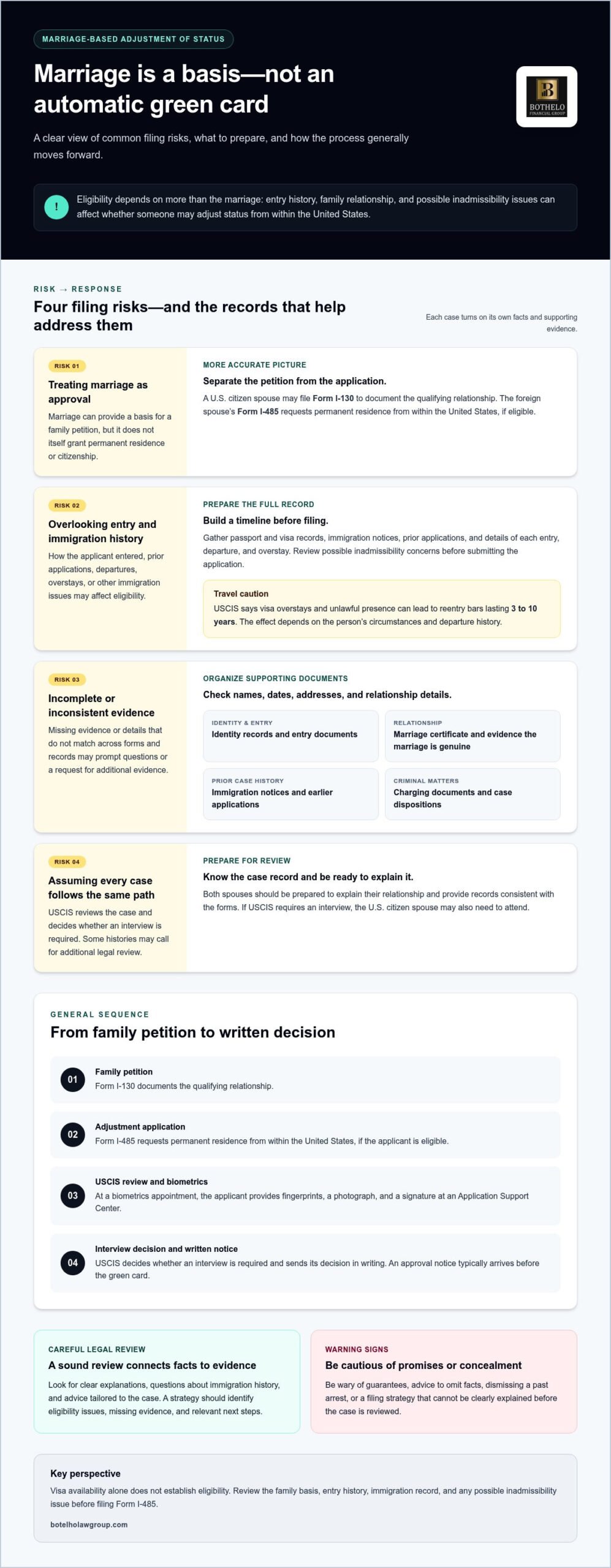
Before hiring a lawyer, look for clear explanations, careful questions about your immigration history, and advice tailored to your facts. Be wary of guarantees or any recommendation to conceal information.
Attorney Selection Warning Signs
Ask how the lawyer evaluates adjustment eligibility, prior entries, criminal records, and possible removal risks. A careful immigration review should explain which records matter and why, rather than promise approval before reviewing your case. Be cautious if someone dismisses a past arrest, advises you to omit facts, or cannot clearly explain the proposed filing strategy.
Attorney Consultations
Prepare for a consultation by gathering immigration notices, passport and visa records, prior applications, and court documents. Accurately explain each entry, departure, overstay, and arrest, even if an event seems unrelated. Ask the attorney to identify key eligibility issues, missing evidence, and next steps. Clear answers should connect your documents and history to the legal questions in your case.
Personalized Case Strategies
A sound strategy starts with a timeline of entries, status changes, petitions, and contact with immigration authorities. The lawyer can compare that record with the adjustment requirements and identify evidence for each issue. For example, a prior denial calls for reviewing the decision and original filing before preparing another application. The strategy should also account for removal proceedings and any available waiver process.
Criminal matters require particular care. Certain criminal conduct can prevent an immediate-relative applicant from obtaining permanent residence. In Padilla v. Kentucky, the U.S. Supreme Court recognized that immigration consequences can be serious enough that defense counsel must address them. If you face a criminal case, understand its immigration consequences before pleading guilty. Give the immigration lawyer charging documents and case dispositions, not just a verbal summary.
Visa overstays and unlawful presence can also affect future travel. According to U.S. Citizenship and Immigration Services, visa overstays and unlawful presence can lead to bars on reentering the United States lasting 3 to 10 years. For certain visa overstays, an unlawful presence waiver application may be filed with USCIS using Form I-601A, according to U.S. Citizenship and Immigration Services. A lawyer can assess how your departure history and immigration record relate to that process.
Developing the case means matching each claim to reliable documentation. Under 8 U.S.C. § 1255, federal law sets adjustment eligibility requirements and bars for certain applicants. An attorney can use that framework to identify gaps, prepare explanations, and respond to requests for evidence. Keep copies of every submission and notice so your lawyer can track deadlines and preserve a complete record.
When Is A Marriage Adjustment Of Status Required?
Marriage can provide a basis for a family petition, but it does not itself grant a green card or U.S. citizenship. The key question is whether the foreign spouse is eligible to apply for permanent residence from within the United States.
Form I-485 for the Foreign Spouse
A U.S. citizen spouse may file Form I-130 to petition for their foreign spouse. The petition documents the qualifying relationship; it does not, by itself, make the spouse a permanent resident. Applicants in the United States may need to file Form I-485, Application to Register Permanent Residence or Adjust Status, to adjust status, according to U.S. Citizenship and Immigration Services.
The foreign spouse’s I-485 requests permanent residence from within the country. Before filing, organize identity records, entry documents, the marriage certificate, and evidence that the marriage is genuine. Consistency matters: names, dates, addresses, and relationship details should match across forms and supporting records.
Process Steps, Biometrics, and Interview
The process generally proceeds from the family petition and adjustment application to USCIS review, biometrics, and a written decision. At a biometrics appointment, the applicant provides fingerprints, a photograph, and a signature at an Application Support Center. USCIS decides whether an interview is required, and the U.S. citizen spouse may also need to attend.
Both spouses should be prepared to explain their relationship and provide records consistent with the forms. USCIS sends its decision in writing. An approval notice typically arrives before the green card.
What are the current USCIS filing fees and processing times for adjustment of status? Fees depend on the forms and filing circumstances, while processing times vary by case and agency workload. Review the current USCIS fee schedule and case-status information before preparing a filing.
Are there free or low-cost immigration legal services in Boston for adjustment of status? Free or reduced-fee help depends on program eligibility and capacity. Legal aid and nonprofit immigration programs are common options to explore. Ask whether assistance includes legal advice, application preparation, or referrals.
What is the step-by-step adjustment of status process, including biometrics and the interview? The petitioner submits Form I-130, and the applicant files Form I-485 when eligible. The applicant then responds to USCIS notices, attends biometrics, completes any requested interview, and receives a written decision.
Adjustment of status is a process for an eligible person already in the United States. Applicants outside the country generally pursue an immigrant visa through consular processing instead. Marriage to a U.S. citizen does not automatically confer citizenship, and a family petition does not remove the need to meet adjustment requirements.
If the marriage is less than two years old when permanent residence is granted, the foreign spouse may receive a conditional CR-1 green card. The couple should understand that this classification is conditional and keep records that document their shared life. A marriage certificate establishes the legal marriage, while other evidence can help show the relationship is genuine.
For a case based on marriage, an immigration attorney can assess whether the proposed filings align with the spouse’s entry and immigration history. If you need help preparing a family petition, family-based green card petition guidance can help you understand the legal steps involved.
Medical exams and supporting documentation
A well-organized application connects each form answer to reliable records. Review medical examination materials, identity documents, immigration history, and supporting evidence together before filing. A missing page or inconsistent date can prompt USCIS to request more information and add work to the immigration process.
Follow the medical examination instructions for your filing, and keep the resulting records with your application materials. Before submitting, compare names and identifying details across the examination paperwork, passport, prior immigration documents, and forms. If a record uses a different spelling or date, prepare a clear explanation with supporting documents rather than leaving the discrepancy unexplained.
USCIS may request additional evidence when submitted evidence is insufficient, no longer valid, or does not provide enough information to determine eligibility. Treat a request for evidence as a specific task: identify each requested item, locate the document that addresses it, and organize your response in the order requested. Keep a complete copy of your response and proof of submission with your case file.
Supporting records vary with the facts of an application. A useful preparation process includes:
- Identity and entry records: collect passport pages, visa records, and documents showing the applicant’s immigration history.
- Relationship evidence: organize relevant records that support the claimed family relationship, such as shared address or financial documents when applicable.
- Prior filings and notices: gather copies of earlier applications, USCIS correspondence, and any immigration court paperwork.
- Translations and explanations: identify documents that need translation and explain material inconsistencies with supporting records.
Work authorization and travel documents raise practical considerations separate from proving eligibility for permanent residence. Identify whether you need to request either document, and ensure the application details align with your adjustment filing. Keep USCIS receipts and notices accessible to track what was filed and what action may be needed next. Do not assume an adjustment filing alone meets every work or travel need.
Document preparation involves more than collecting papers. A careful review checks that each record is legible, complete, current for its intended use, and consistent with the forms. For example, if an earlier immigration record lists a different address, note the timeline and provide records that clarify the change.
An immigration attorney or law firm can help build an indexed file, identify missing evidence, and prepare responses to USCIS requests. If immigration court proceedings are part of your history, include every related notice and filing in the review. A clear record helps your legal representative assess the application and connect each supporting document to the issue it addresses.
Eligibility after entering on a visitor, student, or work-related visa
Entering on a temporary visa does not automatically prevent someone from seeking a green card. A visitor, student, or work-related visa holder who later marries a U.S. citizen may apply for permanent residence, but eligibility depends on the complete immigration record and applicable requirements.
The visa category helps explain the original purpose of entry. B-1 covers business activities, while B-2 covers tourism or visiting family. F-1 and M-1 are for academic or vocational students; J-1 is for exchange visitors, including scholars and interns. Work-related visa categories vary according to the purpose and circumstances of the employment.
For an immediate-relative green card applicant, entry history can be central. The applicant may need to have entered the United States with inspection at an authorized port of entry. A lawyer can review passport stamps, visa records, and other entry documents to establish how the person arrived and was processed.
A visa overstay does not determine eligibility by itself. The review should also identify unauthorized stay, prior removal orders, criminal history, and any departure after an unauthorized stay that could trigger an inadmissibility bar. Build a clear timeline of each event, including entry and departure dates, immigration notices, and prior applications.
Before filing, organize these records:
- Passports and visa pages showing the category used for entry.
- Entry records and documents showing inspection at a port of entry.
- School or employment records that help explain F-1, J-1, H-1B, or other visa activity.
- Prior immigration filings, notices, and removal court documents.
- Marriage records and evidence supporting the qualifying relationship.
For example, an F-1 student who later marries a U.S. citizen should preserve school and entry records alongside marriage evidence. An H-1B professional should include relevant visa and employment records. These examples help explain the history; the documents must also align with the information in the adjustment application.
USCIS may schedule an interview and ask about the applicant’s entry, immigration history, and relationship. Prepare by reviewing submitted forms and records so your answers are accurate and consistent. If a prior removal order or criminal case appears in your record, address it before filing rather than leaving it unexplained.
An immigration lawyer can review your case in detail, explain how each visa period affects it, and plan representation around documented facts. The key steps are to establish the basis for adjustment, confirm entry history, identify possible inadmissibility concerns, and prepare evidence that addresses those concerns directly.
Visa availability and priority dates
Visa availability depends first on the family relationship and the immigrant category. According to U.S. Citizenship and Immigration Services, immediate relatives of U.S. citizens, including spouses, unmarried children under 21, and parents, have an unlimited number of visas available. This removes a category-based visa wait, but applicants must still meet adjustment requirements.
Other family-sponsored categories have limited visa availability. For those cases, the priority date is generally the date the relative filed the immigrant petition. Track that date against visa availability for the relevant category and country of chargeability. Filing a petition alone does not mean a visa is currently available.
Start by identifying the petitioner’s status and the exact family relationship. A U.S. citizen petitioning for a spouse is treated differently from a lawful permanent resident petitioning for a spouse. Unmarried children under 21 of U.S. citizens or lawful permanent residents may qualify under certain family-based categories, while parents, brothers, and sisters of U.S. citizens may qualify in other situations.
For a limited category, organize the case around these steps:
- Confirm the petitioner’s citizenship or permanent-resident status.
- Identify the family category that matches the relationship.
- Locate the petition filing date that establishes the priority date.
- Compare the date and category with current visa availability before planning the next filing.
- Keep petition notices and records together so the date can be verified.
Family-sponsored applicants outside immediate-relative categories may face waits of many years. The wait depends on the category, priority date, and visa availability. A priority date is a practical case marker, not a guarantee of when an applicant may obtain permanent residence. Review it whenever filing plans change.
These distinctions matter for families planning work, travel, and long-term residence. A spouse of a U.S. citizen may have immediate-relative visa availability, while a spouse of a permanent resident falls within a limited family-sponsored category. An immigration lawyer can explain which category applies and how the priority date affects the filing sequence.
Visa availability does not resolve every issue. Entry history, prior applications, inadmissibility concerns, and deportation proceedings can make a case more complex. Preserve USCIS notices, petition receipts, and prior immigration records. These documents help an immigration lawyer assess whether a visa is available and what steps remain before filing for adjustment.
For applicants in limited categories, avoid treating an old priority-date estimate as current. Track the petition date and category, then review visa availability before taking the next step. If you need case-specific guidance on family petitions and visa timing, discuss your family-based immigration case.
Botelho Law Group: Estate Planning and Asset Protection
Botelho Law Group assists individuals and families with immigration matters, including family-based green card petitions. If you are considering adjustment of status, the firm’s immigration representation can help assess the family petition and relevant records. This support can be useful when questions about visa availability, entry history, or supporting documents make the next step unclear.
Botelho Law Group also handles estate planning and asset protection in Massachusetts, a separate service for people addressing long-term planning needs. For immigration matters, bring relevant notices, prior applications, and entry records to explain your circumstances. Contact Botelho Law Group to discuss your immigration needs.
Take the Next Step With a Clear Case Plan
Choose your next step based on your complete immigration record, not assumptions about a visa or relationship. Gather documents showing your entry history, family circumstances, and prior immigration filings. Then identify unresolved questions, such as whether you can adjust status from within the United States or whether another process applies.
An adjustment of status attorney in Boston can help assess these facts and explain how they shape your options. The goal is a considered plan that addresses eligibility concerns, prepares supporting records, and sets out next steps. If your path involves a family petition, Botelho Law Group handles family-based green card petitions. The firm also provides naturalization and citizenship applications, as well as estate planning and asset protection in Massachusetts.
When you’re ready to discuss your circumstances and next steps, contact Botelho Law Group. A focused conversation can help you move forward with greater clarity.
Frequently Asked Questions
Is There a Visa Available for Me?
Visa availability depends on your relationship to the petitioner and your family-based category. According to U.S. immigration law, immediate relatives of U.S. citizens—including spouses, unmarried children under 21, and parents—enjoy unlimited visa availability. Other family-sponsored categories have annual limits. For those petitions, the priority date helps establish an applicant’s place in line, so identify the category and petition filing date first.
What does an adjustment of status attorney in Boston help with?
An adjustment of status attorney in Boston can review your immigration history and help organize your application strategy. Counsel can compare passport and entry records with previous filings, identify missing evidence, and prepare responses to USCIS requests. Legal representation can also help you understand how a prior denial, removal order, or criminal case affects the issues to address before filing.
How do I find an experienced immigration lawyer for adjustment of status in Boston?
Look for a lawyer who regularly handles immigration matters and can explain how your history affects your case. Bring prior applications, USCIS notices, and entry records to an initial discussion, then consider whether the lawyer identifies practical next steps. Ask how communication, document review, and interview preparation are handled. Treat promises of guaranteed approval or advice to omit facts as serious warning signs.
What are the eligibility requirements for adjustment of status in the United States?
Eligibility depends on an available immigrant category, admissibility, and the applicant’s immigration history. Federal adjustment law appears in 8 U.S.C. § 1255. For some immediate-relative applicants, entry with inspection at an authorized port may be relevant. Unauthorized stay, criminal history, a prior removal order, or certain departures can raise additional barriers. Review those issues before filing, rather than relying on marriage or a petition alone.
What documents are needed for a marriage-based adjustment of status application?
Prepare identity and entry records, the marriage certificate, family petition materials, and documents supporting the relationship. When applicable, these might include records showing a shared address or financial responsibilities. Include copies of earlier immigration filings and notices, which may reveal inconsistencies that need explanation. Organize documents by topic and check that names, dates, and addresses align across forms and records.
Can I work or travel while my adjustment of status application is pending?
A pending green-card application does not, by itself, answer whether you can work or travel. Work authorization and travel permission involve separate considerations, and your existing status and documents matter. Form I-765 is used for an employment authorization application. Before accepting work or leaving the United States, review your current documents and the filings in your case with Botelho Law Group, especially if your status has changed.
How can I compare Boston adjustment of status attorneys, consultations, and client reviews?
Compare lawyers by the questions they ask, how clearly they explain risks, and whether their proposed steps fit your records. In a consultation, accurately describe prior entries, applications, and any criminal or removal history. Look for patterns in reviews about communication and case preparation, while remembering that each account reflects an individual experience. Focus your comparison on the lawyer’s approach to your facts, not a promised outcome.