
In 2026, filing an I-130 petition is no longer a simple administrative task. It is a high-stakes evidentiary battle where a single oversight can delay your family’s reunification by years. As an experienced I-130 petition lawyer will tell you, the anxiety surrounding USCIS’s increasingly strict document requirements and long processing times is a significant burden for any family. You likely feel the weight of this responsibility and the fear that a minor error could lead to a painful separation. However, you don’t have to face this complex federal system without a sophisticated advocate by your side.
This article provides a clear roadmap for navigating the current immigration landscape, from understanding the latest biometric protocols to managing government correspondence. You’ll learn how professional advocacy transforms a confusing process into a structured path toward a successful approval. We’ll outline the specific timelines for 2026 and the strategic steps required to bring your relatives home without unnecessary delays. By securing expert legal guidance, you can master these complexities and protect your family’s future with confidence.
Key Takeaways
- Master the fundamental legal roles of the “Petitioner” and “Beneficiary” to ensure your family-based petition is built on a solid foundation.
- Discover the specific filing timeline for 2026 and how a proactive strategy can minimize the impact of long processing times.
- Learn how an experienced I-130 petition lawyer identifies hidden inadmissibility issues that often lead to denials in seemingly simple cases.
- Identify the most common RFE triggers, such as inconsistent information and signature errors, to prevent avoidable delays in your reunification.
- Understand how a dedicated advocate can manage complex government correspondence and represent your interests across all 50 states.
Understanding the Form I-130 Petition for Alien Relative
Form I-130 is the essential legal foundation for any family-based immigration case. It serves as the official request to the United States government to recognize a qualifying relationship between a U.S. citizen or permanent resident and a foreign relative. Without an approved I-130, the path to a green card remains closed. In this legal framework, the person filing the form is the “Petitioner,” while the relative seeking status is the “Beneficiary.” Establishing this link is the first step in a multi-stage process that requires absolute precision.
The 2026 immigration landscape demands a higher standard of proof than in previous years. USCIS has implemented stricter evidence submission requirements and enhanced biometric protocols to verify the authenticity of every claim. This increased scrutiny means that even minor inconsistencies can trigger a Request for Evidence (RFE) or an outright denial. Engaging an I-130 petition lawyer ensures that this foundation is laid with the necessary legal rigor to withstand federal review.
Who is Eligible to File an I-130 Petition?
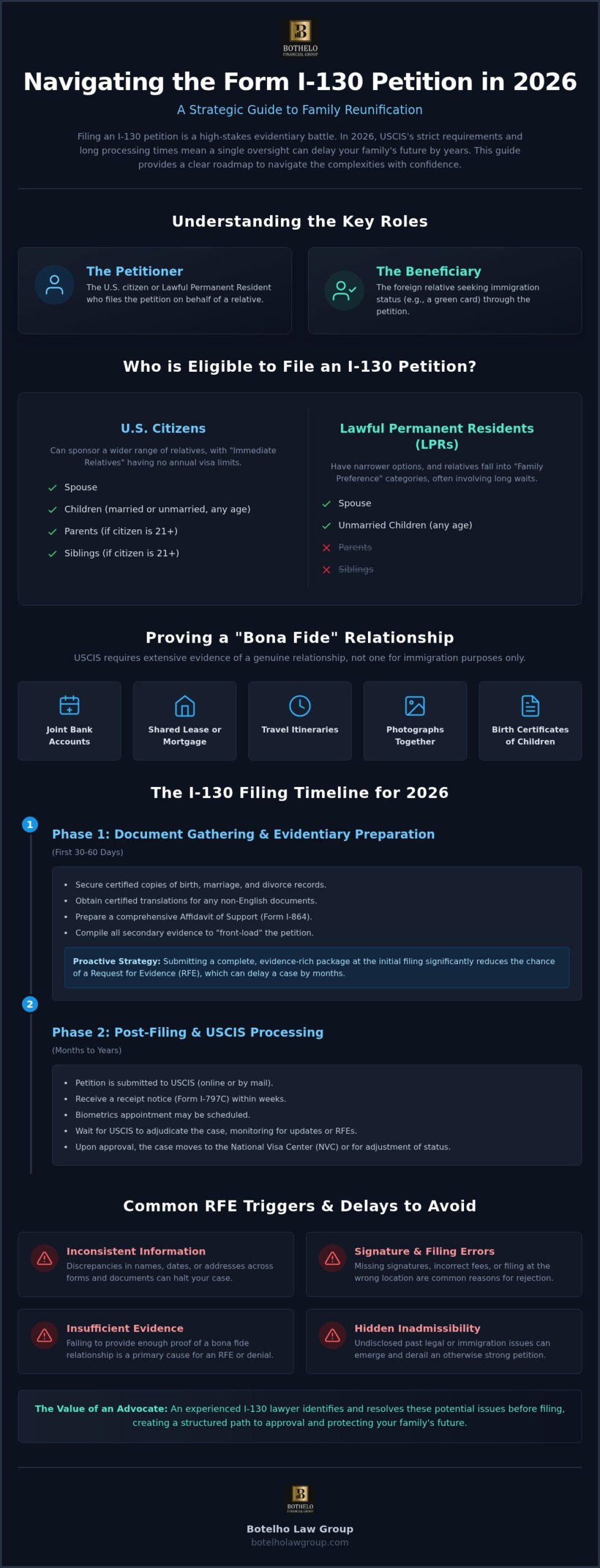
Eligibility depends strictly on the status of the Petitioner and the nature of the family tie. U.S. citizens have the broadest sponsorship authority. They can file for spouses, children, parents, and siblings. Lawful Permanent Residents (LPRs) face narrower options, as they are limited to sponsoring spouses and unmarried children. These distinctions are vital because they dictate the processing timeline. Understanding Family-Based Visas involves recognizing the difference between “Immediate Relatives,” who have no annual visa limits, and “Family Preference” categories, which often involve years of waiting due to statutory caps.
Establishing a “Bona Fide” Relationship for USCIS
The core objective of the petition is proving that the relationship is legitimate and not entered into for the sole purpose of circumventing immigration laws. For spousal petitions, USCIS requires extensive documentation of a shared life. This evidence typically includes:
- Joint bank account statements and financial commingling records.
- Lease agreements or mortgages showing a shared residence.
- Birth certificates for children born into the relationship.
- Photographs, travel itineraries, and affidavits from credible third parties.
A bona fide marriage is a legal union entered into with the genuine intent of establishing a life together, rather than solely for the purpose of obtaining immigration benefits. For parent-child or sibling relationships, the focus shifts to DNA evidence or secondary records like school and medical documents. An I-130 petition lawyer acts as a strategic guide, helping families compile a comprehensive evidentiary package that anticipates and addresses potential government skepticism before the file is even submitted.
The I-130 Filing Process: A Step-by-Step Timeline for 2026
Filing a petition for a family member in 2026 requires a methodical approach that begins long before you submit a single form. The process is a chronological series of legal milestones, each requiring specific evidence and strategic timing. Success depends on moving from the initial strategy phase to document collection without losing momentum. By working with a skilled I-130 petition lawyer, you ensure that your case is built on a foundation of technical accuracy and legal foresight.
Phase 1: Document Gathering and Evidentiary Preparation
The first 30 to 60 days focus on comprehensive document collection. This stage is critical because USCIS now requires higher evidentiary standards for all family-based petitions. You must secure certified copies of birth certificates, marriage licenses, and any relevant divorce decrees. If these documents aren’t in English, they require certified translations that meet federal standards. This is also when you must prepare the Affidavit of Support to prove the petitioner can financially sustain the beneficiary.
We recommend “front-loading” the petition. This means submitting all secondary evidence, such as joint financial records or shared property deeds, at the time of the initial filing. Providing this depth of information immediately reduces the likelihood of receiving a Request for Evidence (RFE), which can stall a case for months. You can find technical details on the Official Form I-130 Information page, but applying those rules to your specific family history requires a nuanced legal eye.
Phase 2: Post-Filing Milestones and Processing Times
Once you submit the petition, typically via the USCIS online portal to take advantage of the $625 filing fee, you’ll receive Form I-797C, the Notice of Action. This document confirms receipt and provides your Priority Date. In 2026, immediate relatives of U.S. citizens can expect processing times of approximately 10 to 15 months. However, those in family preference categories must monitor the monthly Visa Bulletin, as wait times for these visas can extend for several years depending on the specific category and country of origin.
During the background check and security clearance phase, USCIS reviews biometric data and cross-references information against federal databases. It’s vital to monitor your case through the online portal to address any government correspondence immediately. If the complexity of these timelines feels overwhelming, it’s often helpful to consult with a family immigration professional who can manage these administrative burdens on your behalf. A dedicated I-130 petition lawyer ensures your case remains on track while you focus on preparing for your relative’s arrival.
Navigating the Decision: Why Hire an I-130 Petition Lawyer?
The decision to handle an immigration case independently often stems from a misunderstanding of the process’s complexity. While the Form I-130, Petition for Alien Relative appears straightforward, it’s merely the entry point into a rigid federal system. Simple cases frequently become complex due to clerical errors or a lack of supporting evidence, leading to multi-year delays. An I-130 petition lawyer acts as a sophisticated problem-solver who identifies these risks before they result in a denial.
Beyond administrative accuracy, a dedicated advocate uncovers hidden inadmissibility issues. These might include past visa overstays, minor criminal records, or previous interactions with border officials that the petitioner might consider irrelevant. Identifying these factors early allows for the preparation of necessary waivers, preventing the heartbreak of a sudden rejection at the interview stage. Professional management of government correspondence and deadlines also removes the psychological burden from the family, allowing you to focus on your future together rather than tracking USCIS updates.
Lawyer vs. DIY: Risk Assessment for Family Petitions
The financial cost of legal representation is often lower than the cumulative cost of a denied petition. Re-filing requires new government fees and restarts the long waiting periods mentioned in previous sections. Relying on “notarios” or unlicensed form-fillers is a dangerous alternative; these individuals lack legal training and cannot represent you before federal agencies. For families on the move, having a representative with the capability to handle cases across all 50 states provides a stable point of contact regardless of where you reside during the process.
Strategic Counsel for Consular Processing and Adjustment of Status
A critical strategic decision involves determining whether the beneficiary should file for a green card within the United States or through a U.S. embassy abroad. This choice depends on the beneficiary’s current legal status and location. If your relative is overseas, you’ll need a Consular Processing Attorney for Families Abroad to manage the transition from USCIS approval to the National Visa Center (NVC) stage.
The approval of the I-130 is not the end of the journey; it’s the catalyst for the next phase. For those already in the U.S., it sets the stage for the I-485 Adjustment of Status. For those abroad, it triggers the NVC document collection process. An I-130 petition lawyer ensures that the information provided in the initial petition aligns perfectly with these subsequent filings, maintaining the consistency that federal officers demand. If you’re unsure which path is right for your family, consulting with a qualified legal strategist can provide the clarity you need to move forward safely.
Avoiding Delays: Common I-130 Pitfalls and RFE Triggers
Precision is mandatory when dealing with federal immigration authorities. In 2026, USCIS has implemented enhanced biometric protocols and stricter evidence requirements that leave no room for clerical errors. A primary cause for immediate rejection is the submission of incorrect filing fees; petitioners often confuse the $625 online filing fee with the $675 paper filing fee. Missing signatures or outdated form versions also result in the immediate return of your package, forcing your family to wait months just to receive a new receipt notice.
Inconsistent information creates a red flag for fraud. Discrepancies in dates, addresses, or the spelling of names across different government forms can trigger intense scrutiny. While you may view a minor typo as a simple mistake, a USCIS officer may interpret it as an attempt to provide false information. An I-130 petition lawyer reviews every line of your documentation to ensure total alignment across all forms, including the I-130A supplemental information for spouses.
The Danger of Requests for Evidence (RFEs)
A Request for Evidence (RFE) is a formal notification that the officer cannot approve your case based on the current file. Receiving an RFE typically adds four to six months to your timeline. It isn’t just a request for more paper; it’s a signal that the government doubts the legitimacy of your relationship or the eligibility of the petitioner. Under the preponderance of evidence standard, the petitioner must demonstrate that their claims are more likely than not to be true based on the documentation provided. When an RFE is issued, an I-130 petition lawyer crafts a persuasive legal memorandum to address the officer’s specific concerns and bridge the evidentiary gap.
Protecting Your Case from Fraud Scams and Unqualified “Notarios”
The rise in immigration complexity has unfortunately led to an increase in fraud scams. Many families fall victim to “notarios” or form-fillers who claim to have “special connections” with USCIS. These individuals are not licensed attorneys and are legally prohibited from providing legal advice or representing you in federal matters. Red flags include anyone who guarantees an approval, asks you to sign blank forms, or refuses to sign the form as a paid preparer. Filing a poorly prepared or fraudulent petition can lead to a permanent bar from the United States for the beneficiary.
Only a member in good standing of a U.S. state bar should handle your case. Licensed attorneys are bound by ethical rules and possess the sophisticated training required to navigate federal regulations. If you’ve received a government notice or want to ensure your initial filing is flawless, contact Botelho Law Group today to speak with a dedicated advocate who will protect your family’s interests.
Botelho Law Group: Your Dedicated I-130 Petition Advocates
Botelho Law Group stands as a sophisticated legal partner for families facing the rigors of federal immigration systems. As a premier immigration lawyer Fall River MA, our firm provides the protective advocacy required to navigate high-stakes petitions. We recognize that an I-130 filing is more than an administrative requirement; it’s a vital step in securing your family’s future. Our role as your I-130 petition lawyer is to act as a relentless strategist, ensuring every document meets the precise standards of the 2026 regulatory environment.
Our firm balances the power of a nationwide authority with the individual attention of a dedicated partner. We understand that the gravity of legal matters requires a calm, composed, and results-oriented approach. By positioning our firm as a sophisticated problem-solver, we help clients overcome the psychological stress and technical hurdles of the USCIS process. We don’t just fill out forms; we build comprehensive legal cases designed to withstand federal scrutiny.
Comprehensive Representation for All 50 States
While our headquarters is located in Fall River, we maintain a powerful nationwide reach. We represent clients in all 50 states, utilizing secure technology to manage government correspondence and evidentiary submissions with precision. This creates a unique advantage for our clients. You receive the attentive service of a localized partner combined with the authority of a firm capable of handling complex consular processing across the globe. Our systematic approach ensures that once your petition reaches the National Visa Center, which currently processes cases within 5 to 11 business days of receipt, every document is prepared for immediate review.
For residents in Massachusetts and Rhode Island, our local presence offers accessible, in-person counsel. For families across the country, our digital infrastructure ensures you remain informed at every milestone. We are committed to transparency, providing clear timelines and direct communication so you never feel lost in the system.
A Results-Oriented Approach to Reuniting Your Family
Our methodology is methodical and highly structured. We don’t rely on generic templates. Instead, we develop tailored legal strategies based on your specific family history and long-term goals. As a comprehensive family based green card attorney, we understand how an I-130 approval integrates with broader immigration objectives. Our deep expertise also extends to professional work authorization as an employment based visa attorney, allowing us to provide holistic counsel for families with diverse legal needs.
The complexities of 2026 immigration law require a dedicated I-130 petition lawyer who understands the gravity of your case. Don’t leave your family’s status to chance or unqualified form-fillers. Contact Botelho Law Group today to schedule a professional consultation and secure the expert guidance your case deserves.
Secure Your Family’s Future with Strategic Advocacy
Navigating the family-based immigration system in 2026 requires more than just completing forms; it demands a disciplined approach to evidence and a thorough understanding of evolving federal regulations. Minor errors or inconsistent data can result in multi-year delays or even permanent bars for your relatives. By securing the services of a dedicated I-130 petition lawyer, you ensure that your case is handled with the precision and protective advocacy required to succeed in this high-stakes environment.
Botelho Law Group acts as a sophisticated legal strategist for families across the country. From our local office in Fall River, MA, we maintain a powerful nationwide reach, representing clients in all 50 states and assisting with complex consular processing abroad. Our results-oriented team is committed to keeping you informed at every stage while we manage the heavy technical burdens of government correspondence. You don’t have to face the complexities of the federal system alone.
Schedule Your I-130 Consultation with Botelho Law Group Today and take the first step toward a successful approval. It’s time to move forward with the confidence that your family’s future is in expert hands.
Frequently Asked Questions
How much does it cost to file an I-130 petition in 2026?
The current filing fee for Form I-130 is $625 if you submit the petition online and $675 if you file via paper. These fees include the cost of biometric services, and USCIS encourages online filing to improve processing efficiency. You should verify these costs immediately before submission as government fees are subject to change. An I-130 petition lawyer can ensure your payment is processed correctly to avoid an immediate rejection of your package.
How long does it take for an I-130 petition to be approved?
Processing times vary based on the relationship category and the specific service center. For immediate relatives of U.S. citizens, approval typically takes 10 to 15 months in 2026. Family preference categories may see initial approval in 12 to 18 months, though total wait times for a visa can extend for several years due to statutory backlogs. These timelines are estimates and depend on the quality of the evidence provided in the initial filing.
Can I file an I-130 for my spouse if they are already in the U.S.?
Yes, you can file for a spouse currently residing in the United States through a process known as Adjustment of Status. This often allows for concurrent filing of Form I-130 and Form I-485, which can streamline the timeline significantly. Many couples using this method see their cases completed in under 12 months. It’s vital to confirm your spouse entered the country legally and maintains eligibility to adjust status before submitting your documents to federal authorities.
What happens after the I-130 petition is approved?
After approval, the next steps depend on the beneficiary’s location. If they are outside the U.S., the case moves to the National Visa Center for consular processing. If they are inside the U.S. and eligible, they proceed with their Adjustment of Status application. For preference categories, the beneficiary must wait for their priority date to become current on the Visa Bulletin. An I-130 petition lawyer provides essential guidance during this transition to ensure all subsequent forms are filed accurately.
Can I appeal a denied I-130 petition?
You generally have the right to appeal a denied I-130 petition to the Board of Immigration Appeals. Alternatively, you may file a Motion to Reopen or Reconsider if you have new evidence or believe the officer made a legal error. In many cases, it’s more strategic to file a new petition with stronger supporting documentation rather than entering a lengthy appeal process. A legal advocate can help you determine the most efficient path forward after a denial.
What is the difference between a U.S. citizen and an LPR filing an I-130?
U.S. citizens can sponsor a wider range of relatives, including parents and siblings, and their immediate relatives aren’t subject to annual visa caps. Lawful Permanent Residents (LPRs) are limited to sponsoring spouses and unmarried children. LPR petitions fall into preference categories, which involve significant waiting periods. For example, spouses of LPRs in the F2A category currently face wait times ranging from 55 to 107 months depending on the specific backlog and country of origin.
Do I need a separate I-130 for each family member I sponsor?
Yes, you must generally file a separate Form I-130 for each qualifying relative you wish to sponsor. While some preference categories allow for derivative beneficiaries to be included on a single petition, immediate relative petitions for U.S. citizens require individual filings for each person. This means a U.S. citizen sponsoring both parents must submit two distinct petitions and pay two separate filing fees. Ensuring each file is complete is critical for a synchronized approval.
Is an interview required for the I-130 petition stage?
USCIS doesn’t always require an interview for the initial I-130 petition stage, especially for parent-child or sibling relationships. However, spousal petitions frequently involve an interview to verify the bona fide nature of the marriage. These interviews usually occur during the final green card stage, either at a local USCIS office or a U.S. consulate abroad. If the government suspects fraud or finds the evidence insufficient, they may schedule a dedicated interview to question the couple separately.