
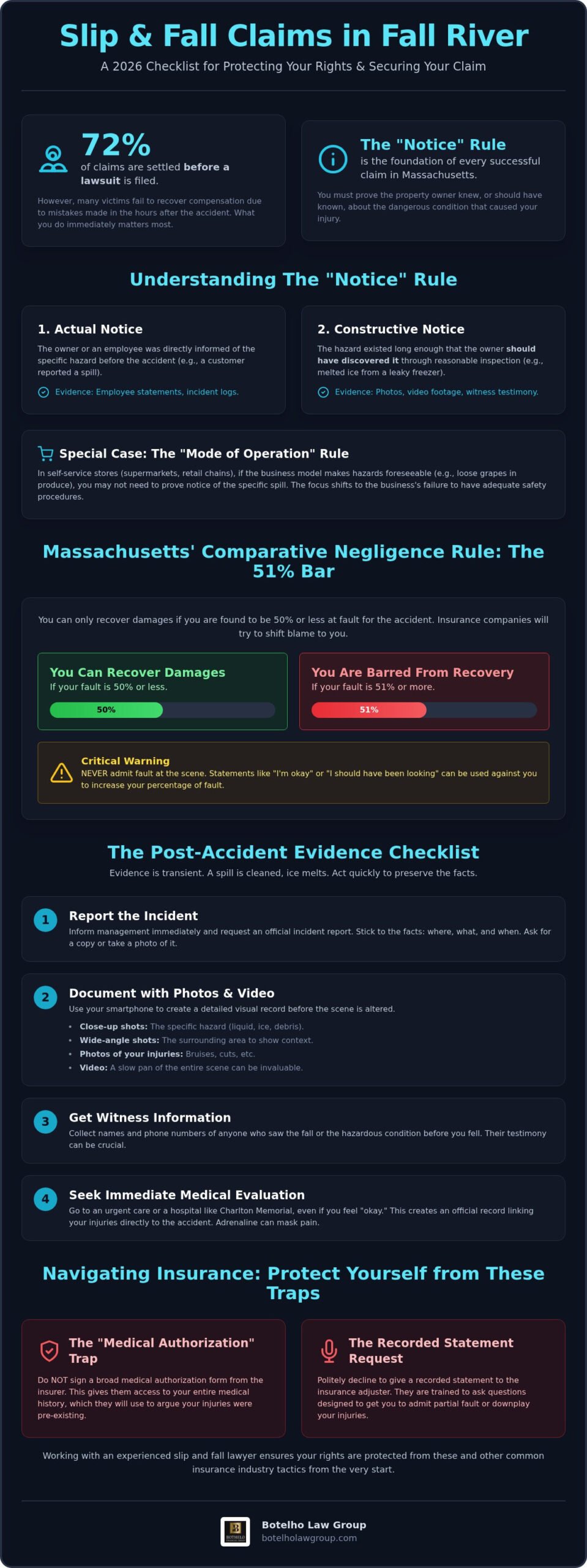
Did you know that 72% of slip and fall claims are settled before a lawsuit is ever filed, yet many victims in Bristol County fail to recover a single dollar? Securing a settlement depends entirely on what you do in the hours immediately following your accident. If you’re currently managing mounting medical bills from Charlton Memorial or feeling anxious about missing work, you aren’t alone. It’s common to feel overwhelmed by the “Notice” rule and the pressure of insurance adjusters. Working with an experienced slip and fall lawyer Fall River ensures that your rights are protected from the start.
We understand that the legal system feels like a maze when you’re focused on physical recovery. You deserve a clear path forward that removes the guesswork from your claim. This 2026 checklist provides a systematic approach to securing evidence and navigating Massachusetts premises liability laws. We’ll explore the modified comparative negligence rule, the critical importance of the “Notice” rule, and the specific steps you must take to ensure your medical records and scene photos translate into a successful recovery.
Key Takeaways
- Identify how the Massachusetts “Notice” rule determines the success of your claim and what evidence is required to prove property owner negligence.
- Access a comprehensive checklist for capturing time-sensitive evidence, including photos of the hazard and witness contact information, before it is lost.
- Learn why immediate medical evaluation at local facilities like Charlton Memorial is essential to link your injuries directly to the accident.
- Discover how a slip and fall lawyer Fall River protects you from insurance industry tactics like the “Medical Authorization” trap and recorded statement requests.
- Understand the methodical process for documenting financial losses to ensure you are fully compensated for both medical bills and lost wages.
Understanding Premises Liability in Fall River: The “Notice” Rule
Massachusetts law requires property owners to maintain their premises in a reasonably safe condition for all lawful visitors. This legal framework, known as Premises liability, holds owners accountable when their negligence leads to a preventable injury. However, simply falling on someone else’s property doesn’t automatically guarantee compensation. To secure a recovery, a slip and fall lawyer Fall River must prove that the property owner breached their duty of care by failing to address a known hazard.
The foundation of any successful claim is the “Notice” rule. You must demonstrate that the owner knew, or should have known, about the dangerous condition. This is often the most contested element of a case. We categorize notice into two distinct types. Actual notice occurs when the owner or an employee was explicitly informed of the hazard, such as a spill in a grocery store aisle. Constructive notice is more common; it implies the hazard existed for a sufficient length of time that the owner should have discovered and corrected it through reasonable inspection.
In Fall River, these hazards often manifest as icy patches on steep Bedford Street sidewalks during winter or liquid spills in high-traffic retail hubs like the SouthCoast Marketplace. Proving constructive notice in these scenarios requires meticulous evidence. We look for surveillance footage, maintenance logs, and witness statements to show the danger wasn’t a “transient” or brand-new condition that the owner had no time to address.
The “Mode of Operation” Rule in MA
Massachusetts recognizes the “Mode of Operation” rule, which provides a critical advantage for victims in self-service environments. If a business’s chosen method of operation makes it foreseeable that hazards will occur, such as loose grapes in a produce section or open liquid containers, you may not need to prove the owner had notice of the specific spill. This rule is particularly relevant in Fall River supermarkets and large retail chains where customer self-service is the standard. It shifts the focus from the specific spill to the business’s failure to implement adequate safety protocols.
Comparative Negligence: What if You Were Partially at Fault?
Insurance companies frequently attempt to shift blame onto the victim to reduce their financial liability. Massachusetts follows a modified comparative negligence rule, specifically the 51% bar. You can only recover damages if your share of the fault is 50% or less. If a jury determines you were 51% responsible, perhaps due to distracted walking or wearing improper footwear for icy conditions, you are barred from recovery. A dedicated slip and fall lawyer Fall River will fight these allegations by proving the property owner’s negligence was the primary cause of your injury. Never admit fault at the scene of the accident. Statements made in the heat of the moment can be used to undermine your legal rights during the litigation process.
The Immediate Post-Accident Evidence Checklist
Evidence in a slip and fall case is often “transient.” A liquid spill on a retail floor or a patch of ice on a sidewalk can vanish in minutes. If you don’t document the scene immediately, the property owner may later claim the hazard never existed or was corrected before your accident. While Massachusetts law provides a three-year statute of limitations for filing a personal injury claim, the most valuable evidence is typically lost within the first hour. Your priority must be the preservation of facts before the environment changes.
The first step is reporting the incident to management. Request that an official incident report be filed. When speaking with staff, stick strictly to the facts: where you fell, what you slipped on, and the time it occurred. Avoid the temptation to apologize or minimize your injuries. Statements like “I’m okay” or “I should have been looking” are frequently documented by businesses and used by insurance adjusters to argue that you were more than 51% at fault. After the report is filed, ask for a copy or take a photo of it with your phone.
Digital Evidence: Photos and Video
Use your smartphone to create a comprehensive visual record of the scene. A few quick snapshots are rarely enough to overcome a determined defense. Follow this structured approach to photography:
- Close-up shots: Capture the specific substance, debris, or structural defect that caused the fall.
- Wide-angle shots: Document the hazard in relation to the entire room or walkway to show the context of the accident.
- Surveillance identification: Identify nearby CCTV cameras in Fall River businesses, such as those in the SouthCoast Marketplace or local supermarkets.
Ensure all digital files are time-stamped. This prevents defense attorneys from arguing the photos were taken after the conditions had changed. If you are unable to take photos due to your injuries, ask a witness or companion to do so on your behalf.
Witness Statements and Credibility
Independent witnesses are the backbone of a strong liability claim. Unlike friends or family, a stranger who observed the fall is viewed as an unbiased party by the court. Politely ask any bystanders for their names and phone numbers. Ask them specifically if they noticed the hazard before you fell. Their testimony regarding a “lack of warnings”, such as the absence of yellow “Wet Floor” signs or salt on an icy path, is vital. Documenting these details immediately allows a slip and fall lawyer Fall River to build a case based on verified third-party observations rather than just your own recollection.
Finally, preserve your physical evidence. Do not wash the clothing you were wearing or continue to wear the shoes involved in the fall. These items may contain traces of the substance that caused your slip or prove that your footwear provided adequate traction. Bag these items and store them in a safe place. This level of detail positions you as a disciplined claimant and makes it significantly harder for insurance companies to deny your account of the events.
Documenting Your Injuries: The Medical and Financial Checklist
Physical recovery is your primary concern, but legal recovery depends entirely on the documentation of your physical state. Insurance adjusters look for any “gap in treatment” to argue that your injuries are either exaggerated or unrelated to the fall. Seeking immediate medical attention is both a health necessity and a legal requirement for a successful claim. A slip and fall lawyer Fall River will use these early medical records to establish a direct causal link between the hazard you encountered and the trauma you sustained. If you wait even a few days to see a doctor, you give the defense an opportunity to claim an intervening event caused your pain.
You must maintain an organized file of every medical interaction following your accident. A systematic approach to record-keeping prevents critical details from being lost during the litigation process. Your evidence file should include:
- Emergency department discharge papers and physician intake notes.
- Referrals to specialists, such as orthopedists, neurologists, or pain management clinics.
- Physical therapy progress reports and attendance logs.
- Pharmacy receipts and invoices for medical equipment like braces or crutches.
Beyond medical bills, documenting the non-economic impact of your fall is vital. Many preventable workplace injuries and public property falls result in chronic pain that isn’t easily captured on a standard billing statement. We recommend keeping a daily injury journal. Use this to record your pain levels, sleep disturbances, and specific activities you can no longer perform. This personal record provides the human context needed to seek compensation for pain and suffering, which often makes up a significant portion of a settlement.
Local Fall River Medical Documentation
If you were treated at local facilities like Charlton Memorial Hospital or Saint Anne’s Hospital, you must request your complete electronic health records, not just the discharge summary. Diagnostic imaging, such as MRIs and CT scans, is essential for proving “invisible” injuries like herniated discs or soft tissue tears. These objective findings leave little room for insurance companies to dispute the severity of your condition. Additionally, keep a log of all out-of-pocket expenses, including parking fees at the hospital and over-the-counter medications.
The Long-Term Impact Checklist
A comprehensive claim accounts for your future, not just your past medical bills. We must assess whether you will require ongoing surgery, home modifications, or permanent disability support. In 2026 litigation, expert medical testimony is often the deciding factor in securing a settlement that covers a lifetime of care. Proving economic damages also requires gathering your W-2s and paystubs. This documentation allows a slip and fall lawyer Fall River to calculate lost wages and the loss of future earning capacity if your injuries prevent you from returning to your previous professional role. For workers whose employment status in the U.S. may be affected by a serious injury, consulting an employment based visa attorney can be equally critical to protecting your work authorization alongside your injury claim. Similarly, multinational employees transferred to the U.S. who suffer a workplace injury may need to consult an L-1 visa lawyer to understand how a serious injury and resulting absence from work could impact their intracompany transfer status and immigration standing.
Navigating Insurance Claims: A Communication and Compliance Checklist
Dealing with insurance adjusters requires a disciplined communication strategy. Their primary objective is to minimize the financial exposure of the insurance company, not to ensure you are fairly compensated for your injuries. When you are contacted by an adjuster, your priority must be to protect your legal rights. You are under no legal obligation to provide a recorded statement immediately following your accident. These recordings are often used to find minor inconsistencies in your account of the events, which adjusters then use to argue you were more than 51% at fault under Massachusetts law. A dedicated slip and fall lawyer Fall River serves as your shield, managing all high-stakes communication to ensure your words aren’t used against you.
Another common pitfall is the “Medical Authorization” trap. Adjusters may ask you to sign a broad release form, claiming they simply need to verify your current injuries. In reality, these forms often grant them access to your entire medical history. They will search for pre-existing conditions or past injuries to argue that your current pain is unrelated to the fall. You should also exercise extreme caution on social media. In 2026, insurance companies routinely monitor a claimant’s public profiles. A single photo of you attending a family gathering can be presented as evidence that your injuries are not as severe as you claim, potentially ruining a legitimate case.
Common Insurance Adjuster Tactics
The “Quick Settlement” lure is a dangerous tactic designed to close your file before you understand the full impact of your accident. An adjuster might offer a check within days of your fall, hoping you will sign a release before you have finished your medical treatment. Many spinal issues or soft tissue injuries don’t fully manifest for weeks. Once you sign that release, you lose the right to seek additional compensation, regardless of how much your medical bills grow. If you are feeling pressured to settle, it’s vital to consult an expert in personal injury litigation to evaluate the true value of your claim.
Compliance and Deadlines
Staying compliant with Massachusetts legal deadlines is non-negotiable for a successful recovery. While the standard statute of limitations for personal injury in 2026 is three years, claims against government entities follow much stricter rules. If your fall occurred on property owned by the City of Fall River, you must often file a formal “Notice of Claim” in as few as 60 to 180 days. Missing this specific filing window can result in the permanent dismissal of your case. A slip and fall lawyer Fall River ensures that all procedural requirements are met, preventing a technicality from ending your pursuit of justice.
Securing Legal Advocacy: Why Botelho Law Group is the Preferred Fall River Choice
Securing a full recovery after a traumatic fall requires more than just a list of evidence; it requires a sophisticated legal strategy capable of withstanding aggressive defense tactics. When you hire a slip and fall lawyer Fall River, you’re securing a dedicated representative to manage the high-stakes communication with insurance companies and defense counsel. At Botelho Law Group, we act as a “Focused Advocate” for our clients. We understand that you’re likely balancing medical appointments at Charlton Memorial with the stress of lost wages. Our role is to assume the entire burden of your litigation so you can prioritize your physical rehabilitation without the weight of legal complexity.
Our deep roots in the community provide a distinct advantage for your claim. Navigating local court systems, including the Fall River District Court and the Bristol County Superior Court, requires specific procedural knowledge and familiarity with local rules. This specialized experience allows our personal injury lawyer Fall River MA team to anticipate common defense arguments and build a “bulletproof” evidentiary trail. We don’t just collect records; we analyze them to prove the property owner’s notice and liability beyond doubt. This methodical preparation is essential for maximizing the value of your settlement.
The Botelho Law Group Advantage
We believe high-quality legal representation must be accessible to everyone, regardless of their current financial situation. This is why we operate as a no upfront fee personal injury lawyer. Under this contingency-based model, you pay nothing out of pocket to initiate your case. We only receive a fee if we successfully recover compensation for you. This structure removes the financial risk of pursuing justice and ensures our interests are perfectly aligned with yours. Our firm provides comprehensive support throughout the entire lifecycle of personal injury litigation, from the initial investigation to final resolution.
Your Next Steps to Recovery
The investigation into your accident begins the moment you retain our services. We immediately move to preserve surveillance footage, secure maintenance logs, and interview witnesses before the property owner can alter the scene or evidence is lost. Early legal intervention is the most effective way to overcome defenses like the “Notice” rule or allegations of comparative negligence. During your free initial consultation, we’ll conduct a thorough review of your incident and provide a transparent assessment of your legal rights. By choosing a slip and fall lawyer Fall River from our firm, you’re choosing a partner who is both a sophisticated legal strategist and a relentless fighter for your interests.
Taking Control of Your Personal Injury Claim
Recovering from a fall involves more than just physical healing. It requires a disciplined approach to evidence preservation and a deep understanding of Massachusetts premises liability laws. By following the 2026 injury checklist, you’ve already taken the first step toward building a credible case. You now understand how the “Notice” rule and the modified comparative negligence rule can impact your settlement. However, managing high-stakes communication with insurance adjusters while recovering is a burden you don’t have to carry alone.
Partnering with a dedicated slip and fall lawyer Fall River ensures that every legal deadline is met and every piece of evidence is leveraged for your benefit. Botelho Law Group provides professional advocacy for complex claims from our local Fall River office. We operate on a contingency basis, meaning there is no fee unless we recover compensation for you. Our team is ready to act as your focused advocate, protecting your interests against insurance company tactics and the complexities of the court system.
Schedule a Free Consultation with a Fall River Slip and Fall Lawyer to begin your journey toward justice. You deserve a partner who fights for the full recovery you are owed and provides the peace of mind you need during this challenging time.
Frequently Asked Questions
How much is a slip and fall case worth in Fall River?
The value of your claim is calculated based on the sum of your medical expenses, lost income, and non-economic damages like pain and suffering. Every case is unique; a minor fracture results in a different recovery than a traumatic brain injury. A slip and fall lawyer Fall River will evaluate your specific medical documentation and financial losses to determine a fair settlement range that accounts for both current and future needs.
What happens if I fell on a city-owned sidewalk in Fall River?
Falling on a city-owned sidewalk triggers specific sovereign immunity laws and much shorter deadlines than private property claims. You must file a formal “Notice of Claim” with the City of Fall River, which often requires notification within 60 to 180 days of the incident. Missing these narrow windows can permanently bar your recovery regardless of the injury’s severity, making immediate legal intervention essential for government-owned property accidents.
Can I still sue if there was a “Wet Floor” sign present?
A “Wet Floor” sign doesn’t provide a property owner with absolute immunity from liability. If the warning was obscured, placed too far from the hazard, or if the owner allowed the danger to persist longer than necessary, you may still have a valid claim. We examine whether the owner took reasonable steps to actually fix the problem rather than just placing a temporary warning that failed to prevent the injury.
Do I have to pay my lawyer if we do not win the case?
You don’t have to pay any attorney fees unless we successfully recover compensation for you. Our firm operates on a contingency fee model, which removes the financial barrier to high-quality legal representation for injured victims. We cover the upfront costs of investigation and litigation, and we’re only reimbursed if we win your case. This ensures that your legal representative is fully invested in the outcome of your claim.
How long do I have to file a slip and fall lawsuit in Massachusetts?
The standard deadline to file a personal injury lawsuit in Massachusetts is three years from the date of the fall. However, this is the final limit for filing in court, not a suggestion to wait. As discussed in previous sections, notification requirements for government property or specific insurance policies often require action within weeks of the incident. Acting early allows for the preservation of time-sensitive evidence that would otherwise be lost.
What if I was partially at fault for my fall?
You can still recover compensation if you were partially at fault, provided your responsibility doesn’t exceed 50%. Under the Massachusetts modified comparative negligence rule, your final settlement is reduced by your percentage of fault. For example, if you’re found 20% responsible for not seeing a spill, you’d receive 80% of the total damages. If your fault is 51% or higher, you’re barred from any recovery under state law.
Will my slip and fall case have to go to court?
Most slip and fall claims are resolved through insurance settlements without ever entering a courtroom. While a slip and fall lawyer Fall River will prepare your case for trial to maintain maximum leverage, litigation is typically a last resort used only when an insurance company refuses to offer a fair settlement. Having a trial-ready case often encourages adjusters to settle for a reasonable amount to avoid the risks of a jury verdict.
How long does it take to get a settlement for a slip and fall injury?
The duration of a case depends largely on the length of your medical recovery. It’s critical to wait until you’ve reached “maximum medical improvement” so we can accurately calculate the total cost of your care. Most claims reach a resolution within nine to eighteen months. Settling too early can be a costly mistake, as you can’t seek additional compensation if new medical complications arise after you’ve signed a release.