

The real timeline and the real costs, track by track, including the two costs nobody sends you a bill for.
Everybody says probate is slow and expensive. Almost nobody explains what that means in months and dollars in Massachusetts specifically. This guide does that, with the current court fees, the deadlines that actually set the pace, and the costs families tend to forget.
First, the honest caveat: anyone who quotes you one number for probate is guessing. Massachusetts has three different tracks, and which one your family lands on changes the answer completely.
What are the three types of probate in Massachusetts?
| Track | Who handles it | Earliest step | Real estate allowed? |
|---|---|---|---|
| Voluntary administration | Filed with the Register; no court appointment | 30 days after death | No |
| Informal probate | A magistrate; no hearing | An order as early as 7 days after death | Yes |
| Formal probate | A judge; may involve one or more hearings | Depends on notice and the court’s schedule | Yes |
Voluntary administration: the small-estate path
Voluntary administration is available when the person was a Massachusetts resident and the probate estate is made up entirely of personal property worth $25,000 or less, not counting the value of a car. At least 30 days must have passed since the death, and no other probate proceeding can be pending. A family member files a sworn statement, and this track is measured in weeks, not years.
Notice the limit that matters most: no real estate. In Massachusetts, where so much family wealth is the house itself, that rules out most of the estates people are actually worried about. The person who files also does not receive an official court appointment.
Informal probate: the most common route for straightforward estates
Informal probate is handled by a Massachusetts Uniform Probate Code magistrate rather than a judge, and there is no hearing. It generally requires the original will (if there is one), an official death certificate, knowledge of every heir and devisee, and a petitioner who has priority to be appointed.
- Written notice must go to the people entitled to it at least seven days before the petition is filed.
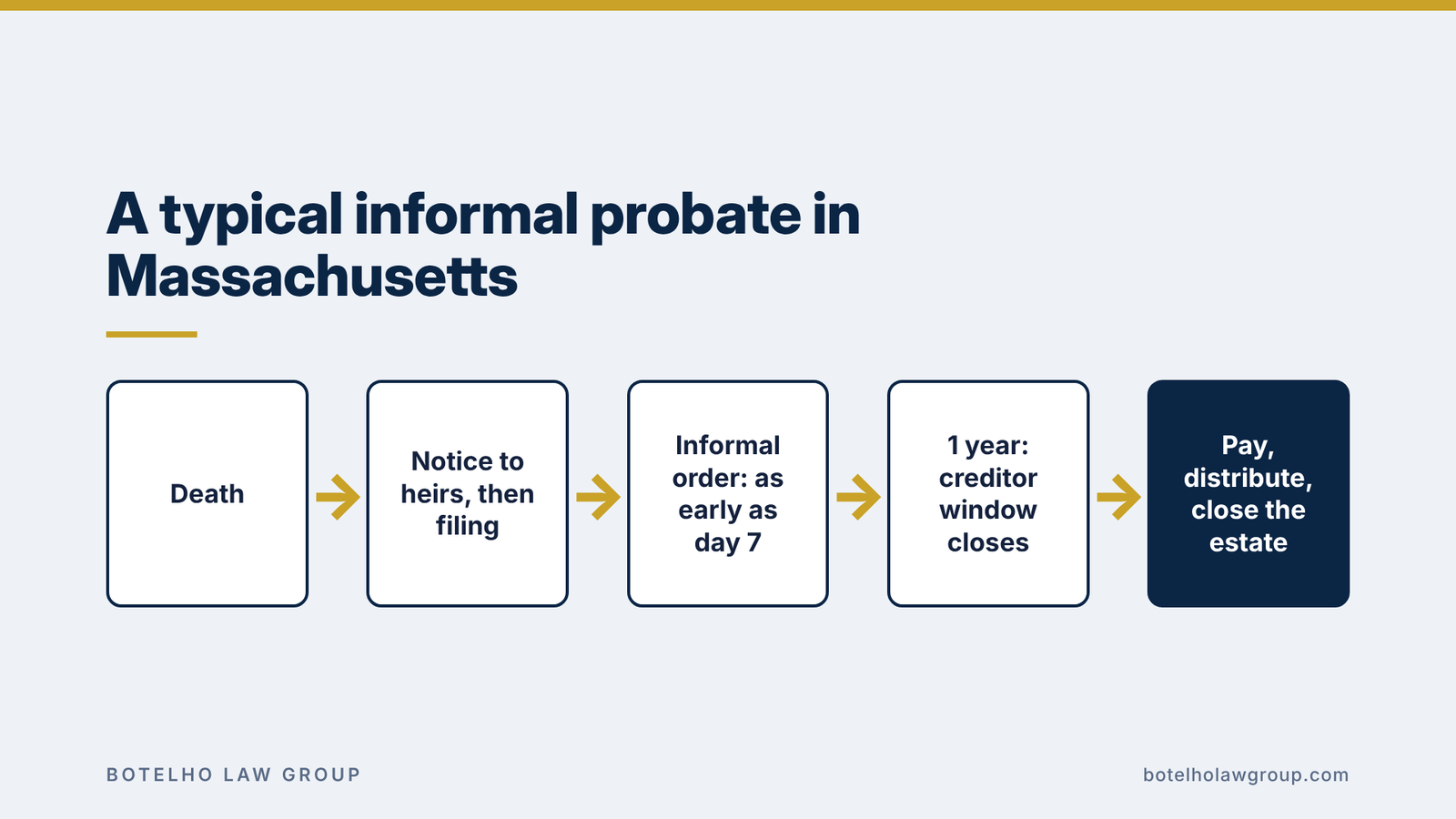
- A magistrate can issue an informal order as soon as seven days after the death.
- After the court accepts the petition, a notice is generally published in a newspaper the Register designates, within 30 days.
- A bond is generally required. Whether it needs sureties (often an insurance company that charges a premium) depends on the will, written waivers from the heirs, or the court.
The appointment can happen quickly. But this is exactly where families get the wrong idea: getting appointed in a week does not mean the estate closes in a week. Appointment is the start of the work, not the end.
Formal probate: a judge, and sometimes a hearing
Formal probate is heard by a judge and may involve one or more hearings. It is required when someone objects, when only a copy of the will exists or the will has handwritten changes, when the terms are unclear, when a minor or incapacitated heir is not represented by a conservator or guardian, when the person asking to be appointed does not have priority, or when a judge’s signature on an order or final decree is needed. It is the longest road.
How long does probate take in Massachusetts?
For most estates that go through informal or formal probate, plan on at least a year, and longer if there is real estate to sell, a dispute, or a missing heir. The reason has nothing to do with how organized the family is.
The one-year creditor window
Under G.L. c. 190B, § 3-803, a creditor of the person who died generally has to bring an action within one year after the date of death and present it to the personal representative, either by having the papers delivered in hand or by filing a notice with the Register of Probate. A responsible personal representative is not going to hand out the money and then discover a claim afterward. So the estate waits.
That is not inefficiency. It is the system working as designed, and no amount of hustle shortens it. There are exceptions (mortgages and other liens on property can still be enforced, and MassHealth claims follow their own rules), which is one more reason distributions are usually held until the year has passed.
The estate tax lien on Massachusetts real estate
Real estate has its own wrinkle. When someone with an interest in Massachusetts real property dies, a Massachusetts estate tax lien attaches to that property under G.L. c. 65C, § 14. That happens even when no estate tax is owed, and even for property held jointly. Until a release is recorded, the lien is a cloud on the title for up to ten years after the death.
- If the estate is large enough to require a Massachusetts estate tax return (a gross estate over $2,000,000 for deaths in 2023 or later), the release generally comes from the Department of Revenue as a Form M-792 certificate after the return is filed.
- If no return is required, the lien can generally be released by a sworn affidavit recorded at the registry of deeds with a death certificate.
Either way, a family that wants to sell the house can find itself waiting on a release it did not know existed. Buyers’ attorneys and title companies will ask for it before the sale closes.
How much does probate cost in Massachusetts?
There is no single number, but the categories are predictable. Here are the court’s own fees as currently published, followed by the costs that vary.
| Cost | What it is | Amount |
|---|---|---|
| Petition for informal or formal probate | Court filing fee to probate a will or appoint a personal representative | $375 plus a $15 surcharge |
| Voluntary administration statement | Court filing fee for the small-estate path | $100 plus a $15 surcharge |
| Citation | Issued in formal proceedings | $15 each |
| Newspaper publication | Legal notice in a designated newspaper | Set by the newspaper |
| Bond premium | Charged by a surety company when sureties are required | Varies with the estate |
| Appraisals | Real estate, a business, or valuables | Varies |
| Accounting and tax returns | Inventory, accounts, final income tax and, if required, an estate tax return | Varies |
| Attorney’s fees | Depends on the track, complexity, disputes, and county | Varies |
Court fees change, so check the Probate and Family Court’s published fee schedule for the current numbers before you file. Recording fees at the registry of deeds apply to anything recorded there, such as a lien release or a deed out of the estate.
The two costs nobody sends you a bill for
Probate is public
The petition is a public filing. What the estate contained, who the heirs are, and who received what generally become part of a court record that anyone can look at. If you have a blended family, have chosen to treat children differently, or simply consider your finances your business, that is a real cost even though no one invoices it.
Common mistakes that add time and cost
- Assuming a will avoids probate. A will is the instruction manual for probate, not a way around it.
- Assuming the seven-day order means the estate is almost done.
- Distributing money before the one-year creditor window has passed.
- Forgetting the estate tax lien until a buyer’s attorney asks for the release.
- Waiting years to start. After three years, the options narrow to a late and limited formal proceeding, and a late and limited personal representative cannot get a license to sell the real estate.
- Adding a child to the deed to dodge probate, which can create tax and long-term care problems of its own.
What if your situation is different?
- The only asset is a small bank account and a car. Voluntary administration may fit, as long as there is no real estate and the personal property is $25,000 or less, not counting the car.
- There is no will. The estate still goes through probate, and Massachusetts law decides who inherits and who has priority to serve.
- A family member objects. The case moves to formal probate before a judge, which takes longer and costs more.
- The house is held jointly with a right of survivorship or in a funded trust. It generally passes outside probate, though the estate tax lien still has to be addressed.
What actually reduces probate time and cost?
Not a will. What reduces probate is having fewer assets that need the process at all, and that is a titling question: how the deed reads, who is named on each beneficiary form, and whether a trust you signed actually owns anything. Whether it is worth restructuring depends on what you own, whether real estate is involved, and what your family looks like.
Frequently asked questions
How long does probate take in Massachusetts?
For most estates that go through informal or formal probate, plan on at least a year. Creditors generally have one year from the date of death to bring claims under G.L. c. 190B, § 3-803, and personal representatives usually wait for that window to close before distributing. Disputes, missing heirs, or a house to sell can make it longer.
How much does it cost to file for probate in Massachusetts?
The Probate and Family Court currently lists a $375 filing fee plus a $15 surcharge for an informal or formal probate petition, and a $100 fee plus a $15 surcharge for a voluntary administration statement. Publication, bond premiums, appraisals, accounting, and attorney’s fees are separate and vary by estate.
What is voluntary administration in Massachusetts?
It is a simplified process for small estates. It is available when the person was a Massachusetts resident and the estate is entirely personal property worth $25,000 or less, not counting a car, with no real estate. It can be filed once at least 30 days have passed since the death.
How fast can a personal representative be appointed in Massachusetts?
In informal probate, a magistrate can issue an order as early as seven days after the death, and written notice must be given to heirs and devisees at least seven days before filing. Being appointed starts the administration; it does not finish it.
Why can’t the estate be distributed right away?
Because creditors generally have one year from the date of death to bring claims. A personal representative who distributes early can end up having paid out money that was needed for a valid claim.
What is the Massachusetts estate tax lien on real estate?
Under G.L. c. 65C, § 14, a lien attaches to Massachusetts real estate when an owner dies, even if no estate tax is owed. It is released by a Department of Revenue Form M-792 certificate when an estate tax return is required, or by a recorded affidavit when it is not.
Is probate public in Massachusetts?
Generally, yes. Probate filings are part of a public court record, so the estate’s contents and the heirs can be seen by anyone who looks, with limited exceptions for impounded information.
What happens if no one opens probate within three years?
Generally, after three years the only option is a late and limited formal proceeding to confirm who owns the probate assets and pay administration expenses. A late and limited personal representative cannot get a license to sell the decedent’s real estate.
Sources
- Mass.gov: Learn about the types of probate for an estate
- Mass.gov: Instructions for Voluntary Administration (MPC 961)
- Mass.gov: File an informal probate for an estate
- Mass.gov: Probate and Family Court filing fees
- G.L. c. 190B, § 3-803: Limitations on presentation of claims
- G.L. c. 65C, § 14: Estate tax lien
- Barnstable County Registry of Deeds: Estate tax liens
- Mass.gov: Massachusetts estate tax guide
- Mass.gov: Probate and Family Court access to public court records FAQ
Attorney Advertising. General information about Massachusetts law only, not legal advice. Watching or reading this does not create an attorney-client relationship. Laws change and every situation is different; consult a licensed attorney about your own circumstances. Prior results do not guarantee a similar outcome.