
What happens if an illness leaves you unable to make decisions, or your family must settle your affairs without clear instructions? Worcester MA estate planning is about more than writing a will. It means preparing documents that reflect your household, property, and wishes, so the people closest to you have direction when it matters. It’s understandable to feel uncertain about which documents you need or how Massachusetts law affects your choices.
A practical plan starts with the decisions that matter most: who can manage financial and health care matters if you’re incapacitated, how your property should pass after death, and whether a trust or asset protection strategy fits your goals. This guide explains the roles of wills, trusts, powers of attorney, health care proxies, and other planning tools, along with Massachusetts considerations such as estate tax and MassHealth long-term care planning.
Botelho Law Group serves Worcester residents with estate planning and asset protection under Massachusetts law. The sections ahead connect legal documents to real family needs, helping you identify priorities and understand how coordinated planning can protect loved ones and clarify who may act on your behalf.
Key Takeaways
- A coordinated estate plan can address both what happens to your property after death and who can make decisions if you become incapacitated.
- Wills and trusts serve different purposes; the right combination depends on your family, assets, and planning goals.
- Worcester MA estate planning should account for Massachusetts law and the specific concerns that affect your household.
- Prepare for a planning discussion by outlining your goals, family relationships, major assets, existing documents, and trusted decision-makers.
- Botelho Law Group provides estate planning and asset protection services under Massachusetts law, helping Worcester residents consider their planning priorities.
Worcester, MA Estate Planning: What a Plan Can Protect
A sound estate plan coordinates legal instructions for your property, care, and decision-making. It can guide how your estate is handled after death and identify trusted people to act if illness or injury leaves you unable to make or communicate decisions. A will, trust, financial power of attorney, and health care proxy each address different needs. The goal is to make those choices fit together, not to collect documents without a clear purpose.
A Massachusetts estate plan is a coordinated set of legal instructions tailored to a person’s family, property, and decision-making needs under Massachusetts law. That matters because a homeowner with minor children may have different priorities from someone focused on long-term care planning or managing assets for a dependent. For a broader overview, see What is Estate Planning?. A useful starting point is to identify the decisions your household may need someone else to make.
Which Worcester households may benefit from an estate plan?
Homeowners may want to clarify how property should be handled. Parents and other caregivers may need to consider who they trust to support dependents and how resources should be managed for them. People with significant assets may have additional coordination concerns, but estate planning isn’t limited to high-net-worth families or older adults. Anyone who wants to name trusted financial or health care decision-makers can benefit from considering a plan.
For Worcester households, Worcester MA estate planning means connecting those choices to real circumstances: who relies on your support, what property you own, and who understands your values. Clear instructions can also reduce uncertainty for loved ones by giving them direction during a difficult period.
Why plan before a major life change?
Marriage, becoming a parent, buying property, or experiencing changing health needs can all prompt a review of existing legal instructions. These events don’t automatically invalidate documents, but they may change what you want those documents to accomplish. For families navigating medical considerations, securing financial safety nets through Special Risk Term can be an important companion to legal directives. Reviewing your plan as circumstances evolve gives you time to consider who should act, what support dependents may need, and whether your current instructions still reflect your priorities.
Advance planning gives you room to make deliberate choices. You can identify trusted people, discuss responsibilities, and coordinate documents around your household’s needs instead of making decisions under pressure. Consider the questions that matter most:
- Who should handle financial matters if you can’t act?
- Who do you trust to communicate or make health care decisions on your behalf?
- Who depends on your care or financial support?
- What property or other assets should your plan address?
Your answers provide a practical foundation for deciding which planning documents and strategies to consider next.
How Massachusetts Estate Planning Documents Work Together
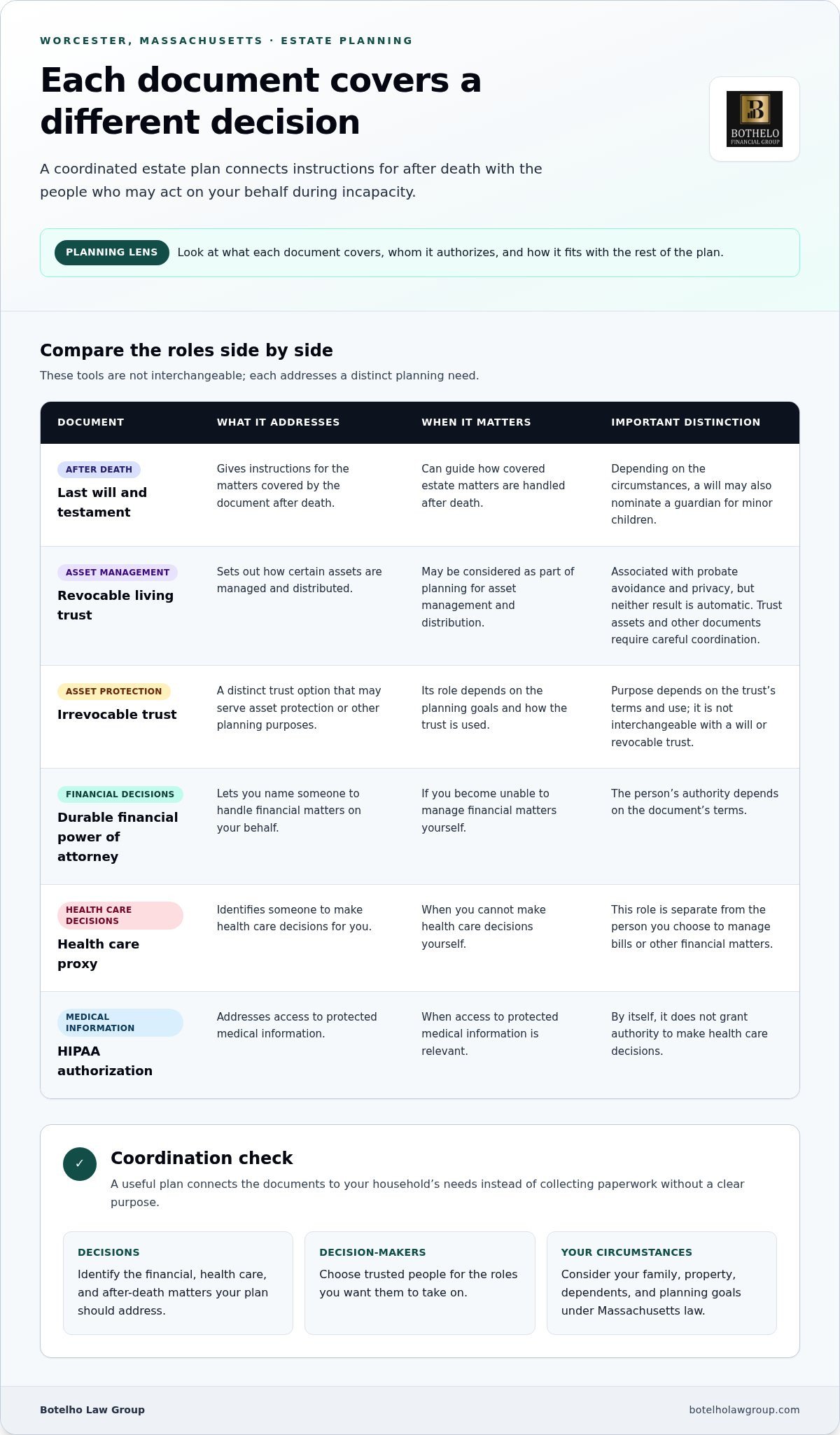
Estate planning documents address different decisions, and their value depends on how well they coordinate. A will gives instructions for handling matters covered by the document after death. A trust can set out how certain assets are managed and distributed. Separate documents can name people to handle financial or health care matters if you cannot act for yourself. Massachusetts-specific rules matter, so the state’s Massachusetts Estate Laws resource offers a starting point for understanding wills and estates.
A will, a trust, and incapacity documents address different planning needs, so a coordinated plan considers how each document fits your goals. For Worcester households, look beyond a document’s name. Consider what decisions it covers, whom it authorizes, and how it works alongside the rest of the plan.
Wills and trusts: different roles in a plan
A last will and testament provides instructions for the matters it covers after death. Depending on the circumstances, a will may also nominate a guardian for minor children. A revocable living trust is a planning option associated with probate avoidance and privacy, but neither result is automatic. An irrevocable trust is a distinct tool that may serve asset protection or other planning purposes, depending on its terms and use.
These tools aren’t interchangeable. A trust-based plan still requires careful coordination with assets and other documents, while a will alone may not address every goal. Learn more about how these choices compare in this Massachusetts will and trust comparison guide.
Planning for financial and health care decisions
A durable financial power of attorney lets you name someone to handle financial matters on your behalf if you become unable to manage them. Its authority depends on the document’s terms. A health care proxy serves a different purpose: it identifies someone to make health care decisions when you cannot. A HIPAA authorization addresses access to protected medical information; by itself, it doesn’t grant authority to make those decisions.
Keep these roles distinct. The person you trust to manage bills may not be the person you want making health care decisions. Choosing appropriate decision-makers and ensuring the documents reflect your intentions can reduce uncertainty for family members. A guide to financial power of attorney explains the authority such a document can provide.
- Will: Gives instructions for covered matters after death.
- Trust: Provides a framework for managing specified assets under its terms.
- Financial power of attorney: Names someone to handle financial matters within the authority granted.
- Health care proxy and HIPAA authorization: Address health care decision-making and access to medical information, respectively.
Worcester MA estate planning is most useful when these documents are considered together, not in isolation. To discuss how your documents and priorities fit under Massachusetts law, explore estate planning with Botelho Law Group.
Wills, Trusts, and Asset Protection: Address the “A Will Is Enough” Concern
A will is an important foundation, but it may not meet every planning objective. It provides instructions for matters it covers after death; on its own, it doesn’t name someone to manage your finances or make health care decisions if you become incapacitated. A will-centered plan may also leave other goals, such as privacy, asset protection, or specialized support for a dependent, unaddressed.
No single document is right for every household. The useful question isn’t whether a trust is always better than a will, but which concerns your plan needs to address. In Worcester MA estate planning, that assessment should consider the property you own, your family circumstances, and what you want each document to accomplish.
When might a will-centered plan need additional tools?
Consider each objective separately. Probate avoidance and privacy may lead someone to explore a revocable trust, but a trust doesn’t automatically avoid every probate issue. Incapacity planning calls for documents authorizing trusted decision-makers. Asset protection may involve considering an irrevocable trust, but its legal effect depends on its terms, timing, and your circumstances. Evaluate a trust as part of a coordinated plan, not as a universal solution.
Estate tax planning is a separate concern. Massachusetts estate tax rules should be considered under current law and in light of an individual’s assets and circumstances. A trust does not automatically eliminate estate tax. Effective planning requires looking at how assets are owned, what a document provides, and how applicable law treats the arrangement.
When should families consider specialized planning?
Some circumstances call for more focused tools or legal proceedings. A special needs trust may be considered when a beneficiary has disability-related needs and the family wants a plan for managing funds with those needs in mind. Its design should reflect the beneficiary’s circumstances and relevant benefit rules; creating a trust alone doesn’t guarantee a particular eligibility outcome.
Families considering MassHealth long-term care planning should understand that the five-year look-back period can make the timing and nature of asset transfers important. Gifts or transfers made for less than fair market value during that period may affect eligibility and require careful legal analysis. Planning ahead matters, but don’t assume a transfer protects assets simply because it was made through a trust or gift.
Guardianship and conservatorship petitions may also arise when someone needs legal authority to make decisions or manage affairs for another person. These court proceedings differ from advance documents that name decision-makers ahead of time. The appropriate path depends on the person’s needs, existing documents, family situation, and applicable Massachusetts law.
Use these questions to identify whether a basic will addresses your priorities or whether further analysis may be warranted:
- Do you have goals involving privacy, probate, or how specific assets are managed?
- Does a dependent need planning tailored to disability-related circumstances?
- Are you considering MassHealth long-term care planning or asset transfers?
- Could someone need legal authority through a guardianship or conservatorship petition?
Clear answers help frame a focused review of your documents and goals under Massachusetts law.
Prepare for an Estate Planning Consultation in Worcester
A focused conversation starts with a clear picture of your priorities, family circumstances, and major assets. You don’t need to resolve every legal question beforehand. Organizing a few key details can make the discussion more productive and help identify which decisions deserve attention first. For Worcester MA estate planning, preparation means sharing the context behind your goals, not arriving with a finished plan.
Information to organize before the meeting
Use this sequence to prepare a practical overview. Keep it high-level: don’t include passwords, PINs, full account credentials, or other sensitive login information in your notes or preparation materials.
- Identify your goals. Note what you want your plan to address, such as providing for dependents, organizing property, or naming trusted decision-makers.
- List family relationships. Record your spouse or partner, children, other dependents, and intended beneficiaries. Flag circumstances that may call for special consideration, including a beneficiary with disability-related needs.
- Inventory major assets. Make a general list of real estate, financial accounts, insurance, and business interests. Categories and approximate descriptions are useful for discussion; passwords and login details are not needed.
- Gather existing documents. Collect any wills, trusts, financial powers of attorney, health care proxies, living wills, or related planning documents you already have. Note any changes in your family or circumstances since they were prepared.
Questions that help clarify your goals
Before the meeting, consider whom you would trust to manage financial matters if you couldn’t act and whom you would want involved in health care decisions. Think about what you want loved ones to understand about your care, property, and future responsibilities. Listing possible decision-makers doesn’t commit you to a final choice; it gives you a starting point for evaluating who is appropriate and willing to serve.
Also consider whether your priorities include protecting assets, planning for long-term care, or providing for a dependent with specific needs. If MassHealth long-term care planning may be relevant, note any questions about timing and the five-year look-back period. The goal is to identify issues for discussion, not to assume that one document or strategy will address them all.
Bring questions even if you don’t yet know the right solution. A useful preparation sheet might include concerns about who should act, what property should be addressed, and what you want your plan to accomplish. That gives the discussion direction while leaving room to examine how Massachusetts law applies to your circumstances.
Worcester residents can discuss their estate planning priorities with Botelho Law Group and explore how family needs, property, and decision-making concerns fit into a Massachusetts estate plan.
Worcester Estate Planning with Botelho Law Group: Choose Your Next Step
A practical plan takes shape through connected decisions. Start by identifying what you want to protect and who depends on you. Then consider how a will, trust, and incapacity-planning documents serve different purposes. Flag specialized concerns, such as planning for a beneficiary with disability-related needs or preparing for long-term care. Finally, organize your family information, major assets, and existing documents so you can discuss your priorities clearly.
That process turns Worcester MA estate planning from a broad concern into a focused legal discussion. You don’t need to decide in advance that you need every available document. The goal is to understand which options may address your circumstances and how they can work together under Massachusetts law.
How Botelho Law Group supports Massachusetts estate planning
Botelho Law Group provides estate planning and asset protection services under Massachusetts law and serves residents in Worcester. The firm handles wills, revocable and irrevocable trusts, financial powers of attorney, health care proxies, living wills, probate and estate administration, and related planning matters. Its focused approach connects these tools to each client’s goals rather than treating every document as necessary for every family.
Some households may need to clarify how property should be handled after death. Others may want to identify who can manage financial or health care decisions during incapacity, plan for a dependent, or address asset protection and MassHealth long-term care concerns. A legal review can help identify which issues apply and which documents or strategies merit consideration.
Take the next step for your Worcester estate plan
Bring your priorities and existing documents to a planning discussion. A concise list of questions can focus the conversation: What do you want your plan to accomplish? Whom would you trust to act on your behalf? Have your family, assets, or care needs changed since your documents were prepared? If probate, asset protection, or long-term care planning is a concern, include that as well.
Botelho Law Group can discuss planning options under Massachusetts law and help you consider how your documents relate to your needs. The discussion can address wills and trusts, incapacity documents, probate, and other estate planning matters without assuming that one approach fits every household.
Worcester residents ready to explore a plan tailored to their family and property can Discuss your Massachusetts estate planning needs through the firm’s website.
Take a Deliberate Step Toward Protecting Your Family
Your estate plan should reflect the life you have now and the decisions you want trusted people to make in the future. You don’t need every answer before beginning. A clear conversation about what matters to you can turn uncertainty into a practical next step.
Botelho Law Group serves Worcester residents with estate planning and asset protection under Massachusetts law. The firm’s attorneys bring decades of combined experience to this work, with a focused approach shaped around each person’s circumstances. Your priorities deserve careful attention, not a one-size-fits-all plan.
Discuss your Massachusetts estate planning needs with Botelho Law Group. Start with the questions you have today and take a considered step toward greater clarity for your family.
Frequently Asked Questions
Is estate planning only necessary for wealthy families?
No. Estate planning can help people with modest assets clarify who should handle financial or health care decisions and how dependents should be supported. For example, a parent may want to plan for a child’s care even if the family’s main assets are a home and everyday savings. Worcester residents can assess their needs based on family responsibilities and decision-making priorities, not only net worth.
Can I use an online will template in Massachusetts?
You can use an online template to organize your thoughts, but it may not address your family circumstances, assets, or Massachusetts legal requirements. A will also needs to be completed correctly and considered alongside other documents, such as a trust or financial power of attorney. Before relying on a template, identify what it covers and what it leaves unresolved. This general guidance isn’t a review of a specific document.
What happens to a child’s inheritance if a parent dies?
How a child’s inheritance is handled depends on the estate plan, the property involved, and applicable Massachusetts law. Parents can consider who should manage assets for a minor and whether that person should be different from the person they would want to care for the child. Those roles and instructions should be considered deliberately. A Massachusetts estate planning attorney can explain options based on the family’s circumstances.
Can I update my estate plan after moving to Massachusetts?
Yes, you can review and potentially update your estate plan after moving to Massachusetts. Documents prepared under another state’s laws aren’t automatically invalid simply because you moved, but they may not reflect your current circumstances or goals. Gather signed copies of your documents and note any changes in your family, property, or chosen decision-makers. A Massachusetts attorney can assess whether revisions or other steps may be appropriate.
Do digital accounts need to be considered in an estate plan?
Yes. A practical inventory can identify important digital accounts, such as email, online financial services, and photo storage, and note where instructions are kept. Don’t place passwords or PINs in ordinary estate planning documents. Access and administration can depend on the account, applicable law, and the instructions you’ve made. Discuss how your plan can address these records while keeping sensitive login information secure.
When should I review my estate planning documents?
Review your documents when your goals or circumstances change, such as after a move, a change in health, acquiring property, or a shift in whom you trust to act for you. It’s also sensible to check whether a named decision-maker is still willing and able to serve. There’s no single review schedule for everyone. A Massachusetts attorney can help evaluate whether your documents still reflect your wishes.